
A translation business converts written content from one language to another: legal documents, medical records, technical manuals, business contracts, marketing materials, immigration documents and websites. Translators may work freelance for agencies and direct clients, or build agencies that manage teams across many languages.
Machine translation has changed the industry, but accurate, specialized and certified translation still needs skilled people, especially where errors carry legal, medical or financial consequences. The Bureau of Labor Statistics reports a median pay of $59,440 for interpreters and translators (May 2024), across about 75,300 jobs, with employment projected to grow about 2% over the decade. This guide covers specializations, credentials, certified translations, tools, pricing, a worked example and a 90-day plan.
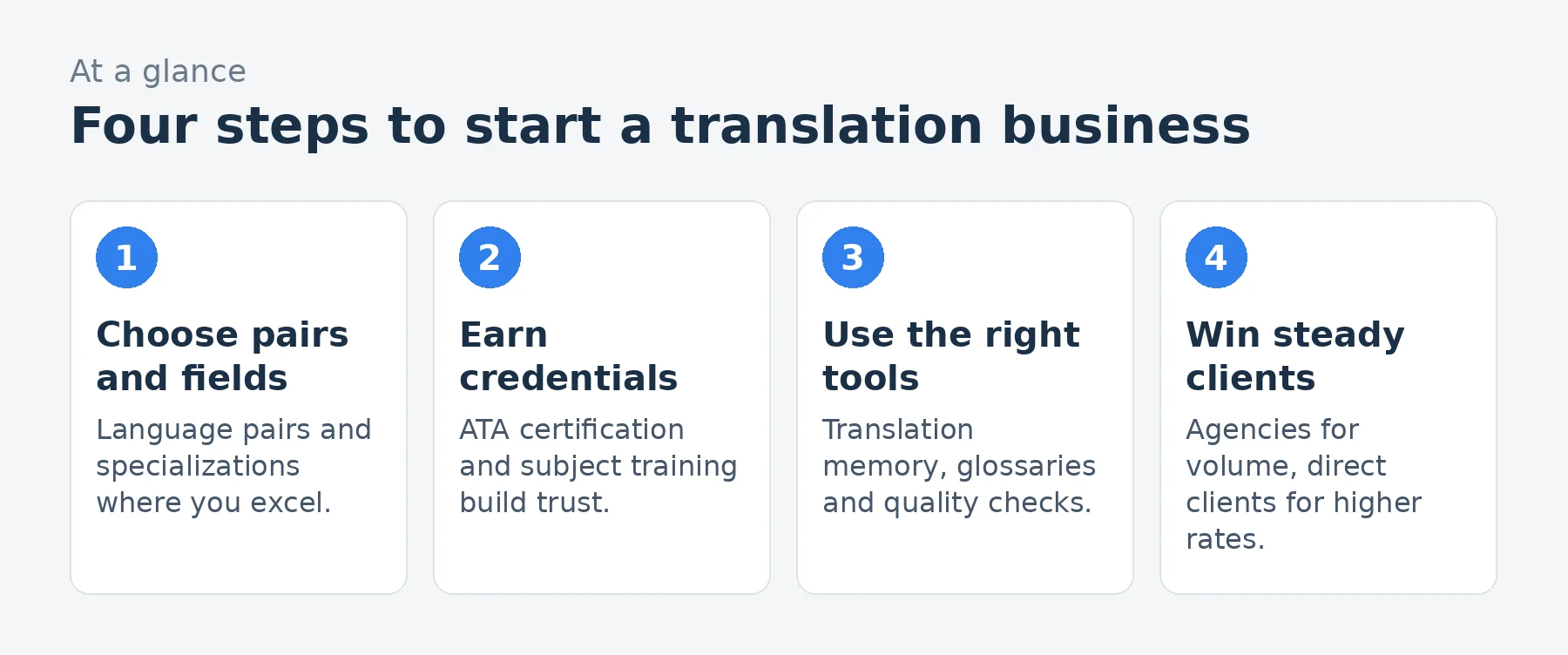
A translation business at a glance
Table of Contents
| Topic | What to expect |
|---|---|
| Startup cost | Low: a computer, translation software (CAT tools), dictionaries and glossaries, insurance, a website and certification fees |
| Credentials | ATA certification for many language pairs; ISO 17100 for agency quality processes |
| Certified translations | For USCIS, a full English translation with the translator’s certification of competence and accuracy |
| How you charge | Per word (often with minimum fees), per page for certified documents or hourly for editing and post-editing |
| Best for | Fluent, precise writers with subject expertise in their language pairs |
Who translation suits
It suits people who are fully fluent in at least two languages, write well in their target language (usually their native language) and enjoy precise, careful work. Subject knowledge in fields such as law, medicine, engineering or finance makes a translator far more valuable.
Choosing language pairs and specializations
- Legal: contracts, court documents, immigration documents and patents.
- Medical and life sciences: records, consent forms, clinical trial documents and device instructions.
- Technical: manuals, specifications and safety documents.
- Financial: reports, statements and banking documents.
- Marketing and creative: websites, ads and brand content (transcreation).
- Government and community: public notices and language access documents.
Rates are usually higher for specialized fields and for language pairs with fewer qualified translators.
Credentials
The American Translators Association offers certification exams in many language pairs, a credential clients and agencies recognize. Agencies may follow ISO 17100, the international standard for translation service processes, including translator qualifications and a second-linguist review. Specialized fields value additional training, such as medical terminology courses.
Certified translations
Many official uses require certified translations. For U.S. immigration (USCIS), any foreign-language document must be accompanied by a full English translation and the translator’s certification that the translation is complete and accurate and that the translator is competent to translate from the foreign language into English. Courts, universities and foreign governments may have additional requirements, such as notarization or sworn translators. Learn each client’s requirements before accepting the job.
Tools and machine translation
Professional translators use computer-assisted translation (CAT) tools with translation memory and terminology databases to stay consistent and efficient. Machine translation can speed some work, but output must be carefully reviewed by a qualified human (post-editing) before use. Never put confidential client documents into public machine translation services unless the client allows it and the service protects data appropriately.
Confidentiality and data security
Translators handle sensitive documents: medical records, legal cases and financial data. Use secure file transfer, encrypt stored files, sign confidentiality agreements, follow client data requirements and delete files when projects end if required. Medical clients may require business associate agreements under HIPAA.
Startup costs to plan for
| Item | What to budget for |
|---|---|
| CAT tool | Translation memory and terminology software |
| Reference resources | Specialized dictionaries and terminology databases |
| Certification | ATA exam and membership |
| Insurance | Professional liability |
| Website and profiles | Services, language pairs and samples |
| Secure systems | Encrypted storage and file transfer |
Use our startup cost calculator for your total.
Pricing
Translators commonly charge per word of source text, with minimum fees for short jobs, per page or document for standard certified translations and hourly rates for editing, post-editing and formatting. Charge more for rush work, complex formatting and specialized subjects. Use our pricing calculator.
A worked example: a freelance translator
These are illustrative assumptions for an established freelance translator, not predictions; rates vary widely by language pair and specialty.
| Assumption | Monthly | |
|---|---|---|
| Specialized translation | 35,000 words at $0.15 | $5,250 |
| Certified document translations | 40 documents at $40 | $1,600 |
| Editing and post-editing | 20 hours at $55 | $1,100 |
| Revenue | $7,950 | |
| Translation software and terminology resources | $(80) | |
| Second-reviewer fees | Proofreading by another linguist | $(500) |
| Insurance and memberships | Professional liability, association dues | $(80) |
| Marketing | $(150) | |
| Profit before owner pay and taxes | $7,140 |
That leaves about $7,140 a month before the translator’s pay and taxes, on about $7,950 of revenue. Specialization and direct clients raise rates more than working faster at low agency rates.
Loading the calculator…
Quality process
- Confirm purpose, audience, format and deadline.
- Build or update a glossary of key terms.
- Translate using translation memory for consistency.
- Self-review against the source.
- Have a second qualified linguist review important work.
- Deliver in the required format with any certification.
Finding clients
- Translation agencies for steady volume.
- Law firms, hospitals and companies in your specialty for direct work.
- Immigration attorneys for certified document translations.
- Professional directories such as the ATA directory.
- Referrals from satisfied clients and other translators.
Growing into an agency
Agencies manage projects across many languages using vetted freelance translators and reviewers. Growth requires project management, quality processes (often following ISO 17100), translator agreements and secure technology.
Going deeper in a specialty
Translators who truly understand a field, such as patents, clinical trials, financial reporting or engineering, can charge more and get steady repeat work. Build expertise through courses, glossaries, reading publications in both languages and working with subject experts who can answer terminology questions.
Working with agencies
Agencies provide volume and handle sales, but pay lower rates and set deadlines. Choose agencies that pay on time, respect reasonable deadlines and provide reference materials. Keep agency work as a base while building direct clients for higher-value work.
Rush work and capacity
Translators produce a limited number of quality words per day. Set realistic daily capacity, charge rush fees for tight deadlines and decline jobs you cannot deliver well. Quality problems from rushing cost more in lost clients than the extra fee earns.
Formatting and desktop publishing
Many documents must keep their layout: brochures, manuals, certificates and forms. Offering formatting and desktop publishing, or partnering with a specialist, adds value and lets you deliver ready-to-use files.
Contracts and liability
Use written terms for every project: scope, source files, deadline, price, payment terms, confidentiality, revisions and liability limits. Errors in legal or medical translations can have serious consequences, so professional liability insurance and careful review processes protect you and your clients.
Building a portfolio and reputation
Prepare short sample translations in your specialties (using non-confidential material), keep a list of document types you have translated and collect testimonials. Active participation in professional associations and conferences builds referrals from other translators and agencies.
Common mistakes to avoid
- Translating into a language you do not write natively.
- Pasting confidential documents into public machine translation.
- Accepting specialized work without subject knowledge.
- Missing certification requirements for official documents.
- Competing only on price with agencies.
Your first 90 days
- Days 1-30: choose language pairs and specializations, set up CAT tools and prepare samples.
- Days 31-60: apply to agencies, register in professional directories and plan for certification.
- Days 61-90: contact direct clients in your specialty and refine your rates.
Frequently asked questions
Do I need certification to be a translator?
Not legally in most cases, but ATA certification and specialty training build trust and support higher rates.
What is a certified translation?
A translation accompanied by the translator’s statement that it is complete and accurate and that they are competent; USCIS requires this for foreign-language documents.
How do translators charge?
Usually per word, with minimum fees, plus per-document rates for certified translations and hourly rates for editing.
Will machine translation replace translators?
It is changing workflows, but specialized, legal, medical and creative translation still needs qualified humans, often as post-editors.
Can I translate into a language that is not my native language?
Most professionals translate into their native language for the best quality.
What is ISO 17100?
An international standard for translation service processes, including qualifications and second-linguist review.
How many words can a translator translate per day?
It varies by content and skill; professionals often translate a few thousand words a day while maintaining quality.
Should I join translation agencies or find direct clients?
Many translators do both: agencies for volume and direct clients for higher rates.
Do translators need insurance?
Professional liability insurance is wise, especially for legal, medical and technical work where errors can cause losses.
What language pairs pay the most?
Pairs with high demand and few qualified translators, and specialized fields such as legal, medical and patent work, typically pay more.
Can I translate for USCIS without being certified?
USCIS requires the translator’s certification of competence and accuracy, not a specific credential, though clients often prefer certified translators.
Keep learning
- Translation services industry data
- How to start an interpreting service
- How to start a localization agency
- Pricing calculator
Sources
- US Bureau of Labor Statistics, Interpreters and translators
- American Translators Association, ATA certification
- ISO 17100: Translation services requirements
- USCIS / 8 CFR 103.2(b)(3), Translations of foreign-language documents
- FTC, Protecting personal information: a guide for business
Last reviewed November 3, 2026. Startup costs are estimates; check local prices, licensing and tax rules before you commit money.

