
A localization agency adapts products and content for people in other languages and markets: software and app interfaces, websites, games, e-learning, marketing campaigns, documentation and support content. Localization goes beyond translation: it adapts dates, currencies, units, images, cultural references and user experience so products feel native.
Localization agencies coordinate teams of linguists, reviewers and engineers using translation management technology, and sell to companies entering new markets. Success depends on project management, quality processes and technical skill as much as language skill. The Bureau of Labor Statistics reports a median pay of $59,440 for interpreters and translators (May 2024), across about 75,300 jobs, with employment projected to grow about 2% over the decade. This guide covers services, technology, linguist networks, quality, pricing, a worked example and a 90-day plan.
A localization agency at a glance
Table of Contents
| Topic | What to expect |
|---|---|
| Startup cost | Low to moderate: a translation management system, QA tools, contracts, insurance, a website and project management |
| Services | Software, app, website and game localization, transcreation, multilingual SEO and internationalization consulting |
| Quality | Linguist qualifications, terminology management, second-linguist review and processes such as ISO 17100 |
| How you charge | Per word with project management and engineering fees, or project and retainer pricing |
| Best for | Bilingual project managers with technical skills who can coordinate teams across time zones |
Who localization suits
It suits multilingual people with project management and technical skills who enjoy coordinating teams and solving problems across cultures. Experience in translation, software or international marketing helps.
Localization vs translation
Translation converts text; localization adapts the whole experience for a market: language, formats for dates and numbers, currencies, units, images, colors, legal requirements and tone. Transcreation recreates marketing messages so they work emotionally in another culture. Internationalization (i18n) is the engineering work that makes software ready to localize, such as separating text from code and supporting different scripts.
Services to offer
- Software and app localization: interface strings, help content and app store listings.
- Website localization, including multilingual SEO.
- Game localization: dialogue, interface and cultural review.
- E-learning and training content, including voiceover and subtitles.
- Marketing transcreation for campaigns and brands.
- Internationalization consulting for development teams.
- Linguistic quality assurance of existing translations.
Technology
Agencies run on a translation management system (TMS) that connects to clients’ content sources, manages workflows, stores translation memory and terminology, and supports quality checks. Software localization needs tools that handle string files and placeholders, plus screenshot or in-context review. Choose tools that integrate with clients’ code repositories and content systems.
Building a linguist network
Recruit translators and reviewers who are native speakers of each target language with subject expertise. Test them with sample work, track quality scores, agree on rates and deadlines and require confidentiality agreements. Classify contractors correctly and pay reliably; good linguists have many options.
Quality assurance
- Glossaries and style guides for each client and language.
- Second-linguist review, as ISO 17100 requires for translation services.
- Automated QA checks for numbers, placeholders, terminology and consistency.
- In-context review on the actual app, site or game.
- Client feedback loops and continuous updates to translation memory.
Multilingual SEO
Localized websites need keyword research in each language, localized titles and descriptions, proper URL structures and hreflang annotations so search engines show the right language version. Google’s guidance on multi-regional and multilingual sites explains the technical setup. Multilingual SEO is a valuable add-on service.
Startup costs to plan for
| Item | What to budget for |
|---|---|
| TMS and tools | Translation management, QA and terminology tools |
| Linguist recruiting | Testing and onboarding |
| Contracts | Client agreements, linguist agreements, NDAs |
| Insurance | Professional and cyber liability |
| Website | Services, case studies and languages |
| Sales | Outreach to companies entering new markets |
Use our startup cost calculator for your total.
Pricing
Agencies commonly price per word by language, with discounts for repeated content found in translation memory, plus fees for project management, engineering, desktop publishing and QA. Ongoing products may use monthly retainers for continuous localization. Make sure prices cover linguist costs, tools and project management time. Use our pricing calculator.
A worked example: a small agency
These are illustrative assumptions for a small agency, not predictions; rates vary widely by language and content.
| Assumption | Monthly | |
|---|---|---|
| Localization projects | 180,000 words across languages at $0.20 average | $36,000 |
| Engineering, QA and project fees | $5,000 | |
| Revenue | $41,000 | |
| Linguist and reviewer costs | About 60% of word revenue | $(21,600) |
| Project manager | With payroll costs | $(6,000) |
| Translation management system and tools | $(800) | |
| Insurance, legal and accounting | $(600) | |
| Sales and marketing | $(2,000) | |
| Profit before owner pay and taxes | $10,000 |
That leaves about $10,000 a month before the owner’s pay and taxes, on about $41,000 of revenue. Agency margins come from project management, technology and quality, so efficient workflows and retained clients matter most.
Loading the calculator…
Continuous localization
Software companies release updates constantly. Continuous localization connects your TMS to the client’s development workflow, so new strings are translated and returned automatically with each release. Offering this keeps you embedded in clients’ processes and creates recurring revenue.
Finding clients
- Software and app companies expanding internationally.
- E-commerce brands selling across borders.
- Game studios.
- E-learning companies and corporate training teams.
- Marketing agencies needing multilingual campaigns.
Industry associations such as GALA connect localization providers and buyers.
Game localization
Games combine creative dialogue, interface text with strict character limits, cultural review and testing in the game itself (localization quality assurance). Game studios value linguists who are players themselves and understand the genre’s tone.
App store and marketplace listings
Localized app store listings, keywords and screenshots help apps reach users in new markets. Combining listing localization with keyword research is a quick, high-value service for app companies.
Voiceover and subtitles
Video content may need subtitles, dubbing or voiceover, plus localized on-screen text. Partnering with voice talent and studios lets you offer complete video localization for training, marketing and entertainment content.
Legal and regulatory content
Some localized content has legal requirements: product labels, safety instructions, privacy policies and terms of service. Use qualified legal or regulatory translators, and recommend that clients have local counsel review legally binding text.
Machine translation in localization
Machine translation with human post-editing can speed large, repetitive content such as support articles, while creative and high-visibility content needs human translation or transcreation. Agree with each client which content uses which approach, and be transparent about it.
Project management
Localization projects juggle many languages, linguists, file types and deadlines. Strong project managers set schedules, prepare files, answer linguist questions, track queries and keep clients informed. Their work often determines whether projects succeed.
Measuring quality
Use a consistent quality framework that scores errors by type and severity, track results by linguist and language and share quality reports with clients. Measured quality builds trust and justifies rates.
Choosing your first languages
Start with languages where you can recruit strong linguists and where clients most often expand, such as major European, Latin American and Asian markets, then add languages as client demand appears. Being reliable in a few languages beats offering many unevenly.
Common mistakes to avoid
- Treating localization as word-for-word translation.
- Skipping in-context review.
- No terminology management.
- Underpricing project management and engineering.
- Weak vetting of linguists.
Your first 90 days
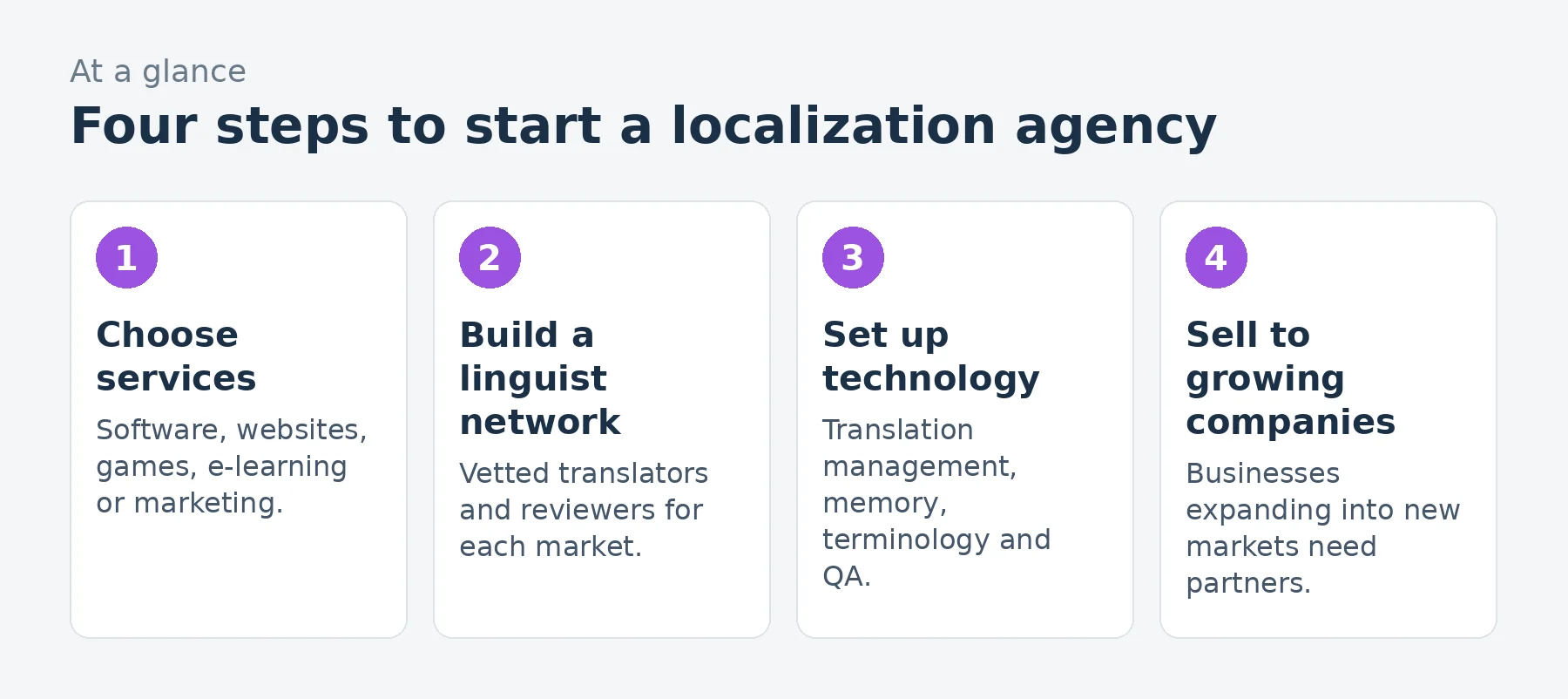
- Days 1-30: choose services and languages, set up a TMS and QA tools and write contracts.
- Days 31-60: recruit and test linguists for your core languages and prepare case studies.
- Days 61-90: pitch software companies and agencies, and deliver first projects with strong QA.
Frequently asked questions
What is the difference between localization and translation?
Translation converts text; localization adapts the whole product or content, including formats, images and culture, for a market.
What is a translation management system?
Software that manages localization workflows, translation memory, terminology and quality checks.
How do localization agencies charge?
Usually per word by language, plus project management, engineering and QA fees, or retainers for continuous work.
What is internationalization?
Engineering software so it can be localized easily, such as separating text from code and supporting different formats and scripts.
What is hreflang?
Annotations that tell search engines which language or regional version of a page to show.
Do I need to speak many languages to run a localization agency?
No. Agencies coordinate native-speaking linguists for each language, though language and project skills help.
How do localization agencies find linguists?
Through translator directories, professional associations, referrals and testing candidates with sample projects.
What tools do localization agencies use?
Translation management systems, translation memory, terminology tools, QA software and in-context review tools.
How much does localization cost?
It depends on languages, word count, content type and engineering; agencies usually quote per word plus project fees.
Can a small agency compete with large localization companies?
Yes, by specializing in a niche, offering responsive service and building deep client relationships.
Do localization agencies need insurance?
Professional and cyber liability insurance protect against errors and data incidents, and enterprise clients often require them.
What is linguistic quality assurance?
Reviewing translated content for accuracy, terminology, style and context, often scored with a consistent error framework.
Keep learning
- Translation services industry data
- How to start a translation business
- How to start an app development business
- Pricing calculator
Sources
- ISO 17100: Translation services requirements
- W3C, Internationalization (i18n) overview
- Google Search Central, Managing multi-regional and multilingual sites (hreflang)
- GALA, Globalization and Localization Association
- US Bureau of Labor Statistics, Interpreters and translators
Last reviewed November 3, 2026. Startup costs are estimates; check local prices, licensing and tax rules before you commit money.

