
An app development business builds mobile and web applications for clients: startups launching products, businesses creating customer apps and companies building internal tools. Projects range from small minimum viable products (MVPs) to complex platforms.
Clients pay for more than code: discovery, design, reliable estimates, testing, launch and maintenance. The biggest risks are scope creep and underestimating effort, so strong scoping and clear contracts matter. The Bureau of Labor Statistics reports a median pay of $133,080 for software developers, quality assurance analysts and testers (May 2024), with employment projected to grow about 15% over the decade. This guide covers services, technology, pricing, contracts, app store rules, privacy, a worked example and a 90-day plan.
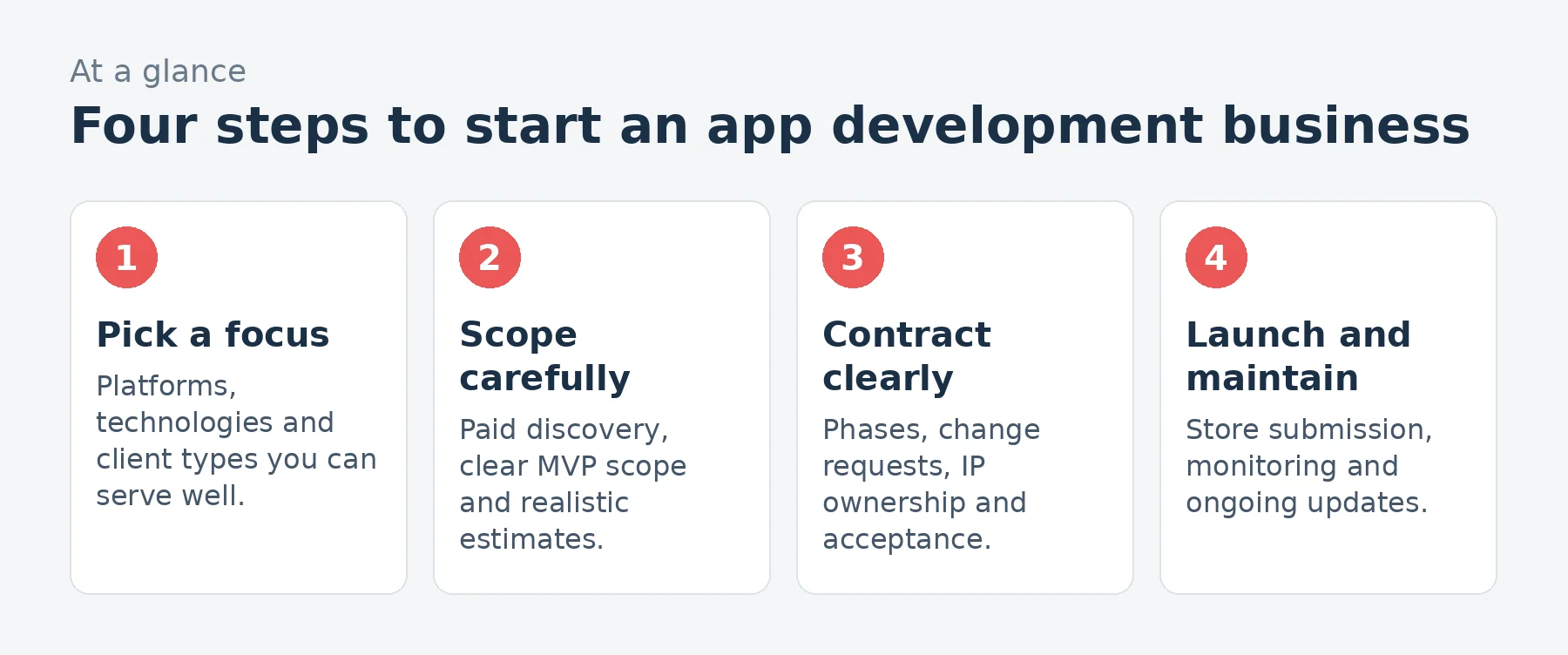
An app development business at a glance
Table of Contents
| Topic | What to expect |
|---|---|
| Startup cost | Low to moderate: computers and test devices, developer accounts, design and project tools, insurance |
| Developer accounts | Apps on clients’ own Apple Developer ($99 a year) and Google Play ($25 one-time) accounts |
| Key rules | App store review guidelines, privacy policies, and COPPA for apps directed at children under 13 |
| How you charge | Fixed-price phases, time and materials, retainers for ongoing development and maintenance |
| Best for | Developers who can scope, communicate and manage projects as well as code |
Who app development suits
It suits developers who enjoy building products and can translate business ideas into features, estimates and plans. Client communication, project management and quality assurance are as important as coding.
Choosing technologies and focus
- Native apps: Swift for iOS, Kotlin for Android, for the best performance and platform features.
- Cross-platform: frameworks such as React Native or Flutter to build for both platforms from one codebase.
- Web apps and progressive web apps for browser-based products.
- Backends: APIs, databases, authentication and cloud services.
Specializing in a stack or an industry (healthcare, fitness, logistics, education) helps you estimate accurately and reuse components.
Discovery and scoping
Sell a paid discovery phase before committing to build: user research, feature list, user flows, wireframes, technical approach and an estimate. Discovery reduces risk for both sides and produces a clear MVP scope: the smallest version that proves the idea.
Pricing models
- Fixed price by phase: clear scope and milestones, with change requests priced separately.
- Time and materials: hourly or daily rates for evolving products.
- Retainers: a team’s monthly capacity for ongoing development and maintenance.
Include design, QA, project management, store submission and buffer time in estimates. Use our pricing calculator.
Contracts and IP
Contracts should define scope, milestones and acceptance criteria, payment schedule, change request process, warranty period for bugs, confidentiality and intellectual property: clients usually own custom code after payment, while you may keep rights to reusable tools you built before the project. Contracts with your contractors should assign their work to you.
App store accounts and review
Apps should be published under the client’s own developer accounts: the Apple Developer Program costs $99 a year, and Google Play requires a $25 one-time registration. Both stores review apps against their guidelines, which cover privacy, payments, content and functionality, so build with the guidelines in mind and plan time for review. Apple and Google each charge commission on digital sales, with reduced rates for smaller developers under their programs.
Privacy, children and accessibility
Apps that collect personal data need privacy policies and disclosures in the app stores. Apps directed at children under 13 must comply with COPPA, including parental consent before collecting personal information. Build accessible apps with platform accessibility features and WCAG principles for web apps.
Startup costs to plan for
| Item | What to budget for |
|---|---|
| Hardware | Computers, including a Mac for iOS builds, and test devices |
| Tools | Design, project management, testing services |
| Contracts | Master services agreement, statements of work |
| Insurance | Professional liability and cyber coverage |
| Contractors | Developers, designers and testers as needed |
| Marketing | Portfolio, case studies, outreach |
Use our startup cost calculator for your total.
Building quality in
Use version control, code reviews, automated tests where practical and real-device testing. Beta testing through the platforms’ testing programs catches problems before launch. Quality protects your reputation and reduces costly post-launch fixes.
A worked example: a small studio
These are illustrative assumptions for a small studio with contractors, not predictions.
| Assumption | Monthly | |
|---|---|---|
| Project milestones billed | Two active MVP projects | $24,000 |
| Maintenance retainers | 4 clients at $1,500 | $6,000 |
| Revenue | $30,000 | |
| Contract developers and designers | $(14,000) | |
| QA and testing | Contract tester, devices | $(1,800) |
| Tools and services | Design, project management, cloud for testing | $(700) |
| Insurance, legal and accounting | Professional liability, contracts | $(900) |
| Marketing and sales | $(800) | |
| Profit before owner pay and taxes | $11,800 |
That leaves about $11,800 a month before the owner’s pay and taxes, on about $30,000 of revenue. Project revenue is lumpy, so maintenance retainers and a pipeline of discovery projects are essential.
Loading the calculator…
Launch and maintenance
Operating systems update every year, devices change and security issues appear, so apps need maintenance. Offer retainers for updates, monitoring, bug fixes and small improvements. Maintenance creates recurring revenue and long client relationships.
Finding clients
- Startups and founders through accelerators and founder communities.
- Businesses needing customer apps or internal tools.
- Agencies that need development partners.
- Case studies and app store links to your work.
- Referrals from past clients.
Managing scope creep
New ideas appear throughout projects. Capture them in a backlog, estimate them separately and decide with the client whether to add them now, swap them for planned features or save them for a later phase. A clear change process keeps projects on budget and relationships healthy.
Design and user experience
Good apps are easy to use. Invest in user research, wireframes and clickable prototypes before development, and test designs with real users. Changes are far cheaper in design than in code.
Backend and hosting costs
Apps often depend on servers, databases, storage and third-party services that cost money every month. Estimate these running costs for clients upfront, choose scalable services and explain who pays for hosting after launch.
Analytics and crash reporting
Add analytics and crash reporting before launch, so you can see how people use the app and fix problems quickly. Respect privacy rules and disclose data collection in privacy policies and app store listings.
Building a team
Small studios often combine a lead developer, a designer, a tester and a project manager, with contractors for specialized skills. Clear processes, code standards and communication tools keep distributed teams productive.
Estimating accurately
Break features into small tasks, estimate each, and add time for design, QA, project management, meetings, store review and a buffer for unknowns. Compare estimates with actual time on past projects and adjust your methods. Accurate estimates protect your margins and your reputation.
App store submission
Prepare store listings (screenshots, descriptions, privacy details and support contacts), test with beta testers and allow time for review. Rejections usually cite specific guidelines; fix the issues and resubmit. Plan the launch date around review time.
Common mistakes to avoid
- Fixed prices without clear scope.
- Publishing apps under your own developer accounts.
- Skipping discovery and user testing.
- Ignoring privacy rules and COPPA.
- No maintenance plan after launch.
Your first 90 days
- Days 1-30: choose a focus, write contracts and a discovery offer and build a portfolio project.
- Days 31-60: sell two discovery projects and convert one to an MVP build.
- Days 61-90: deliver milestones, line up maintenance retainers and publish a case study.
Frequently asked questions
How much does it cost to build an app?
It depends on features, platforms and complexity. A paid discovery phase produces a realistic estimate.
Should apps be published under my account or the client’s?
The client’s own developer accounts, so they own the listing and data.
What are Apple and Google developer fees?
The Apple Developer Program costs $99 a year; Google Play requires a $25 one-time registration.
What is an MVP?
A minimum viable product: the smallest version of an app that proves the idea with real users.
Do apps for kids have special rules?
Yes. Apps directed at children under 13 must comply with COPPA, including parental consent for data collection.
Who owns the code?
Usually the client after payment, as defined in the contract; you may keep rights to pre-existing tools.
Should I build native or cross-platform apps?
It depends on the app. Cross-platform frameworks save time for many business apps, while native development suits apps needing the best performance or platform features.
How long does an MVP take?
Many MVPs take a few months, depending on features, design and backend needs.
Do I need a Mac to build iOS apps?
Yes, building and submitting iOS apps requires Apple’s development tools on macOS, though some cloud build services help.
How do app development agencies find clients?
Through referrals, startup communities and accelerators, agency partnerships and case studies with links to published apps.
Should I charge for discovery?
Yes. A paid discovery phase produces a clear scope and estimate, and it shows clients how you work before a large commitment.
Keep learning
- Software and SaaS industry data
- How to start a mobile app business
- How to start a SaaS startup
- Pricing calculator
Sources
- US Bureau of Labor Statistics, Software developers, quality assurance analysts and testers
- Apple Developer Program (membership and fees)
- Google Play Console, Developer registration
- FTC, Children's Online Privacy Protection Rule (COPPA)
- FTC, Protecting personal information: a guide for business
- W3C, Web Content Accessibility Guidelines (WCAG) overview
Last reviewed November 3, 2026. Startup costs are estimates; check local prices, licensing and tax rules before you commit money.

