
A tax preparation business prepares and files income tax returns for individuals and small businesses, and often provides year-round services such as bookkeeping, tax planning and help with IRS notices. Tax season brings intense, predictable demand each year, and loyal clients return year after year.
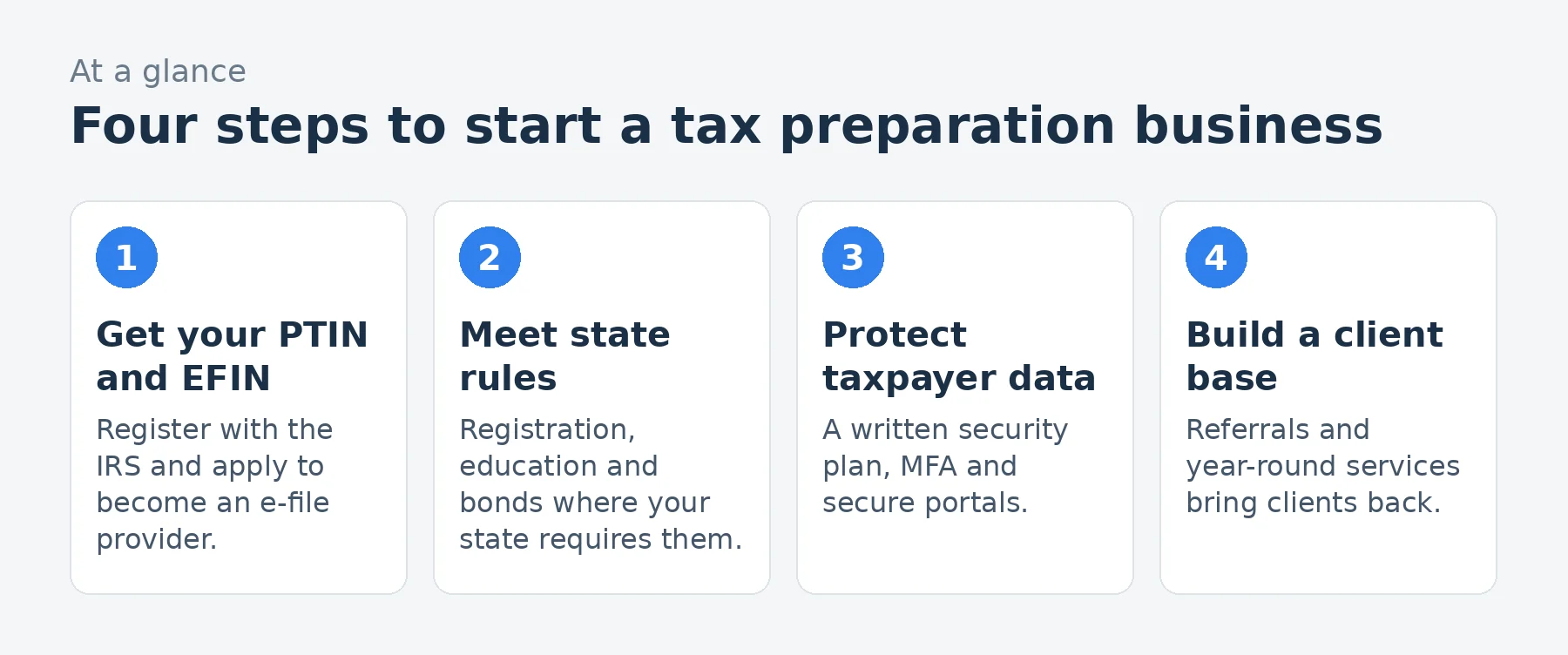
Tax preparation is regulated. Anyone paid to prepare federal returns needs an IRS Preparer Tax Identification Number (PTIN), preparers who file returns electronically need an EFIN, several states require registration or licensing, and preparers must protect client data under the FTC’s Safeguards Rule. Advanton’s tax preparation industry data shows a median pay of $50,560 for tax preparers. This guide covers requirements, credentials, due diligence, security, software, pricing, a worked example and a 90-day plan.
A tax preparation business at a glance
Table of Contents
| Topic | What to expect |
|---|---|
| Startup cost | Low to moderate: professional tax software, a secure client portal, insurance, training, marketing and possibly an office |
| IRS requirements | A PTIN renewed every year; an EFIN to e-file; preparers filing more than 10 returns a year must generally e-file |
| State rules | California, Oregon, Maryland and New York have their own registration, education or licensing requirements |
| Key duties | Due diligence for certain credits (Form 8867) and a written information security plan under the FTC Safeguards Rule |
| Best for | Detail-oriented people who keep up with tax law and handle deadline pressure well |
Who tax preparation suits
It suits people who enjoy precision, keep up with tax law changes and can handle long hours during filing season. Communication skills matter: clients need help gathering documents and understanding results.
IRS requirements
- PTIN: anyone who prepares, or helps prepare, federal tax returns for compensation must have a valid PTIN, renewed each year.
- EFIN: to file returns electronically, apply to become an IRS authorized e-file provider (Form 8633); the process includes suitability checks and, for some applicants, fingerprints.
- E-file requirement: preparers who reasonably expect to file more than 10 individual returns in a year must generally file them electronically.
- Signatures and copies: sign returns as the paid preparer, include your PTIN and give clients copies.
Credentials and representation
The IRS Annual Filing Season Program is a voluntary program for non-credentialed preparers that includes continuing education and limited representation rights. Enrolled agents, who pass a three-part IRS exam, have unlimited rights to represent taxpayers before the IRS, as do CPAs and attorneys. Credentials build trust and let you offer higher-value services such as audit and notice representation.
State requirements
Some states regulate preparers directly. California requires registration with the California Tax Education Council (CTEC), qualifying education and a bond; Oregon licenses tax preparers; Maryland and New York have their own registration requirements. Check your state’s rules, and the rules for states where your clients live, before preparing returns.
Due diligence and accuracy
Paid preparers must meet due diligence requirements when claiming certain credits and filing statuses, such as the earned income tax credit, child tax credits, the American opportunity tax credit and head of household status, including completing Form 8867 and keeping records. Penalties apply for failures. Ask questions, document answers and never file returns you believe are inaccurate.
Protecting taxpayer data
Financial records are sensitive and attractive to criminals. Use encrypted storage and secure client portals instead of email attachments, enforce multi-factor authentication, limit access and train anyone who works with you. Businesses that prepare tax returns must follow the FTC’s Safeguards Rule, including a written information security plan, and the IRS publishes guidance for tax professionals in Publication 4557.
Tax professionals are frequent targets of phishing and account takeover. Report suspected data theft to the IRS promptly, following its guidance.
Startup costs to plan for
| Item | What to budget for |
|---|---|
| Tax software | Professional software with e-file, priced by returns or unlimited |
| Credentials | PTIN renewal, education, enrolled agent exam if pursued |
| State requirements | Registration, education and bonds where required |
| Security | Secure portal, encryption, MFA, written security plan |
| Insurance | Errors and omissions |
| Office and marketing | Seasonal office, signage, online presence |
Use our startup cost calculator for your total.
Pricing
Price by the forms and complexity involved (wages only, itemized deductions, self-employment, rental properties, multiple states, business returns), with published starting prices. Avoid pricing tied to the size of a refund. Add fees for amendments, notices and extensions. Use our pricing calculator.
A worked example: a small practice
These are illustrative assumptions for a small practice, shown as a typical tax-season month, not predictions.
| Assumption | Monthly | |
|---|---|---|
| Individual returns | 180 returns at $260 average | $46,800 |
| Small business returns | 15 returns at $900 | $13,500 |
| Revenue | $60,300 | |
| Seasonal preparers and staff | With payroll costs | $(14,000) |
| Professional tax software | Share of annual cost | $(2,000) |
| Office rent and utilities | Seasonal office | $(2,500) |
| Insurance and bonds | Errors and omissions, any required bond | $(300) |
| Secure portal, e-signature and IT | $(400) | |
| Marketing | $(1,500) | |
| Profit before owner pay and taxes | $39,600 |
That leaves about $39,600 in a peak tax-season month before the owner’s pay and taxes, on about $60,300 of revenue. Most revenue arrives between February and April, so budget for the rest of the year or add year-round services.
Loading the calculator…
A season workflow
- Send organizers and document checklists in January.
- Collect documents through a secure portal.
- Interview clients and complete due diligence.
- Prepare, review and sign returns.
- Get e-file authorization, file and track acceptance.
- Deliver copies and schedule follow-ups.
Year-round services
To smooth seasonal income, add bookkeeping, payroll, quarterly estimated tax planning, business entity planning, IRS notice response (with the right credentials) and amended returns. Year-round services also deepen relationships with clients.
Finding clients
- Referrals from existing clients, the best source in tax practices.
- Small business owners and the self-employed, who need more help.
- Bookkeepers and financial advisors as referral partners.
- Community organizations and employers.
- A Google Business Profile with reviews for local searches.
Responding to IRS notices
Clients often receive IRS letters about mismatched income, math errors or missing forms. Helping them understand and respond to notices is a valuable service, within your representation rights: enrolled agents, CPAs and attorneys can represent clients fully, while other preparers have more limited rights.
Spotting fraud and identity theft
Tax-related identity theft and fraudulent refund schemes are common. Verify client identities, watch for unusual requests, never file returns with information you believe is false and use IRS identity protection resources for clients who have been victims.
Small business returns
Self-employed clients, partnerships and corporations need more expertise and pay higher fees. Learn business returns, depreciation and entity issues gradually, and refer complex cases to specialists until you are confident.
Building a seasonal team
Growing practices hire seasonal preparers and reviewers. Each preparer needs their own PTIN, training and access controls, and every return should be reviewed before filing. Clear procedures protect quality during the rush.
Extensions and off-season work
Extensions push some returns into the fall, spreading work beyond April. Use the off-season for amended returns, prior-year filings, tax planning meetings, training and marketing for the next season.
Common mistakes to avoid
- Preparing returns without a valid PTIN.
- Ignoring state registration rules.
- Weak due diligence on credits.
- Emailing tax documents without encryption.
- Pricing based on refund size.
Your first 90 days
- Days 1-30: get your PTIN, apply for an EFIN, check state requirements and complete training.
- Days 31-60: choose software, write your security plan, buy insurance and set prices.
- Days 61-90: market before January, line up referral partners and prepare client organizers.
Frequently asked questions
Do I need a license to prepare taxes?
You need an IRS PTIN to prepare federal returns for pay, plus state registration or licensing in some states, including California, Oregon, Maryland and New York.
What is an EFIN?
An Electronic Filing Identification Number issued when the IRS approves you as an authorized e-file provider.
Do I have to e-file?
Preparers who expect to file more than 10 individual returns a year must generally file them electronically.
What is an enrolled agent?
A tax professional who passes an IRS exam and has unlimited rights to represent taxpayers before the IRS.
What is the FTC Safeguards Rule?
A rule requiring tax preparers and other covered businesses to protect customer data, including a written information security plan.
How much do tax preparers charge?
Fees depend on complexity, usually priced by forms and schedules rather than refund size.
Can I prepare taxes from home?
Yes, many preparers work from home or remotely, with secure systems and any local business licenses required.
Do I need insurance as a tax preparer?
Errors and omissions insurance protects you if a mistake causes a client penalty or loss.
When should I start marketing my tax business?
Before January, when clients choose their preparer; referrals and reminders to past clients work best.
Can I offer tax planning?
Yes. Planning meetings and quarterly estimate help are valuable year-round services, within the rules for your credentials.
How long does it take to become an enrolled agent?
It depends on study time; candidates must pass all three parts of the IRS Special Enrollment Examination and a suitability check.
Keep learning
- Tax preparation industry data
- How to start a bookkeeping business
- How to start a payroll service
- Pricing calculator
Sources
- IRS, Preparer Tax Identification Number (PTIN) requirements
- IRS, Become an authorized e-file provider
- IRS, Annual Filing Season Program
- IRS, Enrolled agent information
- IRS, Paid preparer due diligence (Form 8867)
- FTC, FTC Safeguards Rule: what your business needs to know
- IRS, Publication 4557: Safeguarding taxpayer data
- California Tax Education Council (CTEC), Registration requirements
Last reviewed November 3, 2026. Startup costs are estimates; check local prices, licensing and tax rules before you commit money.

