
A sustainability consultant helps organizations measure and reduce their environmental impact and communicate it honestly: calculating carbon footprints, cutting energy and waste, answering customers’ sustainability questionnaires, preparing reports and making sure green marketing claims are accurate.
Demand comes from large customers asking suppliers for emissions data, investors and lenders, cost savings from efficiency and, for the largest companies, disclosure laws. The rules have been changing: the SEC’s 2024 climate disclosure rule was put on hold, and the SEC stopped defending it in 2025, while California’s climate disclosure laws for large companies are being implemented amid rulemaking and legal challenges. Accurate, current advice is the consultant’s core value. This guide covers services, standards, rules, green claims, pricing, a worked example and a 90-day plan.
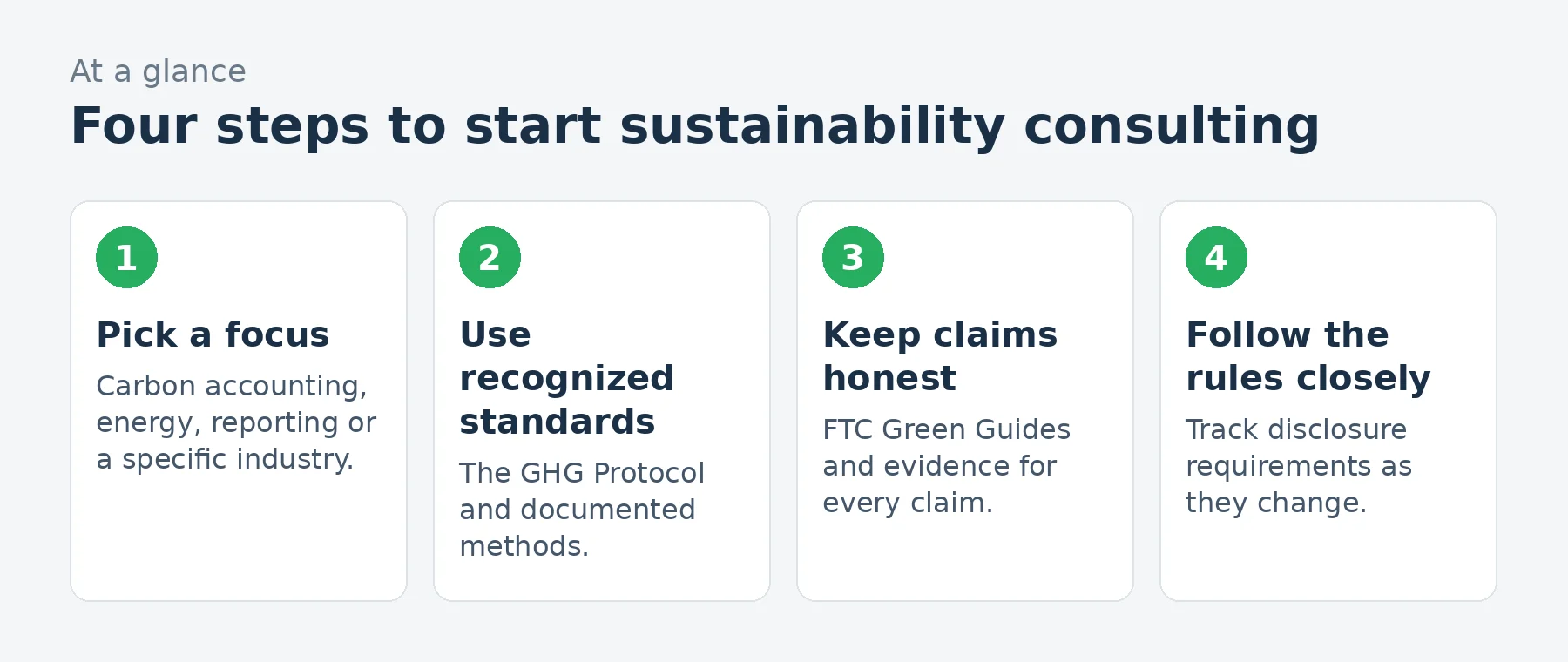
A sustainability consulting business at a glance
Table of Contents
| Topic | What to expect |
|---|---|
| Startup cost | Low: a computer, carbon accounting tools, training, insurance and a website |
| Key standards | The GHG Protocol for emissions inventories (Scopes 1, 2 and 3) and the FTC Green Guides for environmental claims |
| Changing rules | SEC climate rule on hold and no longer defended; California disclosure laws for large companies phasing in amid litigation |
| How you charge | Fixed-price footprints and assessments, reporting projects and monthly retainers |
| Best for | Analytical people with environmental, engineering or finance backgrounds who explain clearly |
Who sustainability consulting suits
It suits analytical people with backgrounds in environmental science, engineering, energy, finance or operations who enjoy working with data and explaining it clearly. Credibility depends on rigorous, transparent methods.
Services to offer
- Greenhouse gas inventories (carbon footprints) for Scope 1, 2 and 3 emissions.
- Reduction plans and targets: energy, transport, waste and supply chain.
- Energy efficiency projects and building benchmarking.
- Supplier questionnaires from large customers and procurement platforms.
- Sustainability reports for customers, investors and employees.
- Green marketing review against the FTC Green Guides.
- Certification support for recognized environmental and social certifications.
The GHG Protocol
The Greenhouse Gas Protocol is the most widely used standard for measuring emissions. Scope 1 covers direct emissions (fuel burned by the business), Scope 2 covers purchased electricity and energy, and Scope 3 covers the value chain, such as purchased goods, transportation, business travel and use of sold products. Document data sources, emission factors and assumptions so results can be checked and repeated.
The changing disclosure rules
Climate disclosure rules have shifted. The SEC adopted a climate disclosure rule for public companies in 2024, but it was put on hold during legal challenges, and in 2025 the SEC voted to stop defending it. California’s SB 253 and SB 261 require large companies doing business in the state to report emissions and climate-related risks, with requirements set by the California Air Resources Board and subject to ongoing rulemaking and litigation. Some U.S. companies with European operations face EU rules. Check current status before advising, and say clearly when requirements are uncertain.
Green claims and the FTC
The FTC’s Green Guides explain how to make environmental marketing claims that are not deceptive: claims such as "eco-friendly," "carbon neutral," "recyclable" or "compostable" must be specific, qualified where needed and backed by evidence. Reviewing clients’ claims protects them from greenwashing accusations and enforcement.
Proposals and statements of work
Every engagement should start with a written proposal and statement of work: the client’s goals, your approach, deliverables, timeline, what the client must provide, fees and payment terms. Clear scope prevents the most common consulting problem: work growing beyond what was agreed and paid for.
Pricing consulting work
Consultants charge in several ways: hourly for open-ended advice, fixed project fees for defined deliverables, monthly retainers for ongoing support and sometimes value-based fees tied to the size of the result. Fixed fees and retainers usually reward expertise better than hourly billing. Use our pricing calculator to check that your rates cover non-billable time such as sales and admin.
Startup costs to plan for
| Item | What to budget for |
|---|---|
| Carbon accounting tools | Software or spreadsheet models with emission factors |
| Training | GHG accounting, energy and reporting courses |
| Insurance | Professional liability |
| Website | Services and case studies |
| Contracts | Consulting agreement and statement of work |
| Marketing | Industry associations and procurement networks |
Use our startup cost calculator for your total.
A carbon footprint project
- Set boundaries: which facilities, operations and scopes are included.
- Collect data: fuel, electricity, travel, purchases and shipping.
- Apply recognized emission factors and calculate emissions.
- Document methods and data quality.
- Identify reduction opportunities and report results.
A worked example: a solo consultant
These are illustrative assumptions for an established solo consultant, not predictions.
| Assumption | Monthly | |
|---|---|---|
| Carbon footprint projects | 2 projects at $5,500 | $11,000 |
| Supplier questionnaires and reporting | $3,500 | |
| Monthly retainers | 3 clients at $1,500 | $4,500 |
| Revenue | $19,000 | |
| Carbon accounting software | $(400) | |
| Contract specialists | Energy auditor or data analyst | $(1,500) |
| Insurance | Professional liability | $(200) |
| Training and memberships | $(200) | |
| Marketing, legal and accounting | $(700) | |
| Profit before owner pay and taxes | $16,000 |
That leaves about $16,000 a month before the consultant’s pay and taxes, on about $19,000 of revenue. Annual reporting cycles create repeat work, which helps steady income.
Loading the calculator…
Energy efficiency and savings
Efficiency projects often pay for themselves through lower bills: lighting, heating and cooling controls, equipment upgrades and building benchmarking with ENERGY STAR Portfolio Manager. Savings make sustainability work easier to sell, especially to small and midsize businesses.
Finding clients
- Suppliers to large companies facing customer questionnaires.
- Manufacturers and logistics companies with significant energy use.
- Companies preparing reports for investors, lenders or customers.
- Brands making green claims that need review.
- Partners: energy contractors, engineers, accountants and marketing agencies.
Data quality and honesty
Sustainability work is only valuable if it is credible. Use primary data where possible, disclose estimates, avoid overstating offsets and reductions and recommend independent verification when reports will be relied on by others.
Scope 3 data
Scope 3 emissions often make up most of a company’s footprint but are the hardest to measure. Start with spend-based estimates, then improve accuracy over time with supplier-specific data for the largest categories. Be transparent about which figures are estimates.
Supplier engagement
Large companies increasingly ask suppliers for emissions data and reduction targets. Helping suppliers answer questionnaires accurately, and set realistic targets, keeps them competitive for contracts and builds repeat annual work.
Carbon offsets and credits
Offsets vary widely in quality. Advise clients to prioritize reducing their own emissions, use offsets cautiously, choose credible standards and describe offset-based claims precisely, following the FTC Green Guides.
Reporting frameworks
Companies may report using several frameworks depending on their audience, such as customer questionnaires, voluntary sustainability reporting standards and investor frameworks. Map which frameworks each client actually needs before writing reports, to avoid unnecessary work.
Waste and circular economy projects
Waste audits, recycling and composting programs, packaging changes and reuse systems cut costs and emissions. They are concrete projects that clients and employees can see, which builds momentum for broader sustainability work.
Common mistakes to avoid
- Advising on rules without checking their current status.
- Undocumented methods and assumptions.
- Supporting vague or exaggerated green claims.
- Overpromising offsets as a substitute for reductions.
- Ignoring cost savings that make projects attractive.
Your first 90 days
- Days 1-30: choose a focus and industry, complete GHG accounting training and set up tools and contracts.
- Days 31-60: complete two footprint projects (some at reduced rates) and document results.
- Days 61-90: target suppliers facing questionnaires and propose annual reporting retainers.
Frequently asked questions
What is the GHG Protocol?
The most widely used standard for measuring and reporting greenhouse gas emissions across Scopes 1, 2 and 3.
Is the SEC climate disclosure rule in effect?
It was put on hold during legal challenges, and the SEC voted in 2025 to stop defending it. Check current status before advising.
What are California’s climate disclosure laws?
SB 253 and SB 261 require large companies doing business in California to report emissions and climate-related risks, with details set through rulemaking and subject to litigation.
What are the FTC Green Guides?
FTC guidance on making environmental marketing claims that are specific, qualified and supported by evidence.
Do small businesses need sustainability consulting?
Many do when large customers ask for emissions data, or when they want energy savings and credible green claims.
Do I need a certification?
Not legally, but training in GHG accounting and energy management builds credibility.
What are Scope 3 emissions?
Emissions from a company’s value chain, such as purchased goods, transportation, business travel and use of sold products.
Should companies buy carbon offsets?
Reducing their own emissions should come first; offsets should be used carefully, from credible standards, with precise claims.
How do sustainability consultants charge?
Fixed prices for footprints, assessments and reports, plus monthly retainers for ongoing reduction programs and annual reporting.
What background do sustainability consultants need?
Many come from environmental science, engineering, energy, finance or operations, plus training in GHG accounting and reporting.
Can I offer sustainability consulting part-time?
Yes, many start with footprint and questionnaire projects while employed, if their employer allows it.
Keep learning
- Consulting industry data
- How to start a business consulting firm
- Startup cost calculator
- Pricing calculator
Sources
- Greenhouse Gas Protocol, Corporate standards
- FTC, Green Guides for environmental marketing claims
- California Air Resources Board, Climate disclosure laws (SB 253 and SB 261)
- SEC, Climate-related disclosures rule and 2025 decision to end its defense
- ENERGY STAR, Portfolio Manager for buildings
- US Bureau of Labor Statistics, Management analysts
Last reviewed November 3, 2026. Startup costs are estimates; check local prices, licensing and tax rules before you commit money.

