
A cybersecurity consulting business helps organizations understand and reduce their cyber risk: security assessments, penetration testing, policies and compliance programs, incident response planning, staff training and part-time security leadership (virtual CISO). Small and midsize businesses face growing threats and compliance demands but rarely have security staff.
Demand is strong: the Bureau of Labor Statistics reports a median pay of $124,910 for information security analysts (May 2024), with employment projected to grow about 29% over the decade, much faster than average. Consultants must work carefully within the law, especially for testing, which requires written authorization. This guide covers services, frameworks, authorization, certifications, contracts, pricing, a worked example and a 90-day plan.
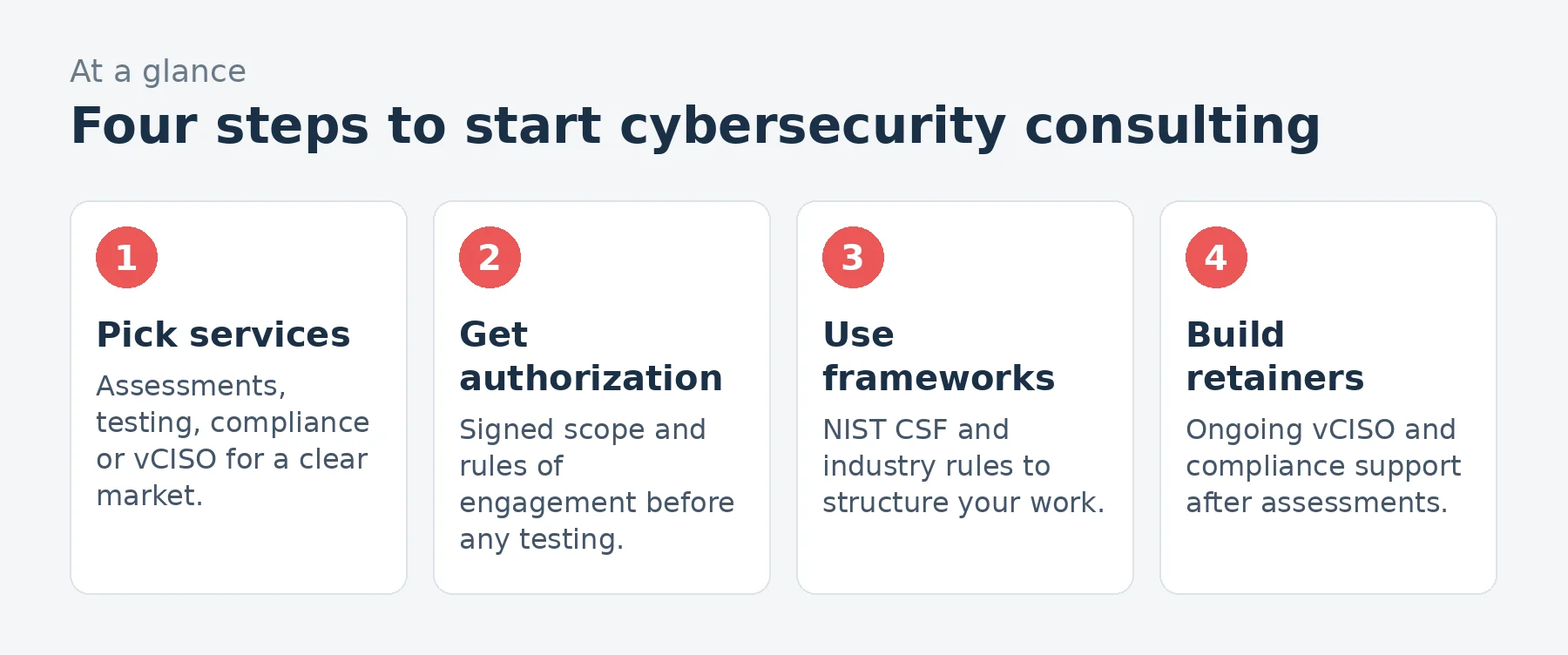
A cybersecurity consulting business at a glance
Table of Contents
| Topic | What to expect |
|---|---|
| Startup cost | Low to moderate: certifications, testing and scanning tools, insurance, contracts and a portfolio |
| Key rules | Written authorization and rules of engagement for any testing; confidentiality for findings |
| Frameworks | NIST Cybersecurity Framework 2.0, HIPAA, the FTC Safeguards Rule, PCI DSS and CMMC for defense contractors |
| How you charge | Fixed-price assessments and tests, monthly virtual CISO retainers and hourly incident support |
| Best for | Experienced security professionals who can explain risk to business owners |
Who security consulting suits
It suits experienced security or IT professionals who enjoy investigating systems, writing clear reports and helping business owners make decisions. Ethics, discretion and communication matter as much as technical skill.
Services to offer
- Risk and security assessments against a framework.
- Vulnerability scanning and penetration testing of networks, applications and cloud.
- Compliance programs: HIPAA, the FTC Safeguards Rule, PCI DSS and CMMC readiness.
- Virtual CISO: part-time security leadership, policies and roadmaps.
- Incident response planning and tabletop exercises.
- Security awareness training and phishing simulations.
Frameworks that structure your work
The NIST Cybersecurity Framework 2.0 (released in 2024) organizes security into govern, identify, protect, detect, respond and recover functions, and works for organizations of any size. Industry rules add requirements: HIPAA for healthcare data, the FTC Safeguards Rule for financial businesses such as tax preparers and auto dealers, PCI DSS for card data and CMMC for Defense Department contractors, which the department began phasing into contracts in 2025.
Authorization and the law
Testing systems without permission can violate the federal Computer Fraud and Abuse Act and state laws, even with good intentions. Before any scanning or testing, get written authorization from someone with authority over the systems, define the scope (systems, dates, methods), agree on rules of engagement and confirm third-party systems such as cloud and hosting providers allow testing. Stay strictly within scope.
Certifications
Certifications build credibility with clients and insurers: entry and intermediate credentials such as CompTIA Security+, advanced ones such as CISSP and CISM for management and consulting, and hands-on penetration testing certifications. Compliance work may call for specific training, such as CMMC-related roles.
Contracts and confidentiality
Contracts should define scope, deliverables, timelines, authorization, confidentiality of findings, handling of client data, limitation of liability and what happens if testing causes disruption. Store findings and reports securely, since a report listing a client’s weaknesses is sensitive information.
Insurance
Carry professional liability (errors and omissions) and cyber liability insurance, and confirm your policy covers penetration testing and advisory work. Clients, especially larger ones, may require specific coverage levels.
Startup costs to plan for
| Item | What to budget for |
|---|---|
| Certifications | Exam fees and training |
| Tools | Scanners, testing tools, reporting software |
| Lab | Practice environment for skills and tool testing |
| Insurance | Professional and cyber liability |
| Contracts | Engagement letters, authorization forms, NDAs |
| Marketing | Website, case studies, speaking |
Use our startup cost calculator for your total.
Pricing
Price assessments and tests as fixed-price projects based on scope (number of systems, applications, locations and complexity), and vCISO services as monthly retainers with defined hours and deliverables. Incident response is often hourly with priority rates. Use our pricing calculator.
A worked example: a solo consultant
These are illustrative assumptions for an established solo consultant, not predictions.
| Assumption | Monthly | |
|---|---|---|
| Security assessments | 2 assessments at $6,000 | $12,000 |
| Virtual CISO retainers | 4 clients at $2,500 | $10,000 |
| Training and policy work | $2,000 | |
| Revenue | $24,000 | |
| Testing and scanning tools | $(600) | |
| Contract testers | Specialist help on larger tests | $(3,500) |
| Insurance | Professional and cyber liability | $(700) |
| Certifications and training | $(300) | |
| Marketing, legal and accounting | $(900) | |
| Profit before owner pay and taxes | $18,000 |
That leaves about $18,000 a month before the owner’s pay and taxes, on about $24,000 of revenue. Retainers that follow assessments create steady income and long relationships.
Loading the calculator…
Writing reports that get action
Reports should include an executive summary in plain language, risk ratings, specific findings with evidence and clear, prioritized recommendations. Business owners need to know what to fix first and why; technical teams need detail to fix it.
Working with MSPs
Many managed IT providers need security expertise for their clients. Partnering with MSPs (for assessments, compliance or vCISO services) brings steady work, while the MSP handles day-to-day IT.
Finding clients
- Regulated small businesses: medical, dental, accounting, legal and financial firms.
- Defense contractors preparing for CMMC.
- MSPs and IT firms needing a security partner.
- Cyber insurance requirements, which push businesses to improve controls.
- Speaking and workshops for business associations.
Incident response readiness
Small businesses often have no plan for ransomware or a compromised email account. Helping them write an incident response plan, test backups and run a tabletop exercise is valuable work that also builds trust before an emergency.
Cyber insurance requirements
Cyber insurers increasingly require controls such as multi-factor authentication, endpoint detection, tested backups and security training before issuing or renewing policies. Helping businesses meet insurer questionnaires is a practical service that leads to broader security work.
Email security
Business email compromise and phishing cause many small business losses. Services such as email authentication setup (SPF, DKIM and DMARC), mailbox security settings and payment verification procedures deliver quick, visible risk reduction.
Security awareness training
People are often the first target. Short, regular training and simulated phishing exercises, reported with improvement over time, help clients reduce risk and show progress to leadership and insurers.
vCISO deliverables
- A security roadmap and risk register.
- Policies and procedures tailored to the business.
- Vendor and third-party risk reviews.
- Quarterly reports for leadership.
- Support during audits, insurance renewals and customer security questionnaires.
Building trust as a new firm
Security buyers want proof before trusting you with their weaknesses. Publish practical guidance, speak at business associations, share anonymized case studies, show certifications and references, and start with well-scoped assessments that demonstrate the quality of your reports.
Keeping skills current
Threats and tools change constantly. Set aside time for training, labs, industry briefings and certification maintenance, and follow guidance from CISA and NIST so your advice stays current.
Common mistakes to avoid
- Testing anything without written authorization.
- Going outside the agreed scope.
- Reports full of jargon without priorities.
- Weak protection of client findings.
- Insurance that excludes testing work.
Your first 90 days
- Days 1-30: choose services and a market, prepare contracts and authorization forms and buy insurance.
- Days 31-60: complete two assessments (some at reduced rates) and refine your report template.
- Days 61-90: partner with MSPs, speak to a business group and convert assessments into retainers.
Frequently asked questions
Do I need a license to be a cybersecurity consultant?
Generally no license is required, though some states regulate certain investigations; certifications and experience matter most.
Is penetration testing legal?
Yes, with written authorization from the system owner and a clear scope. Unauthorized testing can violate federal and state laws.
What is the NIST Cybersecurity Framework?
A widely used framework for managing cyber risk, updated to version 2.0 in 2024.
What is CMMC?
The Defense Department’s Cybersecurity Maturity Model Certification program for contractors handling certain federal information.
How much do cybersecurity consultants charge?
Fixed prices for assessments and tests by scope, monthly retainers for vCISO work and hourly rates for incidents.
Is there demand for cybersecurity work?
Yes. BLS projects employment of information security analysts to grow about 29% over the decade.
What is a virtual CISO?
A part-time security leader who provides strategy, policies and oversight for organizations without a full-time security executive.
Can I start without penetration testing skills?
Yes. Assessments, compliance, vCISO and training services rely more on frameworks, judgment and communication.
Do small businesses really need cybersecurity consultants?
Many do, especially those handling health, financial or customer data, or required by insurers and customers to show security controls.
What certifications should a cybersecurity consultant have?
Common choices include CompTIA Security+ to start, CISSP or CISM for senior advisory work and hands-on penetration testing certifications for testers.
How long does a security assessment take?
Small business assessments often take a few weeks from kickoff to report, depending on scope and access.
Can I work with managed IT providers?
Yes. Many MSPs partner with security consultants for assessments, compliance programs and vCISO services for their clients.
Do I need cyber liability insurance?
Yes. Professional and cyber liability insurance protect you if your advice or testing is linked to a client loss.
Keep learning
- Cybersecurity industry data
- How to start a managed IT services business
- How to start a business consulting firm
- Pricing calculator
Sources
- US Bureau of Labor Statistics, Information security analysts
- NIST, Cybersecurity Framework 2.0
- U.S. Department of Defense, Cybersecurity Maturity Model Certification (CMMC)
- FTC, FTC Safeguards Rule: what your business needs to know
- HHS, Business associate contracts under HIPAA
- U.S. Department of Justice, Computer Fraud and Abuse Act (18 U.S.C. 1030) and good-faith security research policy
- CISA, Cyber guidance for small businesses
Last reviewed November 3, 2026. Startup costs are estimates; check local prices, licensing and tax rules before you commit money.

