
A soap making business crafts handmade bar soaps, liquid soaps and often related bath and body products such as lotions, scrubs and bath bombs. Customers love handmade soap for its ingredients, scents and looks, and soap is a natural product for markets, gift shops and online stores.
The rules depend on what you make and how you describe it. Under FDA guidance, true soap made from fats and an alkali and marketed only for cleaning is regulated by the Consumer Product Safety Commission, while products that make cosmetic claims (such as moisturizing) or contain other ingredients are cosmetics regulated by the FDA, now including requirements under the 2022 cosmetics law known as MoCRA. The Bureau of Labor Statistics reports a median pay of $56,260 for craft and fine artists (May 2024), across about 52,000 jobs, with little change projected over the decade. Most handmade business owners are self-employed, so income depends on pricing, volume and sales channels. This guide covers rules, methods, safety, labels, pricing, selling, a worked example and a 90-day plan.
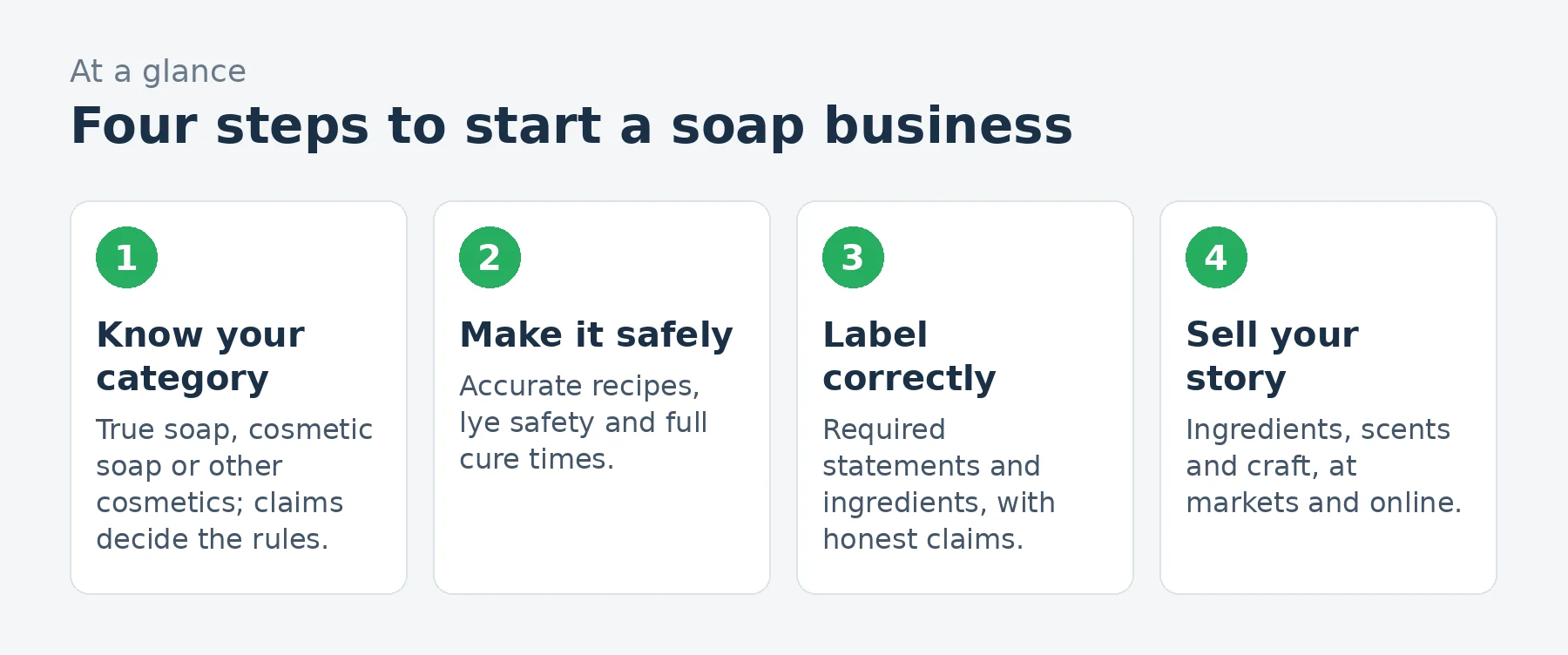
A soap making business at a glance
Table of Contents
| Topic | What to expect |
|---|---|
| Startup cost | Low: oils and butters, lye, fragrance or essential oils, molds, a scale, safety gear and packaging |
| Key rules | True soap (cleaning claims only) falls under CPSC; cosmetic claims or ingredients bring FDA cosmetics rules and MoCRA |
| Small business relief | MoCRA exempts many small businesses from facility registration and product listing, but not from safety and adverse event duties |
| How you sell | Markets, online, gift shops and boutiques, wholesale and custom favors |
| Best for | Careful, creative makers who respect lye safety and enjoy experimenting with recipes |
Who soap making suits
It suits careful, creative people who enjoy chemistry-like precision and design. Lye is caustic, so safe handling and accurate recipes are essential.
Soap or cosmetic? Why it matters
According to the FDA, a product is regulated as soap by the CPSC when it is made mainly of fats and an alkali, its cleaning action comes from those soap compounds and it is marketed only for cleaning. If you add other cleansing agents, or claim the product moisturizes, softens skin, treats acne or does anything beyond cleaning, it is a cosmetic (and claims that treat conditions can make it a drug). Plan your marketing language as carefully as your recipe.
MoCRA and cosmetics rules
The Modernization of Cosmetics Regulation Act of 2022 added requirements for cosmetics, including facility registration, product listing, safety substantiation, adverse event reporting and recordkeeping. Small businesses with average annual cosmetics sales below a set threshold are generally exempt from registration and listing, but still have duties such as safety substantiation and reporting serious adverse events. Check the FDA’s MoCRA guidance for current requirements before selling lotions, scrubs or soaps with cosmetic claims.
Soap making methods
- Cold process: oils and lye mixed at moderate temperatures, then cured for several weeks; full control of ingredients.
- Hot process: the soap is cooked to speed saponification, usually with a more rustic look.
- Melt and pour: pre-made soap base melted, scented and molded; no lye handling, faster to start.
- Liquid soap: made with potassium hydroxide, diluted and bottled.
Lye safety and curing
Always use a lye calculator to create recipes, weigh ingredients on a digital scale, wear gloves and eye protection, add lye to water (never water to lye), work in a ventilated space and keep children and pets away. Cure cold process bars fully before selling so they are mild and hard. Record every batch.
Labels
Labels for true soap can be simpler, but cosmetics must follow FDA labeling rules: identity of the product, net quantity, ingredient list in the required order and names, and the name and place of business. Avoid claims that turn soap into a cosmetic or drug unless you are ready to meet those rules. Many makers list ingredients on all products to build trust and help customers with allergies.
Startup costs to plan for
| Item | What to budget for |
|---|---|
| Ingredients | Oils, butters, lye, fragrance or essential oils, colorants |
| Equipment | Digital scale, stick blender, molds, thermometer |
| Safety gear | Gloves, goggles, long sleeves |
| Curing space | Racks with airflow |
| Labels and packaging | Wraps, boxes, labels |
| Insurance | Product liability |
Use our startup cost calculator for your total.
Pricing your soap
Calculate cost per bar from your recipe (oils, lye, fragrance, colorants, packaging), plus labor, curing space and overhead. Set wholesale prices that cover costs and profit, then retail around twice wholesale. Bundles and gift sets raise the average sale. Use our pricing calculator.
A worked example: a home-based maker
These are illustrative assumptions for a home-based maker in a busy month, not predictions.
| Assumption | Monthly | |
|---|---|---|
| Market sales | 4 markets at $650 | $2,600 |
| Online sales | 200 bars at $9 plus shipping | $1,800 |
| Wholesale to shops | 250 bars at $4.50 | $1,125 |
| Revenue | $5,525 | |
| Ingredients and packaging | About $1.60 per bar for 700 bars | $(1,120) |
| Market fees and shipping | $(600) | |
| Labels and supplies | $(200) | |
| Marketing, website and fees | $(350) | |
| Insurance | Product liability | $(50) |
| Profit before owner pay and taxes | $3,205 |
That leaves about $3,205 a month before taxes and the value of your time, on about $5,525 of revenue. Cold process soap needs weeks to cure, so plan production ahead of busy seasons.
Loading the calculator…
Selling soap
- Farmers markets and craft fairs: customers can smell and see the bars.
- Online store: clear photos, ingredients and scent notes.
- Gift shops, boutiques and spas: wholesale or consignment.
- Wedding and corporate favors: custom labels and small bars.
- Subscriptions: monthly bars or bath boxes.
Building a product line
Many soap makers add related products: shampoo bars, lip balms, lotions, scrubs and bath bombs. Remember that many of these are cosmetics with FDA requirements, so add them deliberately and label them correctly.
Scents, colors and natural positioning
Decide on a style: natural with essential oils and clays, colorful and playful designs, unscented sensitive-skin bars or luxury scents. Use skin-safe fragrance oils and essential oils at safe levels, and be honest about "natural" claims.
Packaging
Packaging protects bars and sells them: paper wraps or boxes with ingredient information, shrink wrap for gift shops and sturdy boxes for shipping. Eco-friendly packaging suits many soap brands.
Sourcing ingredients
Buy oils, butters, lye and fragrance from suppliers that provide safety data and consistent quality. Keep supplier information and batch records, which help with consistency, customer questions and safety records for cosmetics.
A production schedule
Cold process soap needs weeks to cure, so production runs well ahead of sales. Plan batches for markets and the holiday season months in advance, and keep a cure calendar so you always have ready bars on hand.
Records and batch tracking
Record every batch: recipe, ingredient lots, date, cure time and where bars were sold. Good records help you repeat successes, trace any problem and meet recordkeeping expectations for cosmetics.
Pricing for markets and wholesale
Offer single bars, bundles and gift sets at markets, and set wholesale case packs for shops. Keep a consistent retail price across channels so stores are not undercut by your own website.
Common mistakes to avoid
- Making moisturizing or healing claims on true soap.
- Skipping a lye calculator or safety gear.
- Selling bars before they have cured.
- Ignoring MoCRA rules for cosmetics.
- Underpricing handmade products.
Your first 90 days
- Days 1-30: learn safe soap making, test recipes and decide whether you will sell true soap, cosmetics or both.
- Days 31-60: cure test batches, design labels and buy insurance.
- Days 61-90: launch at markets and online and approach local shops.
Frequently asked questions
Does the FDA regulate handmade soap?
True soap marketed only for cleaning is regulated by the CPSC. Products with cosmetic claims or other ingredients are cosmetics regulated by the FDA.
What is MoCRA?
The Modernization of Cosmetics Regulation Act of 2022, which added registration, listing, safety and reporting requirements for cosmetics, with exemptions for many small businesses from registration and listing.
Can I say my soap moisturizes skin?
That claim generally makes it a cosmetic, bringing FDA cosmetics rules. Choose claims carefully.
How long does handmade soap need to cure?
Cold process soap typically cures for several weeks before it is ready to use and sell.
Is melt and pour soap easier to start?
Yes. It avoids handling lye and has no long cure time, though it offers less control over ingredients.
Do I need insurance to sell soap?
Product liability insurance is strongly recommended and often required by markets and shops.
What should a soap label include?
At minimum the product name, net weight and your business name and location; cosmetics require ingredient lists and other FDA labeling elements.
Can I sell bath bombs and lotions too?
Yes, but they are cosmetics under FDA rules, including MoCRA requirements, so label and document them correctly.
Is a soap making business profitable?
It can be with good pricing, efficient batches and multiple channels, since ingredient costs per bar are relatively low.
Keep learning
- Candles and soap industry data
- How to start a candle making business
- How to start a gift shop
- Pricing calculator
Sources
- FDA, Soap: is it a cosmetic?
- FDA, Modernization of Cosmetics Regulation Act of 2022 (MoCRA)
- FDA, Cosmetics labeling guide
- US Bureau of Labor Statistics, Craft and fine artists
Last reviewed November 3, 2026. Startup costs are estimates; check local prices, licensing and tax rules before you commit money.

