
A candle business makes and sells scented and decorative candles: container candles, pillars, tealights, wax melts and gift sets. Candles are popular gifts and home goods, and many makers start in their kitchen with a few signature scents before growing into studios, wholesale accounts and custom corporate orders.
Candles involve an open flame, so safety testing and warning labels matter as much as scent. Competition is strong, so branding and consistent quality set businesses apart. The Bureau of Labor Statistics reports a median pay of $56,260 for craft and fine artists (May 2024), across about 52,000 jobs, with little change projected over the decade. Most handmade business owners are self-employed, so income depends on pricing, volume and sales channels. This guide covers materials, testing, safety labels, pricing, selling, a worked example and a 90-day plan.
A candle making business at a glance
Table of Contents
| Topic | What to expect |
|---|---|
| Startup cost | Low: wax, wicks, fragrance oils, containers, a thermometer, scale, pouring pitcher, labels and packaging |
| Key safety | Burn testing every candle design and fire safety warning labels based on the ASTM F2417 standard |
| Insurance | Product liability insurance is strongly recommended and often required by stores and markets |
| How you sell | Online, craft fairs and markets, local shops, wholesale, corporate and wedding gifts |
| Best for | Patient, detail-oriented makers who enjoy testing, branding and selling |
Who candle making suits
It suits patient makers who enjoy experimenting, careful testing and creating a recognizable brand. Much of the work is repeatable production, labeling and packing, plus marketing.
Choosing wax, wicks and fragrance
- Wax: soy, coconut, coconut-soy blends, paraffin and beeswax each burn differently and hold fragrance differently.
- Wicks: cotton, wood and other wick types come in sizes matched to the container diameter and wax.
- Fragrance oils: use oils made for candles, within the supplier’s recommended fragrance load, and follow IFRA standards for safe use levels.
- Containers: heat-resistant glass, tins or ceramic designed for candles; avoid containers that can crack.
Burn testing
Every combination of wax, wick, fragrance and container needs testing. Burn test candles from start to finish, checking flame height, melt pool, soot, container temperature and how the candle behaves near the end. Record results for each batch. A candle that tunnels, smokes or overheats the container is a safety and quality problem, not just a cosmetic one.
Fire safety labels
The industry standard ASTM F2417 sets fire safety labeling for candles, including warnings such as never leaving a burning candle unattended, keeping it away from things that can catch fire and out of reach of children and pets. Many retailers require labels that follow this standard, and the National Candle Association publishes guidance. Also include your business name, the scent and net weight, plus any allergen or fragrance information you choose to share.
Insurance and safety
Product liability insurance protects you if a candle causes damage or injury, and many shops and markets require it. Work in a safe space: heat wax with a thermometer, never leave melting wax unattended, keep a fire extinguisher nearby and store fragrance oils safely.
Startup costs to plan for
| Item | What to budget for |
|---|---|
| Materials | Wax, wicks, fragrance oils, dyes, containers |
| Tools | Scale, thermometer, pouring pitcher, heat source, wick centering tools |
| Testing | Extra materials for burn tests |
| Labels and packaging | Warning labels, boxes, shipping supplies |
| Insurance | Product liability |
| Market booth | Displays, table, signage |
Use our startup cost calculator for your total.
Pricing your candles
Calculate the cost of every candle: wax, wick, fragrance, container, label, packaging and a share of testing and waste. Add your labor and overhead, then set a wholesale price with profit and a retail price around twice wholesale. Premium containers and unique scents support higher prices. Use our pricing calculator.
A worked example: a home-based maker
These are illustrative assumptions for a home-based maker in a busy month, not predictions.
| Assumption | Monthly | |
|---|---|---|
| Online sales | 180 candles at $28 | $5,040 |
| Markets and pop-ups | 4 events at $600 | $2,400 |
| Wholesale to shops | 120 candles at $14 | $1,680 |
| Revenue | $9,120 | |
| Materials | 420 candles at $5.50 (wax, wick, fragrance, container) | $(2,310) |
| Labels, boxes and shipping supplies | $(600) | |
| Market fees and shipping | $(700) | |
| Marketing and website fees | $(450) | |
| Insurance | Product liability | $(60) |
| Profit before owner pay and taxes | $5,000 |
That leaves about $5,000 a month before taxes and the value of your time, on about $9,120 of revenue. The holiday season often brings the biggest months; plan inventory and packaging early.
Developing signature scents
A few memorable signature scents build a brand more than a huge menu. Name scents with personality, describe them clearly (top, middle and base notes) and offer seasonal scents for holidays. Ask customers what they love, and retire slow sellers.
Selling candles
- Online store with good photos and scent descriptions.
- Craft fairs and holiday markets: customers can smell the candles.
- Local shops and boutiques: wholesale or consignment.
- Corporate gifts and weddings: custom labels and favors.
- Subscriptions: a new scent each month.
Wholesale accounts
Shops want consistent quality, attractive packaging, safety labels, reliable restocking and wholesale terms (minimum order, payment terms, lead times). Create a line sheet with photos, scents, sizes and wholesale and suggested retail prices.
Packaging and shipping
Candles are fragile and heavy. Use protective packaging, test shipments in hot weather (wax can soften) and consider lids and boxes that make candles giftable. Good packaging also protects your margin by reducing breakage.
Growing your candle business
As demand grows, batch production, buy wax and containers in bulk, standardize recipes and consider hiring help for pouring and packing. Some makers move into a small studio for space and safety.
Wax melts, diffusers and add-ons
Wax melts, reed diffusers, room sprays and matches extend a candle line with little new equipment and raise the average order. Some products, such as room sprays, have their own labeling considerations, so check requirements before adding them.
Planning for the holiday season
November and December can bring a large share of a candle maker’s annual sales. Order containers, wax and fragrance in late summer, build inventory in early fall, design holiday scents and gift sets, and set order deadlines for shipping. Many makers also see spikes before Mother’s Day and Valentine’s Day.
Custom and corporate orders
Weddings, real estate agents, businesses and event planners order custom-labeled candles as gifts and favors. Offer minimum quantities, custom label templates and lead times, and take a deposit before production.
Testing scents with customers
Use markets to test new scents: offer samples, note which jars people pick up and smell, and ask for feedback. Customer favorites become your core line, and the feedback helps you retire scents that do not sell.
Choosing containers and vessels
Containers shape your brand and your safety. Use vessels designed for candles that tolerate heat, match wick size to the diameter and test each new container. Reusable or refillable vessels appeal to customers and can support a refill program that brings them back.
Common mistakes to avoid
- Selling without burn testing.
- Missing fire safety warning labels.
- Overloading fragrance beyond recommended levels.
- Underpricing after counting only wax.
- Skipping product liability insurance.
Your first 90 days
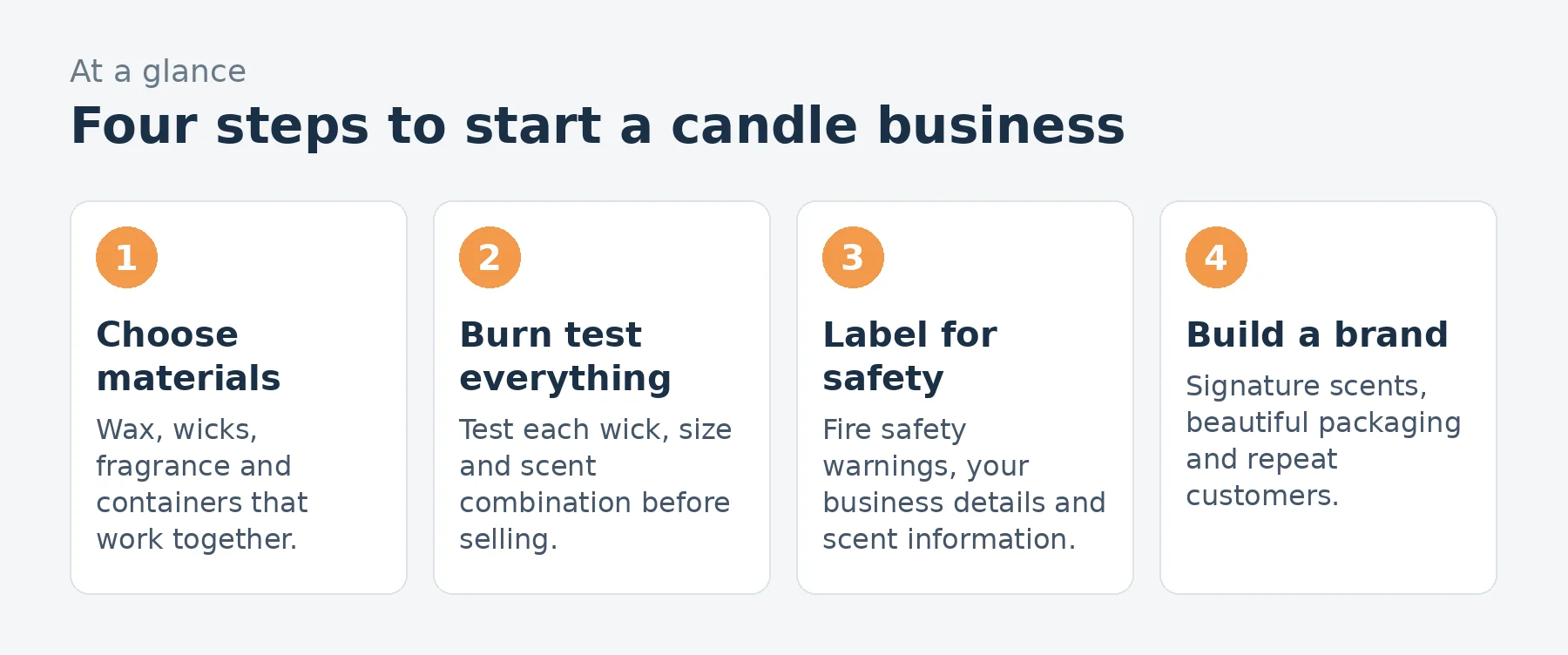
- Days 1-30: choose materials, make test batches and burn test every combination.
- Days 31-60: finalize three to five scents, design labels with safety warnings and buy insurance.
- Days 61-90: launch online, sell at two markets and approach three local shops.
Frequently asked questions
Do I need a license to sell candles?
Usually just a business license and sales tax permit, but candles need safety labeling, and insurance is strongly recommended.
What warning labels do candles need?
Most makers follow the ASTM F2417 fire safety labeling standard, which many retailers require.
What is the best wax for candles?
It depends on your goals: soy and coconut blends are popular for natural positioning, while paraffin and blends offer strong scent throw. Test to find your best combination.
How much fragrance oil should I use?
Follow your supplier’s recommended fragrance load and IFRA guidance, and confirm with burn tests.
Can I sell candles from home?
Many makers do, if local zoning allows and they work safely with proper insurance.
How should I price candles?
Cover materials, packaging, labor and overhead for a wholesale price, then retail at about twice wholesale.
How long do candles need to cure?
Many candle makers let candles cure for several days to two weeks before selling, depending on the wax, to improve scent throw. Test your combination.
Can I ship candles in summer?
Yes, with care. Heat can soften wax, so use insulated packaging, ship early in the week and consider pausing shipments to very hot areas.
Do candle makers need special insurance?
Product liability insurance is the key coverage, and many markets and shops require proof of it.
What scents sell best?
Clean, fresh and cozy scents sell steadily, with seasonal scents peaking around holidays. Test at markets and track sales to find your bestsellers.
Keep learning
- Candles and soap industry data
- How to start a soap making business
- How to start a gift shop
- Pricing calculator
Sources
- ASTM International, F2417 Standard specification for fire safety for candles
- National Candle Association, Candle safety and industry standards
- US Bureau of Labor Statistics, Craft and fine artists
- IFRA, International Fragrance Association standards
Last reviewed November 3, 2026. Startup costs are estimates; check local prices, licensing and tax rules before you commit money.

