
A SaaS (software as a service) startup sells software that customers use online for a recurring subscription: tools for scheduling, accounting, marketing, project management, industry operations and countless other jobs. Recurring revenue is attractive because each customer can pay month after month.
Most SaaS startups fail not because the software is bad, but because they build something too few people will pay for. The winning approach is to validate demand before building, launch a focused minimum viable product (MVP) and obsess over retention. The Bureau of Labor Statistics reports a median pay of $133,080 for software developers, quality assurance analysts and testers (May 2024), across about 1.9 million jobs, with employment projected to grow about 15% over the decade. This guide covers validation, building, pricing, subscription rules, security, metrics, funding, a worked example and a 90-day plan.
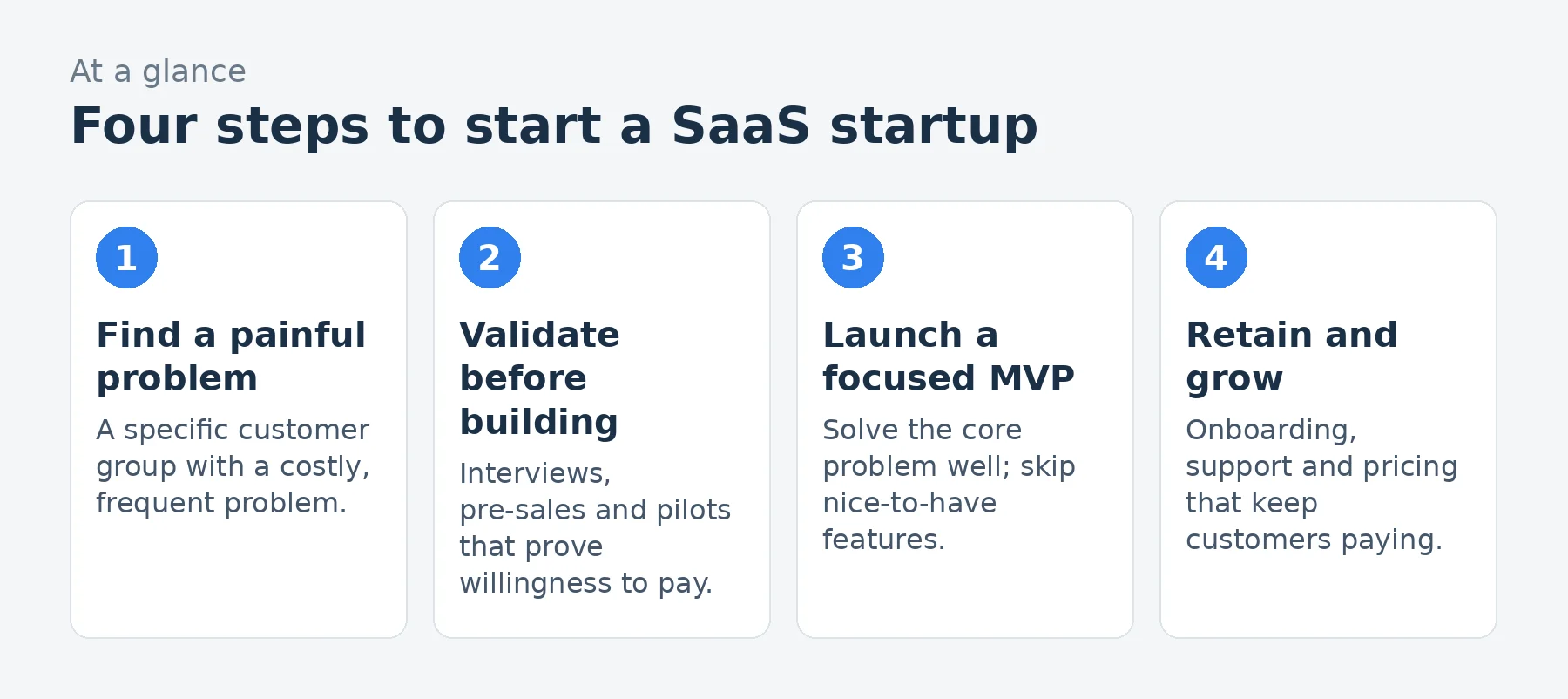
A SaaS startup at a glance
Table of Contents
| Topic | What to expect |
|---|---|
| Startup cost | Low to high: from a solo founder’s time and cloud hosting to funded teams; development is the main cost |
| Key rules | State automatic renewal laws, privacy and data security, sales tax on SaaS in some states, COPPA for products for children |
| How you earn | Monthly or annual subscriptions, usually in tiers by features, users or usage |
| Key metrics | Monthly recurring revenue (MRR), churn, customer acquisition cost (CAC) and lifetime value (LTV) |
| Best for | Founders who deeply understand a customer problem and can build, sell or both |
Who a SaaS startup suits
It suits founders who understand a customer problem deeply, often from working in that industry, and who can build the product or partner with someone who can. Selling and listening to customers matter as much as code.
Finding a problem worth solving
- Vertical SaaS: software for one industry, such as dental offices, contractors, gyms or property managers.
- Workflow tools: replacing spreadsheets, paper or manual processes.
- Integrations: connecting tools businesses already use.
- Compliance and reporting: jobs businesses must do and dislike doing.
The best problems are frequent, costly and currently solved badly. Talk to dozens of potential customers before writing code.
Validating demand
Validation means evidence that people will pay. Conduct customer interviews about their current process and costs, build a landing page explaining the solution, show mockups and ask for pre-orders, letters of intent or paid pilots. A handful of customers paying before the product is finished is far stronger evidence than many people saying they like the idea.
Building the MVP
Build the smallest product that solves the core problem for your first customers. Choose a familiar tech stack, use managed services (authentication, payments, email, hosting) rather than building them, and ship quickly. Spend time with early users, watch how they use the product and improve based on what they do, not only what they say.
Pricing
Price on the value delivered, not your costs. Common models include tiers by features, number of users, usage or locations. Offer annual plans with a discount to improve cash flow and retention. Test pricing with early customers; many founders start too low. Use our pricing calculator to check unit economics.
Subscription and tax rules
Subscriptions bring legal duties. Several states have automatic renewal laws (California’s is one of the most detailed) that require clear disclosure of renewal terms, affirmative consent and an easy way to cancel. A federal FTC "click-to-cancel" rule adopted in 2024 was struck down in court in 2025, but state laws and the FTC’s general rules against deceptive practices still apply. Sales tax on software and SaaS also varies by state, so get tax advice as you grow.
Privacy and security
Software that stores customer data needs a privacy policy, strong security practices and a plan for data requests. Business buyers often ask for security documentation; many SaaS companies eventually pursue a SOC 2 report, an independent audit of security controls under AICPA criteria. Products for children under 13 must follow COPPA.
Startup costs to plan for
| Item | What to budget for |
|---|---|
| Development | Founder time, contractors or a technical cofounder |
| Hosting and services | Cloud, database, email, monitoring |
| Payments and billing | Subscription billing provider |
| Legal | Terms of service, privacy policy, company setup |
| Marketing | Website, content, early customer acquisition |
| Security | Practices now, SOC 2 later if selling to larger businesses |
Use our startup cost calculator for your total.
Key SaaS metrics
- MRR (monthly recurring revenue): subscription revenue each month.
- Churn: the share of customers or revenue lost each month.
- CAC (customer acquisition cost): what it costs to win a customer.
- LTV (lifetime value): revenue a customer brings over their lifetime.
- Activation: the share of new users who reach the product’s key value.
Healthy SaaS businesses keep churn low and earn back acquisition costs within a reasonable time.
A worked example: a bootstrapped SaaS
These are illustrative assumptions for a bootstrapped SaaS about two years in, not predictions.
| Assumption | Monthly | |
|---|---|---|
| Subscription revenue (MRR) | 220 customers at $79 a month average | $17,380 |
| Revenue | $17,380 | |
| Payment processing | Card fees, about 3% | $(520) |
| Hosting and infrastructure | Cloud, database, email delivery | $(1,100) |
| Third-party services | Analytics, support desk, monitoring | $(500) |
| Contract developer | Part-time | $(4,500) |
| Marketing and customer acquisition | Content, ads, partnerships | $(2,500) |
| Support help | Part-time | $(1,200) |
| Legal, accounting and insurance | $(600) | |
| Profit before owner pay and taxes | $6,460 |
That leaves about $6,460 a month before the founder’s pay and taxes, on about $17,380 of recurring revenue. Each 1% of monthly churn means replacing customers just to stand still, so retention matters as much as acquisition.
Loading the calculator…
Getting first customers
- Your network and industry contacts.
- Communities where your customers gather, offering help, not spam.
- Content and search around the problem you solve.
- Partnerships with consultants and tools your customers already use.
- Direct outreach to well-matched prospects.
Onboarding and retention
Many customers cancel because they never got value. Design onboarding that gets users to their first success quickly, send helpful emails, offer live onboarding for higher-priced plans and respond fast to support requests. Talk to customers who cancel to learn why.
Bootstrapping or raising money
Bootstrapping keeps control and forces focus on revenue; venture capital funds faster growth but expects large outcomes and gives up ownership. Many SaaS businesses start bootstrapped, sometimes with small angel investment, and raise later once growth is proven.
Customer support as a product
In early SaaS, support is one of your strongest advantages. Answer quickly, fix bugs fast, record common questions and turn them into help articles and product improvements. Founders who handle support personally learn more about their customers than any survey can tell them.
Selling to businesses
Business buyers often need demos, trials, security answers and sometimes procurement paperwork. Prepare a short demo, a security overview, standard terms and simple onboarding. Higher-priced plans may justify a sales call; lower-priced plans should be fully self-serve.
A product roadmap
Keep a public or customer-facing roadmap of what is planned, prioritize features that reduce churn or win larger customers and say no to requests that serve only one account. A focused roadmap keeps a small team effective.
Choosing a cofounder
Many SaaS startups pair a technical founder with a founder who sells and understands the customer. Agree early on roles, ownership, decision-making and what happens if someone leaves, and put it in writing with vesting schedules.
Common mistakes to avoid
- Building for months before talking to customers.
- Pricing too low.
- Adding features instead of fixing onboarding.
- Confusing renewal terms or hard cancellation.
- Weak security for customer data.
Your first 90 days
- Days 1-30: interview 20 to 30 potential customers and define the core problem.
- Days 31-60: validate with a landing page, mockups and paid pilots or pre-orders.
- Days 61-90: build and launch an MVP to your first paying customers and track activation and churn.
Frequently asked questions
How much does it cost to start a SaaS company?
It can start with little more than the founder’s time and hosting, but development time is the main investment.
Do I need to know how to code?
Not necessarily, but you need a technical cofounder, contractors or no-code tools to build the product.
What are automatic renewal laws?
State laws, such as California’s, requiring clear renewal terms, consent and easy cancellation for subscriptions.
What is SOC 2?
An independent audit of security controls that many business customers ask SaaS vendors to provide.
What is a good churn rate?
Lower is better; it varies by customer type, and small-business SaaS usually sees higher churn than enterprise software.
Should I raise venture capital?
Only if you need fast growth capital and are comfortable with investors’ expectations; many SaaS companies bootstrap.
Should my SaaS offer a free plan?
A free plan can drive sign-ups but adds support costs; many SaaS products use free trials instead.
Do I need terms of service?
Yes. Terms of service and a privacy policy are essential for any SaaS product.
How long until a SaaS startup is profitable?
It varies widely; bootstrapped products often take a year or more to reach steady profit, depending on pricing, churn and acquisition costs.
Keep learning
- Software and SaaS industry data
- How to start a micro-SaaS business
- How to start an app development business
- Business Idea Reality Check
Sources
- US Bureau of Labor Statistics, Software developers, quality assurance analysts and testers
- California Business and Professions Code, Automatic Renewal Law (section 17600 and following)
- AICPA, SOC 2: SOC for Service Organizations (Trust Services Criteria)
- FTC, Protecting personal information: a guide for business
- FTC, Children's Online Privacy Protection Rule (COPPA)
Last reviewed November 3, 2026. Startup costs are estimates; check local prices, licensing and tax rules before you commit money.

