
A micro-SaaS is a small software business, often run by one person or a tiny team, that solves a specific problem for a narrow group of customers: an add-on for a popular platform, a tool for one profession or a utility that saves people time. The goal is usually a profitable, sustainable business rather than a venture-funded giant.
Micro-SaaS products succeed by choosing narrow niches that larger companies ignore, keeping costs low and automating as much as possible. Risks include dependence on another platform and slow growth. The Bureau of Labor Statistics reports a median pay of $133,080 for software developers, quality assurance analysts and testers (May 2024), across about 1.9 million jobs, with employment projected to grow about 15% over the decade. This guide covers ideas, building, pricing, automation, rules, a worked example and a 90-day plan.
A micro-SaaS business at a glance
Table of Contents
| Topic | What to expect |
|---|---|
| Startup cost | Low: the founder’s time, hosting, a domain, billing and a few software services |
| Typical model | Small monthly subscriptions from a focused customer group |
| Common formats | Add-ons for platforms (stores, CRMs, workspace tools), niche web apps and browser extensions |
| Key risks | Platform policy changes, slow customer acquisition and founder burnout |
| Best for | Builders who want a small, profitable business they can run with little overhead |
Who micro-SaaS suits
It suits developers or technical founders who want independence and are willing to handle marketing, support and operations themselves. Patience matters: many micro-SaaS products grow slowly at first.
Finding micro-SaaS ideas
- Platform add-ons: apps for online store platforms, CRMs, workspace tools, accounting software or website builders.
- Niche professional tools: software for a single profession’s specific task.
- Data and reporting tools: turning messy exports into useful reports.
- Automation: connecting two tools or eliminating a repetitive task.
- Browser extensions that save time on frequent tasks.
Look in forums, app marketplace reviews and community discussions for repeated complaints and requests.
Validating fast
Talk to people with the problem, describe a simple solution and ask whether they would pay. Build a landing page, collect sign-ups or pre-orders and launch a basic version quickly. Charging from day one validates demand far better than free users.
Building solo
Use a familiar tech stack, managed services for authentication, payments and email, and keep the product simple. No-code and low-code tools can work for some products. Focus on one core job done exceptionally well, and resist building features only a few users ask for.
Platform add-ons and marketplace rules
Selling through a platform’s app marketplace brings built-in customers, but you must follow its rules, often share revenue and accept that policy or API changes can affect your product. Diversify where possible, and build direct relationships with customers through email.
Pricing
Many micro-SaaS products use simple plans, often one or two tiers, with annual discounts. Price for value, not your low costs, and raise prices for new customers as the product improves. Use our pricing calculator to check the numbers.
Subscription, privacy and tax rules
Subscriptions bring legal duties. Several states have automatic renewal laws (California’s is one of the most detailed) that require clear disclosure of renewal terms, affirmative consent and an easy way to cancel. A federal FTC "click-to-cancel" rule adopted in 2024 was struck down in court in 2025, but state laws and the FTC’s general rules against deceptive practices still apply. Sales tax on software and SaaS also varies by state, so get tax advice as you grow.
Software that stores customer data needs a privacy policy, strong security practices and a plan for data requests. Business buyers often ask for security documentation; many SaaS companies eventually pursue a SOC 2 report, an independent audit of security controls under AICPA criteria. Products for children under 13 must follow COPPA.
Startup costs to plan for
| Item | What to budget for |
|---|---|
| Hosting and services | Cloud, database, email delivery |
| Billing | Subscription billing provider |
| Domain and website | Landing page and documentation |
| Legal | Terms of service, privacy policy |
| Tools | Support, analytics, monitoring |
| Marketing | Content, marketplace listing, small ads tests |
Use our startup cost calculator for your total.
Automating the business
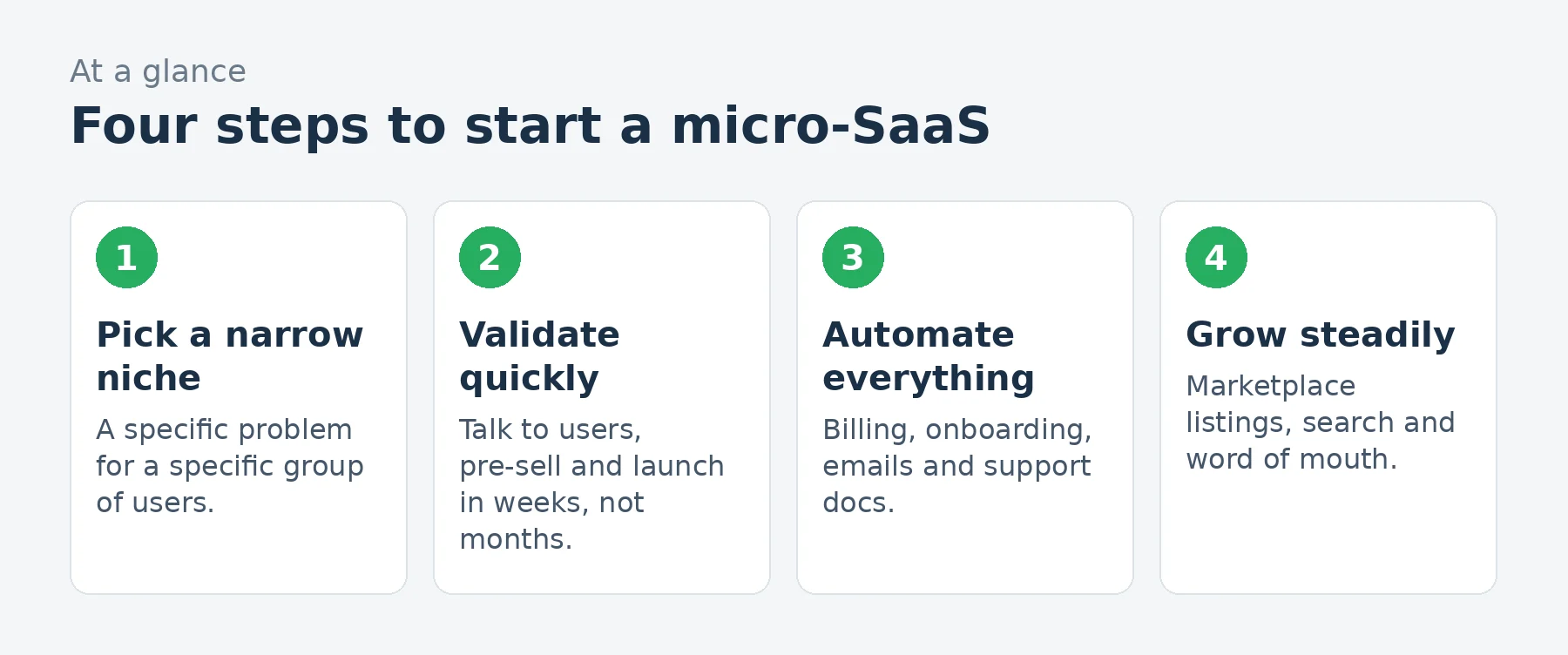
- Self-serve sign-up, billing and plan changes.
- Onboarding emails that guide users to their first success.
- Help documentation and short videos for common questions.
- Monitoring and alerts for outages.
- Automated invoices and dunning (retrying failed payments).
Automation lets one person serve hundreds of customers.
A worked example: a solo micro-SaaS
These are illustrative assumptions for a solo-founder micro-SaaS after about 18 months, not predictions.
| Assumption | Monthly | |
|---|---|---|
| Subscriptions | 310 customers at $19 a month | $5,890 |
| Revenue | $5,890 | |
| Marketplace or platform fees | Where sold through an app marketplace | $(590) |
| Payment processing | $(180) | |
| Hosting and services | $(250) | |
| Support tools and email | $(80) | |
| Marketing | Content and small ads tests | $(300) |
| Accounting and legal | $(120) | |
| Profit before owner pay and taxes | $4,370 |
That leaves about $4,370 a month before the founder’s pay and taxes, on about $5,890 of recurring revenue. Small products can be very profitable because costs stay low, but growth depends on steady acquisition and low churn.
Loading the calculator…
Marketing on a small budget
- Marketplace listings with clear screenshots and reviews.
- Search content answering the problem your tool solves.
- Communities where your users ask for help.
- Integrations and partnerships with complementary tools.
- Building in public, sharing progress to attract early users.
Support without burnout
Set support hours, answer common questions with documentation, use templates for frequent replies and prioritize fixing issues that cause repeated questions. Many solo founders limit support channels to email to keep it manageable.
Selling a micro-SaaS later
Profitable micro-SaaS businesses with steady revenue and low churn can sometimes be sold to buyers through marketplaces for online businesses. Clean financials, documentation and low founder dependence increase their value.
Sizing a niche
A niche must be big enough to reach your income goal. Estimate how many potential customers exist, how many you might realistically reach and what they would pay. A few hundred customers at a modest monthly price can support a solo founder, but very small niches may not.
Launching
Launch where your users already are: the platform marketplace, relevant communities, newsletters and product directories. Offer launch pricing for early adopters, collect feedback quickly and turn early users into testimonials.
Raising prices over time
As your product improves, raise prices for new customers and consider keeping early customers at their original price as a thank-you. Price increases often improve profit more than adding features.
Platform risk in practice
If your product depends on another company’s platform or API, read its developer terms closely, follow its updates and build features that would still matter if the platform changed. Keep your own customer list and consider supporting a second platform as you grow.
Measuring what matters
Track monthly recurring revenue, new customers, churn, trial conversion and support volume. A simple dashboard reviewed weekly shows whether the business is growing and where to focus.
Common mistakes to avoid
- Building for months without paying users.
- A niche too small to support a business.
- Underpricing.
- Relying entirely on one platform.
- Unclear renewal and cancellation terms.
Your first 90 days
- Days 1-30: research niche problems and talk to 15 to 20 potential users.
- Days 31-60: build a simple version, set up billing and launch to early users at a paid price.
- Days 61-90: improve onboarding, publish documentation and list in relevant marketplaces.
Frequently asked questions
What is a micro-SaaS?
A small software-as-a-service business, often run solo, solving a specific problem for a narrow group of customers.
How much can a micro-SaaS make?
It varies widely. Small products can be very profitable because costs stay low, but revenue depends on customers and churn.
Can I build a micro-SaaS without coding?
Some products can be built with no-code tools, though coding skills give more flexibility.
Is building on another platform risky?
Yes. Policy, fee or API changes can affect your product, so diversify and keep direct customer relationships.
Do I need terms of service?
Yes. Terms of service and a privacy policy are essential for any subscription product.
Can I sell my micro-SaaS later?
Profitable products with steady revenue and documentation can sometimes be sold to buyers of online businesses.
How long does it take to build a micro-SaaS?
A focused first version can often be built in weeks or a few months by an experienced developer.
What is a good first micro-SaaS idea?
An add-on or tool that solves a frequent, specific problem for users of a platform you know well.
Should a micro-SaaS have a free trial?
Many offer short free trials to let users see value before paying, with clear terms on when billing starts.
Do I need a company to sell software?
Forming a business entity is wise for liability and taxes, and payment providers and marketplaces may require business details.
How do micro-SaaS founders handle taxes on subscriptions?
Sales tax on software varies by state and country; many founders use billing tools that calculate tax or a merchant of record service, and get tax advice.
Keep learning
- Software and SaaS industry data
- How to start a SaaS startup
- How to start a mobile app business
- Pricing calculator
Sources
- US Bureau of Labor Statistics, Software developers, quality assurance analysts and testers
- California Business and Professions Code, Automatic Renewal Law (section 17600 and following)
- FTC, Protecting personal information: a guide for business
- AICPA, SOC 2: SOC for Service Organizations (Trust Services Criteria)
Last reviewed November 3, 2026. Startup costs are estimates; check local prices, licensing and tax rules before you commit money.

