
Millions of residential and commercial pools need weekly cleaning, chemical balancing, equipment repair and eventually renovation. Pool service is one of the most recurring home service businesses: customers pay every month, and routes can be packed tightly in neighborhoods with many pools. The work is closest to general maintenance and repair, where the Bureau of Labor Statistics counted about 1.63 million workers in 2024, with a median wage of $48,620 in May 2024 and 4% projected growth.
Pool businesses range from a single technician running a weekly route to repair and equipment specialists and builders who design and install new pools. Climate shapes the year: in the Sun Belt, service runs year-round; in colder regions, openings and closings bookend a shorter season.
The workforce
| Occupation | Jobs (2024) | Median pay (May 2024) | Projected growth, 2024 to 2034 |
|---|---|---|---|
| General maintenance and repair workers (closest BLS occupation for pool technicians) | about 1.6 million | $48,620 | +4% |
Source: U.S. Bureau of Labor Statistics, Occupational Outlook Handbook and Occupational Employment and Wage Statistics.
Business models compared
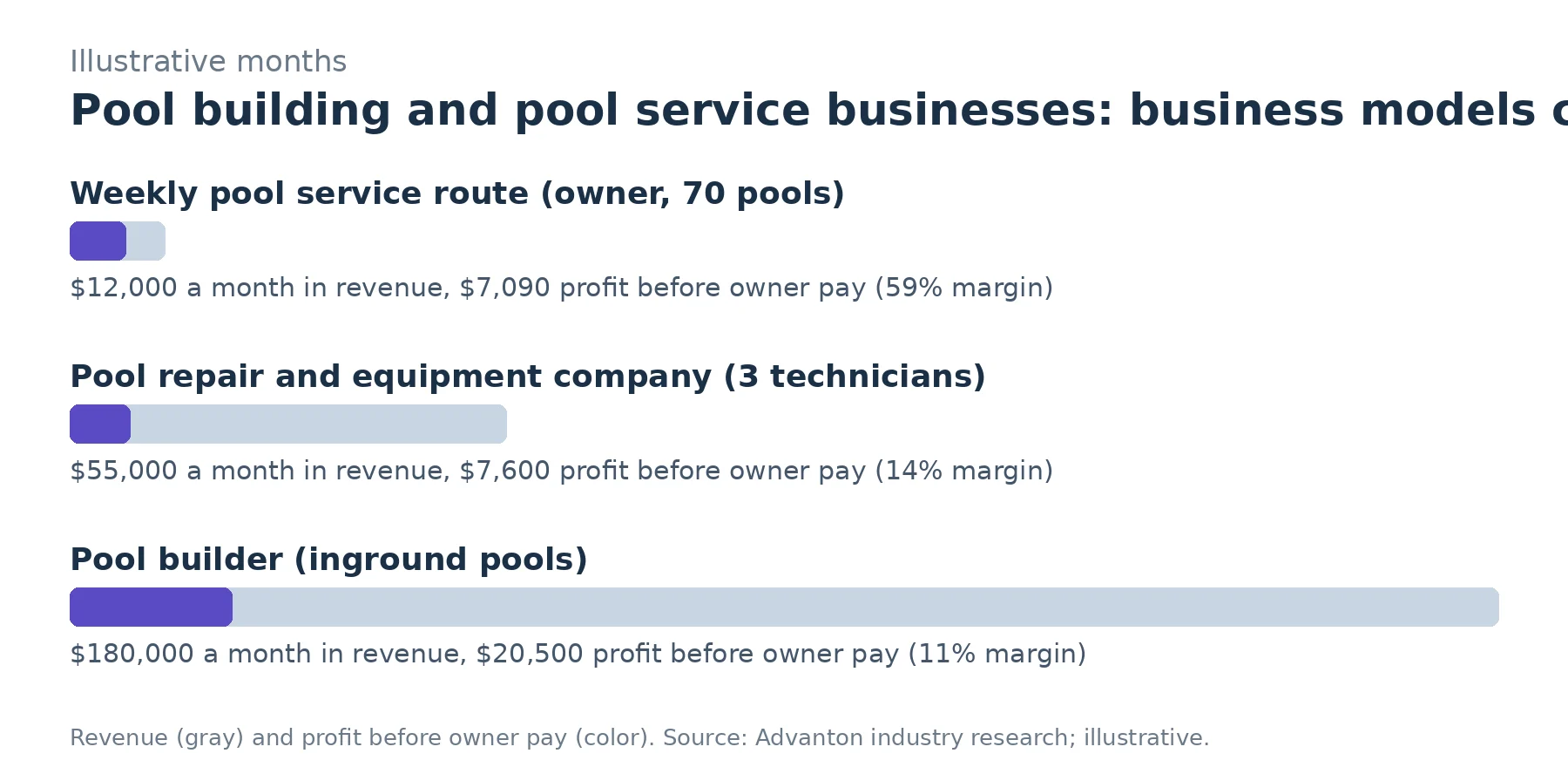
The figures below are illustrative months from our research, not industry averages. They show how revenue and costs typically fit together; your market, prices and costs will differ.
| Business model | Startup costs | Example monthly revenue | Costs | Profit before owner pay | Margin |
|---|---|---|---|---|---|
| Weekly pool service route (owner, 70 pools) | Low: truck, test kits, cleaning equipment, chemicals | $12,000 | $4,910 | $7,090 | 59% |
| Pool repair and equipment company (3 technicians) | Moderate: trucks, parts inventory, licenses | $55,000 | $47,400 | $7,600 | 14% |
| Pool builder (inground pools) | High: contractor license, excavation and finishing subs, design, sales | $180,000 | $159,500 | $20,500 | 11% |
Fixed and variable costs
For projections, the most useful split is between variable costs, which rise and fall with sales (materials, supplies, hourly labor, fees), and fixed costs, which you pay every month regardless (rent, salaried staff, insurance, loan payments).
| Business model | Variable costs (% of revenue) | Fixed costs per month | What it means |
|---|---|---|---|
| Weekly pool service route (owner, 70 pools) | 27.5% | $1,610 | Mostly fixed: needs steady volume to cover overhead |
| Pool repair and equipment company (3 technicians) | 40.0% | $25,400 | Balanced: margins improve as volume grows |
| Pool builder (inground pools) | 65.0% | $42,500 | Mostly variable: profitable early, but watch cash flow |
What the numbers say
Service routes have strong margins because chemicals and fuel are the main variable costs, and recurring monthly billing makes revenue predictable.
Repair and equipment work raises revenue per visit but passes much of it through to pumps, filters and heaters.
Pool building is large, seasonal and capital-intensive, with materials and subcontractors taking most of each project.
The three models in brief
Weekly service route. Cleaning, chemical balancing and equipment checks for residential pools, billed monthly.
Repair and equipment company. Pumps, filters, heaters, automation and leak detection, often alongside service routes.
Pool builder. Design, sales and construction of new pools, managing excavation, plumbing, electrical and finishing trades. See how to win commercial contracting jobs.
Cost structure: weekly pool service route (owner, 70 pools)
Each cost as a share of the example month’s revenue ($12,000):
| Cost | Monthly amount | Share of revenue | Type |
|---|---|---|---|
| Chemicals | $2,100 | 17.5% | Variable |
| Truck payment and insurance | $900 | 7.5% | Fixed |
| Fuel | $700 | 5.8% | Variable |
| Parts for minor repairs | $500 | 4.2% | Variable |
| Marketing | $300 | 2.5% | Fixed |
| Liability insurance | $200 | 1.7% | Fixed |
| Equipment and tools | $150 | 1.2% | Fixed |
| Route software | $60 | 0.5% | Fixed |
| Profit before owner pay | $7,090 | 59% |
A first-year projection: weekly pool service route (owner, 70 pools)
New businesses rarely start at full speed. This projection assumes revenue ramps from 35% of the example month in month 1 to 100% by month 12, variable costs move with revenue, and fixed costs stay the same every month. It’s a planning illustration, not a forecast.
| Month | Revenue | Variable costs | Fixed costs | Profit | Cumulative |
|---|---|---|---|---|---|
| 1 | $4,200 | $1,155 | $1,610 | $1,435 | $1,435 |
| 2 | $5,400 | $1,485 | $1,610 | $2,305 | $3,740 |
| 3 | $6,600 | $1,815 | $1,610 | $3,175 | $6,915 |
| 4 | $7,440 | $2,046 | $1,610 | $3,784 | $10,699 |
| 5 | $8,400 | $2,310 | $1,610 | $4,480 | $15,179 |
| 6 | $9,120 | $2,508 | $1,610 | $5,002 | $20,181 |
| 7 | $9,840 | $2,706 | $1,610 | $5,524 | $25,705 |
| 8 | $10,440 | $2,871 | $1,610 | $5,959 | $31,664 |
| 9 | $10,920 | $3,003 | $1,610 | $6,307 | $37,971 |
| 10 | $11,400 | $3,135 | $1,610 | $6,655 | $44,626 |
| 11 | $11,760 | $3,234 | $1,610 | $6,916 | $51,542 |
| 12 | $12,000 | $3,300 | $1,610 | $7,090 | $58,632 |
Year one: revenue $107,520, profit before owner pay $58,632. The first profitable month is month 1. Cumulative results stay positive from the start, before any startup costs.
Chemicals and fuel move with the route, and the truck and insurance are modest fixed costs, so this route illustration is profitable from month 1 even while it fills. The real early risk is winning enough customers to make each route day worthwhile, which is why many owners buy an existing route.
How pool businesses earn
- Monthly service plans for weekly visits.
- Openings and closings in seasonal climates.
- Equipment sales and installation: pumps, filters, heaters and automation.
- Repairs and leak detection.
- Renovations: resurfacing, tile and decking.
- New construction.
Route density decides profit
A route with 15 pools on nearby streets earns far more per hour than 15 pools spread across a county. Grow by adding neighbors, buy routes in your area when available, and plan stops to minimize driving.
Pricing a weekly route
Most pool services charge a flat monthly fee for weekly visits, with chemicals included or billed separately. Price by pool size, features (spas, waterfalls, salt systems), debris load and travel time. Raise prices on pools that consistently take longer, and quote repairs and green-pool cleanups separately. Clear service agreements explain what’s included, how chemicals are billed and how cancellations work.
Buying a pool route
Many owners grow by buying existing routes, usually priced as a multiple of monthly service revenue. Verify customer lists, payment histories and retention, ask about transition support from the seller, and expect some customers to leave after the change.
A startup checklist
- Learn water chemistry and get certified through a recognized pool operator or technician course.
- Check licensing for repairs, electrical and construction in your state.
- Insure the business with general liability and commercial auto coverage.
- Store chemicals safely and follow label directions.
- Choose route software for scheduling, billing and service notes.
Safety and chemicals
Chlorine and acids are hazardous if mixed or stored incorrectly. Train every technician, keep chemicals separated and ventilated, use protective equipment, and document readings and treatments at every visit. Safe drain covers and barriers protect swimmers and your business.
Seasonality and climate
In warm states, service continues year-round with lighter winter chemical use; in colder regions, spring openings and fall closings bring peaks, and winter is time for repairs, renovation sales and planning.
Where the opportunities are
- Variable-speed pump and automation upgrades.
- Saltwater systems and conversions.
- Leak detection and repair.
- HOA and apartment community pools.
- Renovations of aging pools.
Key terms
| Term | Meaning |
|---|---|
| Route | A set of recurring weekly service stops |
| Water balance | Keeping pH, alkalinity and sanitizer in safe ranges |
| VGB Act | Federal drain-safety law for public pools and spas |
| Opening and closing | Seasonal startup and winterizing services |
Key numbers to track
Watch pools per route day, revenue per stop, chemical cost per pool, customer retention, callbacks and repair revenue per service customer.
Common mistakes
- Scattered routes with long drives.
- Underpricing pools that need extra work.
- Unsafe chemical storage.
- Electrical repairs without the required license.
- No written service agreements.
Marketing a pool business
Neighborhood referrals, door hangers near existing routes, Google Business Profile, reviews and partnerships with real estate agents and pool supply stores bring new customers. See neighborhood marketing.
Test these numbers with your own plan
Open this industry in our free Business Idea Reality Check to start from any model above, change prices, costs, startup budget and your own pay, and see your break-even month, the cash you’d need, three scenarios and how new businesses in this sector survive in your state.
- Start with the closest model and its cost structure.
- Replace every price and cost with local quotes.
- Estimate your ramp: how fast customers will realistically come in year one.
- Map cash month by month with the free Cash & Payroll Planner.
- Build the full plan in the free Business Planner.
About this data
Workforce figures come from the U.S. Bureau of Labor Statistics (Occupational Outlook Handbook and Occupational Employment and Wage Statistics, May 2024 wages and the 2024 to 2034 projections, unless noted). Market figures cite their sources above. Business model figures are illustrative months built from typical prices and costs to show how revenue, fixed costs and variable costs fit together; they are not industry averages or guarantees. We review these profiles when new government data is released, at least once a year, and the same figures power the Business Idea Reality Check.
Licensing and rules
Many states and cities require pool contractor licenses for construction and some repairs; electrical work on pumps, heaters and lighting often requires a licensed electrician; commercial pools are regulated by health departments and must meet drain-safety requirements under the federal Virginia Graeme Baker Pool and Spa Safety Act; chemical storage and handling must follow product labels and safety rules; some states license or certify pool operators for public pools. Requirements change; confirm with your state and local agencies before you start.
Frequently asked questions
Is a pool service business profitable?
It can be, with dense routes, fair pricing and recurring monthly billing.
Do I need a license to clean pools?
Basic cleaning often doesn’t, but repairs, electrical work and construction often require licenses; check your state.
How many pools can one technician service?
It depends on route density and pool condition; dense routes allow more stops per day.
What is the Virginia Graeme Baker Act?
A federal law requiring safe drain covers and related protections for public pools and spas.
Should I buy a pool route?
It can speed growth; verify customer history and retention before buying.
How can I test these numbers?
Open pool building and service in the Business Idea Reality Check and enter your own prices and costs.
Keep learning
- Landscaping industry data
- Neighborhood marketing for contractors
- Maintenance agreements for contractors
- Business Idea Reality Check
Sources
Last reviewed November 1, 2026. Startup costs are estimates; check local prices, licensing and tax rules before you commit money.
In India
This business type isn’t common in India. Private pools are limited to luxury projects.
Looking for a business to start in India? Browse industries that fit well, such as interior design, coaching classes, cloud kitchens, salons and beauty parlours, AC service, and the India-only industries like tiffin services and mehendi artists.

