
Building a home for a client is one of the most complex projects a small business can take on: design, permits, financing, dozens of subcontractors, inspections and months of decisions with a family whose biggest investment is on the line. The core of a building company is skilled people; carpenters earned a median of $59,310 in May 2024, and construction managers earned about $114,980 in May 2025, according to BLS wage data as reported in a 2026 construction wage benchmark.
Small custom builders usually grow from remodeling or carpentry, build a few homes a year, and earn their profit through accurate estimating, tight schedules and a reputation that brings referrals. Margins are real but thin relative to project size, so cash flow and change orders decide outcomes.
The workforce
| Occupation | Jobs (2024) | Median pay (May 2024) | Projected growth, 2024 to 2034 |
|---|---|---|---|
| Construction managers (median wage, May 2025, as reported) | n/a | $114,980 | n/a |
| Carpenters | n/a | $59,310 | n/a |
Source: U.S. Bureau of Labor Statistics, Occupational Outlook Handbook and Occupational Employment and Wage Statistics.
Business models compared
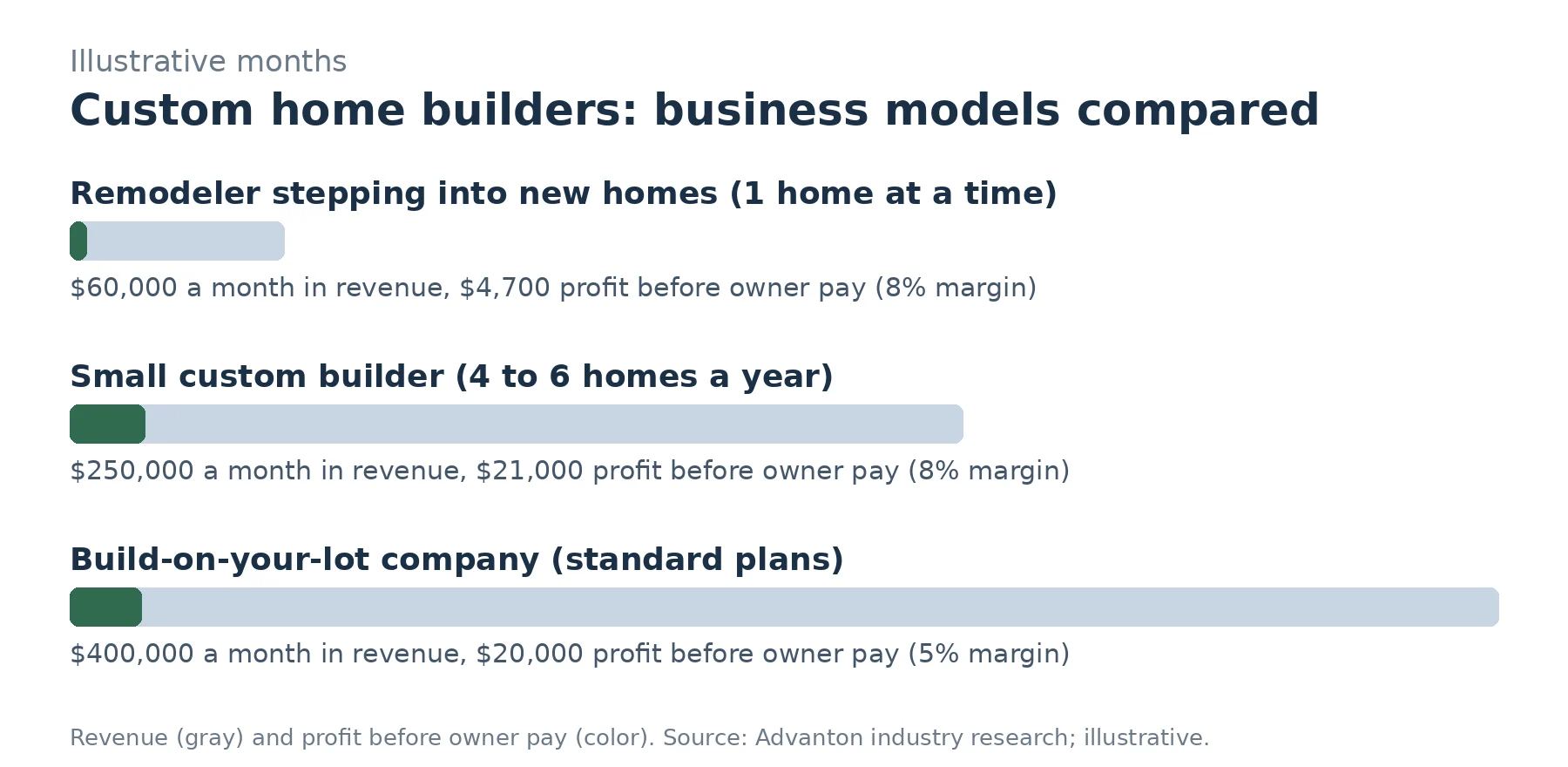
The figures below are illustrative months from our research, not industry averages. They show how revenue and costs typically fit together; your market, prices and costs will differ.
| Business model | Startup costs | Example monthly revenue | Costs | Profit before owner pay | Margin |
|---|---|---|---|---|---|
| Remodeler stepping into new homes (1 home at a time) | Moderate: license upgrade, insurance, working capital | $60,000 | $55,300 | $4,700 | 8% |
| Small custom builder (4 to 6 homes a year) | High: staff, working capital, lender relationships, bonding | $250,000 | $229,000 | $21,000 | 8% |
| Build-on-your-lot company (standard plans) | High: plan library, sales center, staff, financing | $400,000 | $380,000 | $20,000 | 5% |
Fixed and variable costs
For projections, the most useful split is between variable costs, which rise and fall with sales (materials, supplies, hourly labor, fees), and fixed costs, which you pay every month regardless (rent, salaried staff, insurance, loan payments).
| Business model | Variable costs (% of revenue) | Fixed costs per month | What it means |
|---|---|---|---|
| Remodeler stepping into new homes (1 home at a time) | 78.7% | $8,100 | Mostly variable: profitable early, but watch cash flow |
| Small custom builder (4 to 6 homes a year) | 78.0% | $34,000 | Mostly variable: profitable early, but watch cash flow |
| Build-on-your-lot company (standard plans) | 83.0% | $48,000 | Mostly variable: profitable early, but watch cash flow |
What the numbers say
Subcontractors and materials take most of every dollar, so a few percentage points of estimating error can erase profit.
Project management is the main fixed cost, and each superintendent can only run so many homes at once.
Monthly revenue is lumpy. Real builder income follows construction draws and closings, not steady monthly sales, so cash planning matters more than this smooth illustration suggests.
The three models in brief
Remodeler stepping into new homes. One home at a time, often for past remodeling clients. See remodeling data.
Small custom builder. Several homes a year with project managers, a trusted subcontractor team and lender relationships. See general contractors data.
Build-on-your-lot company. Standard plans with customization, built on clients’ land, with a sales and design center.
Cost structure: small custom builder (4 to 6 homes a year)
Each cost as a share of the example month’s revenue ($250,000):
| Cost | Monthly amount | Share of revenue | Type |
|---|---|---|---|
| Subcontractors | $120,000 | 48.0% | Variable |
| Materials | $70,000 | 28.0% | Variable |
| Project managers and superintendents | $16,000 | 6.4% | Fixed |
| Office, estimating and design coordination | $8,000 | 3.2% | Fixed |
| Permits, fees and surveys | $5,000 | 2.0% | Variable |
| Insurance and warranty reserve | $4,000 | 1.6% | Fixed |
| Marketing and model home | $4,000 | 1.6% | Fixed |
| Vehicles and equipment | $2,000 | 0.8% | Fixed |
| Profit before owner pay | $21,000 | 8% |
A first-year projection: small custom builder (4 to 6 homes a year)
New businesses rarely start at full speed. This projection assumes revenue ramps from 35% of the example month in month 1 to 100% by month 12, variable costs move with revenue, and fixed costs stay the same every month. It’s a planning illustration, not a forecast.
| Month | Revenue | Variable costs | Fixed costs | Profit | Cumulative |
|---|---|---|---|---|---|
| 1 | $87,500 | $68,250 | $34,000 | -$14,750 | -$14,750 |
| 2 | $112,500 | $87,750 | $34,000 | -$9,250 | -$24,000 |
| 3 | $137,500 | $107,250 | $34,000 | -$3,750 | -$27,750 |
| 4 | $155,000 | $120,900 | $34,000 | $100 | -$27,650 |
| 5 | $175,000 | $136,500 | $34,000 | $4,500 | -$23,150 |
| 6 | $190,000 | $148,200 | $34,000 | $7,800 | -$15,350 |
| 7 | $205,000 | $159,900 | $34,000 | $11,100 | -$4,250 |
| 8 | $217,500 | $169,650 | $34,000 | $13,850 | $9,600 |
| 9 | $227,500 | $177,450 | $34,000 | $16,050 | $25,650 |
| 10 | $237,500 | $185,250 | $34,000 | $18,250 | $43,900 |
| 11 | $245,000 | $191,100 | $34,000 | $19,900 | $63,800 |
| 12 | $250,000 | $195,000 | $34,000 | $21,000 | $84,800 |
Year one: revenue $2,240,000, profit before owner pay $84,800. The first profitable month is month 4. Cumulative results bottom out at -$27,750, which is the minimum cash cushion this plan would need, before any startup costs.
Project managers and office costs start before the first homes reach later construction draws, so this builder illustration turns profitable in month 4, with a cumulative low of about $27,800. Real cash needs also depend on draw timing and deposits.
How custom builders earn
- Fixed-price contracts with allowances for finishes.
- Cost-plus contracts with a fee or percentage.
- Change orders for client upgrades.
- Design and preconstruction fees.
- Spec homes built without a buyer, at higher risk.
Fixed price vs cost-plus
Fixed-price contracts reward accurate estimating but expose the builder to cost overruns; cost-plus contracts protect the builder but require transparent accounting and client trust. Many custom builders use cost-plus or fixed price with clear allowances and a strict change-order process.
Construction loans and draws
Most custom homes are financed with construction loans that release money in draws as stages are completed and inspected. Builders who submit clean draw requests, keep lien waivers current and coordinate inspections get paid faster. Plan working capital to cover the gap between paying subcontractors and receiving each draw.
A startup checklist
- Confirm licensing and bonding for residential construction in your area.
- Insure the business: general liability, builder’s risk and workers’ compensation.
- Build a reliable subcontractor team with written agreements.
- Create estimating templates with allowances and contingencies.
- Set up construction accounting by job and cost code.
Warranties and closeout
New homes carry implied or statutory warranties in many states, and many builders offer written warranties as well. Document finishes, provide manuals and maintenance guidance, schedule warranty walkthroughs, and set aside a warranty reserve on every home.
Where the opportunities are
- Infill and small-lot homes in established neighborhoods.
- Energy-efficient and all-electric homes.
- Accessory dwelling units where allowed.
- Aging-in-place designs.
- Rebuilds after disasters.
Key terms
| Term | Meaning |
|---|---|
| Draw | A loan disbursement released as construction stages are completed |
| Allowance | A budget for client-selected finishes |
| Cost-plus | A contract where the client pays costs plus a builder fee |
| Certificate of occupancy | Approval that a home is ready to be lived in |
Key numbers to track
Track estimate accuracy by job, gross margin per home, change-order revenue, days from permit to completion, draw timing, warranty costs and referral share of new clients.
Common mistakes
- Underestimating allowances and contingencies.
- Starting work without signed change orders.
- Taking on more homes than supervisors can manage.
- Thin working capital between draws.
- Weak documentation of decisions and approvals.
Marketing a custom builder
Past clients, architects, real estate agents, lenders and lot sellers send most business; a portfolio website with project stories, budgets and timelines builds trust. See project galleries that sell.
Spec homes: higher reward, higher risk
Building a home without a buyer (a spec home) can bring higher margins, but the builder carries the land, loan interest and market risk until it sells. Many small builders limit spec homes to one at a time, in neighborhoods they know well, with enough cash to carry the home if the market slows.
Managing client decisions
Custom clients make hundreds of choices. A selections schedule with deadlines, a design center or vendor visits, and written approvals prevent delays and disputes.
Test these numbers with your own plan
Open this industry in our free Business Idea Reality Check to start from any model above, change prices, costs, startup budget and your own pay, and see your break-even month, the cash you’d need, three scenarios and how new businesses in this sector survive in your state.
- Start with the closest model and its cost structure.
- Replace every price and cost with local quotes.
- Estimate your ramp: how fast customers will realistically come in year one.
- Map cash month by month with the free Cash & Payroll Planner.
- Build the full plan in the free Business Planner.
About this data
Workforce figures come from the U.S. Bureau of Labor Statistics (Occupational Outlook Handbook and Occupational Employment and Wage Statistics, May 2024 wages and the 2024 to 2034 projections, unless noted). Market figures cite their sources above. Business model figures are illustrative months built from typical prices and costs to show how revenue, fixed costs and variable costs fit together; they are not industry averages or guarantees. We review these profiles when new government data is released, at least once a year, and the same figures power the Business Idea Reality Check.
Licensing and rules
Most states or localities license residential builders or general contractors, often with exams, insurance and bonding requirements; building permits, inspections and certificates of occupancy are required; many states set implied or statutory warranties for new homes; lead, energy codes, stormwater and zoning rules apply; builders must carry general liability and builder’s risk insurance and follow OSHA safety rules for their employees. Requirements change; confirm with your state and local agencies before you start.
Frequently asked questions
How much do custom home builders make?
Profit varies widely; margins depend on estimating accuracy, change orders and project management.
Do I need a license to build homes?
Most states or localities require a residential builder or general contractor license.
How do construction draws work?
Lenders release loan funds in stages as work is completed and inspected.
Is fixed price or cost-plus better?
Each has trade-offs; fixed price rewards accurate estimates, while cost-plus shares cost risk with the client.
How many homes can a small builder handle?
It depends on supervisors and subcontractors; growing too fast is a common cause of problems.
How can I test these numbers?
Open custom home builders in the Business Idea Reality Check and enter your own numbers.
Keep learning
- General contractors industry data
- Remodeling industry data
- Home improvement spending outlook
- Business Idea Reality Check
Sources
- Construction managers median wage, BLS OEWS May 2025 (as reported in a 2026 construction wage benchmark)
- U.S. Bureau of Labor Statistics, Carpenters
Last reviewed November 1, 2026. Startup costs are estimates; check local prices, licensing and tax rules before you commit money.

