
Weddings, corporate meetings, holiday parties and celebrations all need food, and many hosts want it handled by professionals. Catering lets a business sell food without a dining room, often with deposits paid in advance. The Bureau of Labor Statistics counted about 352,800 food service managers in 2024, with a median wage of $65,310 in May 2024, 6% projected growth and 30% self-employed; cooks earned a median of $35,760.
Catering businesses range from small caterers using rented commercial kitchens to full-service companies with event staff and rentals, and corporate drop-off caterers serving offices every weekday.
The workforce
| Occupation | Jobs (2024) | Median pay (May 2024) | Projected growth, 2024 to 2034 |
|---|---|---|---|
| Food service managers | 352,800 | $65,310 | +6% |
| Cooks | n/a | $35,760 | n/a |
Source: U.S. Bureau of Labor Statistics, Occupational Outlook Handbook and Occupational Employment and Wage Statistics.
Market data
| Measure | Value |
|---|---|
| Share of food service managers who are self-employed (2024) | 30% |
Business models compared
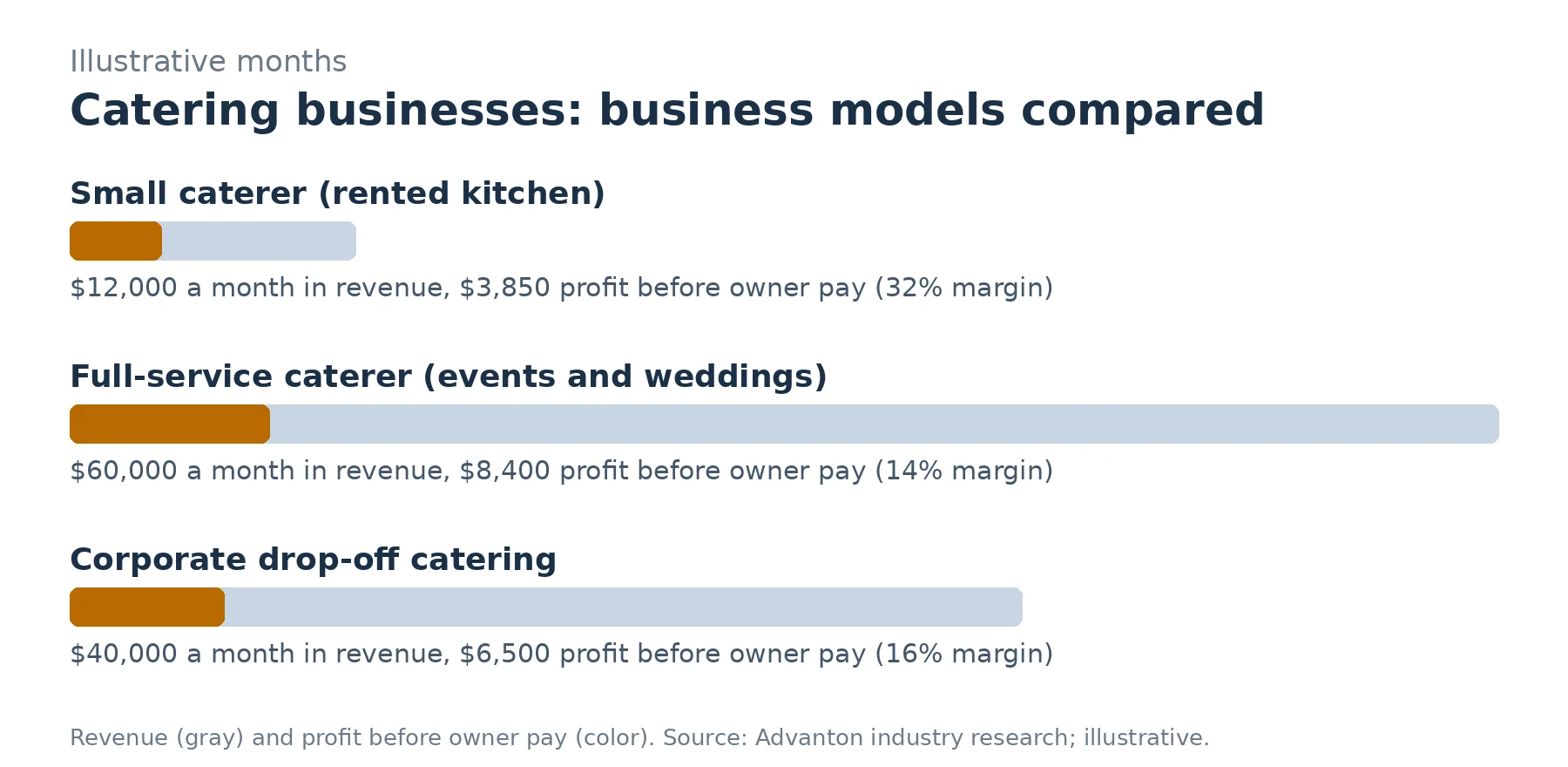
The figures below are illustrative months from our research, not industry averages. They show how revenue and costs typically fit together; your market, prices and costs will differ.
| Business model | Startup costs | Example monthly revenue | Costs | Profit before owner pay | Margin |
|---|---|---|---|---|---|
| Small caterer (rented kitchen) | Low to moderate: kitchen rental, equipment, transport containers | $12,000 | $8,150 | $3,850 | 32% |
| Full-service caterer (events and weddings) | Moderate to high: kitchen lease, equipment, van, staff | $60,000 | $51,600 | $8,400 | 14% |
| Corporate drop-off catering | Moderate: kitchen, delivery vehicles, ordering system | $40,000 | $33,500 | $6,500 | 16% |
Fixed and variable costs
For projections, the most useful split is between variable costs, which rise and fall with sales (materials, supplies, hourly labor, fees), and fixed costs, which you pay every month regardless (rent, salaried staff, insurance, loan payments).
| Business model | Variable costs (% of revenue) | Fixed costs per month | What it means |
|---|---|---|---|
| Small caterer (rented kitchen) | 52.5% | $1,850 | Mostly variable: profitable early, but watch cash flow |
| Full-service caterer (events and weddings) | 54.2% | $19,100 | Mostly variable: profitable early, but watch cash flow |
| Corporate drop-off catering | 65.5% | $7,300 | Mostly variable: profitable early, but watch cash flow |
What the numbers say
Food and event labor are the largest costs, so per-person pricing and staffing plans decide margins.
Deposits help cash flow: clients usually pay part in advance, reducing risk.
Corporate drop-off catering brings weekday volume with lower labor per order but more delivery logistics.
The three models in brief
Small caterer. Smaller events using a rented commercial kitchen.
Full-service caterer. Weddings and large events with staff, rentals and coordination. See events and weddings data.
Corporate drop-off catering. Packaged meals and trays for offices on weekdays. See restaurant data.
Cost structure: full-service caterer (events and weddings)
Each cost as a share of the example month’s revenue ($60,000):
| Cost | Monthly amount | Share of revenue | Type |
|---|---|---|---|
| Food | $18,000 | 30.0% | Variable |
| Event staff | $10,000 | 16.7% | Variable |
| Chef and manager salaries | $9,000 | 15.0% | Fixed |
| Kitchen lease | $4,000 | 6.7% | Fixed |
| Rentals and disposables | $3,000 | 5.0% | Variable |
| Payroll taxes | $2,200 | 3.7% | Fixed |
| Sales and marketing | $2,000 | 3.3% | Fixed |
| Card fees | $1,500 | 2.5% | Variable |
| Vehicles | $1,200 | 2.0% | Fixed |
| Insurance and permits | $700 | 1.2% | Fixed |
| Profit before owner pay | $8,400 | 14% |
A first-year projection: full-service caterer (events and weddings)
New businesses rarely start at full speed. This projection assumes revenue ramps from 35% of the example month in month 1 to 100% by month 12, variable costs move with revenue, and fixed costs stay the same every month. It’s a planning illustration, not a forecast.
| Month | Revenue | Variable costs | Fixed costs | Profit | Cumulative |
|---|---|---|---|---|---|
| 1 | $21,000 | $11,382 | $19,100 | -$9,482 | -$9,482 |
| 2 | $27,000 | $14,634 | $19,100 | -$6,734 | -$16,216 |
| 3 | $33,000 | $17,886 | $19,100 | -$3,986 | -$20,202 |
| 4 | $37,200 | $20,162 | $19,100 | -$2,062 | -$22,264 |
| 5 | $42,000 | $22,764 | $19,100 | $136 | -$22,128 |
| 6 | $45,600 | $24,715 | $19,100 | $1,785 | -$20,343 |
| 7 | $49,200 | $26,666 | $19,100 | $3,434 | -$16,909 |
| 8 | $52,200 | $28,292 | $19,100 | $4,808 | -$12,101 |
| 9 | $54,600 | $29,593 | $19,100 | $5,907 | -$6,194 |
| 10 | $57,000 | $30,894 | $19,100 | $7,006 | $812 |
| 11 | $58,800 | $31,870 | $19,100 | $7,830 | $8,642 |
| 12 | $60,000 | $32,520 | $19,100 | $8,380 | $17,022 |
Year one: revenue $537,600, profit before owner pay $17,022. The first profitable month is month 5. Cumulative results bottom out at -$22,264, which is the minimum cash cushion this plan would need, before any startup costs.
The kitchen lease, chef and manager salaries start before the event calendar fills, so this caterer illustration turns profitable in month 5, with a cumulative low of about $22,300.
How caterers price
- Per person for menus and service.
- Package tiers for buffets, family style and plated service.
- Service fees for staff and coordination.
- Rentals and bar service priced separately.
- Deposits and payment schedules to secure dates.
Costing a menu
Calculate ingredient cost per serving, add packaging, labor hours and overhead, then price to your target margin. Recost menus when ingredient prices change, especially for proteins.
Kitchens and permits
Most caterers need a licensed commercial kitchen. Many start in shared or commissary kitchens, then lease their own as volume grows. Some states allow limited home-based food businesses under cottage food laws, but these usually exclude catered meals.
A startup checklist
- Secure a licensed kitchen and health permits.
- Get a certified food protection manager.
- Insure the business, including liquor liability if you serve alcohol.
- Create contracts with deposits, guest counts and cancellation terms.
- Build menus with costed recipes.
Food safety at events
Transporting and holding food safely is the hardest part of catering. Use insulated carriers, thermometers and time-and-temperature logs, and train staff on handwashing and allergen handling.
Where the opportunities are
- Corporate catering for meetings and offices.
- Weddings and celebrations.
- Specialty diets: vegan, gluten-free and allergen-friendly menus.
- Cultural cuisines for community events.
- Meal prep and family meals.
Key terms
| Term | Meaning |
|---|---|
| Per-person price | Price per guest for food and service |
| Final count | Confirmed guest number due before an event |
| BEO | Banquet event order describing the event plan |
| Cottage food law | State rules allowing limited home food production |
Staffing events
Event staff are often hired per event. Plan staff-to-guest ratios by service style, train servers on your standards, and confirm staffing well before each event.
Key numbers to track
Track food cost percentage, labor cost per event, average event revenue, booking rate on proposals, repeat corporate clients and deposits on the calendar.
Common mistakes
- Underpricing labor and rentals.
- Operating without a licensed kitchen.
- Vague contracts without final counts and cancellation terms.
- Weak food safety during transport.
- Relying only on weddings.
Marketing a catering business
Photos of events and plated dishes, Google Business Profile, reviews, wedding platforms, venue partnerships and corporate outreach bring bookings. See events and weddings data.
Seasonality
Wedding season, graduations and the holidays bring peaks; corporate catering can steady weekdays year-round. Plan staffing and deposits around your busiest months.
Venue relationships
Many venues keep preferred caterer lists. Earn a place by being professional, cleaning up thoroughly and making the venue look good. Venue referrals can fill a calendar.
Tastings and proposals
Tastings help couples and event planners choose menus and build confidence. Many caterers charge for tastings and credit the fee toward a booking. Clear written proposals with menus, service style, staffing, rentals and payment schedule speed decisions.
Alcohol service
Serving alcohol brings liability and licensing rules. Many caterers partner with licensed bartending services or obtain the required licenses and liquor liability insurance, and train staff to serve responsibly.
Test these numbers with your own plan
Open this industry in our free Business Idea Reality Check to start from any model above, change prices, costs, startup budget and your own pay, and see your break-even month, the cash you’d need, three scenarios and how new businesses in this sector survive in your state.
- Start with the closest model and its cost structure.
- Replace every price and cost with local quotes.
- Estimate your ramp: how fast customers will realistically come in year one.
- Map cash month by month with the free Cash & Payroll Planner.
- Build the full plan in the free Business Planner.
About this data
Workforce figures come from the U.S. Bureau of Labor Statistics (Occupational Outlook Handbook and Occupational Employment and Wage Statistics, May 2024 wages and the 2024 to 2034 projections, unless noted). Market figures cite their sources above. Business model figures are illustrative months built from typical prices and costs to show how revenue, fixed costs and variable costs fit together; they are not industry averages or guarantees. We review these profiles when new government data is released, at least once a year, and the same figures power the Business Idea Reality Check.
Licensing and rules
Local health departments permit food businesses and inspect them; many states require at least one certified food protection manager; sales tax permits; business licenses; fire safety rules for cooking equipment and propane; food labeling rules for packaged items. Caterers generally must prepare food in a licensed commercial kitchen, not a home kitchen, unless state cottage food laws allow specific low-risk foods; serving alcohol requires liquor licensing or a licensed bartending partner, depending on state law; events may require temporary food permits and vendor insurance certificates. Requirements change; confirm with your state and local agencies before you start.
Frequently asked questions
Can I start a catering business from home?
Usually not for catered meals; most states require a licensed commercial kitchen, though cottage food laws allow some low-risk foods.
How do caterers price events?
Typically per person, plus staff, rentals and service fees.
Do caterers need a liquor license?
Serving alcohol usually requires licensing or a licensed bartending partner, depending on state law.
Is catering profitable?
It can be, with costed menus, deposits, efficient staffing and a mix of event and corporate clients.
What permits does a caterer need?
Health permits, business licenses, sales tax permits and sometimes temporary event permits.
What do food service managers earn?
BLS reported a median of $65,310 in May 2024.
How can I test these numbers?
Open catering in the Business Idea Reality Check and enter your own prices and costs.
Keep learning
- Food trucks industry data
- Events and weddings industry data
- Restaurants and food service data
- Business Idea Reality Check
Sources
Last reviewed November 1, 2026. Startup costs are estimates; check local prices, licensing and tax rules before you commit money.

