
For a home service business, reviews are the modern version of a neighbor’s recommendation, and they’re read by almost everyone. A homeowner choosing a plumber, roofer or cleaning service usually compares star ratings, scans recent reviews and reads how the business responded to complaints before ever picking up the phone.
This page collects the review statistics that matter most to home service businesses in 2026, explains the federal rules and platform policies that apply, and turns the numbers into a practical system you can run every week.
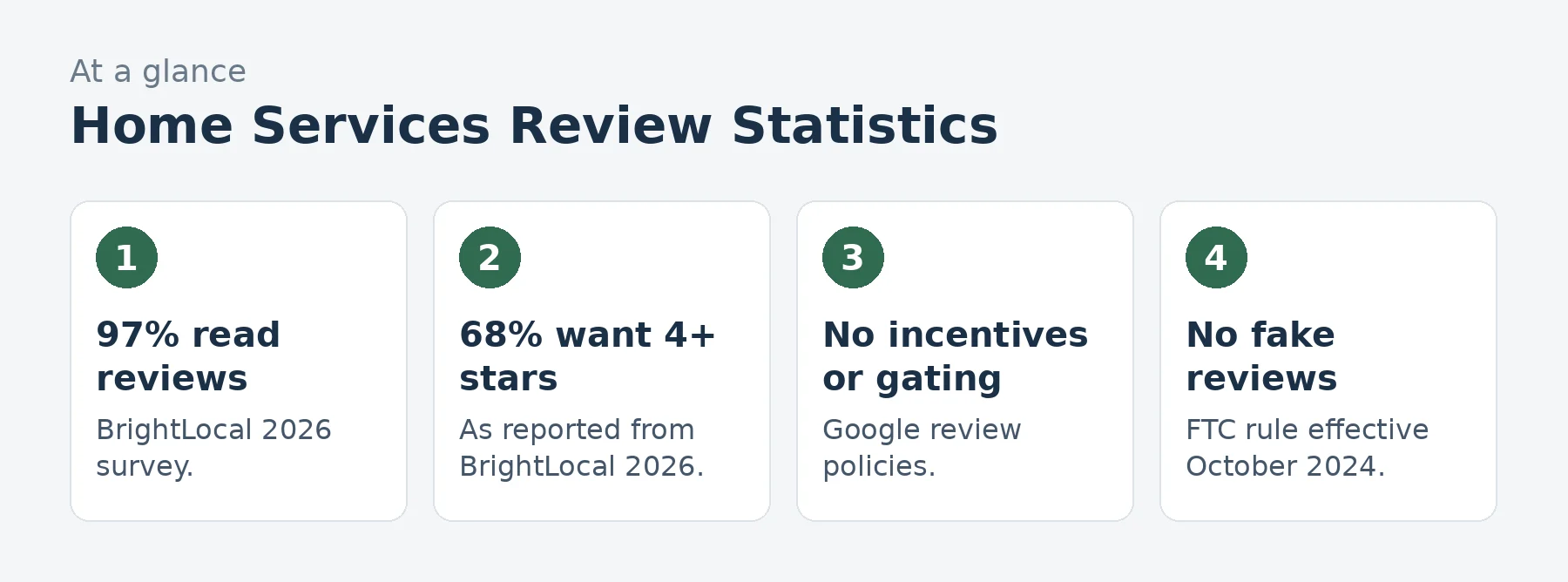
The headline statistics
Table of Contents
| Statistic | Figure | Source |
|---|---|---|
| Consumers who read reviews for local businesses | 97% | BrightLocal 2026 |
| Consumers who always read reviews | 41%, up from 29% | BrightLocal 2026 (as reported) |
| Consumers who require at least 4 stars | 68% | BrightLocal 2026 (as reported) |
| Consumers who only use businesses rated 4.5 stars or higher | 31% | BrightLocal 2026 (as reported) |
| Consumers who trust reviews as much as personal recommendations | 49%, up from 42% | BrightLocal 2026 (as reported) |
| Consumers who used Google to read local reviews | 71%, down from 83% | BrightLocal 2026 (as reported) |
| Average number of review sites consumers use | 6 | BrightLocal 2026 |
These figures cover consumers choosing local businesses generally, but they apply directly to how homeowners choose contractors and home service providers.
What the statistics mean
Almost everyone checks
With 97% of consumers reading reviews, a home service business without recent reviews is invisible to most buyers, or worse, looks inactive.
The bar is rising
More consumers read reviews every time, and many won’t consider businesses below four stars. A rating that seemed fine a few years ago may now cost you calls.
Recency matters
BrightLocal reports that consumers expect more recent reviews than before and value consistent sentiment across many reviews. A steady monthly flow beats a burst of reviews once a year.
Google leads, but isn’t alone
Google remains the most used review platform, but consumers check several sites, including Facebook, Yelp, Nextdoor, Angi and Apple Maps. Your reputation lives wherever customers look.
The rules: what you can and can’t do
| Rule | What it means for you |
|---|---|
| FTC rule on consumer reviews (effective October 2024) | Bans fake reviews, buying reviews, reviews from insiders without disclosure, and suppressing negative reviews through threats or intimidation; violations can bring civil penalties |
| Consumer Review Fairness Act | Contracts can’t prohibit or penalize customers for honest reviews |
| Google review policies | Prohibits offering incentives for reviews and selectively asking only happy customers ("review gating"); fake or conflict-of-interest reviews can be removed |
| Platform rules | Yelp discourages asking for reviews at all; other platforms have their own policies |
Ask every customer the same way, never pay or reward reviews on platforms that prohibit it, never write reviews for yourself or competitors, and never pressure customers to change reviews.
Review platforms that matter for home services
| Platform | Why it matters |
|---|---|
| The most used review platform and a local ranking factor | |
| Recommendations from people customers know | |
| Nextdoor | Neighbors asking neighbors for contractors |
| Yelp | Strong in some cities and trades; discourages solicitation |
| Angi, Thumbtack and Houzz | Reviews tied to lead platforms and design projects |
| Better Business Bureau | Complaint history some homeowners check |
| Apple Maps | Ratings shown to iPhone users |
Focus on Google first, then the one or two platforms customers in your trade and area use most. See where contractors should get reviews.
A review system that works
- Do great work and communicate well. Reviews reflect the whole experience, from first call to cleanup.
- Ask every customer, the same day. Text a direct link while the job is fresh.
- Make it easy: one link, one tap, no searching.
- Remind once, a few days later, politely.
- Thank every reviewer with a personal reply.
- Respond to negative reviews calmly, without sharing private details, and fix what you can. See how to respond to negative reviews.
- Track monthly: new reviews, average rating and response time.
Our free review request kit creates your direct link, QR code and message templates.
Photos and detail make reviews more useful
Reviews with photos of finished work and specific details (the service, the town, the technician’s name, how a problem was solved) help future customers more than a one-line "great job." You can’t write reviews for customers, but you can make it easy for them to add photos and mention what you did, and you can share your own project photos on your profile. See photos and videos that win jobs.
Training your team to ask
Most reviews come from a simple, friendly request at the end of a good job. Train technicians to mention reviews naturally ("If you were happy today, a quick Google review really helps a small business like ours"), have the office send the link the same day, and recognize team members whose customers leave reviews. Make asking part of every job’s checklist so it happens even in busy weeks.
Reviews and AI assistants
BrightLocal’s 2026 survey, as reported, found 45% of consumers now use AI assistants for local recommendations, up from 6% the year before. These tools draw on reviews and business information across the web, so a steady flow of genuine, detailed reviews on several platforms helps your business get described and recommended accurately.
Review velocity: how many is enough?
There’s no magic number, but compare yourself with the top businesses in your area on Google Maps: their review count, rating and how recent their reviews are. Set a monthly goal that closes the gap over a realistic period. Our free Local SEO Check includes a competitor gap calculator. See how many reviews a contractor needs.
The rating math
| Current reviews | Current average | New 5-star reviews needed to reach 4.6 | To reach 4.8 |
|---|---|---|---|
| 20 | 4.3 | 15 | 50 |
| 50 | 4.4 | 25 | 100 |
| 100 | 4.5 | 25 | 150 |
Each extra tenth of a star takes more reviews as your count grows, which is why consistency matters more than any single campaign. The formula: new 5-star reviews needed = current reviews × (target − current average) ÷ (5 − target), rounded up.
Responding to reviews
Responses show future customers how you treat people. Thank positive reviewers by name and mention the service. For negative reviews, acknowledge the concern, explain briefly what you did or will do, and invite the customer to contact you directly. Never argue, reveal private information or offer incentives to remove a review.
Reviews and local search
Google says review count and score factor into local ranking, alongside relevance, distance and prominence. Reviews that mention specific services and towns also help customers judge fit. Encourage detail without scripting what customers should say.
What to do about fake or unfair reviews
If a review violates platform policy (it’s fake, from a competitor, or not about a real customer experience), flag it through the platform’s reporting process and keep records. Reply professionally in the meantime. Never retaliate against customers for honest reviews; federal law protects them.
Turning reviews into marketing
Reviews work beyond review sites. Share standout reviews (with the customer’s permission) on your website, service pages, proposals and social media, and display your rating and review count near contact buttons. Group reviews by service and town on relevant pages so homeowners see proof from customers like them. Keep shared reviews accurate and unedited, and update them as new ones arrive.
Measuring your reputation
Track a few numbers monthly: new reviews by platform, average rating, share of jobs that produced a review, time to respond, and how your rating compares with the top three competitors in your area. If the share of jobs producing reviews falls, look at how and when your team is asking.
Common mistakes
- Asking only happy customers (review gating), which Google prohibits.
- Offering discounts or gifts for reviews where platforms prohibit it.
- Buying reviews or posting fake ones, which the FTC rule bans.
- Letting reviews go stale for months.
- Arguing with negative reviewers in public.
Frequently asked questions
How many consumers read online reviews?
BrightLocal’s 2026 survey found 97% of consumers read reviews for local businesses.
What star rating do homeowners expect?
As reported from BrightLocal’s 2026 survey, 68% require at least 4 stars, and 31% only use businesses rated 4.5 or higher.
Can I offer a discount for a Google review?
No. Google’s policies prohibit offering incentives for reviews.
Is it illegal to buy reviews?
The FTC’s rule on consumer reviews, effective October 2024, bans buying or selling fake reviews and can bring civil penalties.
Can my contract stop customers from leaving bad reviews?
No. The Consumer Review Fairness Act prohibits contract terms that restrict honest reviews.
How often should I ask for reviews?
After every completed job, the same day, with one polite reminder a few days later.
Should I reply to every review?
Yes. Thank positive reviewers and respond professionally to negative ones; replies show future customers how you treat people.
Do reviews on sites other than Google matter?
Yes. Consumers use about six review sites on average, so keep your profiles accurate and active where customers look.
How Advanton helps
Advanton is a free resource for small businesses. Create review links and templates with the free review request kit, compare yourself with competitors in the Local SEO Check, and add your business to the Advanton directory for free. Advanton earns money when you buy a domain or hosting through our store, which helps keep everything else free.
Keep learning
- Local search and review statistics for home services
- Review request templates for contractors
- Where contractors should get reviews
Sources
- BrightLocal, Local Consumer Review Survey 2026
- Federal Trade Commission, Trade Regulation Rule on the Use of Consumer Reviews and Testimonials
- Federal Trade Commission, Consumer Review Fairness Act: What Businesses Need to Know
- Google Maps User Contributed Content Policy
Last reviewed November 1, 2026. Startup costs are estimates; check local prices, licensing and tax rules before you commit money.


Leave a Reply