
Independent shops give neighborhoods character: boutiques, gift shops, bookstores, home goods and specialty stores. Retail employs millions, with about 555,800 retail salesperson openings projected each year and a median wage of about $34,580, according to BLS data summarized by secondary sources.
Independent retailers compete with large chains and online giants by curating unique products, offering personal service and combining storefronts with online sales and local events.
The workforce
| Occupation | Jobs (2024) | Median pay (May 2024) | Projected growth, 2024 to 2034 |
|---|---|---|---|
| Retail salespersons (BLS projections via secondary source) | n/a | $34,580 | n/a |
Source: U.S. Bureau of Labor Statistics, Occupational Outlook Handbook.
Market data
| Measure | Value |
|---|---|
| Retail salesperson openings per year, 2024-2034 | about 555,800 |
Business models compared
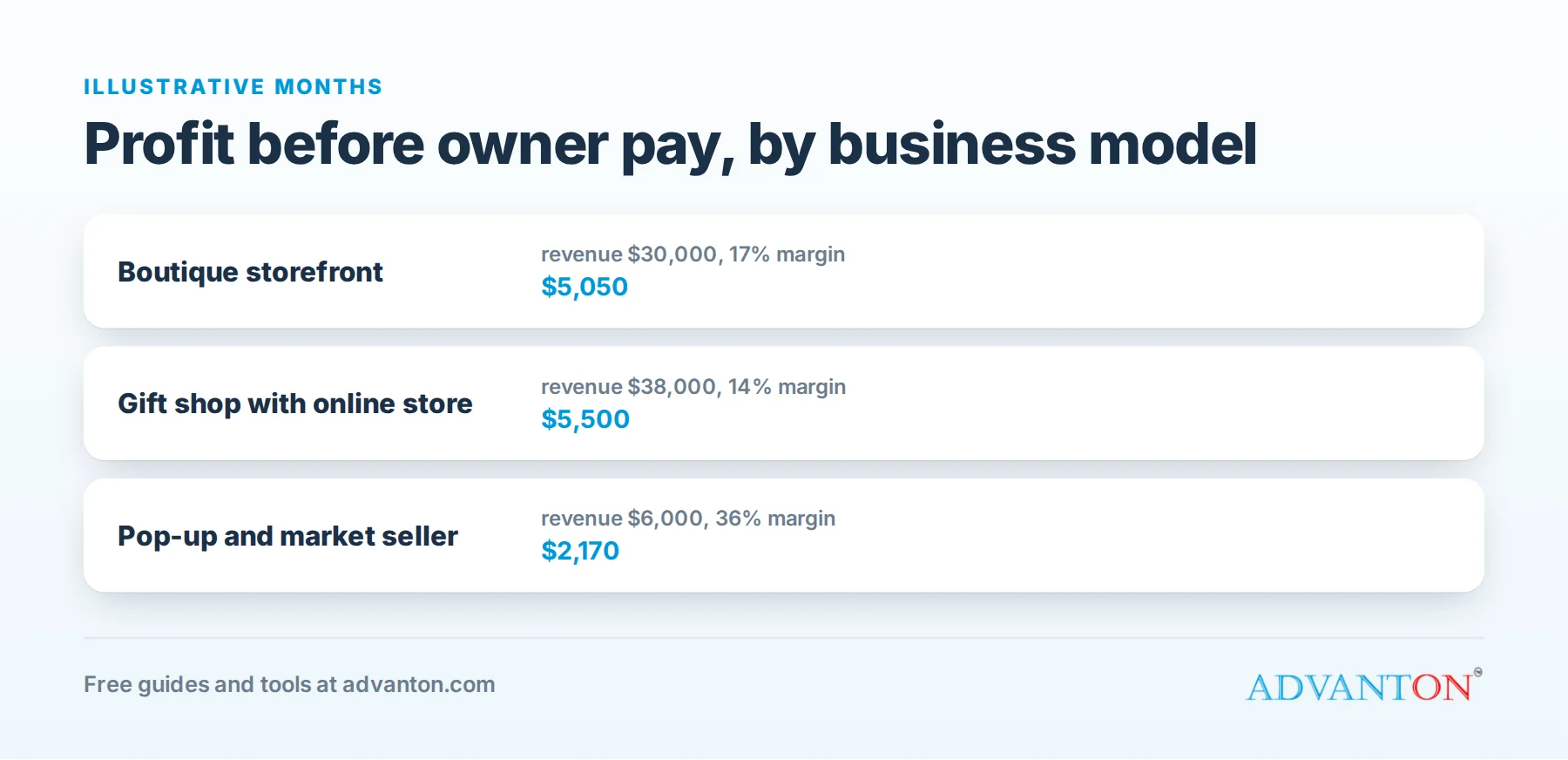
The figures below are illustrative months from our step-by-step guides, not industry averages. They show how revenue and costs typically fit together; your market, prices and costs will differ.
| Business model | Startup costs | Example monthly revenue | Costs | Profit before owner pay | Margin |
|---|---|---|---|---|---|
| Boutique storefront (owner plus 2 part-time) | Moderate: lease, fixtures, inventory, POS | $30,000 | $24,950 | $5,050 | 17% |
| Gift shop with online store | Moderate: storefront plus ecommerce platform, photography | $38,000 | $32,500 | $5,500 | 14% |
| Pop-up and market seller | Low: inventory, tent, display, card reader | $6,000 | $3,830 | $2,170 | 36% |
Fixed and variable costs
For projections, the most useful split is between variable costs, which rise and fall with sales (materials, parts, hourly labor), and fixed costs, which you pay every month regardless (rent, salaried staff, insurance, loan payments).
| Business model | Variable costs (% of revenue) | Fixed costs per month | What it means |
|---|---|---|---|
| Boutique storefront (owner plus 2 part-time) | 53.0% | $9,050 | Mostly variable: profitable early, but watch cash flow |
| Gift shop with online store | 56.8% | $10,900 | Mostly variable: profitable early, but watch cash flow |
| Pop-up and market seller | 48.0% | $950 | Mostly variable: profitable early, but watch cash flow |
What the numbers say
Inventory is the biggest cost. Margins depend on buying well and avoiding unsold stock.
Storefronts carry rent and staff. Steady foot traffic and events fill the store.
Online sales extend reach but add shipping and platform costs.
The three models in brief
Boutique storefront. Curated products and personal service.
Gift shop with online store. Local customers plus online orders. See business ideas.
Pop-up and market selling. Low-cost testing at markets and events.
Cost structure: gift shop with online store
Each cost as a share of the example month’s revenue ($38,000):
| Cost | Monthly amount | Share of revenue | Type |
|---|---|---|---|
| Inventory (cost of goods) | $19,000 | 50.0% | Variable |
| Staff | $5,000 | 13.2% | Fixed |
| Rent | $3,500 | 9.2% | Fixed |
| Marketing | $1,800 | 4.7% | Fixed |
| Shipping and packaging | $1,500 | 3.9% | Variable |
| Card processing | $1,100 | 2.9% | Variable |
| Ecommerce platform and apps | $300 | 0.8% | Fixed |
| Insurance | $300 | 0.8% | Fixed |
| Profit before owner pay | $5,500 | 14% |
A first-year projection: gift shop with online store
New businesses rarely start at full speed. This projection assumes revenue ramps from 35% of the example month in month 1 to 100% by month 12, variable costs move with revenue, and fixed costs stay the same every month. It’s a planning illustration, not a forecast.
| Month | Revenue | Variable costs | Fixed costs | Profit | Cumulative |
|---|---|---|---|---|---|
| 1 | $13,300 | $7,560 | $10,900 | -$5,160 | -$5,160 |
| 2 | $17,100 | $9,720 | $10,900 | -$3,520 | -$8,680 |
| 3 | $20,900 | $11,880 | $10,900 | -$1,880 | -$10,560 |
| 4 | $23,560 | $13,392 | $10,900 | -$732 | -$11,292 |
| 5 | $26,600 | $15,120 | $10,900 | $580 | -$10,712 |
| 6 | $28,880 | $16,416 | $10,900 | $1,564 | -$9,148 |
| 7 | $31,160 | $17,712 | $10,900 | $2,548 | -$6,600 |
| 8 | $33,060 | $18,792 | $10,900 | $3,368 | -$3,232 |
| 9 | $34,580 | $19,656 | $10,900 | $4,024 | $792 |
| 10 | $36,100 | $20,520 | $10,900 | $4,680 | $5,472 |
| 11 | $37,240 | $21,168 | $10,900 | $5,172 | $10,644 |
| 12 | $38,000 | $21,600 | $10,900 | $5,500 | $16,144 |
Year one: revenue $340,480, profit before owner pay $16,144. The first profitable month is month 5. Cumulative results bottom out at -$11,292, which is the minimum cash cushion this plan would need, before any startup costs.
Rent, staff and inventory come before sales build, so this gift shop illustration turns profitable in month 5, with a cumulative low of about $11,300. Holiday season results can shift the year.
How independent retailers earn
- Product margins between wholesale and retail prices.
- Online sales through their own store or marketplaces.
- Events and workshops.
- Gift cards and loyalty programs.
A startup checklist
- Get a business license and sales tax permit.
- Obtain resale certificates for wholesale purchases.
- Choose a POS system that tracks inventory.
- Plan opening inventory and reorder points.
- Set return policies clearly.
Where the opportunities are
- Local makers and artisans.
- Experiential retail with classes and events.
- Buy-online, pick-up-in-store.
- Community loyalty programs.
Key terms
| Term | Meaning |
|---|---|
| Markup | Price increase over wholesale cost |
| Sell-through | Share of inventory sold in a period |
| Open-to-buy | Budget for new inventory |
| Shrink | Inventory lost to theft or damage |
Know your customers
Independent shops win by knowing customers personally, curating for them and creating experiences chains can’t.
Marketing an independent shop
Local search, social media, events, collaborations with other shops and loyalty programs bring repeat customers. Our free rewards program helps.
Watch inventory weekly
Track sell-through, reorder winners and mark down slow items before they tie up cash.
How to use these numbers for your own plan
- Start with the closest model above and its cost structure.
- Replace every price and cost with local quotes: insurance, wages, vehicles, materials and your expected prices.
- Estimate your ramp: how many jobs you can realistically win each month in year one.
- Separate fixed and variable costs, then calculate your break-even point with our free break-even calculator.
- Map cash month by month with our cash flow forecast, including equipment and loan payments.
- Build the plan in our free Business Planner.
These figures will also feed a planned Advanton projection tool, so you’ll be able to start from an industry template and adjust it to your situation.
About this data
Workforce figures come from the U.S. Bureau of Labor Statistics (Occupational Outlook Handbook and Occupational Employment and Wage Statistics, May 2024 and the 2024 to 2034 projections). Market figures cite their sources in the list above. Business model figures are illustrative months built from typical prices and costs to show how revenue, fixed costs and variable costs fit together; they are not industry averages or guarantees. We review these profiles when new government data is released, at least once a year. The same figures are available in a structured format for Advanton’s upcoming business projection tool.
Licensing and rules
Business license and sales tax permit; resale certificates for wholesale purchases; local zoning and signage rules; market and event permits for pop-ups; consumer protection rules for returns and pricing. Requirements change; confirm with your state and local agencies before you start.
Frequently asked questions
Is opening a retail store profitable?
It can be with good buying, inventory control and loyal customers.
Do retailers need a sales tax permit?
Yes, in states with sales tax; resale certificates let you buy wholesale without paying sales tax.
How can independent shops compete online?
By adding online sales, local pickup and unique products.
How can I use these numbers?
Start with the closest retail model, then replace every figure with your local prices, wages and expected volume.
Keep learning
- Boutique storefront
- Local SEO for contractors
- How to get more contractor leads
- Specialty trades industry data
Sources
Last reviewed October 30, 2026. Startup costs are estimates; check local prices, licensing and tax rules before you commit money.

