
Homeowners and businesses want cameras, alarms, smart locks and access control, and many prefer professional installation. Security and fire alarm system installer jobs are projected to grow 10% from 2024 to 2034, adding about 8,900 jobs, and the median wage was about $60,960 in BLS wage data for May 2025, according to industry sources summarizing BLS figures.
Security businesses combine installation revenue with recurring monitoring and service agreements, which can create steady income over time. Licensing, background checks and honest selling are central to the trade.
The workforce
| Occupation | Jobs (2024) | Median pay (May 2024) | Projected growth, 2024 to 2034 |
|---|---|---|---|
| Security and fire alarm systems installers | n/a | $60,960 | +10% |
Source: U.S. Bureau of Labor Statistics, Occupational Outlook Handbook.
Market data
| Measure | Value |
|---|---|
| Installer jobs added, 2024-2034 | 8,900 |
Business models compared
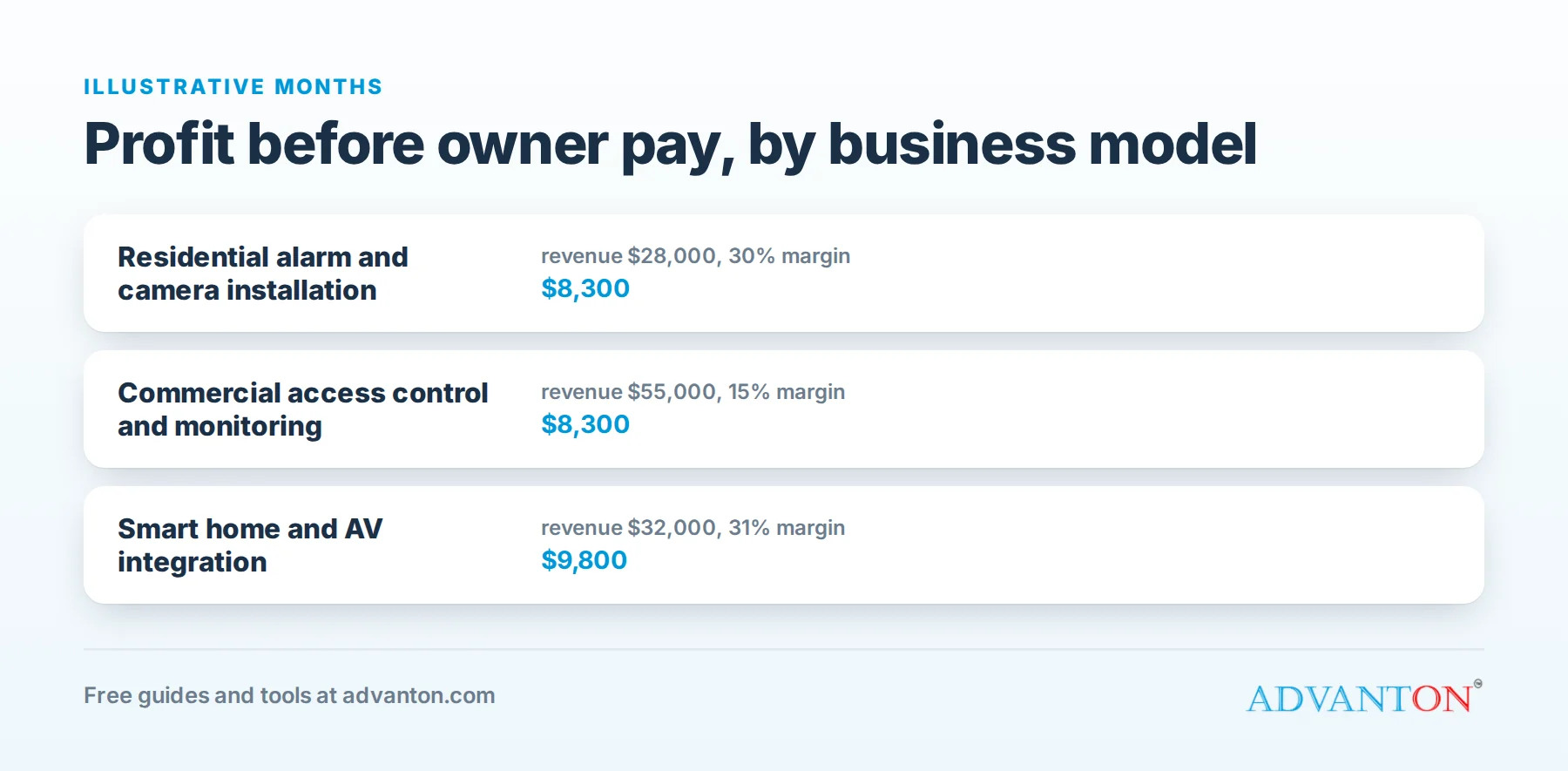
The figures below are illustrative months from our step-by-step guides, not industry averages. They show how revenue and costs typically fit together; your market, prices and costs will differ.
| Business model | Startup costs | Example monthly revenue | Costs | Profit before owner pay | Margin |
|---|---|---|---|---|---|
| Residential alarm and camera installation | Moderate: licensing, tools, inventory, monitoring partner | $28,000 | $19,700 | $8,300 | 30% |
| Commercial access control and monitoring | Moderate to high: certifications, technicians, monitoring contracts | $55,000 | $46,700 | $8,300 | 15% |
| Smart home and AV integration | Moderate: tools, showroom samples, product training | $32,000 | $22,200 | $9,800 | 31% |
Fixed and variable costs
For projections, the most useful split is between variable costs, which rise and fall with sales (materials, parts, hourly labor), and fixed costs, which you pay every month regardless (rent, salaried staff, insurance, loan payments).
| Business model | Variable costs (% of revenue) | Fixed costs per month | What it means |
|---|---|---|---|
| Residential alarm and camera installation | 35.0% | $9,900 | Mostly fixed: slow start-up months are expensive |
| Commercial access control and monitoring | 44.5% | $22,200 | Mostly fixed: slow start-up months are expensive |
| Smart home and AV integration | 43.8% | $8,200 | Mostly variable: profitable early, but watch cash flow |
What the numbers say
Equipment takes a large share. Margins depend on purchasing, installation efficiency and recurring revenue.
Commercial work has heavy fixed costs. Technicians, sales and office staff must be covered before volume builds.
Recurring revenue is the prize. Monitoring and service agreements smooth cash flow and raise business value.
The three models in brief
Residential alarms and cameras. Installation plus monitoring through a partner or your own center.
Commercial access control. Card readers, cameras, monitoring and service contracts for businesses.
Smart home integration. Locks, cameras, lighting, networking and audio-visual systems.
Cost structure: commercial access control and monitoring
Each cost as a share of the example month’s revenue ($55,000):
| Cost | Monthly amount | Share of revenue | Type |
|---|---|---|---|
| Equipment and hardware | $22,000 | 40.0% | Variable |
| Technicians | $11,000 | 20.0% | Fixed |
| Office and sales | $4,000 | 7.3% | Fixed |
| Monitoring center fees | $2,500 | 4.5% | Variable |
| Payroll taxes and benefits | $2,200 | 4.0% | Fixed |
| Vans | $2,000 | 3.6% | Fixed |
| Insurance | $1,500 | 2.7% | Fixed |
| Marketing | $1,500 | 2.7% | Fixed |
| Profit before owner pay | $8,300 | 15% |
A first-year projection: commercial access control and monitoring
New businesses rarely start at full speed. This projection assumes revenue ramps from 35% of the example month in month 1 to 100% by month 12, variable costs move with revenue, and fixed costs stay the same every month. It’s a planning illustration, not a forecast.
| Month | Revenue | Variable costs | Fixed costs | Profit | Cumulative |
|---|---|---|---|---|---|
| 1 | $19,250 | $8,575 | $22,200 | -$11,525 | -$11,525 |
| 2 | $24,750 | $11,025 | $22,200 | -$8,475 | -$20,000 |
| 3 | $30,250 | $13,475 | $22,200 | -$5,425 | -$25,425 |
| 4 | $34,100 | $15,190 | $22,200 | -$3,290 | -$28,715 |
| 5 | $38,500 | $17,150 | $22,200 | -$850 | -$29,565 |
| 6 | $41,800 | $18,620 | $22,200 | $980 | -$28,585 |
| 7 | $45,100 | $20,090 | $22,200 | $2,810 | -$25,775 |
| 8 | $47,850 | $21,315 | $22,200 | $4,335 | -$21,440 |
| 9 | $50,050 | $22,295 | $22,200 | $5,555 | -$15,885 |
| 10 | $52,250 | $23,275 | $22,200 | $6,775 | -$9,110 |
| 11 | $53,900 | $24,010 | $22,200 | $7,690 | -$1,420 |
| 12 | $55,000 | $24,500 | $22,200 | $8,300 | $6,880 |
Year one: revenue $492,800, profit before owner pay $6,880. The first profitable month is month 6. Cumulative results bottom out at -$29,565, which is the minimum cash cushion this plan would need, before any startup costs.
A commercial security company carries technicians, sales and office costs before contracts build, so this illustration turns profitable in month 6, with a cumulative low of about $29,600.
How security businesses earn
- Installation priced by equipment and labor.
- Monitoring as a monthly fee, often through a partner central station.
- Service agreements for maintenance and priority repairs.
- Upgrades as technology changes.
A startup checklist
- Check state licensing for alarm and low-voltage work, and background check requirements.
- Choose a monitoring partner if you won’t run your own center.
- Get product training and certifications.
- Arrange insurance suitable for security work.
- Write clear contracts, including monitoring terms and cancellation policies.
Where the opportunities are
- Small business camera and access systems.
- Smart home installation for busy homeowners.
- Property manager and HOA systems.
- Upgrades from old wired systems.
Key terms
| Term | Meaning |
|---|---|
| Central station | The monitoring center that responds to alarms |
| Access control | Electronic systems controlling who enters |
| Recurring monthly revenue | Ongoing monitoring and service fees |
| Low voltage | Wiring for security, data and AV systems |
Sell honestly
Security sales have drawn complaints about pressure tactics and long contracts. Clear pricing, honest recommendations and fair contract terms build referrals and protect your license.
Marketing a security business
Reviews, local search, partnerships with electricians, builders, property managers and insurance agents, and clear service pages bring steady leads. See how to get more electrical leads.
Keep systems working
Regular checks, prompt repairs and customer education reduce false alarms and keep monitoring customers loyal.
How to use these numbers for your own plan
- Start with the closest model above and its cost structure.
- Replace every price and cost with local quotes: insurance, wages, vehicles, materials and your expected prices.
- Estimate your ramp: how many jobs you can realistically win each month in year one.
- Separate fixed and variable costs, then calculate your break-even point with our free break-even calculator.
- Map cash month by month with our cash flow forecast, including equipment and loan payments.
- Build the plan in our free Business Planner.
These figures will also feed a planned Advanton projection tool, so you’ll be able to start from an industry template and adjust it to your situation.
About this data
Workforce figures come from the U.S. Bureau of Labor Statistics (Occupational Outlook Handbook and Occupational Employment and Wage Statistics, May 2024 and the 2024 to 2034 projections). Market figures cite their sources in the list above. Business model figures are illustrative months built from typical prices and costs to show how revenue, fixed costs and variable costs fit together; they are not industry averages or guarantees. We review these profiles when new government data is released, at least once a year. The same figures are available in a structured format for Advanton’s upcoming business projection tool.
Licensing and rules
Many states license alarm and low-voltage contractors and require background checks for installers; some cities require alarm permits for monitored systems; fire alarm work often requires additional certification; electrical work beyond low voltage needs licensed electricians. Requirements change; confirm with your state and local agencies before you start.
Frequently asked questions
Is security installation growing?
Installer jobs are projected to grow 10% from 2024 to 2034.
Do security installers need a license?
Many states license alarm and low-voltage contractors and require background checks.
Where does recurring revenue come from?
Monitoring and service agreements.
How can I use these numbers?
Start with the closest security installation model, then replace every figure with your local prices, wages and expected volume.
Keep learning
- Residential alarm and camera installation
- Local SEO for contractors
- How to get more contractor leads
- Specialty trades industry data
Sources
- FinanceBuzz summary of BLS Employment Projections 2024-2034 (security and fire alarm system installers)
- World Cup Career Index (PR Newswire), citing BLS OEWS May 2025
Last reviewed October 30, 2026. Startup costs are estimates; check local prices, licensing and tax rules before you commit money.

