
What if you could put your flyer in every mailbox in the neighborhoods around your business, without buying a mailing list, renting addresses or getting a permit? That’s exactly what Every Door Direct Mail (EDDM) does. You choose mail carrier routes on a map, print your flyers or postcards, and your letter carrier delivers one to every address on those routes along with the day’s mail.
For local businesses (restaurants, contractors, salons, dentists, real estate agents, cleaners and gyms), EDDM is one of the most affordable ways to reach every nearby household. This guide covers what it costs in 2026, the size rules, how to choose routes, how to design a piece that works, a worked budget, and how to measure results.
EDDM at a glance
Table of Contents
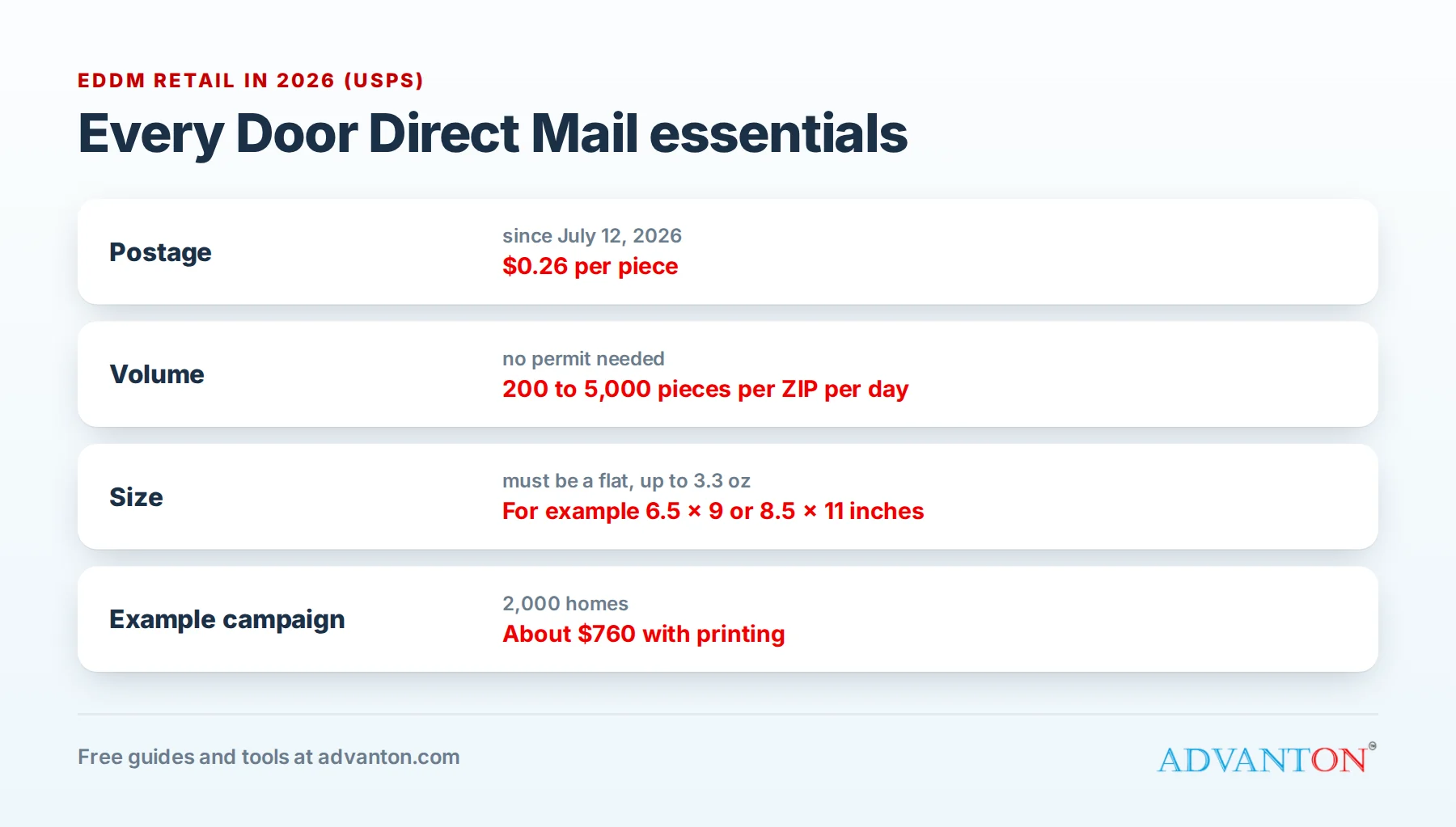
| Topic | EDDM Retail (for most small businesses) |
|---|---|
| Postage | $0.26 per piece since July 12, 2026 (up from $0.247) |
| Permit needed? | No |
| Mailing list needed? | No; every address on the routes you choose receives a piece |
| How many | At least 200 and up to 5,000 pieces per ZIP Code per day |
| Weight | Up to 3.3 ounces per piece |
| Size | Must be a "flat": a large postcard or flyer (see below) |
| Drop-off | At the Post Office that serves the routes you chose |
| Who receives it | Residential routes (business routes need EDDM BMEU) |
EDDM BMEU is the high-volume version: you’ll need a mailing permit and annual fee, but there’s no daily cap, and you can include business routes. Most small businesses start with EDDM Retail.
Size rules: your piece must be a "flat"
EDDM requires pieces larger than standard letters. A piece qualifies as a flat if it’s taller than 6⅛ inches, longer than 11½ inches, or thicker than ¼ inch, while staying within 15 by 12 inches and ¾ inch thick.
Popular EDDM sizes include:
| Size | Good for |
|---|---|
| 6.5 × 9 inches | Postcards with one clear offer |
| 6.5 × 12 inches | Menus, before-and-after photos, service lists |
| 8.5 × 11 inches | Letter-size flyers with more detail |
A money-saving detail: EDDM Retail postage is the same for any qualifying size up to 3.3 ounces, so a bigger piece costs more to print but nothing extra to mail. A standard 4 × 6 postcard is too small; it counts as a letter.
You can design a letter-size flyer for free with our flyer maker, then have it printed by a local or online printer. Ask the printer to add the EDDM postage block (called the indicia) and the "Local Postal Customer" line.
How EDDM works, step by step
- Choose your routes. Use the USPS EDDM online tool to search by ZIP Code, city or address. You’ll see each carrier route on a map, with the number of addresses, and you can filter by household demographics such as age and income ranges.
- Design your piece. Include your offer, contact details, and the required EDDM Retail indicia and address line ("Local Postal Customer" or "Postal Customer").
- Print exactly the right number for your routes, plus a few spares.
- Pay postage online through the EDDM tool, or at the Post Office.
- Bundle your mail: group pieces into bundles of 50 to 100, as USPS instructs, with a facing slip on each bundle showing the route.
- Drop it off at the Post Office that serves those routes, with your receipt or a completed PS Form 3587. You can also ship your bundles to that Post Office.
- Your carriers deliver to every address on the routes, usually within a few days.
What you’ll see in the USPS EDDM tool
When you search an area in the online EDDM tool, you’ll see each carrier route drawn on the map, with:
- The number of residential addresses on the route (and business addresses for EDDM BMEU).
- Household demographic filters, such as age ranges, household income ranges and household size.
- A running total of the pieces and postage for the routes you select.
Select the routes you want, and the tool calculates postage and prepares your paperwork and bundle facing slips.
Choosing the right routes
- Start close: routes within a short drive of your business usually respond best for restaurants, salons and service businesses.
- Match your customers: use the demographic filters. A lawn care company might choose routes with mostly single-family homes; a family restaurant might choose routes with more households with children.
- Avoid wasting pieces: skip routes dominated by apartments if your service is for homeowners.
- Test, then expand: mail a few routes first, measure results, and grow into the routes that work.
Designing a piece that gets results
- One clear offer: "Free estimate this month", "Kids eat free on Tuesdays", "$20 off your first cleaning".
- A strong headline readable from arm’s length.
- A great photo: your food, your finished work, your team.
- Proof: a star rating, a short review or "Serving Plano since 2012".
- An easy next step: a phone number, website and QR code. Use a unique code or phone number so you can track responses.
- A deadline to encourage action.
EDDM ideas by industry
| Business | What to mail |
|---|---|
| Restaurants and cafés | A menu postcard with a first-visit offer and a QR code for online ordering |
| Contractors and home services | Before-and-after photos, a seasonal service reminder, and a free estimate offer |
| Salons and spas | A new-client offer and photos of your work |
| Dentists and clinics | New-patient offers, insurance accepted, and opening hours |
| Gyms and studios | A free trial week with a class schedule |
| Real estate agents | Recent sales in the neighborhood and a free home valuation offer |
| Cleaning and lawn care | Seasonal packages and a recurring-service discount |
When to mail, and how often
- Time it to your season: HVAC before summer and winter, landscaping in early spring, tax preparers in January, restaurants before holidays and local events.
- Allow delivery time: EDDM usually arrives within a few days of drop-off, so mail about a week before your offer starts.
- Mail more than once: many businesses mail the same routes every four to six weeks during their busy season, because familiarity builds trust.
- Avoid crowded weeks when mailboxes are full of holiday catalogs, unless your offer is holiday-related.
A worked example: a neighborhood campaign budget
These are illustrative numbers. Print prices vary widely by printer, size and quantity.
| Amount | |
|---|---|
| Routes chosen | 4 routes, 2,000 homes |
| Postage | 2,000 × $0.26 = $520 |
| Printing (example: about $0.12 per 6.5 × 9 postcard at this quantity) | about $240 |
| Total campaign cost | about $760 |
| Responses at a 1% response rate | 20 inquiries |
| Cost per inquiry | about $38 |
If one new customer is worth a few hundred dollars over a year, as with a cleaning service, dentist or lawn care business, a campaign like this can pay for itself several times over. Response rates vary widely, so measure your own.
Make every piece work harder
- Add a QR code linking to a landing page with the same offer, so phone-first customers can act immediately.
- Repeat your Google Business Profile name, so people who search for you later find the right business.
- Include a map or landmark if customers need to find your location.
- Print on sturdy stock, so your piece stands out from thinner mail and survives the mailbox.
Measure your results
- Use a unique offer code or a dedicated phone number on each mailing.
- Ask every new customer how they heard about you.
- Track cost per customer, not just responses.
- Mail more than once: repeated mailings to the same routes often perform better than a single drop, as people remember your name.
EDDM vs targeted mail and digital ads
| Option | Best for | Trade-off |
|---|---|---|
| EDDM | Reaching every home near you | Not targeted to individual households |
| Targeted direct mail (list-based) | Reaching specific people, such as new homeowners | Requires buying a list and usually a permit; higher postage |
| Door hangers | Neighborhoods right around a job site | You deliver them yourself; make them with our door hanger maker |
| Social media and search ads | Precise targeting and fast testing | Easy to scroll past; costs can rise quickly |
Common mistakes
- Choosing a 4 × 6 postcard, which doesn’t qualify.
- Forgetting the indicia or using the wrong address line.
- Dropping off at the wrong Post Office. It must be the one serving your routes.
- Too much text and no clear offer.
- Mailing once and giving up.
Frequently asked questions
How much does EDDM cost?
EDDM Retail postage is $0.26 per piece since July 12, 2026, plus printing. There’s no permit or mailing list cost.
What’s the minimum for EDDM?
At least 200 pieces per mailing, and up to 5,000 pieces per ZIP Code per day with EDDM Retail.
Can I choose which houses receive my mail?
No. EDDM goes to every address on the routes you choose. For specific households, use list-based targeted mail.
Can I send EDDM to businesses?
EDDM Retail covers residential routes. To include business routes, use EDDM BMEU, which requires a permit.
Do I need to address each piece?
No. EDDM Retail pieces use a simplified address line, "Local Postal Customer" or "Postal Customer", instead of individual names and addresses, which is why no mailing list is needed.
How long does EDDM take to arrive?
Usually within a few days of drop-off. Plan your offer dates to allow for delivery, and drop off early in the week if timing matters.
Keep learning
- USPS for small business: every service explained
- Free flyer maker
- Creative, low-budget advertising ideas
Sources
- USPS, Every Door Direct Mail
- USPS, EDDM Retail fact sheet
- 4OVER4, EDDM pricing explained (July 2026 rate)
- 4OVER4, Popular EDDM sizes and USPS mailing guidelines
Last reviewed October 27, 2026. Startup costs are estimates; check local prices, licensing and tax rules before you commit money.


Leave a Reply