
Your business name is one of your most valuable assets. Once customers know it, it carries your reputation, and that’s exactly why a competitor using a similar name can do real damage. Registering your name as a federal trademark with the US Patent and Trademark Office (USPTO) gives you nationwide rights to use it for your goods or services, and practical legal tools to stop others from using confusingly similar names.
Forming an LLC or registering a DBA does not do this. This guide explains when a trademark is worth it, how to search properly, the current USPTO fees with a worked 10-year cost example, why applications get refused, the timeline, keeping your registration alive and avoiding scams.
This is general information, not legal advice. For valuable brands, crowded markets or a refusal, a trademark attorney is worth the cost.
What a trademark protects, and what it doesn’t
Table of Contents
A trademark protects a brand identifier (a name, logo, slogan or other mark) for specific goods or services. That second part matters: "Delta" is a registered trademark for an airline and, separately, for faucets, because customers aren’t confused between the two.
| Protection | What it covers |
|---|---|
| Federal registration (USPTO) | Nationwide rights for your listed goods or services, the right to use ®, a public record that deters copycats, and the ability to record it with US Customs to block counterfeit imports |
| State registration | Rights within one state; cheaper and faster, but much weaker |
| Common-law rights | Automatic rights from actually using a name, but only in the geographic area where you use it, and harder to prove |
| LLC or DBA filing | No trademark rights at all |
Do you need a federal trademark?
It’s usually worth it if you:
- Sell across state lines or online, or plan to.
- Are investing in your brand: signs, vehicle wraps, packaging, a website and advertising.
- Plan to franchise, license or sell the business someday; a registered trademark adds real value.
- Work in a crowded market where similar names are common.
A small local business that never plans to expand may rely on common-law rights at first. But registering early is cheaper than rebranding later because someone else registered a similar name.
Choose a strong name
Trademark law ranks names on a spectrum from weak to strong:
| Type | Example | Registrable? |
|---|---|---|
| Generic | "Pizza Shop" for a pizza shop | Never |
| Descriptive | "Fast Plumbing" for plumbing | Usually not at first; may qualify later on the Supplemental Register or after years of use |
| Suggestive | "Coppertone" for sunscreen | Yes |
| Arbitrary | "Apple" for computers | Yes, and strong |
| Fanciful (invented) | "Kodak" | Yes, and strongest |
Many owners like descriptive names because customers instantly understand them, but they’re the hardest to protect. A suggestive or invented name is usually the better long-term brand.
Step 1: Search before you invest
A conflicting earlier mark is the most common reason applications fail. Search:
- The USPTO trademark database for identical and similar names (different spellings, sound-alikes and translations) used for related goods or services.
- The web, app stores and social media, since unregistered businesses may have common-law rights.
- State business records and domain names.
Look for likelihood of confusion: similar names used for related goods or services, sold to similar customers. "Sunrise Cleaning" and "Sun Rise Cleaners" for home cleaning would likely conflict; "Sunrise Cleaning" and "Sunrise Bakery" probably wouldn’t.
Step 2: Prepare your application
You’ll need:
- The mark. A standard character filing protects the words in any font, color or style, and is usually the best first filing for a name. A special form filing protects a specific logo design.
- Your goods or services, sorted into the USPTO’s international classes. A plumbing company would typically file in Class 37 (construction and repair services); a bakery selling packaged goods might file in Class 30.
- Your filing basis: use in commerce (you’re already using the name across state lines) or intent to use (you plan to).
- A specimen, if you’re already using it: for services, a website page or advertisement showing the name with your services; for goods, the name on the product, labels or packaging.
- The owner: the person or company that will own the mark, usually your LLC or corporation.
Step 3: File with the USPTO and pay the fees
Applications are filed online through the USPTO’s Trademark Center. Since January 18, 2025, the fees are:
| Fee | Amount |
|---|---|
| Base application | $350 per class |
| Writing your own description of goods or services instead of using the USPTO’s ID Manual | +$200 per class |
| Missing required information | +$100 per class |
| Each extra 1,000 characters of description beyond the first 1,000 | +$200 per class |
| Statement of use (for intent-to-use filings, once you start using the mark) | $150 per class |
| Extension of time to file a statement of use | $125 per class |
Choose descriptions from the USPTO’s ID Manual and fill in every required field to avoid surcharges.
Who can file: US-based owners can file on their own. Owners based outside the US must use a US-licensed attorney.
A worked example: the first 10 years
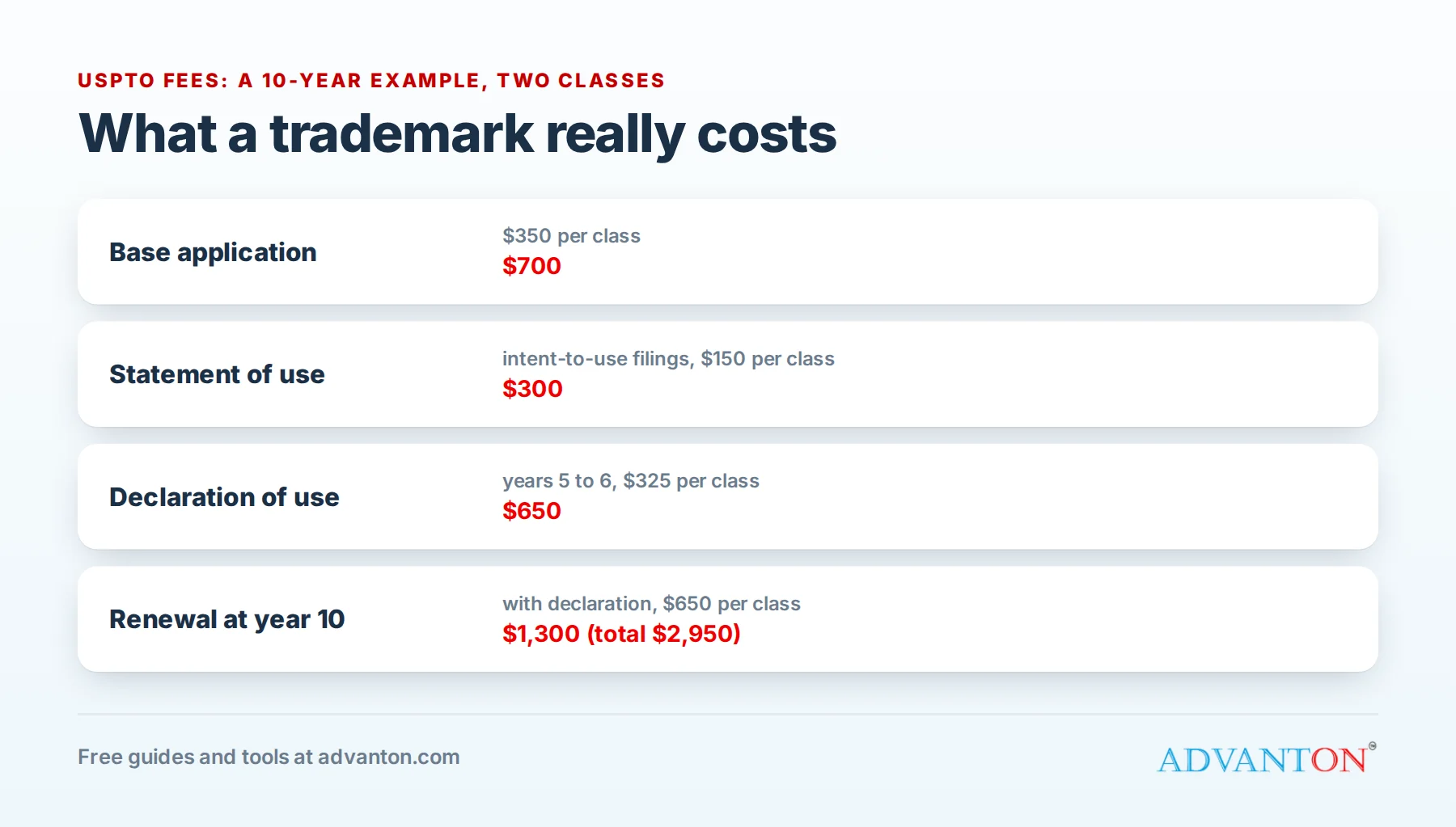
A company files for its name in two classes on an intent-to-use basis, using ID Manual descriptions:
| Step | USPTO fees |
|---|---|
| Base application (2 classes) | $700 |
| Statement of use once it starts using the name (2 classes) | $300 |
| Declaration of use between years 5 and 6 (2 classes) | $650 |
| Renewal at year 10, including a declaration of use (2 classes) | $1,300 |
| Total USPTO fees over 10 years | $2,950 |
Writing its own descriptions instead of using the ID Manual would add $400 at filing. Attorney fees, if you use one, are extra.
Step 4: Examination, publication and registration
- Examination: a USPTO examining attorney reviews your application, usually several months after filing.
- Office action: if there are problems, you’ll receive a letter explaining them, with a deadline to respond. Missing the deadline abandons the application.
- Publication: if approved, your mark is published in the USPTO’s Official Gazette, and anyone who believes they’d be harmed has 30 days to oppose it.
- Registration: for use-based applications, the mark then registers. For intent-to-use applications, you receive a notice of allowance and must file a statement of use once you’re using the mark.
The whole process often takes about a year or longer, so file early.
Why applications get refused
- Likelihood of confusion with an existing registered or pending mark.
- Merely descriptive: the name just describes the goods or services.
- Generic terms.
- Geographically descriptive: for example, "Texas Plumbing" for plumbing in Texas.
- Surnames, which are generally treated as descriptive at first.
- Specimen problems: the evidence doesn’t show the mark used with the listed goods or services.
Many refusals can be overcome with a well-argued response or an amended description, which is where an attorney often earns their fee.
Using ™ and ®
- ™ (or ℠ for services): use anytime to claim rights, registered or not.
- ®: use only after registration, and only for the registered goods or services. Using ® on an unregistered mark can cause legal problems.
Keep your registration alive
- Between years 5 and 6: file a declaration of use (Section 8), showing you still use the mark.
- Every 10 years: file a renewal (Section 9) with a declaration of use.
- Watch for copycats: search periodically, or use a watch service, and act quickly on infringement, starting with a polite letter.
- Use the mark consistently as a brand name ("Sunrise® cleaning services"), not as a generic word.
A simple trademark strategy for small businesses
- Start with your main brand name, in standard characters, in your core class. This gives the broadest protection for the least money.
- Add your logo once it’s settled and important to customers.
- Add classes as you expand: for example, a bakery that starts selling branded coffee or merchandise.
- Consider a slogan only if it’s distinctive and central to your marketing.
- Think about other countries only when you actually sell there. A US registration doesn’t protect you abroad, but it can be the basis for international filings.
If someone uses your name
- Document it: screenshots, dates, where you found it and examples of customers being confused.
- Check your rights: who used the name first, where and for what. A registration makes this much easier.
- Send a polite letter first. Many conflicts end there, often because the other business didn’t know about you.
- Use platform tools. Marketplaces and social networks have trademark complaint processes; Amazon Brand Registry, for example, requires a registered or pending trademark.
- Escalate if needed: a cease-and-desist letter from an attorney, an opposition or cancellation proceeding at the USPTO’s Trademark Trial and Appeal Board, or, as a last resort, a lawsuit.
If you receive a cease-and-desist letter
Don’t panic, and don’t ignore it. Check the facts: when each business started using the name, where, and for what goods or services. Many letters overreach, but some are well founded, and rebranding early is far cheaper than losing a dispute later. A short consultation with a trademark attorney is usually money well spent.
Beware of trademark scams
Once you file, your details are public, and scammers send official-looking letters and emails offering "registration", "monitoring" or "renewal" services, or demanding fees. Official USPTO emails come from the uspto.gov domain, and fees are paid through the USPTO’s own systems. If in doubt, check your application status on the USPTO website before paying anything.
Frequently asked questions
How long does a trademark last?
Indefinitely, as long as you keep using the mark and file the required declarations and renewals.
Should I trademark my name or my logo first?
Usually the name, in standard characters, because it protects the words in any style. Add the logo later if it’s distinctive and important to your brand.
Can I trademark a name someone else uses in another state?
If they used it first, they may keep rights in their area, and their use could block your registration. Search carefully.
Do I need an attorney?
Not if you’re US-based and your filing is simple. An attorney is valuable for clearance searches in crowded markets, multiple classes, and responding to refusals.
How much does a trademark cost in total?
USPTO fees start at $350 per class to apply. On an intent-to-use basis, add $150 per class for the statement of use, and plan for maintenance fees in years 5 to 6 and every 10 years. Our worked example above totals $2,950 in USPTO fees over 10 years for two classes. Attorney fees, if you use one, are extra and vary widely.
Can I register a name before my business launches?
Yes. An intent-to-use application reserves your place in line from the filing date, as long as you start using the name and file a statement of use before the deadline (extensions are available for a fee). It’s a smart move before spending heavily on signs, packaging or a website.
Keep learning
Sources
- USPTO, Summary of 2025 trademark fee changes
- Perkins Coie, USPTO's restructuring of trademark fees (January 18, 2025)
- Husch Blackwell, New USPTO trademark filing fees and procedures
- USPTO, Trademark search
Last reviewed October 26, 2026. Startup costs are estimates; check local prices, licensing and tax rules before you commit money.


Leave a Reply