
Electrical work is one of the strongest trades for a new business right now. The Bureau of Labor Statistics projects electrician jobs to grow 9% from 2024 to 2034, much faster than the average for all occupations, with 818,700 electricians earning a median of $62,350 in May 2024. Homes and businesses are adding EV chargers, heat pumps, solar panels, batteries, generators and bigger electrical panels, and almost all of that work needs a licensed electrician and a permit.
This guide covers how to go from licensed electrician to business owner: licensing, the services to focus on, startup costs, what homeowners pay, a worked profit example, and how to win steady customers.
Electrical contracting at a glance
Table of Contents
| Topic | What to expect |
|---|---|
| Startup cost | Moderate: a work van, tools and testing equipment, inventory, licensing, insurance and marketing |
| License required? | Yes: state (and sometimes city) electrician licenses, and usually an electrical contractor license to run a business |
| What homeowners pay | Commonly $50 to $130 an hour, plus service-call fees; panel upgrades about $1,300 to $4,000 |
| Demand | 9% job growth projected 2024 to 2034, much faster than average (BLS) |
| Best for | Licensed electricians ready to run a business, especially in growing areas |
Step 1: Get the right licenses
Electrical licensing is set by states, and some cities add their own. The usual path:
- Apprentice: a paid apprenticeship of about four to five years, combining on-the-job training with classroom hours.
- Journeyman electrician: licensed to work independently after passing an exam on the National Electrical Code and local rules.
- Master electrician: more experience and another exam; often required to pull permits and supervise others.
- Electrical contractor license: most states require a separate license (often held by a master electrician) to run an electrical business, usually with proof of insurance and sometimes a bond.
For example, Texas licenses electricians and electrical contractors through the Texas Department of Licensing and Regulation, and California requires a C-10 electrical contractor license from the Contractors State License Board. Check your own state’s requirements, and plan for continuing education to keep your licenses current.
Step 2: Choose your services
| Service area | Why it’s attractive | What it takes |
|---|---|---|
| Residential service and repair | Steady demand; fast-paying jobs | Quick response and good troubleshooting |
| Panel upgrades | High-value jobs, often triggered by EVs, heat pumps and remodels | Permits, utility coordination and inspections |
| EV charger installation | Growing demand as EV ownership rises | Load calculations, permits and sometimes panel work |
| Generators and surge protection | Demand rises after storms and outages | Transfer switches and gas coordination |
| Lighting and smart home | Recessed lighting, outdoor lighting, smart switches | Good finish work and design sense |
| Solar and batteries | Long-term growth | Extra training, certifications and partnerships |
| Commercial work | Contracts and maintenance agreements | More insurance, bonding and estimating skills |
Many new electrical businesses start with residential service, then build a reputation for one or two high-value specialties such as panel upgrades and EV chargers.
Step 3: Set up the business
- Choose a structure: many electricians form an LLC. See LLC vs sole proprietorship vs corporation.
- Get an EIN and a business bank account. See how to get an EIN and how to open a business bank account.
- Insurance: general liability, commercial auto, tools and equipment, and workers’ compensation once you hire. Many commercial clients require higher limits and certificates of insurance.
- Paperwork: written estimates, contracts, warranties and permit records for every job.
Startup costs to plan for
| Item | What to budget for |
|---|---|
| Work van | Shelving, ladder racks and secure tool storage |
| Tools and testers | Multimeters, clamp meters, circuit tracers, insulation testers, benders, fish tapes and power tools |
| Starter inventory | Wire, breakers, boxes, connectors, devices and fittings |
| Licensing | Exams, license fees, contractor registration and bonding |
| Insurance | General liability, commercial auto and equipment |
| Software | Scheduling, estimates, invoices and permit tracking |
| Marketing | Website, Google Business Profile, vehicle graphics |
| Working capital | Several months of expenses while you build steady work |
Use our startup cost calculator for your total.
What homeowners pay
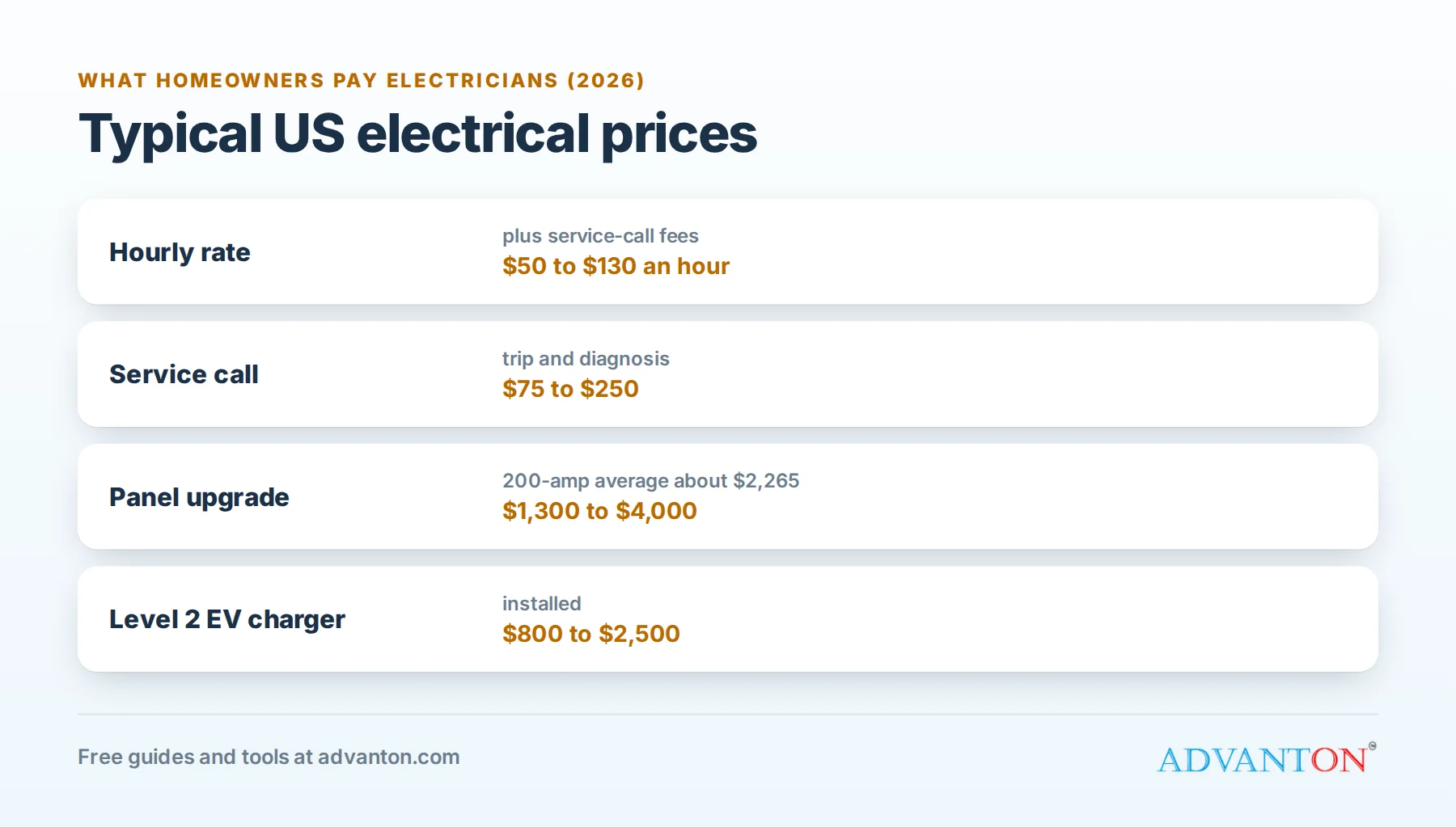
| Service | Typical prices homeowners pay |
|---|---|
| Hourly rate | Commonly $50 to $130 an hour |
| Service-call fee | Often $75 to $250, covering the trip and diagnosis |
| Panel upgrade | About $1,300 to $4,000; one 2026 cost guide averages $2,265 for a standard 200-amp upgrade |
| Level 2 EV charger installation | About $800 to $2,500, depending on distance from the panel and whether the panel needs work |
| Outlet or switch | Often $120 to $300, mostly the service call; several on one visit cost less each |
How to price your work
- Flat-rate pricing for common jobs (outlets, fixtures, EV chargers, breaker replacements) makes quoting faster and builds trust.
- Know your true hourly cost. Divide your yearly costs and target pay by your billable hours, not your working hours.
- Charge a diagnostic fee for troubleshooting, credited toward the repair.
- Write a detailed scope for panel and permit work, so surprises behind walls are handled fairly.
- Offer options: for example, a standard EV charger installation versus one with a dedicated subpanel or load management.
Our pricing calculator helps you set profitable prices, and our quote and invoice generator makes professional estimates.
A worked example: one van, one electrician
These are illustrative assumptions, not predictions. Replace them with your own prices and costs.
| Assumption | Monthly | |
|---|---|---|
| Service calls and small jobs | 40 jobs at $300 average | $12,000 |
| Panel upgrades | 2 at $2,500 average | $5,000 |
| EV charger installations | 4 at $1,400 average | $5,600 |
| Revenue | $22,600 | |
| Materials and equipment | About 25% of revenue | $(5,650) |
| Van, fuel and maintenance | $(1,800) | |
| Insurance, licensing and permits | $(1,300) | |
| Software, phone and marketing | $(1,400) | |
| Tools, supplies and payment fees | $(1,000) | |
| Profit before owner pay and taxes | $11,450 |
The biggest levers are high-value specialties (panel upgrades and EV chargers raise your average ticket), efficient routing, and partnerships that send steady work.
Permits and inspections: how they work
Most electrical work beyond simple repairs, such as panel upgrades, new circuits, EV chargers and generator connections, requires a permit from your city or county, followed by an inspection before walls are closed or the work is energized. Panel upgrades often also need coordination with the electric utility to disconnect and reconnect service.
Handling permits well is a selling point:
- Explain the process in your estimate, including inspection timing.
- Build permit fees and time into your price.
- Keep records of every permit and inspection; homeowners and future buyers value them.
- Never skip permits to win a job on price. Unpermitted work can cause insurance problems for homeowners and put your license at risk.
Growing beyond yourself
The fastest way to grow an electrical business is to add capacity:
- Hire an apprentice to help on jobs while they train toward their journeyman license.
- Add a journeyman who can run service calls independently.
- Specialize your team: one van for service and repair, another for installations such as panels and EV chargers.
- Systematize: price books, job checklists and scheduling software let others work the way you do.
Check your state’s rules on supervision ratios for apprentices, and see our guide to hiring your first employee.
How to get customers
- Complete your Google Business Profile with each service (EV chargers, panel upgrades, generators) and every area you serve.
- Build a website with a page for every service and town. Our free electrician website builder creates one in about 10 minutes, with your license number in every footer and an estimate request form.
- Partner with HVAC companies, solar installers, remodelers, builders and real estate agents. EV and heat pump installs often need electrical upgrades.
- Connect with car dealerships that sell EVs; buyers need home chargers.
- Ask every customer for a review with our review request kit.
- Use your van and job sites: vehicle graphics and yard signs and door hangers.
See our guide to marketing for contractors.
Common mistakes to avoid
- Underpricing panel and permit work that turns out more complex than expected.
- Skipping permits or inspections.
- Taking on commercial work before you have the insurance, bonding and estimating skills.
- Spreading too thin instead of building a reputation in a few profitable specialties.
Your first 90 days
- Confirm your contractor license, insurance and bonding.
- Form your business and open a bank account.
- Equip your van and build a starter inventory.
- Build a flat-rate price list and estimate templates.
- Launch your website and Google Business Profile.
- Meet five HVAC, solar or remodeling companies, or dealerships.
- Ask every customer for a review.
Frequently asked questions
Do I need a master electrician license to start an electrical business?
Many states require the business to hold an electrical contractor license, often through a master electrician who owns or is employed by the company. Check your state licensing agency.
Is EV charger installation a good niche?
It’s a growing one: home charging installations often involve load calculations, permits and sometimes panel upgrades, which suits licensed electricians well. Pair it with panel upgrades and generator work.
How do electricians find steady work?
A mix of local search (Google Business Profile and a website), reviews, and partnerships with HVAC, solar, remodeling and real estate professionals.
Keep learning
- Home services industry profile
- How to start a plumbing business
- Marketing for contractors
- All contractor tools
Sources
- US Bureau of Labor Statistics, Electricians
- Housecall Pro, Electrician pricing guide 2026
- HomeYou, Electrical costs 2026
- US Small Business Administration, Apply for licenses and permits
Last reviewed October 26, 2026. Startup costs are estimates; check local prices, licensing and tax rules before you commit money.


Leave a Reply