
Few trades are as recession-resistant as plumbing. Pipes leak, drains clog and water heaters fail whatever the economy is doing, and homeowners can’t put those jobs off. The Bureau of Labor Statistics counts 504,500 plumbers, pipefitters and steamfitters, earning a median of $62,970 in May 2024, with about 44,000 openings a year projected through 2034. Many of those openings are created by experienced plumbers retiring, which leaves room for new businesses.
Working for someone else caps your income. Running your own plumbing business lets you set your prices, choose your work and build something you can grow or sell, but it also means licensing, insurance, a stocked truck, and finding customers. This guide covers each step, with what homeowners actually pay and a worked profit example for a one-truck business.
Plumbing business at a glance
Table of Contents
| Topic | What to expect |
|---|---|
| Startup cost | Moderate: a service van, tools, inventory, licensing, insurance and marketing |
| License required? | Yes, set by states (and sometimes cities): usually a master plumber license and often a contractor license to run a business |
| What homeowners pay | Commonly $45 to $200 an hour; the average plumbing job costs about $336 (HomeAdvisor) |
| Demand | 4% job growth projected 2024 to 2034, about 44,000 openings a year (BLS) |
| Best for | Licensed, experienced plumbers ready to run a business |
Step 1: Get licensed
Plumbing licensing is set by each state, and some cities add their own. The usual path:
- Apprentice: paid, on-the-job training under a licensed plumber, usually through a formal apprenticeship of four to five years with classroom hours.
- Journeyman plumber: after the required hours, you pass an exam and can work independently.
- Master plumber: after more experience (often several years as a journeyman) and another exam, you can pull permits, design systems and supervise others.
- Contractor license or registration: many states also require a separate license to run a plumbing business, usually with proof of insurance and sometimes a bond.
For example, plumbing in Texas is licensed by the Texas State Board of Plumbing Examiners, while California plumbing contractors need a C-36 license from the Contractors State License Board. Check your own state’s board, and keep up with continuing education.
Step 2: Choose your focus
| Focus | What it involves | Pros | Cons |
|---|---|---|---|
| Residential service and repair | Leaks, clogs, fixtures, water heaters | Steady demand; fast cash flow; repeat customers | Emergency calls and evening work |
| Water heaters | Repair and replacement, including tankless | High-value jobs; easy to package | Requires stock and permits |
| Drain and sewer | Drain cleaning, camera inspections, sewer lines | Recurring demand; premium equipment pays off | Messy work; expensive equipment |
| Remodels | Kitchen and bath plumbing for homeowners and remodelers | Larger jobs; contractor partnerships | Scheduling depends on other trades |
| New construction | Plumbing for builders | Volume work | Lower margins; slow payment |
| Commercial | Restaurants, offices, property managers | Contracts and maintenance agreements | More regulation and insurance |
Most new plumbing businesses start with residential service and repair, which pays fastest and builds a local reputation, then add water heaters or drain and sewer work.
Step 3: Set up the business properly
- Choose a structure. Many plumbers form an LLC, and some later elect S corporation tax status. See LLC vs sole proprietorship vs corporation and what an S corporation is.
- Get an EIN and open a business bank account. See how to get an EIN.
- Insurance: general liability, commercial auto, tools and equipment, and workers’ compensation once you hire. Some states and many commercial clients also require a surety bond.
- Paperwork: written estimates, contracts with payment terms, warranties, and permit tracking.
Startup costs to plan for
| Item | What to budget for |
|---|---|
| Service van | A reliable cargo van with shelving and organization, new or used |
| Tools | Pipe cutters, wrenches, press tool, drain machine, camera inspection system, leak detection gear |
| Starter inventory | Common fittings, valves, supply lines, wax rings and parts for frequent repairs |
| Licensing and permits | Exams, license fees, contractor registration and bonding |
| Insurance | General liability, commercial auto and equipment coverage |
| Software | Scheduling, dispatch, estimates and invoices |
| Branding and marketing | Website, Google Business Profile, vehicle graphics and signs |
| Working capital | Several months of expenses while you build steady work |
The van and specialty tools (especially a drain machine and camera) are usually the largest costs. Many plumbers start with a well-maintained used van and add specialty equipment as demand grows. Use our startup cost calculator for your total.
What homeowners pay
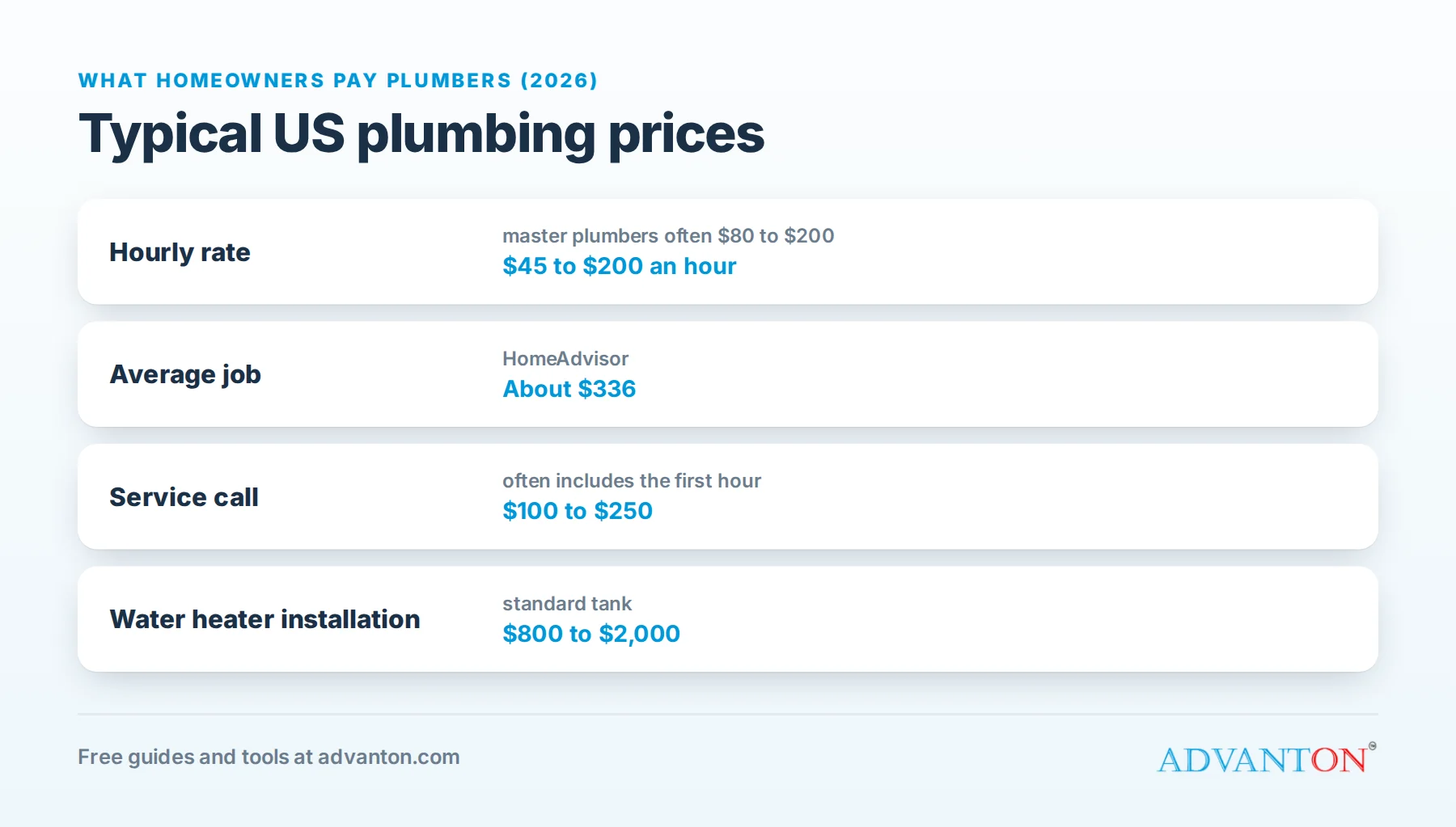
| Service | Typical prices homeowners pay |
|---|---|
| Hourly rate | Commonly $45 to $200 an hour; master plumbers often $80 to $200 (HomeAdvisor) |
| Average plumbing job | About $336, with most jobs between $180 and $494 (HomeAdvisor) |
| Service call fee | Often $100 to $250, frequently including the first hour |
| Drain cleaning | Commonly $100 to $300 for basic clogs |
| Water heater installation | Commonly $800 to $2,000 for standard tanks, more for tankless |
| Emergency calls | Premium rates for nights, weekends and holidays |
How to price your work
- Use flat-rate pricing for common jobs. Homeowners prefer knowing the price before work starts, and flat rates reward you for working efficiently. Build a price book for your 30 to 50 most common jobs.
- Know your true hourly cost. Add your yearly costs (van, insurance, tools, software, marketing, your own pay and taxes) and divide by your billable hours, which are usually far fewer than your working hours once you count driving, quoting and admin.
- Charge a service or diagnostic fee, credited toward the repair if the customer goes ahead.
- Offer good, better and best options on bigger jobs such as water heaters.
Our pricing calculator helps you set prices that cover every cost, and our quote and invoice generator makes professional estimates.
A worked example: one truck, one plumber
These are illustrative assumptions, not predictions. Replace them with your own prices and costs.
| Assumption | Monthly | |
|---|---|---|
| Service and repair jobs | 3 jobs a day on average, 21 working days, $330 average | $20,790 |
| Materials and parts | About 20% of revenue | $(4,158) |
| Van payment, fuel and maintenance | $(1,800) | |
| Insurance and licensing | $(900) | |
| Software, phone and marketing | $(1,500) | |
| Tools, supplies and payment fees | $(1,200) | |
| Profit before owner pay and taxes | $11,232 |
Three jobs a day on average allows for quiet days, longer jobs and time spent quoting, which is realistic for a business that’s still building its customer base. Established plumbers in a compact area often reach four or more, which in this example would add about $5,500 a month in profit. The biggest levers are jobs per day (tight routing and fast response), average ticket (flat rates and options) and repeat customers (maintenance plans and reviews).
How to get plumbing customers
- Complete your Google Business Profile. List every service (drain cleaning, water heaters, leak repair) and every area you serve, with real photos and accurate hours.
- Build a website with a page for every service and town. Our free plumbing website builder creates one in about 10 minutes, with a 24/7 emergency bar, an estimate request form and your license number in every footer.
- Ask every customer for a review the same day, with our review request kit. 97% of consumers read reviews for local businesses (BrightLocal, 2026).
- Partner with real estate agents, property managers, home inspectors and remodelers. They need a reliable plumber they can recommend.
- Answer the phone. Plumbing calls are often urgent, and the first plumber to answer usually wins the job. A call answering service or text-back system pays for itself.
- Brand your van and leave door hangers on nearby homes after each job.
- Offer maintenance plans: annual water heater flushes and inspections bring customers back every year.
Our guide to marketing for contractors covers lead sources in more depth.
Common mistakes to avoid
- Pricing by the hour without knowing your true costs, which often means working hard for little profit.
- Serving too wide an area, so drive time eats your day.
- Skipping permits on work that requires them.
- Weak follow-up: not asking for reviews or offering maintenance plans.
- Mixing personal and business money.
Your first 90 days
- Confirm your master license and contractor registration, and get bonded if required.
- Form your business, get insurance and open a bank account.
- Equip your van and build a starter inventory.
- Write your flat-rate price book.
- Launch your website and Google Business Profile.
- Introduce yourself to five agents, property managers or remodelers.
- Ask every customer for a review, and offer a maintenance plan.
Frequently asked questions
Do I need a master plumber license to start a plumbing business?
In many states, a business must be run by, or employ, a master plumber, and may also need a contractor license or registration. Requirements vary, so check your state plumbing board.
How much can a plumbing business make?
It depends on your prices, jobs per day and costs. Our worked example shows how the numbers fit together, but your local market, efficiency and marketing make the biggest difference.
Should I offer 24/7 emergency service?
Emergency work pays premium rates and wins loyal customers, but only offer it if you can really answer around the clock. Many plumbers start with extended hours instead.
When should I hire my first employee?
When you’re consistently turning work away or working unsustainable hours. Many plumbers start with an apprentice or helper. See hiring your first employee.
Keep learning
- Home services industry profile
- How to start an electrical contracting business
- HVAC service company
- All contractor tools
Sources
- US Bureau of Labor Statistics, Plumbers, pipefitters and steamfitters
- HomeAdvisor, Cost to hire a plumber
- Housecall Pro, Plumbing pricing guide 2026
- US Small Business Administration, Apply for licenses and permits
Last reviewed October 26, 2026. Startup costs are estimates; check local prices, licensing and tax rules before you commit money.


Leave a Reply