
Americans spent $158 billion on their pets in 2025, according to the American Pet Products Association (APPA), and APPA projects $165 billion in 2026. The fastest-growing part of that spending is services: grooming, boarding, training, walking and sitting grew 8% in 2025 to $14.3 billion, faster than food, supplies or veterinary care. With 95 million US households owning a pet, a skilled, trustworthy dog trainer rarely runs short of potential clients.
Dog training is also one of the most accessible pet businesses to start. You can begin with private lessons in clients’ homes, with no storefront, modest equipment and low startup costs, then add group classes or specialty programs as you grow. This guide covers what it really takes: skills and credentials, the business models, what trainers charge, a worked example of monthly profit, and a 90-day plan.
Dog training at a glance
Table of Contents
| Topic | What to expect |
|---|---|
| Startup cost | Low: certification, insurance, equipment and marketing; no premises needed to start |
| License required? | Usually no state license for training itself; local business licenses apply, and boarding requires kennel permits |
| Typical prices | Private sessions often $75 to $200 an hour; group courses about $119 to $300; board-and-train from about $900 for two weeks |
| Time to first client | Weeks, if you already have experience |
| Best for | People with strong dog-handling skills who also enjoy teaching people |
Is dog training right for you?
It’s a great fit if you:
- Understand dog body language and positive, reward-based methods, which most owners now expect.
- Enjoy coaching people. Most training happens between sessions, so your real job is teaching owners to practice.
- Are patient, consistent and calm with dogs that are anxious, reactive or simply untrained.
- Can run a small business: marketing, scheduling, payments and follow-up.
Think twice if you:
- Want to work only with dogs, not people.
- Aren’t comfortable working in strangers’ homes, outdoors in all weather or with occasionally aggressive dogs.
- Need a steady salary from month one. Most trainers build a client base over several months.
The market: who hires dog trainers
The biggest groups of clients are:
- New puppy owners, who want house training, socialization and basic manners.
- Owners of newly adopted dogs, often with fear, leash-pulling or reactivity.
- Busy professionals who want someone to do much of the training for them (day training or board-and-train).
- Owners with behavior problems: reactivity, separation anxiety, resource guarding or aggression. This is the highest-value work, but it requires advanced skills.
- Families with specific goals: therapy dog preparation, sports such as agility, or service dog task training.
Demand peaks in spring and summer, and after the holidays when many people bring home puppies.
Choose your business model
| Model | How it works | Pros | Cons |
|---|---|---|---|
| Private in-home lessons | You visit the client’s home | Low cost to start; tailored training; highest per-hour rate | Travel time limits how many sessions you can do |
| Group classes | Puppy, manners or specialty courses for 4 to 8 dogs | Earn from several clients at once; feeds private clients | Needs space; filling classes takes marketing |
| Day training | You train the dog while the owner is at work | Premium price; convenient for busy owners | Needs daytime availability and transport |
| Board-and-train | The dog lives with you for 1 to 4 weeks | Highest price per client | Kennel licensing, insurance and 24-hour care |
| Behavior consulting | Assessments and plans for serious problems | High value; strong referral source | Requires advanced training; higher liability |
| Virtual training | Coaching by video call | No travel; serve clients anywhere | Harder for hands-on problems |
Most successful trainers start with private lessons, then add group classes for puppies once they have a steady flow of clients, using classes to introduce new families to their private services.
Step 1: Build your skills and credentials
States generally don’t license dog trainers, so anyone can call themselves one. That’s exactly why credentials matter to clients, vets and rescues deciding whom to recommend.
- Certification Council for Professional Dog Trainers (CCPDT): independent certifications such as the CPDT-KA, which require documented training hours and an exam, plus continuing education.
- International Association of Animal Behavior Consultants (IAABC): credentials for behavior work, important if you take on fear, reactivity or aggression cases.
- Mentorship and apprenticeship: working alongside an experienced trainer is the fastest way to learn handling, class management and client coaching.
- Pet first aid and CPR, which reassures clients and prepares you for emergencies.
Be honest in your marketing: never promise results you can’t guarantee, and refer serious aggression cases to a qualified behavior professional or veterinary behaviorist when they’re beyond your experience.
Step 2: Plan your business
- Pick your niche and area. "Puppy training and family manners in three nearby towns" is easier to market than "all dog training everywhere".
- Study the competition. Look up local trainers’ prices, packages and reviews. Repeated complaints (slow replies, no follow-up, harsh methods) show you where to stand out.
- Set your services and packages (see pricing below).
- Write a one-page plan with our free one-page business plan.
Step 3: Set up the business
- Choose a structure. Many trainers form an LLC to separate personal and business liability. See LLC vs sole proprietorship vs corporation.
- Get an EIN (free from the IRS) and open a business bank account. See how to get an EIN.
- Check local rules: a general business license, a home occupation permit if you work from home, and kennel or animal facility licensing if dogs stay with you.
- Get insurance. You’ll want general liability and professional liability, and coverage for animals in your care (often called care, custody and control). Many insurers sell pet professional packages that bundle these.
- Use a written service agreement and liability waiver that covers vaccination requirements, cancellation terms and what training can and can’t promise.
Startup costs to plan for
| Item | What to budget for |
|---|---|
| Education and certification | Courses, mentoring, exam fees and continuing education |
| Insurance | Annual general and professional liability, plus care, custody and control coverage |
| Equipment | Leashes, long lines, harnesses, treat pouches, mats, clickers, cones and a portable pen |
| Vehicle | A reliable vehicle that’s safe for transporting dogs, if you offer day training |
| Business setup | LLC filing fee (varies by state), local license and bank account |
| Marketing | Website, Google Business Profile, business cards and flyers |
| Software | Booking, payments and client records |
| Space (later) | Hourly rental for group classes, often from a pet store, community center or training facility |
Because you can start without premises, your biggest early costs are usually education, insurance and your time. Use our startup cost calculator to total your own numbers.
What dog trainers charge
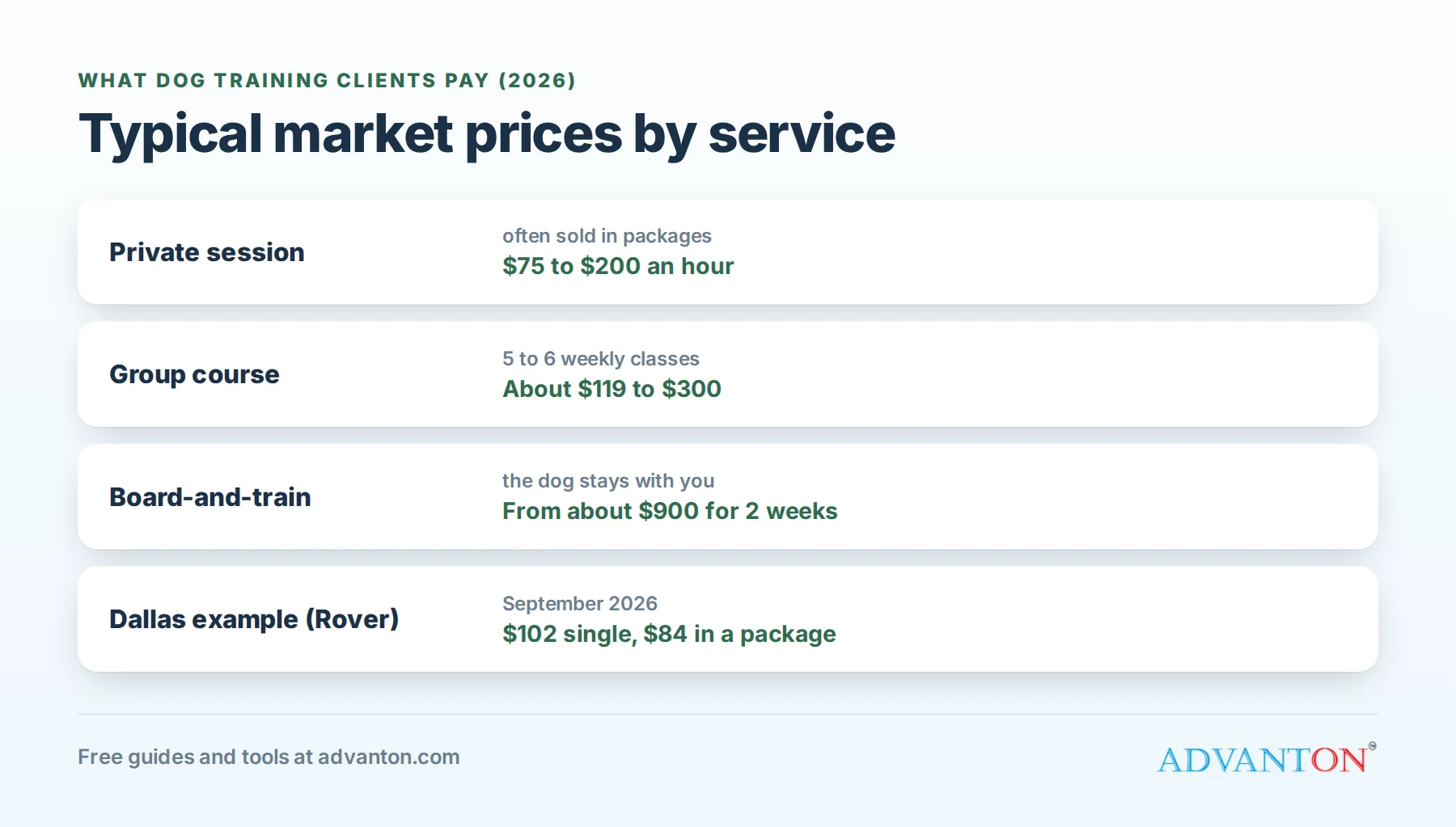
Prices vary widely by city, credentials and specialty:
| Service | Typical market prices |
|---|---|
| Private session | Commonly $75 to $200 an hour; Rover’s September 2026 data for Dallas averaged $102 for a single session and $84 within a package |
| Group course (5 to 6 weeks) | About $119 for a basic big-box store class to $200 to $300 for specialized classes |
| Board-and-train | From about $900 for two weeks, often $1,500 to $4,500 |
| Day training | Often priced per day or per week |
| Behavior consultations | Typically priced above standard sessions, reflecting assessment and planning time |
How to set your own price: add up your yearly costs (insurance, education, marketing, software, vehicle), decide what you want to pay yourself, and divide by the number of sessions you can realistically deliver. Don’t forget travel time and admin: an hour-long in-home session often takes two hours of your day. Our pricing calculator does the math.
Package your services. Most clients get better results with a series, and packages smooth your income. For example: a puppy package of five sessions, a reactivity program with an assessment and six sessions, or a group course plus one private session.
A worked example: monthly profit for a solo trainer
These are illustrative assumptions, not predictions. Replace them with your own local prices and costs.
| Assumption | Monthly | |
|---|---|---|
| Private sessions | 50 sessions at $90 average (mostly packages) | $4,500 |
| Group classes | 2 six-week puppy courses, 6 dogs each, at $180 per dog, spread over the month | $1,080 |
| Revenue | $5,580 | |
| Insurance, software, phone | $(250) | |
| Vehicle and fuel | $(400) | |
| Class space rental | $(200) | |
| Marketing and supplies | $(250) | |
| Education and payment fees | $(250) | |
| Profit before taxes | $4,230 |
Fifty private sessions a month is roughly 12 a week, which leaves time for travel, classes and admin. The levers that grow profit are packages (fewer cancellations, more predictable income), tight service areas (less driving), and group classes (more revenue per hour).
How to find clients
- Partner with veterinarians, groomers, pet stores, daycares and rescues. They’re asked for trainer recommendations every day. Drop off cards, offer a discount for their clients, and send thank-you notes for referrals.
- Complete your Google Business Profile with your services, area, photos and hours, and ask every client for a review with our review request kit.
- Build a simple website with your services, credentials, prices or packages, and a booking link. Our free website builder makes one in about 10 minutes, with a page for each town you serve.
- Teach free workshops, such as "Puppy basics" at a pet store or community center.
- Share short, useful videos (with owners’ permission): quick tips and before-and-after progress.
- Offer adoption packages through local rescues for newly adopted dogs.
Running the business well
- Booking and payments: use a scheduling app with reminders, and take payment upfront for packages. See best free scheduling apps.
- Client records: vaccination records, signed waivers, notes and homework for every dog.
- Homework sheets: a short written plan after each session dramatically improves results and reviews.
- Follow-up: check in a week after a package ends; many clients buy more sessions or refer friends.
Common mistakes to avoid
- Underpricing to win clients, then burning out with too many sessions and too much driving.
- Taking cases beyond your experience, especially serious aggression.
- Skipping insurance and waivers.
- Selling single sessions instead of packages that actually get results.
- Serving too wide an area, so travel eats your profit.
Your first 90 days
- Finish (or enroll in) a recognized certification, and keep logging training hours.
- Form your business, get insurance and open a business bank account.
- Set your services, packages and prices.
- Launch your website and Google Business Profile.
- Meet five local vets, groomers, pet stores or rescues.
- Run your first workshop or group class.
- Ask every client for a review and a referral.
Frequently asked questions
Do I need a license to be a dog trainer?
In most of the US, there’s no state license for dog training itself. You’ll still need a local business license, and boarding dogs usually requires kennel or animal facility permits. Certification isn’t legally required but is highly valued by clients and referral partners.
How long does it take to become a dog trainer?
It depends on your experience. Certifications such as the CPDT-KA require documented hands-on training hours; many trainers spend a year or more learning through courses and mentorship before working independently.
Can I start part-time?
Yes. Many trainers start with evening and weekend private sessions, then go full-time once their client base and referrals are steady.
What’s the most profitable service?
Behavior consulting and board-and-train command the highest prices but carry more responsibility and risk. For most new trainers, packages of private sessions plus group classes are the best balance of income and workload.
Keep learning
- Pet care industry profile
- How to start a dog daycare
- Dog walking and pet sitting
- Mobile dog grooming
Sources
- American Pet Products Association, 2026 State of the Industry (via Global Pet Industry)
- Rover, How much does dog training cost?
- Rover, Dallas dog training prices (September 2026)
- Certification Council for Professional Dog Trainers
- International Association of Animal Behavior Consultants
Last reviewed October 26, 2026. Startup costs are estimates; check local prices, licensing and tax rules before you commit money.


Leave a Reply