
Distributors buy products from manufacturers in bulk and sell them to retailers, restaurants, contractors and other businesses. They earn on the spread between purchase and sale prices and on the convenience they provide. Logisticians earned a median of $80,880 in May 2024, with 19% projected growth, and the Bureau of Labor Statistics counted about 6.95 million hand laborers and material movers, with a median wage of $37,680.
Distributors range from niche specialists representing a few brands to regional food and supply distributors and online B2B wholesalers. Inventory, credit terms and delivery logistics decide profitability.
The workforce
| Occupation | Jobs (2024) | Median pay (May 2024) | Projected growth, 2024 to 2034 |
|---|---|---|---|
| Logisticians | n/a | $80,880 | +19% |
| Hand laborers and material movers | about 7.0 million | $37,680 | +4% |
Source: U.S. Bureau of Labor Statistics, Occupational Outlook Handbook and Occupational Employment and Wage Statistics.
Business models compared
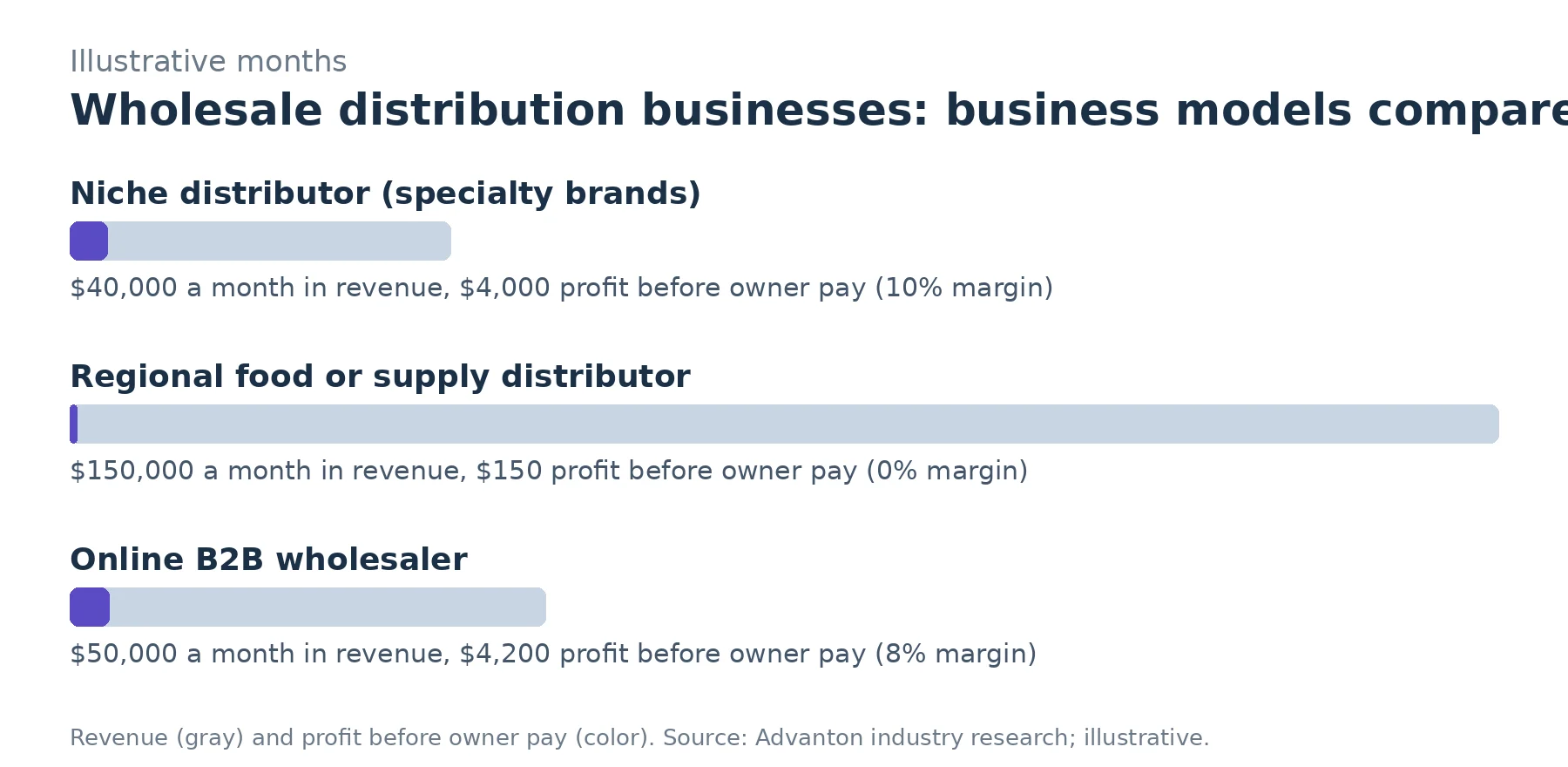
The figures below are illustrative months from our research, not industry averages. They show how revenue and costs typically fit together; your market, prices and costs will differ.
| Business model | Startup costs | Example monthly revenue | Costs | Profit before owner pay | Margin |
|---|---|---|---|---|---|
| Niche distributor (specialty brands) | Moderate: inventory, small warehouse, van | $40,000 | $36,000 | $4,000 | 10% |
| Regional food or supply distributor | High: warehouse, trucks, inventory, staff | $150,000 | $149,850 | $150 | 0% |
| Online B2B wholesaler | Moderate: inventory, B2B platform, fulfillment | $50,000 | $45,800 | $4,200 | 8% |
Fixed and variable costs
For projections, the most useful split is between variable costs, which rise and fall with sales (materials, supplies, hourly labor, fees), and fixed costs, which you pay every month regardless (rent, salaried staff, insurance, loan payments).
| Business model | Variable costs (% of revenue) | Fixed costs per month | What it means |
|---|---|---|---|
| Niche distributor (specialty brands) | 74.0% | $6,400 | Mostly variable: profitable early, but watch cash flow |
| Regional food or supply distributor | 78.5% | $32,100 | Mostly variable: profitable early, but watch cash flow |
| Online B2B wholesaler | 77.0% | $7,300 | Mostly variable: profitable early, but watch cash flow |
What the numbers say
Product cost takes most of every dollar, so margins are thin and volume matters.
Warehouse, trucks and staff are heavy fixed costs for regional distributors.
Credit terms tie up cash: customers often pay in 30 days or more while suppliers want payment sooner.
The three models in brief
Niche distributor. A few specialty brands sold to retailers and restaurants. See import and export data.
Regional food or supply distributor. Broad catalogs delivered on routes. See trucking and logistics data.
Online B2B wholesaler. Wholesale ordering online with shipping or local delivery. See e-commerce data.
Cost structure: niche distributor (specialty brands)
Each cost as a share of the example month’s revenue ($40,000):
| Cost | Monthly amount | Share of revenue | Type |
|---|---|---|---|
| Product cost | $28,000 | 70.0% | Variable |
| Sales rep | $3,000 | 7.5% | Fixed |
| Warehouse rent | $1,500 | 3.8% | Fixed |
| Delivery fuel and freight | $1,200 | 3.0% | Variable |
| Van | $800 | 2.0% | Fixed |
| Marketing | $500 | 1.2% | Fixed |
| Payment fees | $400 | 1.0% | Variable |
| Software | $300 | 0.8% | Fixed |
| Insurance | $300 | 0.8% | Fixed |
| Profit before owner pay | $4,000 | 10% |
A first-year projection: niche distributor (specialty brands)
New businesses rarely start at full speed. This projection assumes revenue ramps from 35% of the example month in month 1 to 100% by month 12, variable costs move with revenue, and fixed costs stay the same every month. It’s a planning illustration, not a forecast.
| Month | Revenue | Variable costs | Fixed costs | Profit | Cumulative |
|---|---|---|---|---|---|
| 1 | $14,000 | $10,360 | $6,400 | -$2,760 | -$2,760 |
| 2 | $18,000 | $13,320 | $6,400 | -$1,720 | -$4,480 |
| 3 | $22,000 | $16,280 | $6,400 | -$680 | -$5,160 |
| 4 | $24,800 | $18,352 | $6,400 | $48 | -$5,112 |
| 5 | $28,000 | $20,720 | $6,400 | $880 | -$4,232 |
| 6 | $30,400 | $22,496 | $6,400 | $1,504 | -$2,728 |
| 7 | $32,800 | $24,272 | $6,400 | $2,128 | -$600 |
| 8 | $34,800 | $25,752 | $6,400 | $2,648 | $2,048 |
| 9 | $36,400 | $26,936 | $6,400 | $3,064 | $5,112 |
| 10 | $38,000 | $28,120 | $6,400 | $3,480 | $8,592 |
| 11 | $39,200 | $29,008 | $6,400 | $3,792 | $12,384 |
| 12 | $40,000 | $29,600 | $6,400 | $4,000 | $16,384 |
Year one: revenue $358,400, profit before owner pay $16,384. The first profitable month is month 4. Cumulative results bottom out at -$5,160, which is the minimum cash cushion this plan would need, before any startup costs.
The sales rep, warehouse and van start before accounts build, so this niche distributor illustration turns profitable in month 4, with a cumulative low of about $5,200, before opening inventory and the cash tied up in customer credit.
How distributors earn
- Margin on products resold.
- Delivery fees and minimum orders.
- Exclusive territories for brands.
- Value-added services: kitting, private labeling, merchandising.
- Volume rebates from manufacturers.
Distribution agreements
Agreements with manufacturers define territories, exclusivity, pricing, minimums and termination. Exclusive rights protect your investment in building a brand’s market.
Inventory and turns
Inventory ties up cash. Track turns by product, avoid slow movers and use sales data to forecast orders.
A startup checklist
- Secure distribution agreements.
- Register for sales tax and set up resale certificates.
- Plan warehouse space and safety.
- Set credit policies for customers.
- Choose inventory and order software.
Credit and cash flow
Offering terms wins customers but creates receivables. Check credit, set limits, invoice promptly and follow up on late payments.
Where the opportunities are
- Local and specialty foods to independent grocers and cafes.
- Construction and janitorial supplies.
- Online B2B ordering for small retailers.
- Underserved rural routes.
- Representing emerging brands.
Key terms
| Term | Meaning |
|---|---|
| Inventory turns | How many times inventory sells each year |
| Resale certificate | Document allowing tax-free purchases for resale |
| Exclusive territory | Area where only you distribute a brand |
| Days sales outstanding | Average days to collect payment |
Warehouse safety
Forklifts, racking and lifting create hazards. Train staff, certify forklift operators and keep aisles clear.
Key numbers to track
Track gross margin by product, inventory turns, days sales outstanding, fill rate and delivery cost per stop.
Common mistakes
- Too much slow-moving inventory.
- Loose credit policies.
- Weak distribution agreements.
- Underpricing delivery.
- Ignoring warehouse safety.
Marketing a distributor
Sales reps, trade shows, sample programs and online catalogs win accounts. See import and export data.
Technology
Inventory, ordering and route software reduce errors and improve service. Online ordering portals let customers reorder anytime and reduce phone and email order mistakes.
Service levels
Reliable deliveries and accurate orders keep accounts loyal. Customers often value consistent service over the lowest price, so track fill rates and on-time deliveries closely.
Food distribution
Food requires temperature control, lot tracking and recall procedures, and many buyers ask for food safety documentation before opening accounts.
Supplier relationships
Strong manufacturer relationships bring better pricing, marketing support, co-op advertising and early access to new products.
Delivery routes
Dense routes and minimum orders keep delivery costs manageable, and set delivery days per area help customers plan orders.
Growth funding
Inventory and receivables need working capital; lines of credit help.
Pricing and margins
Distributors set prices from their landed cost plus a margin that covers warehousing, delivery, credit risk and profit. Margins vary widely by category; specialty and hard-to-find products usually carry better margins than commodity items. Review prices whenever supplier costs change.
Choosing what to carry
Start with products you can sell well to customers you can reach efficiently. Test new lines with small orders, ask customers what they struggle to source and drop products that don’t turn.
Test these numbers with your own plan
Open this industry in our free Business Idea Reality Check to start from any model above, change prices, costs, startup budget and your own pay, and see your break-even month, the cash you’d need, three scenarios and how new businesses in this sector survive in your state.
- Start with the closest model and its cost structure.
- Replace every price and cost with local quotes.
- Estimate your ramp: how fast customers will realistically come in year one.
- Map cash month by month with the free Cash & Payroll Planner.
- Build the full plan in the free Business Planner.
About this data
Workforce figures come from the U.S. Bureau of Labor Statistics (Occupational Outlook Handbook and Occupational Employment and Wage Statistics, May 2024 wages and the 2024 to 2034 projections, unless noted). Market figures cite their sources above. Business model figures are illustrative months built from typical prices and costs to show how revenue, fixed costs and variable costs fit together; they are not industry averages or guarantees. We review these profiles when new government data is released, at least once a year, and the same figures power the Business Idea Reality Check.
Licensing and rules
Register the business and use resale certificates so you don’t pay sales tax on inventory bought for resale; collect resale certificates from your business customers; food distributors may need state or FDA registration and must follow food safety and temperature rules; alcohol and tobacco distribution require special licenses; OSHA rules cover warehouse safety, forklifts and material handling; commercial vehicles above certain weights may need USDOT registration; product safety and labeling rules apply to what you distribute. Requirements change; confirm with your state and local agencies before you start.
Frequently asked questions
Is wholesale distribution profitable?
It can be, with strong margins on the right products, efficient logistics and disciplined credit.
What is a resale certificate?
A document that lets businesses buy inventory for resale without paying sales tax.
Do I need a license to distribute food?
Often state registration and food safety compliance; requirements vary.
What are inventory turns?
How many times inventory sells and is replaced each year.
Should I offer credit terms?
Many customers expect terms; check credit and set limits.
What do logisticians earn?
BLS reported a median of $80,880 in May 2024.
How do distributors find brands to represent?
Trade shows, industry associations, direct outreach and emerging brands seeking local reach.
How much inventory should a new distributor carry?
Start with proven products in modest quantities and reorder based on sales.
Do distributors need a warehouse?
Small distributors often start with shared or third-party warehouse space.
How can I test these numbers?
Open wholesale distribution in the Business Idea Reality Check and enter your own numbers.
Keep learning
- Import and export data
- Trucking and logistics data
- Packaged food brands data
- Business Idea Reality Check
Sources
- U.S. Bureau of Labor Statistics, Logisticians
- U.S. Bureau of Labor Statistics, Hand laborers and material movers
Last reviewed November 1, 2026. Startup costs are estimates; check local prices, licensing and tax rules before you commit money.
In India
Small businesses like this in India
In MoSPI’s survey of unincorporated businesses (proprietorships, partnerships and similar firms), this falls under Wholesale trade. In 2023-24 India had 13.1 lakh such establishments employing 33.4 lakh workers, and 58.8% were run without hired workers. Across the wider trade group, the number of establishments grew 6.18% between 2023-24 and 2025.
| Urban | Rural | All India | |
|---|---|---|---|
| Value added per business a year | ₹9,17,814 | ₹3,62,061 | ₹7,26,634 |
| Value added per worker a year | ₹3,22,716 | ₹1,80,328 | ₹2,84,245 |
| Pay per hired worker a year | ₹1,56,684 | ₹1,13,868 | ₹1,49,125 |
Running it alone or with staff: businesses with no hired workers added about ₹2,86,481 a year on average, while those with hired workers added about ₹13,53,775 (all India).
Where these businesses are: the states with the most small trade businesses are Uttar Pradesh (15.2%), Maharashtra (9.8%), West Bengal (9.0%), Bihar (6.4%), Madhya Pradesh (6.3%) of the national total (2023-24).
Value added is what a business produces minus what it spends on materials and other inputs, before paying its workers and owner, so it’s a rough guide to the income a typical small business generates. These figures cover the whole activity, which can be broader than this one business type. Across all small businesses, average fixed assets such as equipment, furniture and vehicles were ₹3,42,242 per establishment in 2025.
Licences and registrations to expect
- Registration under your state’s Shops and Establishments Act if you have premises or employees.
- A trade licence from your municipal corporation or council for many shop and service businesses.
- GST registration once turnover crosses ₹40 lakh for goods or ₹20 lakh for services (lower in some special category states), or earlier if you sell goods to other states or through e-commerce marketplaces.
- Professional tax registration in states that levy it.
- Free Udyam (MSME) registration, which helps with loans, government schemes and delayed-payment protection.
Rules differ by state and city. Check with your municipal corporation, state departments and a chartered accountant before you start.
Run a business like this in India? List it free in the India Business Directory, with your hours, deals and GST registration.
Free tools for India: Make a GST invoice · Compare business credit cards
Sources: MoSPI, Annual Survey of Unincorporated Sector Enterprises (ASUSE) 2023-24, full report, Appendix A Tables 4, 29, 33, 35 and 37 (survey period October 2023 to September 2024); MoSPI, Annual Survey of Unincorporated Sector Enterprises (ASUSE) 2025, factsheet (survey period January to December 2025, released 24 March 2026). Licensing summary by Advanton, checked November 2026.

