
Attorneys, insurance companies, businesses and individuals hire private investigators to locate people, verify claims, gather evidence, conduct background research and support litigation. The Bureau of Labor Statistics counted about 43,600 private detectives and investigators in 2024 and projects 6% growth from 2024 to 2034. Many come from law enforcement, insurance or legal backgrounds.
Agencies range from solo investigators to small agencies and corporate investigations firms handling fraud, due diligence and workplace investigations. Every method must follow licensing, privacy, recording and data laws, because evidence gathered illegally can hurt clients and end careers.
The workforce
| Occupation | Jobs (2024) | Median pay (May 2024) | Projected growth, 2024 to 2034 |
|---|---|---|---|
| Private detectives and investigators | 43,600 | n/a | +6% |
Source: U.S. Bureau of Labor Statistics, Occupational Outlook Handbook and Occupational Employment and Wage Statistics.
Market data
| Measure | Value |
|---|---|
| Projected job change, 2024 to 2034 | 2,600 |
Business models compared
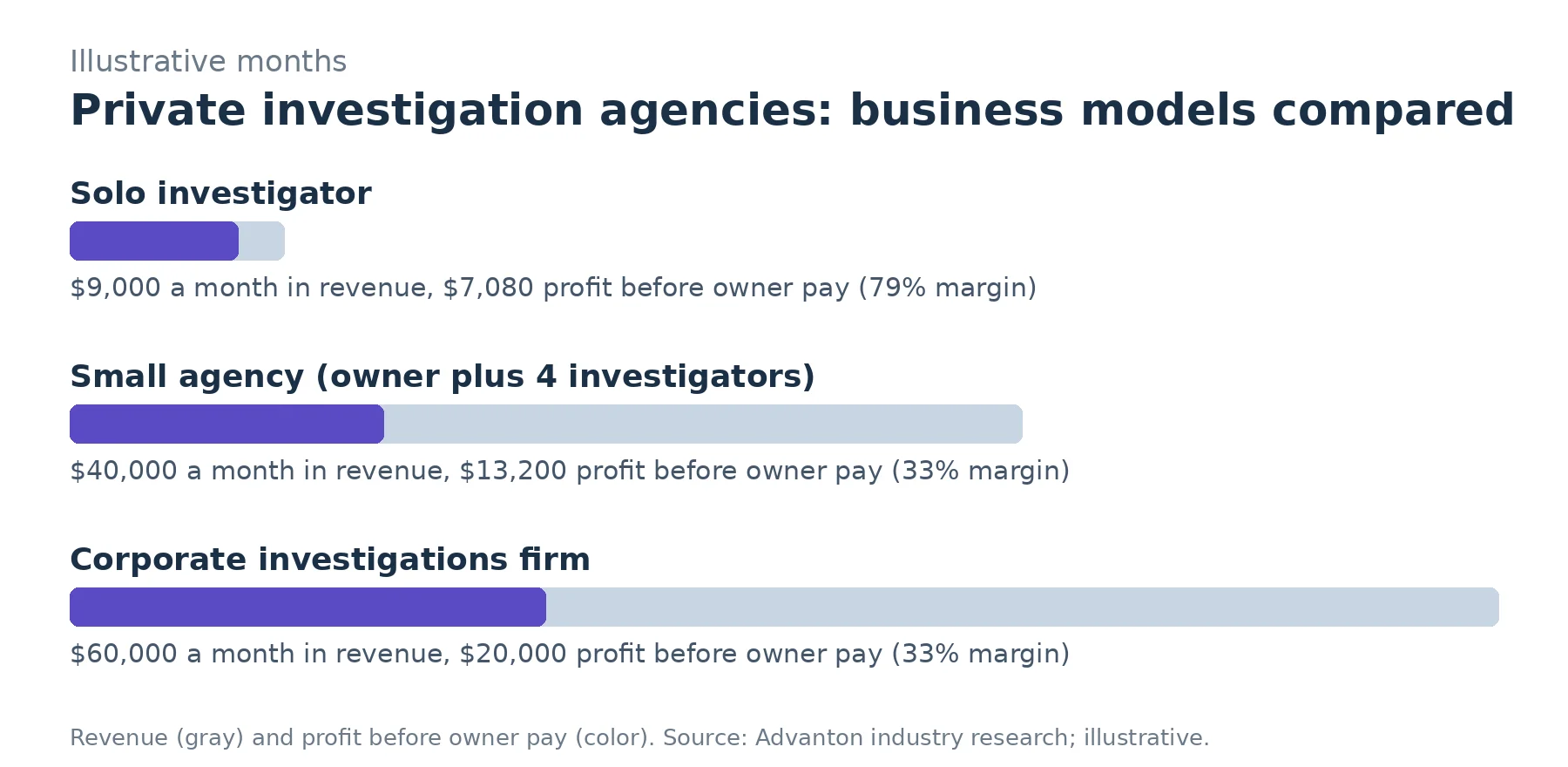
The figures below are illustrative months from our research, not industry averages. They show how revenue and costs typically fit together; your market, prices and costs will differ.
| Business model | Startup costs | Example monthly revenue | Costs | Profit before owner pay | Margin |
|---|---|---|---|---|---|
| Solo investigator | Low to moderate: license, insurance, databases, camera gear, vehicle | $9,000 | $1,920 | $7,080 | 79% |
| Small agency (owner plus 4 investigators) | Moderate: agency license, insurance, vehicles, staff | $40,000 | $26,800 | $13,200 | 33% |
| Corporate investigations firm | Moderate: experienced investigators, analysts, compliance | $60,000 | $40,000 | $20,000 | 33% |
Fixed and variable costs
For projections, the most useful split is between variable costs, which rise and fall with sales (materials, supplies, hourly labor, fees), and fixed costs, which you pay every month regardless (rent, salaried staff, insurance, loan payments).
| Business model | Variable costs (% of revenue) | Fixed costs per month | What it means |
|---|---|---|---|
| Solo investigator | 11.1% | $920 | Mostly fixed: needs steady volume to cover overhead |
| Small agency (owner plus 4 investigators) | 53.8% | $5,300 | Mostly variable: profitable early, but watch cash flow |
| Corporate investigations firm | 51.7% | $9,000 | Mostly variable: profitable early, but watch cash flow |
What the numbers say
Investigator pay is the largest cost for agencies, so billable hours and case mix decide margins.
Solo investigators keep low overhead but are limited by their own hours.
Corporate work pays more per case and requires experienced investigators and strong reporting.
The three models in brief
Solo investigator. Surveillance, locates and background research for attorneys and individuals. See security services data.
Small agency. Several investigators handling insurance, legal and domestic cases.
Corporate investigations firm. Fraud, due diligence, workplace and digital investigations. See cybersecurity data.
Cost structure: small agency (owner plus 4 investigators)
Each cost as a share of the example month’s revenue ($40,000):
| Cost | Monthly amount | Share of revenue | Type |
|---|---|---|---|
| Investigator pay | $18,000 | 45.0% | Variable |
| Mileage | $2,000 | 5.0% | Variable |
| Payroll taxes and workers’ comp | $2,000 | 5.0% | Fixed |
| Database and records fees | $1,500 | 3.8% | Variable |
| Marketing | $1,200 | 3.0% | Fixed |
| Office | $1,000 | 2.5% | Fixed |
| Insurance | $800 | 2.0% | Fixed |
| Case management software | $300 | 0.8% | Fixed |
| Profit before owner pay | $13,200 | 33% |
A first-year projection: small agency (owner plus 4 investigators)
New businesses rarely start at full speed. This projection assumes revenue ramps from 35% of the example month in month 1 to 100% by month 12, variable costs move with revenue, and fixed costs stay the same every month. It’s a planning illustration, not a forecast.
| Month | Revenue | Variable costs | Fixed costs | Profit | Cumulative |
|---|---|---|---|---|---|
| 1 | $14,000 | $7,532 | $5,300 | $1,168 | $1,168 |
| 2 | $18,000 | $9,684 | $5,300 | $3,016 | $4,184 |
| 3 | $22,000 | $11,836 | $5,300 | $4,864 | $9,048 |
| 4 | $24,800 | $13,342 | $5,300 | $6,158 | $15,206 |
| 5 | $28,000 | $15,064 | $5,300 | $7,636 | $22,842 |
| 6 | $30,400 | $16,355 | $5,300 | $8,745 | $31,587 |
| 7 | $32,800 | $17,646 | $5,300 | $9,854 | $41,441 |
| 8 | $34,800 | $18,722 | $5,300 | $10,778 | $52,219 |
| 9 | $36,400 | $19,583 | $5,300 | $11,517 | $63,736 |
| 10 | $38,000 | $20,444 | $5,300 | $12,256 | $75,992 |
| 11 | $39,200 | $21,090 | $5,300 | $12,810 | $88,802 |
| 12 | $40,000 | $21,520 | $5,300 | $13,180 | $101,982 |
Year one: revenue $358,400, profit before owner pay $101,982. The first profitable month is month 1. Cumulative results stay positive from the start, before any startup costs.
Investigators are paid per case and fixed costs are modest, so this agency illustration is profitable from month 1. The real early challenge is building attorney and insurer relationships that send a steady stream of cases.
How investigators earn
- Hourly rates plus mileage and expenses.
- Flat fees for background checks and locates.
- Retainers for larger cases.
- Insurance claim investigations.
- Court testimony and process serving.
Licensing and experience
Most states require investigators to meet experience requirements, pass exams and background checks, and carry insurance or bonds, with separate agency licenses for firms. Some states license by city or have no statewide license, so check carefully.
Staying within the law
Recording laws differ by state: some require one party’s consent, others all parties’. GPS tracking, trespass, pretexting and access to records are restricted. Evidence gathered illegally can be thrown out and expose investigators and clients to liability.
A startup checklist
- Obtain state licenses for yourself and your agency.
- Carry liability insurance and any required bond.
- Learn recording, tracking and privacy laws in your state.
- Subscribe to lawful data sources.
- Use case management and secure storage.
Report writing
Clear, factual, well-documented reports with times, photos and observations are the product clients pay for. Courts and insurers rely on them.
Where the opportunities are
- Insurance fraud investigations.
- Litigation support for attorneys.
- Corporate due diligence.
- Workplace misconduct investigations.
- Skip tracing and locates.
Key terms
| Term | Meaning |
|---|---|
| Pretexting | Obtaining information under false pretenses, often illegal |
| Skip tracing | Locating people who have moved |
| FCRA | Federal law governing consumer background reports |
| Chain of custody | Documentation of evidence handling |
Background checks and FCRA
Background reports used for employment, housing or credit decisions are regulated under the Fair Credit Reporting Act, with requirements for permissible purpose, accuracy and disputes. Know when your work falls under FCRA.
Key numbers to track
Track billable hours, revenue per case, case types, client retention and report turnaround time.
Common mistakes
- Breaking recording or tracking laws.
- Weak documentation.
- Taking cases with improper purposes.
- Underpricing surveillance time.
- Relying on one client.
Marketing an investigation agency
Attorney referrals, insurance company relationships, bar association events, a professional website and reviews bring cases. See security services data.
Screening clients
Decline cases that could help someone stalk or harm another person. Verify clients’ purposes, especially in locate and domestic cases.
Surveillance
Surveillance requires patience, legal positioning and careful documentation, and it is often billed hourly with minimums.
Digital investigations
Open-source research and digital evidence are growing; follow privacy laws and preserve evidence properly.
Testimony
Investigators may testify; professional conduct and accurate notes matter.
Insurance
General liability and errors and omissions coverage protect against claims.
Pricing surveillance work
Surveillance often takes longer than clients expect, with hours of waiting for minutes of useful footage. Clear minimums, hourly rates, mileage and expense policies, and written estimates that explain these realities prevent billing disputes.
Working with attorneys
Attorneys are the most important referral source for many agencies. Understand discovery rules, keep findings confidential, document chain of custody and deliver reports that are ready for litigation. Attorneys who trust your work call you for every case.
Safety in the field
Surveillance and interviews can put investigators in risky situations. Share locations with the office, avoid confrontations, follow traffic laws and never pursue subjects. Personal safety always outweighs a case.
Ethics
Integrity is the foundation of credibility with courts, attorneys and clients.
Test these numbers with your own plan
Open this industry in our free Business Idea Reality Check to start from any model above, change prices, costs, startup budget and your own pay, and see your break-even month, the cash you’d need, three scenarios and how new businesses in this sector survive in your state.
- Start with the closest model and its cost structure.
- Replace every price and cost with local quotes.
- Estimate your ramp: how fast customers will realistically come in year one.
- Map cash month by month with the free Cash & Payroll Planner.
- Build the full plan in the free Business Planner.
About this data
Workforce figures come from the U.S. Bureau of Labor Statistics (Occupational Outlook Handbook and Occupational Employment and Wage Statistics, May 2024 wages and the 2024 to 2034 projections, unless noted). Market figures cite their sources above. Business model figures are illustrative months built from typical prices and costs to show how revenue, fixed costs and variable costs fit together; they are not industry averages or guarantees. We review these profiles when new government data is released, at least once a year, and the same figures power the Business Idea Reality Check.
Licensing and rules
Most states license private investigators and agencies, with experience, exams, background checks and insurance or bonding; investigators must follow state and federal recording laws (some states require all parties’ consent), trespass laws and limits on GPS tracking; the Gramm-Leach-Bliley Act prohibits pretexting to obtain financial information, and other laws restrict obtaining phone and medical records; background checks for employment, tenant or credit purposes must follow the Fair Credit Reporting Act; carrying firearms requires separate permits; impersonating law enforcement is illegal. Requirements change; confirm with your state and local agencies before you start.
Frequently asked questions
Do private investigators need a license?
Most states license investigators and agencies; requirements vary.
Can private investigators record conversations?
Only as allowed by state law; some states require all parties’ consent.
Can PIs use GPS trackers?
Tracking is restricted by law in many states; check rules carefully.
What is pretexting?
Obtaining information under false pretenses; it is illegal for financial records and restricted for others.
Who hires private investigators?
Attorneys, insurers, businesses and individuals.
Is private investigation growing?
BLS projects 6% growth from 2024 to 2034.
How do private investigators charge?
Usually hourly plus mileage and expenses, with flat fees for some services.
How can I test these numbers?
Open private investigation agencies in the Business Idea Reality Check and enter your own rates and costs.
Keep learning
Sources
Last reviewed November 1, 2026. Startup costs are estimates; check local prices, licensing and tax rules before you commit money.
In India
In India: Detective agencies, with limited regulation.
Small businesses like this in India
In MoSPI’s survey of unincorporated businesses (proprietorships, partnerships and similar firms), this falls under Administrative and support services. In 2023-24 India had 23.6 lakh such establishments employing 43.1 lakh workers, and 80.7% were run without hired workers. Across the wider other services group, the number of establishments grew 10.29% between 2023-24 and 2025.
| Urban | Rural | All India | |
|---|---|---|---|
| Value added per business a year | ₹3,40,306 | ₹1,94,921 | ₹2,57,316 |
| Value added per worker a year | ₹1,64,755 | ₹1,18,208 | ₹1,40,784 |
| Pay per hired worker a year | ₹1,29,813 | ₹86,299 | ₹1,12,714 |
Running it alone or with staff: businesses with no hired workers added about ₹1,52,541 a year on average, while those with hired workers added about ₹6,94,636 (all India).
Where these businesses are: the states with the most small other services businesses are West Bengal (13.1%), Uttar Pradesh (11.6%), Maharashtra (8.8%), Tamil Nadu (6.2%), Gujarat (6.0%) of the national total (2023-24).
Value added is what a business produces minus what it spends on materials and other inputs, before paying its workers and owner, so it’s a rough guide to the income a typical small business generates. These figures cover the whole activity, which can be broader than this one business type. Across all small businesses, average fixed assets such as equipment, furniture and vehicles were ₹3,42,242 per establishment in 2025.
Licences and registrations to expect
- A licence under the Private Security Agencies (Regulation) Act (PSARA) from your state’s controlling authority, with police verification and training for guards.
- Registration under your state’s Shops and Establishments Act if you have premises or employees.
- A trade licence from your municipal corporation or council for many shop and service businesses.
- GST registration once turnover crosses ₹40 lakh for goods or ₹20 lakh for services (lower in some special category states), or earlier if you sell goods to other states or through e-commerce marketplaces.
- Professional tax registration in states that levy it.
- Free Udyam (MSME) registration, which helps with loans, government schemes and delayed-payment protection.
Rules differ by state and city. Check with your municipal corporation, state departments and a chartered accountant before you start.
Run a business like this in India? List it free in the India Business Directory, with your hours, deals and GST registration.
Free tools for India: Make a GST invoice · Compare business credit cards
Sources: MoSPI, Annual Survey of Unincorporated Sector Enterprises (ASUSE) 2023-24, full report, Appendix A Tables 4, 29, 33, 35 and 37 (survey period October 2023 to September 2024); MoSPI, Annual Survey of Unincorporated Sector Enterprises (ASUSE) 2025, factsheet (survey period January to December 2025, released 24 March 2026). Licensing summary by Advanton, checked November 2026.

