
Families turn to funeral homes during their hardest moments, and they need compassion, clear choices and honest prices. The business combines caregiving with strict regulation: states license funeral directors, embalmers and establishments, and the FTC’s Funeral Rule governs how prices are disclosed. Funeral service workers earned a median of $59,420 in May 2024, according to the Bureau of Labor Statistics.
Businesses range from direct cremation providers to traditional funeral homes and funeral homes with their own crematories. Cremation’s growth has changed the mix of services families choose.
The workforce
| Occupation | Jobs (2024) | Median pay (May 2024) | Projected growth, 2024 to 2034 |
|---|---|---|---|
| Funeral service workers | n/a | $59,420 | n/a |
Source: U.S. Bureau of Labor Statistics, Occupational Outlook Handbook and Occupational Employment and Wage Statistics.
Business models compared
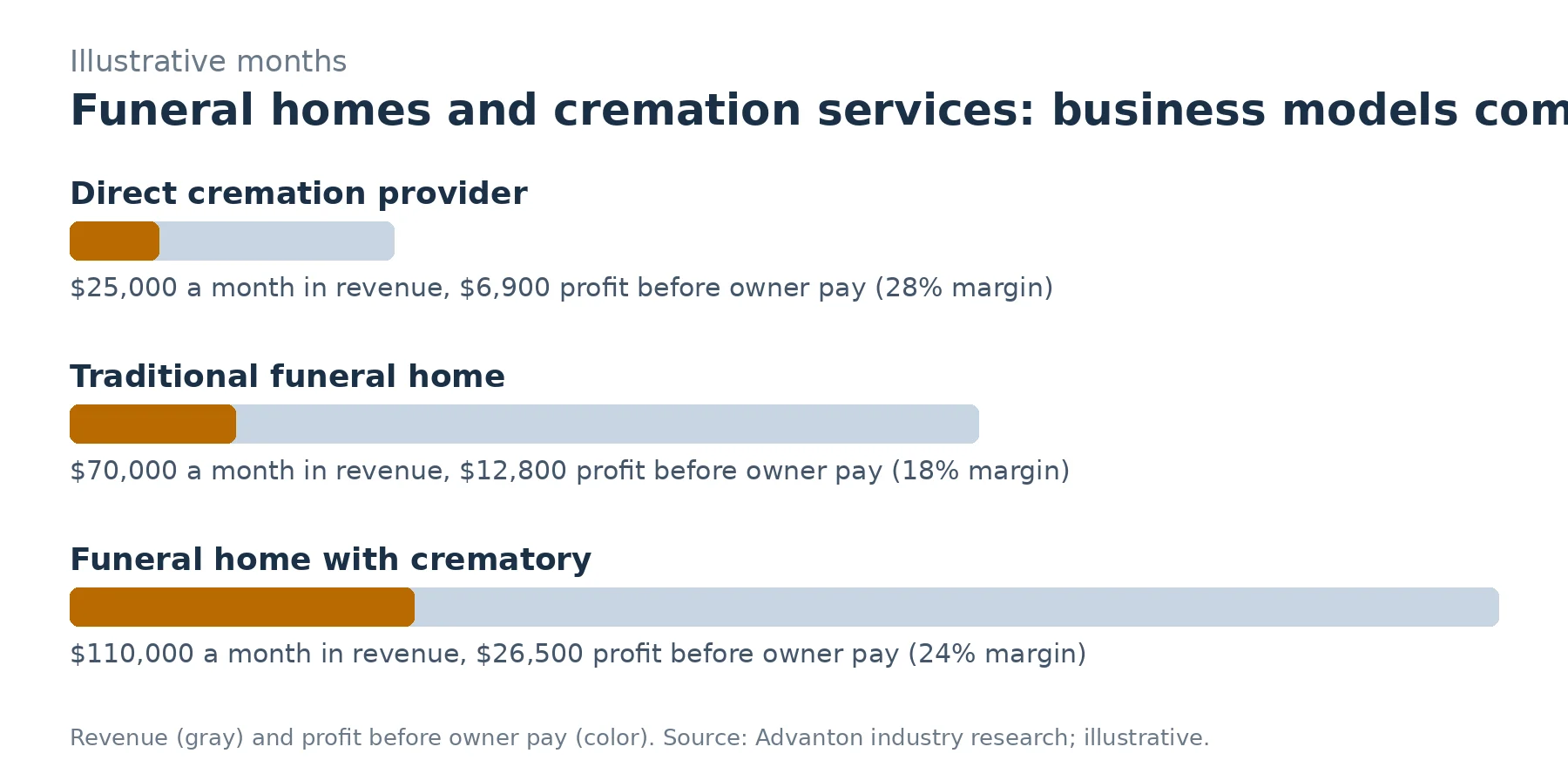
The figures below are illustrative months from our research, not industry averages. They show how revenue and costs typically fit together; your market, prices and costs will differ.
| Business model | Startup costs | Example monthly revenue | Costs | Profit before owner pay | Margin |
|---|---|---|---|---|---|
| Direct cremation provider | Moderate: licensed facility, removal vehicle, crematory contract | $25,000 | $18,100 | $6,900 | 28% |
| Traditional funeral home | Very high: building with chapel and preparation room, vehicles, licenses | $70,000 | $57,200 | $12,800 | 18% |
| Funeral home with crematory | Very high: crematory equipment, permits, facility | $110,000 | $83,500 | $26,500 | 24% |
Fixed and variable costs
For projections, the most useful split is between variable costs, which rise and fall with sales (materials, supplies, hourly labor, fees), and fixed costs, which you pay every month regardless (rent, salaried staff, insurance, loan payments).
| Business model | Variable costs (% of revenue) | Fixed costs per month | What it means |
|---|---|---|---|
| Direct cremation provider | 34.4% | $9,500 | Balanced: margins improve as volume grows |
| Traditional funeral home | 32.9% | $34,200 | Balanced: margins improve as volume grows |
| Funeral home with crematory | 25.5% | $55,500 | Mostly fixed: needs steady volume to cover overhead |
What the numbers say
Staff, facilities and vehicles are heavy fixed costs, so call volume decides profit.
Direct cremation has lower costs and prices with simpler operations.
Owning a crematory reduces third-party fees but adds equipment, permits and environmental compliance.
The three models in brief
Direct cremation provider. Simple cremation without viewing or ceremony, often arranged online or by phone.
Traditional funeral home. Viewings, services, burials and cremation arrangements. See event venues data.
Funeral home with crematory. Full services plus on-site cremation.
Cost structure: traditional funeral home
Each cost as a share of the example month’s revenue ($70,000):
| Cost | Monthly amount | Share of revenue | Type |
|---|---|---|---|
| Funeral directors and staff | $16,000 | 22.9% | Fixed |
| Merchandise (caskets, vaults, urns) | $12,000 | 17.1% | Variable |
| Cash advance items paid for families | $8,000 | 11.4% | Variable |
| Mortgage or lease | $7,000 | 10.0% | Fixed |
| Crematory and third-party fees | $3,000 | 4.3% | Variable |
| Payroll taxes and benefits | $3,000 | 4.3% | Fixed |
| Vehicles | $2,500 | 3.6% | Fixed |
| Utilities and maintenance | $2,500 | 3.6% | Fixed |
| Marketing | $2,000 | 2.9% | Fixed |
| Insurance | $1,200 | 1.7% | Fixed |
| Profit before owner pay | $12,800 | 18% |
A first-year projection: traditional funeral home
New businesses rarely start at full speed. This projection assumes revenue ramps from 35% of the example month in month 1 to 100% by month 12, variable costs move with revenue, and fixed costs stay the same every month. It’s a planning illustration, not a forecast.
| Month | Revenue | Variable costs | Fixed costs | Profit | Cumulative |
|---|---|---|---|---|---|
| 1 | $24,500 | $8,060 | $34,200 | -$17,760 | -$17,760 |
| 2 | $31,500 | $10,364 | $34,200 | -$13,064 | -$30,824 |
| 3 | $38,500 | $12,666 | $34,200 | -$8,366 | -$39,190 |
| 4 | $43,400 | $14,279 | $34,200 | -$5,079 | -$44,269 |
| 5 | $49,000 | $16,121 | $34,200 | -$1,321 | -$45,590 |
| 6 | $53,200 | $17,503 | $34,200 | $1,497 | -$44,093 |
| 7 | $57,400 | $18,885 | $34,200 | $4,315 | -$39,778 |
| 8 | $60,900 | $20,036 | $34,200 | $6,664 | -$33,114 |
| 9 | $63,700 | $20,957 | $34,200 | $8,543 | -$24,571 |
| 10 | $66,500 | $21,878 | $34,200 | $10,422 | -$14,149 |
| 11 | $68,600 | $22,569 | $34,200 | $11,831 | -$2,318 |
| 12 | $70,000 | $23,030 | $34,200 | $12,770 | $10,452 |
Year one: revenue $627,200, profit before owner pay $10,452. The first profitable month is month 6. Cumulative results bottom out at -$45,590, which is the minimum cash cushion this plan would need, before any startup costs.
Funeral directors, the building and vehicles carry fixed costs while the community comes to know the firm, so this funeral home illustration turns profitable in month 6, with a cumulative low of about $45,600, before the property and preparation room investment.
How funeral homes earn
- Professional service fees.
- Embalming, viewing and ceremony charges.
- Caskets, urns and merchandise.
- Cremation services.
- Preneed arrangements and memorial products.
The FTC Funeral Rule
Funeral homes must give families a General Price List with itemized prices, provide prices by phone, and allow families to choose only what they want. They can’t require families to buy a casket from them and must accept caskets and urns bought elsewhere.
Licensing and education
Funeral directors and embalmers usually complete mortuary science education, apprenticeships and exams, and the establishment needs its own license and inspections. Plan years ahead if you’re entering the profession.
A startup checklist
- Earn required licenses and plan the establishment license.
- Create a compliant General Price List.
- Arrange crematory and transport partners.
- Learn your state’s preneed rules.
- Insure the business including professional liability.
Cremation trends
Many families now choose cremation, often with memorial services. Offering flexible cremation options, memorial gatherings and keepsakes meets these needs.
Where the opportunities are
- Direct cremation with online arrangements.
- Celebration-of-life services.
- Green burial where available.
- Pet cremation in partnership with veterinarians.
- Preneed planning for families.
Key terms
| Term | Meaning |
|---|---|
| General Price List | FTC-required itemized price list |
| Preneed | Funeral arrangements made and paid in advance |
| Cash advance items | Third-party costs paid on a family’s behalf |
| Direct cremation | Cremation without viewing or ceremony |
Preneed contracts
States regulate prepaid funeral contracts to protect consumers, often requiring trusts or insurance. Follow your state’s rules precisely.
Key numbers to track
Track calls per year, average revenue per call, cremation share, preneed sales and merchandise margins.
Common mistakes
- Noncompliant price lists.
- Pressuring families.
- Mishandling preneed funds.
- Underestimating facility costs.
- Ignoring cremation trends.
Marketing a funeral home
Community reputation, clergy and hospice relationships, transparent online pricing and preplanning seminars build trust. See assisted living data.
Compassionate service
Families remember kindness and clarity. Train staff to listen, explain options patiently and respect cultural and religious traditions.
Facilities
Chapels, visitation rooms, parking, accessibility and technology for streaming and slideshows matter for services.
Vehicles
Removal vehicles and hearses are significant costs; some firms share, lease or contract for them.
Aftercare
Grief resources, remembrance events and follow-up support build long-term relationships with families and communities.
Buying a funeral home
Many owners buy established homes with reputations; evaluate call volume and preneed trusts carefully.
Pricing transparency online
More families compare prices online before calling. Posting general price ranges or your price list, explaining packages clearly and answering questions by phone builds trust and fits the spirit of the Funeral Rule.
Staffing on call
Deaths happen at all hours, so funeral homes need staff available day and night for removals and family calls. Plan on-call rotations, partner with removal services where appropriate and protect staff from burnout.
Memorialization and personalization
Families increasingly want personal services: photo tributes, video streaming for distant relatives, themed memorials and keepsakes. Offering these options thoughtfully helps families honor loved ones and supports the home’s reputation.
Safety
OSHA rules cover formaldehyde exposure and bloodborne pathogens in preparation rooms.
Test these numbers with your own plan
Open this industry in our free Business Idea Reality Check to start from any model above, change prices, costs, startup budget and your own pay, and see your break-even month, the cash you’d need, three scenarios and how new businesses in this sector survive in your state.
- Start with the closest model and its cost structure.
- Replace every price and cost with local quotes.
- Estimate your ramp: how fast customers will realistically come in year one.
- Map cash month by month with the free Cash & Payroll Planner.
- Build the full plan in the free Business Planner.
About this data
Workforce figures come from the U.S. Bureau of Labor Statistics (Occupational Outlook Handbook and Occupational Employment and Wage Statistics, May 2024 wages and the 2024 to 2034 projections, unless noted). Market figures cite their sources above. Business model figures are illustrative months built from typical prices and costs to show how revenue, fixed costs and variable costs fit together; they are not industry averages or guarantees. We review these profiles when new government data is released, at least once a year, and the same figures power the Business Idea Reality Check.
Licensing and rules
States license funeral directors, embalmers and funeral establishments, typically requiring education, apprenticeship and exams; the FTC Funeral Rule requires a General Price List with itemized prices, price information by phone, a written statement of goods and services selected, and bars requiring purchase of packages or caskets as conditions for other services, including accepting caskets bought elsewhere; preneed funeral contracts are regulated by states, often with trust or insurance requirements; crematories need state and environmental permits; OSHA rules cover formaldehyde and bloodborne pathogens. Requirements change; confirm with your state and local agencies before you start.
Frequently asked questions
Do funeral directors need a license?
Yes; states license funeral directors, embalmers and funeral establishments.
What is the FTC Funeral Rule?
A federal rule requiring itemized price lists and protecting families’ right to choose only what they want.
Can families buy caskets elsewhere?
Yes; funeral homes must accept them without extra fees.
What are preneed contracts?
Prepaid funeral arrangements regulated by states, often with trust requirements.
What do funeral service workers earn?
BLS reported a median of $59,420 in May 2024.
Can a family choose cremation with a service?
Yes; many families combine cremation with viewings or memorial services.
Is a funeral home profitable?
It can be, with steady call volume, fair pricing and controlled facility costs.
How can I test these numbers?
Open funeral homes and cremation services in the Business Idea Reality Check and enter your own numbers.
Keep learning
Sources
Last reviewed November 2, 2026. Startup costs are estimates; check local prices, licensing and tax rules before you commit money.
In India
In India: Funeral and last-rites service providers.
Small businesses like this in India
In MoSPI’s survey of unincorporated businesses (proprietorships, partnerships and similar firms), this falls under Personal and community services (salons, repair, laundry, recreation). In 2023-24 India had 80 lakh such establishments employing 1.08 crore workers, and 87.8% were run without hired workers. Across the wider other services group, the number of establishments grew 10.29% between 2023-24 and 2025.
| Urban | Rural | All India | |
|---|---|---|---|
| Value added per business a year | ₹1,90,118 | ₹1,18,169 | ₹1,57,707 |
| Value added per worker a year | ₹1,33,879 | ₹95,399 | ₹1,17,836 |
| Pay per hired worker a year | ₹1,23,337 | ₹76,541 | ₹1,10,529 |
Running it alone or with staff: businesses with no hired workers added about ₹1,16,951 a year on average, while those with hired workers added about ₹5,02,402 (all India).
Where these businesses are: the states with the most small other services businesses are West Bengal (13.1%), Uttar Pradesh (11.6%), Maharashtra (8.8%), Tamil Nadu (6.2%), Gujarat (6.0%) of the national total (2023-24).
Value added is what a business produces minus what it spends on materials and other inputs, before paying its workers and owner, so it’s a rough guide to the income a typical small business generates. These figures cover the whole activity, which can be broader than this one business type. Across all small businesses, average fixed assets such as equipment, furniture and vehicles were ₹3,42,242 per establishment in 2025.
Licences and registrations to expect
- Registration under your state’s Shops and Establishments Act if you have premises or employees.
- A trade licence from your municipal corporation or council for many shop and service businesses.
- GST registration once turnover crosses ₹40 lakh for goods or ₹20 lakh for services (lower in some special category states), or earlier if you sell goods to other states or through e-commerce marketplaces.
- Professional tax registration in states that levy it.
- Free Udyam (MSME) registration, which helps with loans, government schemes and delayed-payment protection.
Rules differ by state and city. Check with your municipal corporation, state departments and a chartered accountant before you start.
Run a business like this in India? List it free in the India Business Directory, with your hours, deals and GST registration.
Free tools for India: Make a GST invoice · Compare business credit cards
Sources: MoSPI, Annual Survey of Unincorporated Sector Enterprises (ASUSE) 2023-24, full report, Appendix A Tables 4, 29, 33, 35 and 37 (survey period October 2023 to September 2024); MoSPI, Annual Survey of Unincorporated Sector Enterprises (ASUSE) 2025, factsheet (survey period January to December 2025, released 24 March 2026). Licensing summary by Advanton, checked November 2026.

