
Clothing brands increasingly want small-batch, local production for faster turnaround and smaller minimums, and businesses need uniforms and branded apparel. Small apparel manufacturers cut and sew garments for brands, run their own clothing lines or decorate apparel for teams and companies. Tailors, dressmakers and custom sewers earned a median of about $40,860 in May 2024, according to BLS figures as reported.
Businesses range from cut-and-sew contractors producing for designers to small clothing brands with local production and uniform and promotional apparel shops. Labeling, safety and labor laws apply to every garment.
The workforce
| Occupation | Jobs (2024) | Median pay (May 2024) | Projected growth, 2024 to 2034 |
|---|---|---|---|
| Tailors, dressmakers and custom sewers (median as reported) | 16,290 | $40,860 | n/a |
Source: U.S. Bureau of Labor Statistics, Occupational Outlook Handbook and Occupational Employment and Wage Statistics.
Business models compared
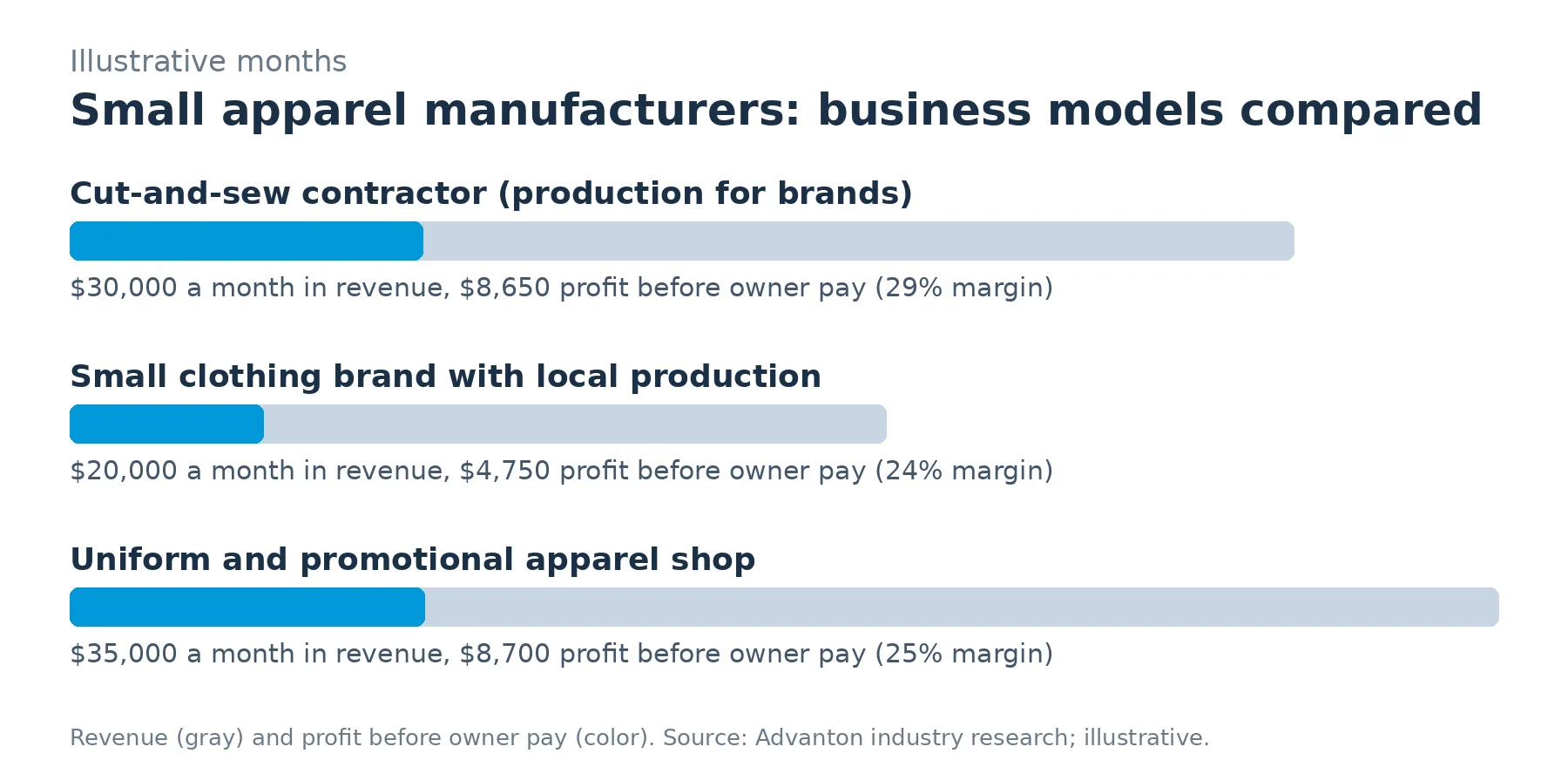
The figures below are illustrative months from our research, not industry averages. They show how revenue and costs typically fit together; your market, prices and costs will differ.
| Business model | Startup costs | Example monthly revenue | Costs | Profit before owner pay | Margin |
|---|---|---|---|---|---|
| Cut-and-sew contractor (production for brands) | Moderate: industrial machines, cutting table, space, sewers | $30,000 | $21,350 | $8,650 | 29% |
| Small clothing brand with local production | Moderate: samples, patterns, first production run, website | $20,000 | $15,250 | $4,750 | 24% |
| Uniform and promotional apparel shop | Moderate: embroidery machines, heat presses, blanks inventory | $35,000 | $26,300 | $8,700 | 25% |
Fixed and variable costs
For projections, the most useful split is between variable costs, which rise and fall with sales (materials, supplies, hourly labor, fees), and fixed costs, which you pay every month regardless (rent, salaried staff, insurance, loan payments).
| Business model | Variable costs (% of revenue) | Fixed costs per month | What it means |
|---|---|---|---|
| Cut-and-sew contractor (production for brands) | 51.7% | $5,850 | Mostly variable: profitable early, but watch cash flow |
| Small clothing brand with local production | 49.5% | $5,350 | Balanced: margins improve as volume grows |
| Uniform and promotional apparel shop | 44.3% | $10,800 | Balanced: margins improve as volume grows |
What the numbers say
Labor is the largest cost for cut-and-sew contractors, so efficiency and pricing per piece decide margins.
Brands earn retail margins but carry inventory and marketing risk.
Uniform shops combine blanks with decoration, earning on volume and repeat business orders.
The three models in brief
Cut-and-sew contractor. Producing garments for brands and designers. See small manufacturing data.
Small clothing brand. Designing and selling your own line with local production. See boutiques data.
Uniform and promotional apparel shop. Embroidery and printing on blanks for businesses and teams. See print on demand data.
Cost structure: small clothing brand with local production
Each cost as a share of the example month’s revenue ($20,000):
| Cost | Monthly amount | Share of revenue | Type |
|---|---|---|---|
| Production and fabric | $8,000 | 40.0% | Variable |
| Ads and marketing | $2,500 | 12.5% | Fixed |
| Studio rent | $1,500 | 7.5% | Fixed |
| Shipping and packaging | $1,200 | 6.0% | Variable |
| Pattern and sample development | $800 | 4.0% | Fixed |
| Payment and platform fees | $700 | 3.5% | Variable |
| Photography | $400 | 2.0% | Fixed |
| Insurance | $150 | 0.8% | Fixed |
| Profit before owner pay | $4,750 | 24% |
A first-year projection: small clothing brand with local production
New businesses rarely start at full speed. This projection assumes revenue ramps from 35% of the example month in month 1 to 100% by month 12, variable costs move with revenue, and fixed costs stay the same every month. It’s a planning illustration, not a forecast.
| Month | Revenue | Variable costs | Fixed costs | Profit | Cumulative |
|---|---|---|---|---|---|
| 1 | $7,000 | $3,465 | $5,350 | -$1,815 | -$1,815 |
| 2 | $9,000 | $4,455 | $5,350 | -$805 | -$2,620 |
| 3 | $11,000 | $5,445 | $5,350 | $205 | -$2,415 |
| 4 | $12,400 | $6,138 | $5,350 | $912 | -$1,503 |
| 5 | $14,000 | $6,930 | $5,350 | $1,720 | $217 |
| 6 | $15,200 | $7,524 | $5,350 | $2,326 | $2,543 |
| 7 | $16,400 | $8,118 | $5,350 | $2,932 | $5,475 |
| 8 | $17,400 | $8,613 | $5,350 | $3,437 | $8,912 |
| 9 | $18,200 | $9,009 | $5,350 | $3,841 | $12,753 |
| 10 | $19,000 | $9,405 | $5,350 | $4,245 | $16,998 |
| 11 | $19,600 | $9,702 | $5,350 | $4,548 | $21,546 |
| 12 | $20,000 | $9,900 | $5,350 | $4,750 | $26,296 |
Year one: revenue $179,200, profit before owner pay $26,296. The first profitable month is month 3. Cumulative results bottom out at -$2,620, which is the minimum cash cushion this plan would need, before any startup costs.
Rent, machine payments and staff start before contracts fill production, so this contractor illustration turns profitable in month 3, with a cumulative low of about $2,600, before equipment purchases.
How apparel manufacturers earn
- Per-piece production pricing.
- Sample and pattern development fees.
- Direct sales of your own brand.
- Decoration such as embroidery and printing.
- Uniform contracts with businesses.
Labeling rules
Every garment needs fiber content, country of origin, manufacturer identity and care instructions. Labels must be accurate and permanent, and brands often rely on manufacturers to get them right.
Children’s clothing safety
Children’s garments must meet lead limits, drawstring rules for outerwear and testing and certification requirements. Many small producers avoid children’s clothing until they understand the requirements.
A startup checklist
- Choose your model: contractor, brand or decoration.
- Equip a production floor with industrial machines.
- Learn labeling and safety rules.
- Register with your state if required.
- Set fair wages and track production.
Pricing production
Price per piece based on sewing time, complexity, minimums and overhead. Time studies on samples improve quotes and show where production can be made more efficient.
Where the opportunities are
- Small-batch production for emerging brands.
- Sustainable and local fashion.
- Uniforms for restaurants and trades.
- Adaptive clothing.
- Team and event apparel.
Key terms
| Term | Meaning |
|---|---|
| Cut-and-sew | Manufacturing garments from cut fabric |
| Minimum order | Smallest production run accepted |
| Tech pack | Detailed garment specifications |
| Care label | Label with washing and care instructions |
Quality control
Inspect seams, measurements and labels before shipping; returns and rework are costly and can end client relationships.
Key numbers to track
Track minutes per garment, defects, on-time delivery, labor cost per piece and customer retention.
Common mistakes
- Underquoting production.
- Missing labeling requirements.
- Children’s products without testing.
- Unsupported Made in USA claims.
- Weak quality control.
Marketing an apparel business
Fashion incubators, design schools, local brands and uniform buyers bring production work. See boutiques data.
Made in USA claims
Products labeled Made in USA must be all or virtually all made domestically under FTC rules, including significant parts and processing.
Fair labor
Fair pay, safe conditions and proper records protect workers, satisfy brand audits and protect your reputation.
Sampling
Sampling and pattern services help new brands refine designs and often lead to repeat production orders.
Equipment
Industrial machines, cutting tables and pressing equipment are core investments; maintain them carefully to avoid production delays.
Lead times
Fast turnaround and small minimums are key advantages for domestic producers competing with overseas factories.
Tech packs and onboarding brands
New brands often arrive without complete specifications. Helping them build tech packs, approve samples and set realistic timelines prevents costly production mistakes and builds long relationships.
Minimums and scheduling
Set minimum order quantities that keep production efficient, and schedule jobs to keep sewers busy without overloading the floor. Clear deposits and approval steps protect cash flow.
Fabric sourcing
Reliable fabric suppliers, minimum orders and lead times affect pricing and schedules, so plan sourcing early with each client.
Test these numbers with your own plan
Open this industry in our free Business Idea Reality Check to start from any model above, change prices, costs, startup budget and your own pay, and see your break-even month, the cash you’d need, three scenarios and how new businesses in this sector survive in your state.
- Start with the closest model and its cost structure.
- Replace every price and cost with local quotes.
- Estimate your ramp: how fast customers will realistically come in year one.
- Map cash month by month with the free Cash & Payroll Planner.
- Build the full plan in the free Business Planner.
About this data
Workforce figures come from the U.S. Bureau of Labor Statistics (Occupational Outlook Handbook and Occupational Employment and Wage Statistics, May 2024 wages and the 2024 to 2034 projections, unless noted). Market figures cite their sources above. Business model figures are illustrative months built from typical prices and costs to show how revenue, fixed costs and variable costs fit together; they are not industry averages or guarantees. We review these profiles when new government data is released, at least once a year, and the same figures power the Business Idea Reality Check.
Licensing and rules
Garments sold in the U.S. need labels showing fiber content, country of origin and manufacturer or dealer identity under FTC textile rules, plus care instructions under the FTC Care Labeling Rule; clothing must meet the federal flammability standard for clothing textiles; children’s apparel must meet CPSC requirements, including lead limits, drawstring rules for outerwear and testing and certification; "Made in USA" claims must meet the FTC standard; some states, such as California, require garment manufacturers to register and impose additional wage protections; wage and hour laws apply to all sewers. Requirements change; confirm with your state and local agencies before you start.
Frequently asked questions
What labels do garments need?
Fiber content, country of origin, manufacturer or dealer identity and care instructions.
Are there rules for children’s clothing?
Yes, including lead limits, drawstring rules and testing and certification.
Can I label clothing Made in USA?
Only if it meets the FTC standard of all or virtually all domestic production.
Do apparel manufacturers need registration?
Some states, such as California, require garment manufacturer registration, along with wage and labor protections.
What do sewers earn?
Tailors and custom sewers earned about a $40,860 median in May 2024 (BLS, as reported).
Is apparel manufacturing profitable?
It can be, with efficient production, fair pricing and steady clients.
What is a tech pack?
A detailed specification of a garment’s design, measurements and materials.
What minimums do small factories set?
Minimums vary; small domestic producers often accept smaller runs than overseas factories.
How can I test these numbers?
Open small apparel manufacturers in the Business Idea Reality Check and enter your own numbers.
Keep learning
Sources
Last reviewed November 2, 2026. Startup costs are estimates; check local prices, licensing and tax rules before you commit money.
In India
Small businesses like this in India
In MoSPI’s survey of unincorporated businesses (proprietorships, partnerships and similar firms), this falls under Wearing apparel (tailoring and garments). In 2023-24 India had 89.3 lakh such establishments employing 1.11 crore workers, and 95.1% were run without hired workers. Across the wider manufacturing group, the number of establishments grew 6.48% between 2023-24 and 2025.
| Urban | Rural | All India | |
|---|---|---|---|
| Value added per business a year | ₹1,56,928 | ₹62,496 | ₹1,00,269 |
| Value added per worker a year | ₹1,06,673 | ₹57,127 | ₹80,548 |
| Pay per hired worker a year | ₹1,33,328 | ₹98,384 | ₹1,28,371 |
Running it alone or with staff: businesses with no hired workers added about ₹66,164 a year on average, while those with hired workers added about ₹7,56,746 (all India).
Where these businesses are: the states with the most small manufacturing businesses are West Bengal (16.0%), Uttar Pradesh (11.8%), Maharashtra (7.7%), Gujarat (7.2%), Tamil Nadu (6.9%) of the national total (2023-24).
Value added is what a business produces minus what it spends on materials and other inputs, before paying its workers and owner, so it’s a rough guide to the income a typical small business generates. These figures cover the whole activity, which can be broader than this one business type. Across all small businesses, average fixed assets such as equipment, furniture and vehicles were ₹3,42,242 per establishment in 2025.
Licences and registrations to expect
- Consent to Establish and Consent to Operate from your State Pollution Control Board, unless your activity is in the exempt white category.
- Factory registration under the OSH Code once you have 20 or more workers with power (40 without).
- BIS certification for products covered by mandatory quality control orders, and Legal Metrology registration for packaged goods.
- Registration under your state’s Shops and Establishments Act if you have premises or employees.
- A trade licence from your municipal corporation or council for many shop and service businesses.
- GST registration once turnover crosses ₹40 lakh for goods or ₹20 lakh for services (lower in some special category states), or earlier if you sell goods to other states or through e-commerce marketplaces.
- Professional tax registration in states that levy it.
- Free Udyam (MSME) registration, which helps with loans, government schemes and delayed-payment protection.
Rules differ by state and city. Check with your municipal corporation, state departments and a chartered accountant before you start.
Run a business like this in India? List it free in the India Business Directory, with your hours, deals and GST registration.
Free tools for India: Make a GST invoice · Compare business credit cards
Sources: MoSPI, Annual Survey of Unincorporated Sector Enterprises (ASUSE) 2023-24, full report, Appendix A Tables 4, 29, 33, 35 and 37 (survey period October 2023 to September 2024); MoSPI, Annual Survey of Unincorporated Sector Enterprises (ASUSE) 2025, factsheet (survey period January to December 2025, released 24 March 2026). Licensing summary by Advanton, checked November 2026.

