
A YouTube channel business earns money from videos: advertising revenue through the YouTube Partner Program, sponsorships, channel memberships, affiliate links, products and services. Channels built around a clear niche, such as cooking, personal finance, home improvement, gaming, education or reviews, can grow into real businesses with teams.
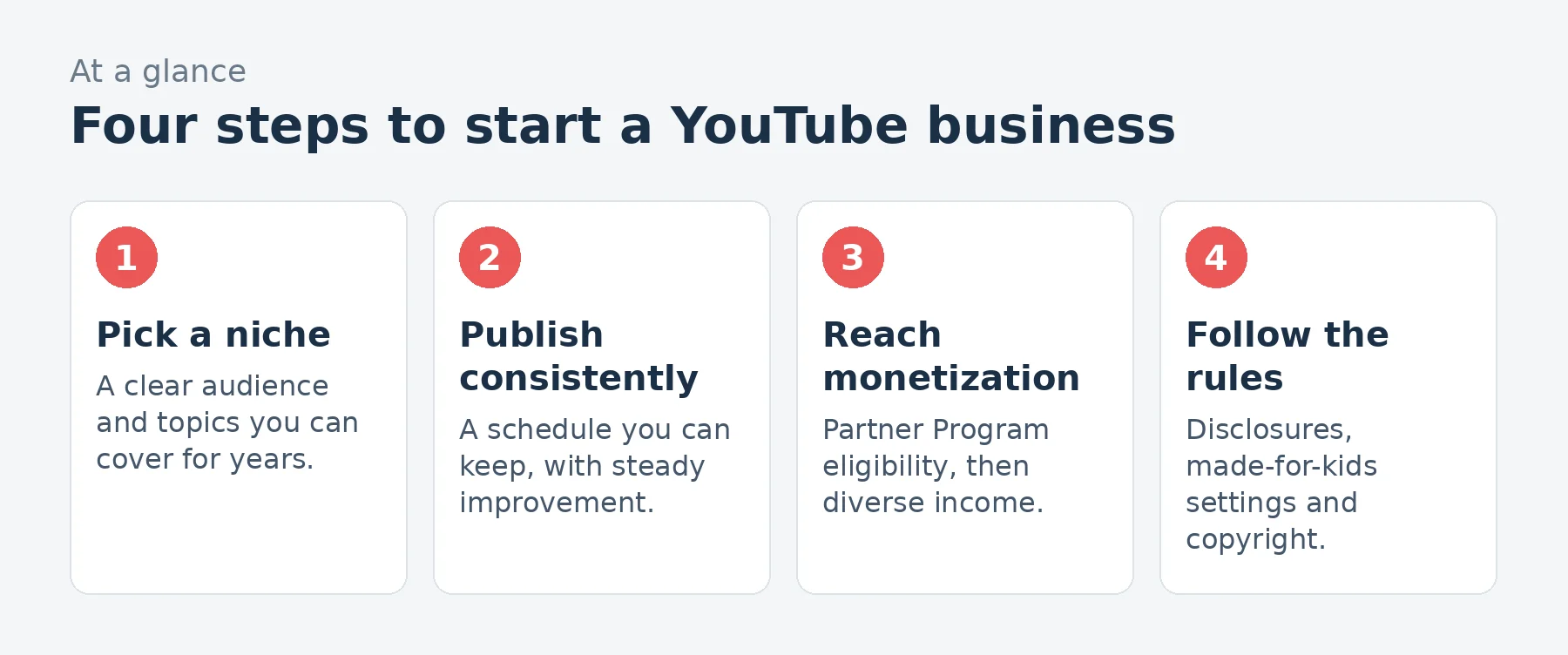
Monetization has thresholds: to earn ad revenue, channels generally need 1,000 subscribers plus either 4,000 valid public watch hours in the past 12 months or 10 million valid public Shorts views in the past 90 days, and must follow YouTube’s policies. Creators also must follow FTC disclosure rules, children’s privacy rules for made-for-kids content and copyright law. The Bureau of Labor Statistics reports a median pay of $72,270 for writers and authors (May 2024), with about 135,400 jobs and employment projected to grow about 4% over the decade. Independent creators’ income varies enormously, from nothing to substantial businesses. This guide covers niche, the Partner Program, revenue streams, rules, equipment, a worked example and a 90-day plan.
A YouTube channel business at a glance
Table of Contents
| Topic | What to expect |
|---|---|
| Startup cost | Low: a camera or phone, microphone, lighting, editing software and time; more as production grows |
| Monetization threshold | 1,000 subscribers and 4,000 public watch hours in 12 months, or 1,000 subscribers and 10 million Shorts views in 90 days |
| Revenue streams | Ad revenue share, sponsorships, memberships, affiliate links, products, courses and services |
| Key rules | FTC disclosure of sponsorships, made-for-kids designation under COPPA rules and copyright |
| Best for | Consistent creators who enjoy teaching or entertaining and can publish for years |
Who a YouTube business suits
It suits people who enjoy creating, can be comfortable on camera (or produce faceless content well), learn from analytics and keep publishing even when growth is slow. Most channels take a long time to grow, so consistency matters more than any single video.
Choosing a niche
A niche is a specific audience plus a topic: "budget home repairs for first-time owners" rather than "home." Niches with clear viewer problems and buying intent (personal finance, software tutorials, home improvement, health and fitness, business) often attract better sponsorships and affiliate income than general entertainment.
The YouTube Partner Program
Channels can apply to the Partner Program once they meet the thresholds: 1,000 subscribers and 4,000 valid public watch hours in the last 12 months, or 1,000 subscribers and 10 million valid public Shorts views in the last 90 days. YouTube also offers earlier access to some fan funding features, such as memberships, at lower thresholds. Channels must follow YouTube’s monetization policies and community guidelines and live in an eligible country.
How ad revenue is shared
For long-form videos, creators in the Partner Program receive 55% of net ad revenue from ads shown on their videos, while Shorts revenue is pooled and shared under a separate formula. Ad rates vary greatly by niche, audience location and season, so ad revenue per view differs widely between channels.
Other revenue streams
- Sponsorships: brand integrations, often the biggest income source for mid-sized channels.
- Channel memberships, Super Chat and Super Thanks from fans.
- Affiliate links to products you recommend.
- Your own products: courses, templates, merchandise, books or services.
- Licensing footage or content to media companies.
Sponsorship disclosures
Sponsorships, affiliate links, free products and paid partnerships must be clearly disclosed under the FTC’s Endorsement Guides: disclosures should be easy to notice, in plain language (such as "sponsored" or "I earn a commission"), and placed where audiences will see them, not buried in a link or at the end.
YouTube also requires creators to turn on its paid promotion setting for videos with paid product placements, sponsorships or endorsements.
Made-for-kids content
Following an FTC settlement over children’s privacy, YouTube requires every creator to set whether videos are made for kids. Made-for-kids videos have personalized ads and some features turned off to comply with COPPA. Mislabeling child-directed content can lead to enforcement against creators, so set the designation accurately.
Copyright and music
Use only music, footage and images you own, license or may use under the law. YouTube’s Content ID system detects copyrighted material and can block videos or send revenue to rights holders. Fair use may allow limited use for commentary, criticism or teaching, but it is judged case by case, so do not rely on it casually. Use YouTube’s audio library or licensed music services.
Equipment and production
- Audio first: a quality microphone matters more than a camera.
- Camera: a recent smartphone is enough to start; upgrade later.
- Lighting: a softbox or ring light and natural light.
- Editing software and a computer that handles video.
- Thumbnails and titles: design tools and testing.
Startup costs to plan for
| Item | What to budget for |
|---|---|
| Audio | Microphone and acoustic treatment |
| Camera and lighting | Phone or camera, lights, tripod |
| Software | Editing, thumbnails, music licensing |
| Computer | Capable of video editing |
| Business setup | Entity, bank account, contracts for sponsors |
| Outsourcing | Editor or thumbnail designer as you grow |
Use our startup cost calculator for your total.
Growing the channel
Study what your audience searches for and watches, write titles and thumbnails that clearly promise value, deliver on that promise quickly in the video and review analytics such as click-through rate and average view duration. Shorts can bring discovery, while long-form videos often build deeper loyalty and more revenue.
A worked example: an educational channel
These are illustrative assumptions for an established educational channel, not predictions; YouTube income varies widely by niche and audience.
| Assumption | Monthly | |
|---|---|---|
| Ad revenue share | About 400,000 long-form monthly views | $2,800 |
| Sponsorships | 2 integrations at $1,500 | $3,000 |
| Affiliate commissions | $900 | |
| Digital product sales | Templates or a mini course | $1,200 |
| Revenue | $7,900 | |
| Video editor | Freelance, per video | $(1,600) |
| Software, music licenses and stock footage | $(150) | |
| Equipment replacement fund | $(200) | |
| Profit before owner pay and taxes | $5,950 |
That leaves about $5,950 a month before the creator’s pay and taxes, on about $7,900 of revenue. Ad revenue alone is rarely enough; sponsorships and the creator’s own products usually make the business work.
Loading the calculator…
Working with sponsors
Prepare a media kit with audience demographics, average views and past results. Agree in writing on deliverables, talking points, review rights, disclosure, usage rights, exclusivity and payment terms. Only promote products you believe in; trust is your audience’s most valuable gift.
Building a team and workflow
Channels that grow often add an editor, thumbnail designer, researcher or manager. A content calendar, script templates and a repeatable editing process let you publish consistently without burning out.
Reading analytics
YouTube Studio shows impressions, click-through rate, average view duration, retention graphs and traffic sources. A low click-through rate points to titles and thumbnails; viewers leaving early points to slow introductions or unmet promises. Review each video’s numbers and change one thing at a time.
Altered or synthetic content
YouTube requires creators to disclose realistic altered or AI-generated content that viewers could mistake for real people, places or events, using its disclosure setting. Being transparent about synthetic content protects trust and keeps the channel within platform policies.
Common mistakes to avoid
- Giving up before the channel has enough videos to learn from.
- Hiding sponsorships or affiliate relationships.
- Mislabeling made-for-kids content.
- Using copyrighted music without a license.
- Relying on ad revenue alone.
Your first 90 days
- Days 1-30: choose a niche, plan 20 video ideas and set up audio, lighting and editing.
- Days 31-60: publish weekly, study analytics and improve titles and thumbnails.
- Days 61-90: keep publishing, add Shorts and start an email list or simple product to own your audience.
Frequently asked questions
How many subscribers do you need to make money on YouTube?
Ad revenue requires 1,000 subscribers plus 4,000 public watch hours in 12 months or 10 million Shorts views in 90 days; some fan funding features open earlier.
How much does YouTube pay creators?
Partner Program creators receive 55% of net ad revenue on long-form videos; earnings per view vary widely by niche and audience.
Do I have to disclose sponsorships?
Yes. FTC rules require clear disclosure, and YouTube requires the paid promotion setting.
What does made for kids mean?
Videos directed at children must be labeled so personalized ads and some features are turned off, to comply with COPPA.
Can I use popular music in my videos?
Only with permission or a license; otherwise Content ID may block the video or redirect revenue.
How long does it take to grow a YouTube channel?
Usually many months or years of consistent publishing, with improvement driven by analytics.
Should I make Shorts or long videos?
Many channels use Shorts for discovery and long-form videos for deeper loyalty and revenue; test both for your niche.
Can I run a faceless YouTube channel?
Yes. Many channels use voiceovers, screen recordings or animation, but original value matters; YouTube restricts monetization of repetitive or mass-produced content.
Do I need to pay taxes on YouTube income?
Yes. YouTube earnings are taxable income; keep records and set aside money for taxes.
Keep learning
- Content creation industry data
- How to start a podcast business
- How to start an online course business
- How to start a video production company
Sources
- YouTube Help, YouTube Partner Program overview and eligibility
- YouTube Help, YouTube Partner Program revenue sharing
- YouTube Help, Determining if your content is made for kids (COPPA)
- FTC, Google and YouTube settlement over children's privacy (COPPA)
- FTC, Disclosures 101 for social media influencers
- US Copyright Office, Fair use index and copyright basics
Last reviewed November 3, 2026. Startup costs are estimates; check local prices, licensing and tax rules before you commit money.

