
A video production company plans, films and edits video for clients: marketing videos, social media content, testimonials, training videos, events, weddings and commercials. Demand has grown as nearly every business now needs video for its website and social media.
Prices vary enormously with scope. The Knot’s 2025 Real Weddings Study put the average wedding videographer at about $2,300, while commercial pricing guides show combined photo and video packages for events and businesses at roughly $500 to $1,500 and cinematic commercial productions at $1,500 to $5,000 or more. This guide covers choosing services, gear, crews, pricing, legal basics, a worked example and winning clients.
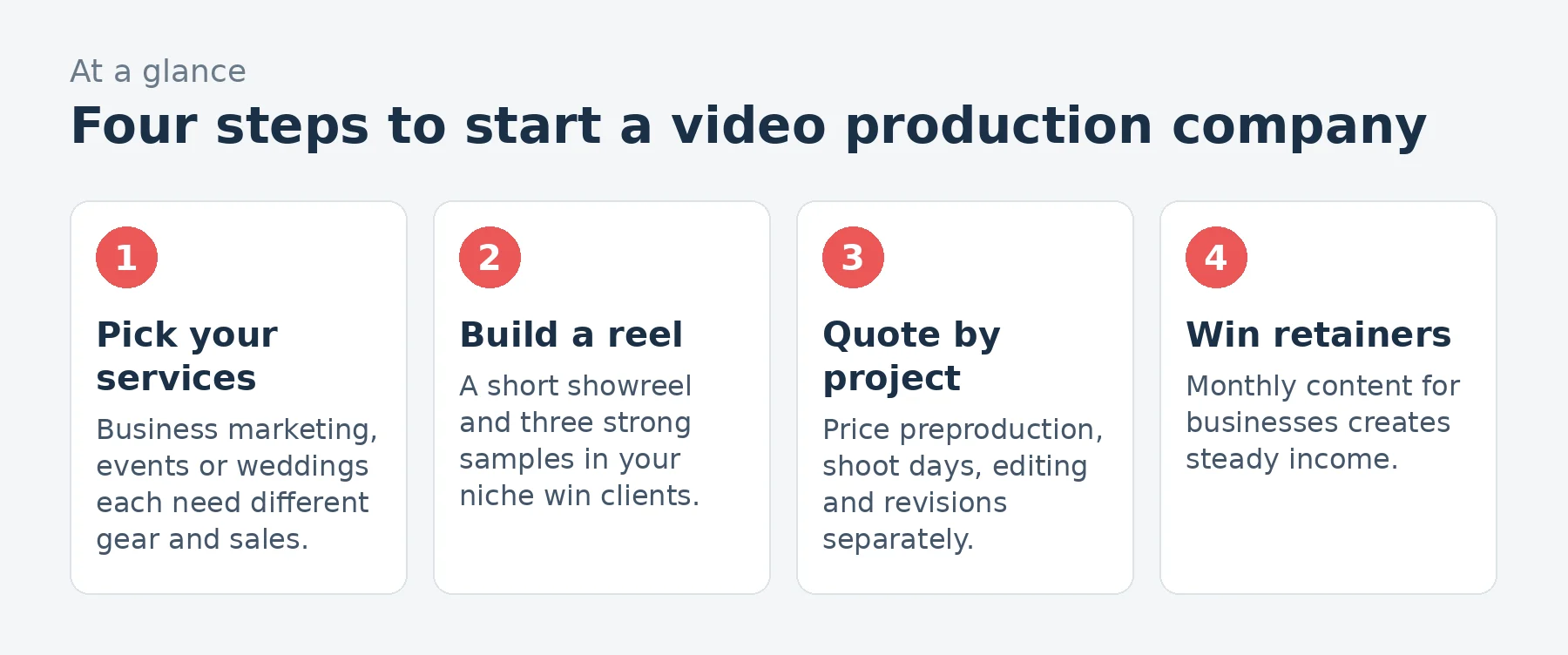
A video production company at a glance
Table of Contents
| Topic | What to expect |
|---|---|
| Startup cost | Moderate: cameras, lenses, audio, lighting, a capable editing computer and software, insurance |
| Licenses | A business license; film permits for some public locations; releases from people filmed |
| What clients pay | Wedding videography about $2,300 on average (The Knot 2025); business videos from hundreds to several thousand dollars per project |
| Best services | Recurring business content, testimonials, training and events |
| Best for | Creative people who also manage projects, deadlines and client expectations well |
Who a video business suits
Video production suits people who combine creative and technical skills with organization. A good video depends on planning (scripts, shot lists, schedules) and on editing, which takes far more time than filming.
The Bureau of Labor Statistics reports a median pay of $70,980 for film and video editors (May 2024). Owners earn what remains after crew, equipment and software, so efficient workflows and well-scoped projects matter.
Choosing your services
- Business marketing videos: brand stories, product videos and website videos.
- Social media content: short videos produced in batches, often on monthly retainers.
- Testimonials and case studies: interviews with customers, steady demand from B2B companies.
- Training and internal videos: for companies, schools and nonprofits.
- Events and conferences: highlight films and recorded sessions.
- Weddings: high emotion and seasonal; The Knot found only 37% of couples book a videographer, and some later regret not doing so.
Specializing makes marketing easier. A company known for testimonial videos for manufacturers, or social content for restaurants, competes less on price.
Equipment
- Cameras: at least two bodies that shoot high-quality video, with matching color.
- Lenses: a versatile zoom and fast primes for interviews.
- Audio: wireless lavalier microphones, a shotgun microphone and a recorder. Viewers forgive imperfect video before bad sound.
- Lighting: a portable kit for interviews.
- Support: tripods, a gimbal and possibly a slider.
- Editing: a powerful computer, editing and color software and plenty of backed-up storage.
Rent specialized gear for specific jobs instead of buying everything at once.
Legal basics: releases, music and permits
Get signed releases from people who appear in client videos, especially in marketing. Use only properly licensed music; copyrighted songs used without permission can get videos removed or lead to claims. Music licensing services offer libraries for commercial use. Some cities and parks require film permits for shooting in public places, particularly with crews or equipment. Your contract should state who owns the final video and raw footage, how many revisions are included and delivery dates.
Pricing your work
| Type of work | Typical pricing references |
|---|---|
| Wedding videography | About $2,300 on average (The Knot 2025 Real Weddings Study) |
| Photo and video for businesses or events | About $500 to $1,500 (Proshoot 2026) |
| Cinematic commercial production | About $1,500 to $5,000+ (Proshoot 2026) |
| 3 to 5 minutes of finished commercial content | About $900 to $2,000+ (Fiverr 2026, drone video) |
Quote by project, broken into preproduction (planning, scripting, scheduling), production (shoot days, crew, gear) and postproduction (editing, color, sound, graphics, revisions). Set the number of revision rounds and charge for extras. Use our pricing calculator to check your margins.
A worked example: owner plus freelancers
These are illustrative assumptions, not predictions.
| Assumption | Monthly | |
|---|---|---|
| Business video projects | 5 projects at $2,000 average | $10,000 |
| Monthly content retainers | 3 clients at $1,200 | $3,600 |
| Event and wedding films | 2 at $2,300 | $4,600 |
| Revenue | $18,200 | |
| Freelance crew and editors | Second shooters and an outside editor | $(4,200) |
| Equipment replacement and rentals | $(900) | |
| Software, storage and music licensing | $(500) | |
| Insurance | Liability and equipment | $(250) |
| Marketing | $(800) | |
| Travel | $(400) | |
| Profit before owner pay and taxes | $11,150 |
That leaves about $11,150 a month before the owner’s pay and taxes, on about $18,200 of revenue. Retainers are the most valuable line: they bring predictable work and long client relationships.
Loading the calculator…
A simple project workflow
- Discovery call: goals, audience, where the video will be used, budget and deadline.
- Proposal and contract: scope, deliverables, revisions, schedule and payment terms.
- Preproduction: script or interview questions, shot list, locations and releases.
- Shoot: capture extra footage and clean audio.
- Edit: rough cut, client review, final cut with color, sound and captions.
- Delivery: files sized for each platform, plus an archive of the project.
Working with freelancers
Most small video companies keep a core team and bring in freelancers per project: camera operators, sound recordists, editors, motion graphics designers and drone pilots. This keeps fixed costs low. Use written agreements that cover pay, deadlines, confidentiality and who owns the footage, and confirm whether each person should be treated as a contractor or employee under your state’s rules. Reliable freelancers are an asset; pay them on time and send them steady work.
Captions, formats and accessibility
Most social video is watched with the sound off, so add captions to nearly everything; they also make videos accessible to people who are deaf or hard of hearing. Deliver versions sized for each platform, such as wide for websites and YouTube and vertical for short-form social video, and include thumbnails and short cut-downs. Offering these as part of a package adds value without much extra shooting.
Turning one shoot into many videos
Clients get more value, and you earn more per shoot day, when one shoot produces a full set of content. Plan shoots so a single interview yields a main brand video, several short clips for social media, quotes for ads and still frames for the website. Explain this in your proposals: a well-planned shoot day that delivers a month of content is easier to sell than a single video.
How to win clients
- A strong showreel and niche samples on your website.
- Marketing agencies that need production partners.
- Local businesses and chambers of commerce, especially for testimonial and social content.
- Wedding and event planners if you film events.
- Retainer offers: monthly content packages for businesses.
Check your local search presence with our Local SEO Check.
Structuring monthly retainers
A retainer works best when the scope is specific. Define the number of shoot days or half-days each month, the number and length of finished videos, platforms and formats, revision rounds and how unused work is handled. Bill at the start of each month, agree to a minimum term such as three or six months, and review the plan with the client quarterly so the content keeps improving their results. Clear scope protects both sides from a retainer slowly turning into unlimited free work.
Common mistakes to avoid when starting a video production company
- Underestimating editing time.
- Unlimited revisions in contracts.
- Poor audio.
- Using unlicensed music.
- Buying expensive gear before winning paying work.
Your first 90 days as a video production company owner
- Days 1-30: choose your niche, register your business, buy core gear and insurance and draft a contract.
- Days 31-60: produce three strong sample videos and a short showreel; set up licensed music.
- Days 61-90: contact 30 businesses and 5 agencies, and pitch monthly content retainers.
Frequently asked questions about starting a video production company
How much does it cost to start a video production company?
It depends on gear. Many start with two good cameras, solid audio, a lighting kit and a strong computer, renting specialized gear as needed.
How much do videographers charge?
Wedding videographers averaged about $2,300 in The Knot’s 2025 study. Business videos range from a few hundred to several thousand dollars depending on scope.
Do I need permission to use music in videos?
Yes. Use licensed music from a library that allows commercial use, or get permission from the rights holder.
Do I need permits to film?
Some cities and parks require film permits for public locations, especially with crews and equipment. Check before you shoot.
What is a video retainer?
A monthly agreement to produce a set amount of content for a client, such as social videos, giving you predictable income.
Should I add captions to client videos?
Yes. Captions help viewers who watch without sound and make videos accessible to people who are deaf or hard of hearing.
How should I price a video retainer?
Base it on the shoot time, editing and deliverables included each month, with a clear scope, a minimum term and a defined number of revisions.
Should I deliver raw footage to clients?
Decide in your contract. Many companies deliver only finished videos by default and charge for raw footage, because it takes storage, time and organization to hand over. Some clients, especially agencies, require it, so price it in when they do.
Keep learning
- Photography and video industry data
- How to start a drone photography business
- Pricing calculator
- Local SEO Check
Sources
- The Knot, 2025 Real Weddings Study vendor costs (via Snappr)
- US Bureau of Labor Statistics, Film and video editors and camera operators
- Fiverr, How much does it cost to hire a drone videographer? (2026)
- Proshoot, Drone photography cost guide 2026
- US Copyright Office, Copyright basics
Last reviewed November 2, 2026. Startup costs are estimates; check local prices, licensing and tax rules before you commit money.
This article is general information, not financial, legal or tax advice. Check the rules that apply to you or talk to a qualified professional before making decisions. See our disclaimer.