
Tire shops sell and install new and used tires and offer balancing, rotation, flat repair, tire pressure monitoring (TPMS) service and often wheel alignment, brakes and oil changes. Every car needs new tires every few years, so demand is steady, and good shops build loyal customers with fair prices and fast service.
Profit depends on buying tires well, keeping bays busy and adding services. There are also specific rules: tire registration at sale, safe handling of used tires, state scrap tire fees and disposal, and OSHA’s rules for safely servicing rim wheels.
A tire shop at a glance
Table of Contents
| Topic | What to expect |
|---|---|
| Startup cost | Moderate to high: lease and bays, tire changers, balancers, lifts, alignment machine, compressor, inventory and insurance |
| Key rules | Tire registration, recall checks, used tire safety, scrap tire fees and disposal, OSHA rim wheel safety |
| Revenue model | Tire sales plus installation, alignment, repairs and add-ons |
| How you earn | Tire margins, labor, road hazard warranties, alignments and services |
| Best for | Hands-on operators who like fast-paced work, sales and managing a busy shop |
Who a tire shop suits
It suits people with automotive experience who can manage a fast-moving shop, sell honestly and keep technicians working safely. Tire work is physical, and busy seasons arrive with the first cold snap and before holidays. Customers come back when you’re quick, fair and explain what they need.
Choosing a location
Look for a visible site on a busy road with zoning for auto service, enough bays, parking and storage for inventory. Check whether the building has space and power for lifts, an alignment rack and a large compressor, and whether your city requires a permit for outdoor tire storage, since tires collect water and can breed mosquitoes.
Rules for repair shops
Check your state and city rules first: many states license or register auto repair shops, require written estimates and customer authorization before work, and let customers ask for replaced parts back. Handle used oil, coolant, solvents, batteries and tires as your state’s environmental rules require, keep safety data sheets for chemicals under OSHA’s Hazard Communication standard, and carry garage liability and garagekeepers insurance, which covers customers’ cars in your care.
Tire registration and recalls
Federal rules require tire dealers to help register new tires so owners can be contacted about recalls: depending on whether you’re independent, you either register the tire identification numbers (TINs) yourself or give customers a registration form or electronic option. Check NHTSA’s recall database for tire recalls, and don’t sell or install recalled tires.
Selling used tires safely
Used tires are a profitable niche, but inspect every one: check tread depth, sidewall damage, bulges, repairs, cracking and age, since tires deteriorate over time even with good tread. Read the DOT code to find the manufacturing date, and don’t sell tires that are too old, damaged or recalled. Many shops set a written used tire standard and stick to it.
Scrap tires
Most states regulate scrap tires: shops collect a state tire fee on new tire sales in many states, must use registered or permitted haulers and keep records showing where waste tires went. Limit how many waste tires you store, keep them covered and away from fire risks, and include disposal fees in your pricing.
Rim wheel safety
Tires can explode when inflated, especially on split or multi-piece rims. OSHA’s standard for servicing rim wheels (29 CFR 1910.177) requires training employees, using restraining devices or cages for certain rims, clip-on chucks and in-line gauges so workers stay out of the trajectory zone, and following rim manuals and charts. Train every technician before they touch a tire, and keep records.
Equipment
- Tire changers for car, light truck and low-profile tires.
- Wheel balancers and a wheel alignment system.
- Lifts, floor jacks, impact wrenches and torque wrenches.
- Air compressor, inflation cage and TPMS tools.
- Tire storage racks and a point-of-sale and inventory system.
Inventory and suppliers
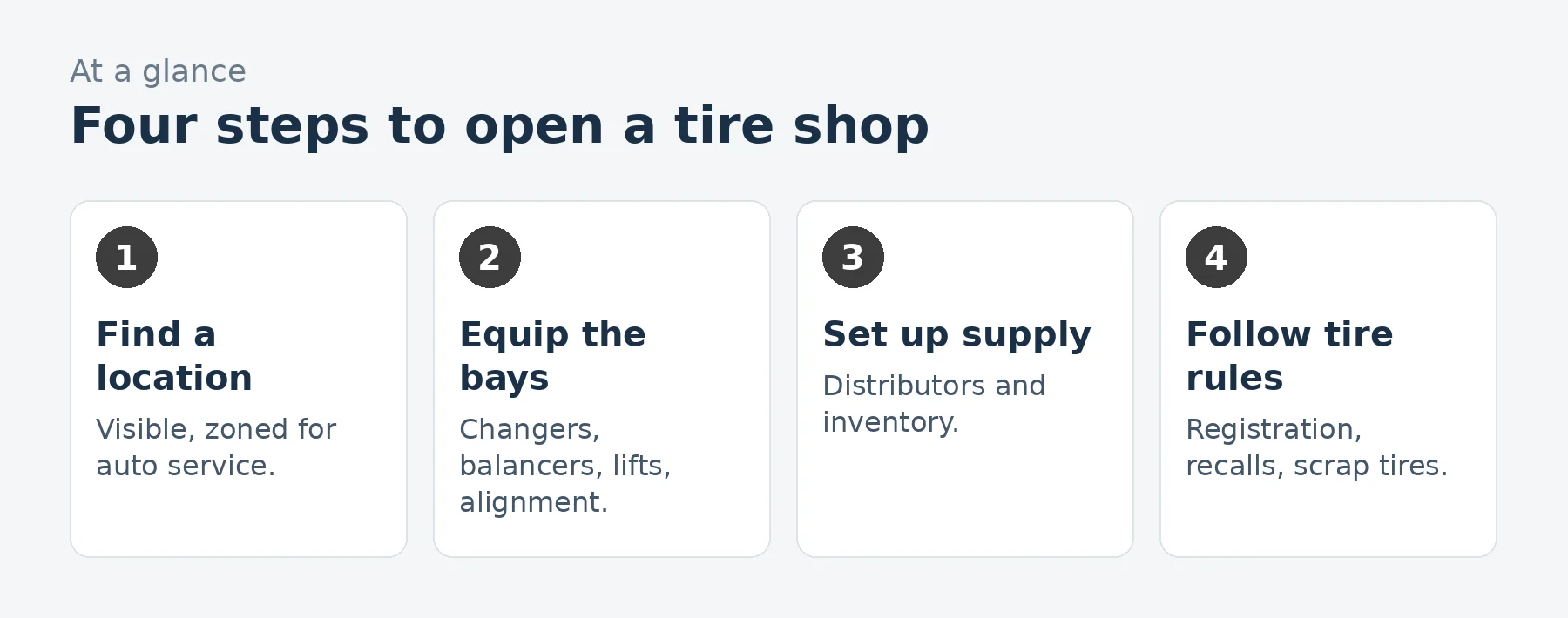
Open accounts with tire distributors, which often deliver several times a day so you don’t need huge stock. Keep popular sizes on hand, order the rest same day and ask about dealer programs, rebates and floor-plan financing. Track your turns so tires don’t age on the shelf.
Pricing
Price tires with a markup, plus installation packages (mounting, balancing, valve stems, disposal) and optional road hazard warranties. Show the full out-the-door price, since surprise fees anger customers. Alignments, flat repairs, TPMS service and brakes add higher-margin labor. Use our pricing calculator.
Startup costs for a tire shop
| Item | What to budget for |
|---|---|
| Lease and build-out | Bays, lighting, air lines, waiting area |
| Equipment | Changers, balancers, lifts, alignment machine |
| Inventory | Popular sizes and used tire stock |
| Software | Point of sale, inventory, registration |
| Insurance | Garage liability, garagekeepers, workers’ comp |
| Signage and marketing | Visible signs and online listings |
Use our startup cost calculator for your total.
A worked example: a two-bay tire shop
These are illustrative assumptions for a two-bay tire shop with three technicians, not predictions.
| Assumption | Monthly | |
|---|---|---|
| Tire sales | 380 tires averaging $135 | $51,300 |
| Installation, balancing and fees | $9,100 | |
| Alignments and repairs | $6,400 | |
| Revenue | $66,800 | |
| Tire cost | About 72% of tire sales | $(36,936) |
| Technician wages | With payroll costs | $(12,800) |
| Rent and utilities | $(4,600) | |
| Scrap tire disposal | $(760) | |
| Equipment payments and maintenance | $(1,300) | |
| Insurance | $(900) | |
| Software, card fees and marketing | $(2,100) | |
| Profit before owner pay and taxes | $7,404 |
That leaves about $7,404 a month before the owner’s pay and taxes, on about $66,800 of revenue. Labor and services carry better margins than tires, so add-ons matter.
Loading the calculator…
Hiring technicians
Hire technicians with tire experience or train them carefully, and consider ASE certification for those doing alignments and repairs. Pay can be hourly or flat-rate, and you’ll need workers’ compensation. Safety training and good equipment reduce injuries and damaged wheels.
Customer service
Explain tire choices clearly (budget, mid-range and premium), show customers tread depth and damage, and give written estimates. Offer appointments as well as walk-ins, and text customers when their car is ready. Torque lug nuts to the right specification and recommend re-torquing after a short drive where appropriate.
Fleet accounts
Local businesses with vans, trucks and service vehicles need regular tire work. Offer fleet accounts with set pricing, monthly invoicing, priority scheduling and tread checks during service. A handful of fleet customers smooths out slow weeks and brings predictable revenue.
Seasonal changeovers and storage
In cold climates, many drivers switch between winter and summer tires. Offer changeover appointments, wheel-and-tire packages and tire storage for a seasonal fee, labeled by customer and position. Storage brings customers back twice a year, but you’ll need racks, space and good records.
Marketing
- Seasonal promotions before winter and summer travel.
- Online tire search with prices on your website.
- Fleet accounts with local businesses.
- Reviews on your Google Business Profile.
- Reminders for rotations and alignments.
Adding higher-margin services
Tires bring customers in, but services keep the shop profitable: alignments after every tire set where needed, brake inspections, TPMS sensors, nitrogen fills where customers want them, wiper blades and oil changes. Offer them honestly, based on what the inspection shows, and track how many tire customers buy at least one service.
Common mistakes to avoid when starting a tire shop
- Selling old or damaged used tires.
- Inflating without cages or training.
- Hidden fees on top of the quoted price.
- Storing too many scrap tires.
- Overstocking slow-moving sizes.
Your first 90 days as a tire shop owner
- Days 1-30: find a location, check zoning and state shop and scrap tire rules.
- Days 31-60: install equipment, open distributor accounts and train technicians.
- Days 61-90: open with promotions, set up fleet accounts and collect reviews.
Frequently asked questions about starting a tire shop
How much does it cost to open a tire shop?
It depends on equipment and inventory; lifts, changers, balancers and an alignment machine are big costs, and distributors reduce inventory needs.
Do I need to register tires I sell?
Federal rules require dealers to help register new tires so owners can get recall notices.
Can I sell used tires?
Yes, if they’re safe; inspect tread, damage and age, and don’t sell recalled tires.
What are scrap tire fees?
Many states charge a fee on new tire sales and regulate how waste tires are stored and hauled.
What is OSHA’s rim wheel rule?
A standard requiring training, cages or restraints and safe inflation practices when servicing wheels.
Are road hazard warranties worth selling?
They add margin and customer peace of mind; explain the terms clearly.
Do tire technicians need certification?
Not legally for basic tire work, but ASE certification helps for alignments and repairs.
When are tire shops busiest?
Before winter, before summer travel and after cold snaps.
Should I offer tire storage?
In cold climates, yes; it brings repeat seasonal visits, but plan for space and labeling.
How old is too old for a used tire?
Many shops set a limit, such as six years from the manufacturing date, even when tread looks good; check the DOT date code.
Do I need an alignment machine?
Not to start, but alignments add profitable labor and many tire customers need one.
Keep learning
- Tire shops industry data
- How to start an auto repair shop
- How to start a mobile mechanic business
- Startup cost calculator
Sources
- NHTSA, Tires: safety, registration and recalls
- OSHA, Servicing multi-piece and single-piece rim wheels (29 CFR 1910.177)
- OSHA, Hazard Communication standard
- ASE, National Institute for Automotive Service Excellence
- US Small Business Administration, Apply for licenses and permits
- NHTSA, Vehicle recalls
Last reviewed November 4, 2026. Startup costs are estimates; check local prices, licensing and tax rules before you commit money.

