
Customers increasingly expect services to come to them, and car repair is no exception. A mobile mechanic fixes cars in driveways, office parking lots and fleet yards, saving customers the time and hassle of a trip to the shop. For skilled technicians, it’s one of the lowest-cost ways to start an auto repair business: no building, no rent, and customers who are grateful you showed up.
The demand is steady. According to the U.S. Bureau of Labor Statistics, automotive service technicians and mechanics held about 805,600 jobs in 2024, earning a median of $49,670, and employment is projected to grow 4% from 2024 to 2034. Going mobile lets an experienced technician keep much more of what each job earns.
Mobile mechanic business at a glance
Table of Contents
| Best jobs | Maintenance, brakes, batteries, starters, alternators, diagnostics, sensors, pre-purchase inspections |
| Not suited | Major engine or transmission work, jobs needing a lift, large A/C or alignment jobs |
| Certifications | ASE (voluntary, trusted); EPA Section 609 for A/C refrigerant work |
| Licensing | Business license; some states register repair businesses, including mobile ones |
| Startup costs | Moderate: van or truck, tools, diagnostic scanner, insurance |
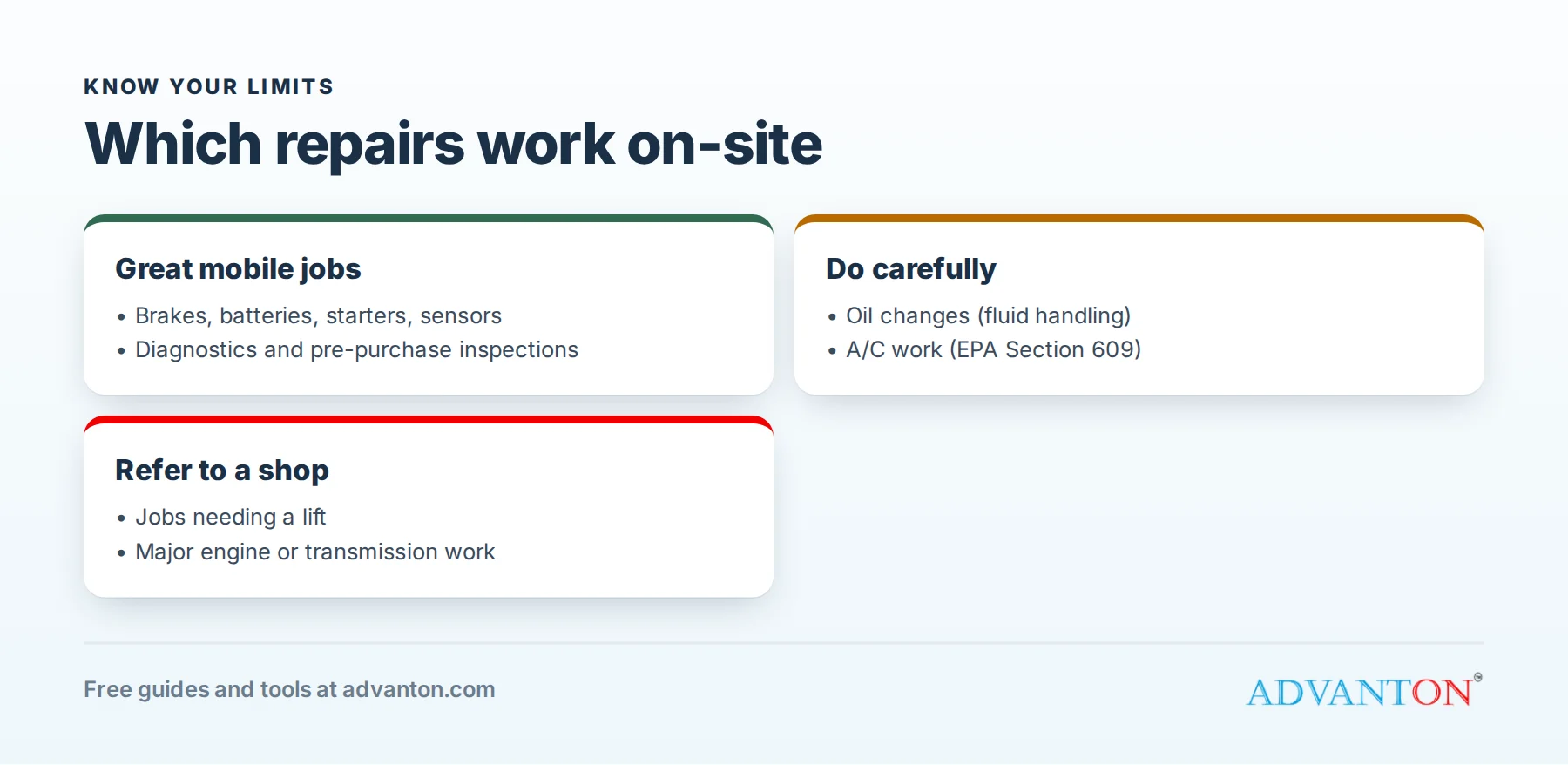
Choose your services
Focus on jobs you can do safely and well in a driveway or parking lot:
- Maintenance: oil changes (where allowed), filters, fluids, wipers and bulbs.
- Brakes: pads, rotors and calipers.
- Electrical: batteries, starters, alternators and sensors.
- Diagnostics: check-engine lights and no-start problems.
- Pre-purchase inspections for used car buyers, a popular, high-value service.
- Fleet maintenance for local businesses’ vans and trucks.
Know your limits: refer jobs that need a lift, specialized equipment or several days to a trusted shop, and you’ll keep customers’ trust.
Certifications and licensing
- ASE certification is voluntary but signals competence to customers who can’t see a shop.
- EPA Section 609 certification is required to service vehicle air conditioning and handle refrigerant.
- State rules vary: some states register or license anyone who repairs vehicles for pay, including mobile mechanics (California is a well-known example). Check your state’s consumer affairs or automotive repair agency.
- Local rules: a business license, and in some places restrictions on working in apartment complexes or HOA neighborhoods; always get permission from property owners.
Environmental responsibilities
Working on customers’ property means managing fluids carefully:
- Use drip pans, absorbent mats and spill kits on every job.
- Collect used oil, coolant and parts and take them to proper recycling or disposal.
- Never let fluids reach storm drains, which carry water to streams untreated.
Customers notice a mechanic who leaves their driveway cleaner than they found it.
Setting up your van
- A reliable van or truck with secure shelving and lockable storage.
- Hand and power tools, including cordless impact tools.
- A professional diagnostic scanner with current software.
- Jacks, jack stands, wheel chocks and creepers.
- A portable battery, air supply and work lights.
- Fluid handling: drain pans, containers and spill kits.
- A small parts stock for common jobs, such as filters, wipers, bulbs and brake hardware.
Use our startup cost calculator to total your equipment, and consider financing larger items. See how to get a startup loan.
Buy first, buy later
| Buy first | Buy as jobs demand |
|---|---|
| Quality hand tools and cordless impact tools | Specialty pullers and kits for specific makes |
| Professional scan tool with updates | A/C recovery machine (with Section 609) |
| Jacks, stands, chocks, drain pans, spill kit | Portable lift or larger lifting equipment |
| Battery tester and jump pack | Programming tools for modules and keys |
Rent or borrow rarely used tools until a job type becomes regular.
Insurance
You’ll need commercial auto insurance for your van, general liability, and garagekeepers coverage for customers’ vehicles while you work on them. Tools and equipment coverage protects gear stolen from your van. Add workers’ comp once you hire. See how to get business insurance.
Pricing your work
- Hourly labor rate times standard labor-guide times, as shops do. Many mobile mechanics charge slightly less than local shops, but a premium for convenience is also common.
- Trip or service-call fee, often credited toward the repair.
- Parts: a reasonable markup that covers sourcing, pickup time and warranty.
- Diagnostic fee, credited if the customer proceeds.
- Written estimates before you start, approved by the customer.
Use our pricing calculator to set a rate that covers your van, tools, insurance and time spent driving and buying parts.
A worked example: a solo mobile mechanic’s month
These figures are illustrative.
| Revenue | Amount |
|---|---|
| Labor: 110 billed hours × $110 | $12,100 |
| Parts sales | $7,500 |
| Total revenue | $19,600 |
| Costs | Amount |
|---|---|
| Parts cost (about 60% of parts sales) | $4,500 |
| Van fuel, insurance and maintenance | $1,300 |
| Diagnostic software and tool payments | $450 |
| Phone, scheduling and software | $120 |
| Marketing | $400 |
| Supplies and disposal | $250 |
| Total costs | $7,020 |
Profit before owner’s pay and taxes: $12,580. This is essentially your wage for 110 billed hours plus driving, parts runs and admin. The key is billed hours: route your day by area, pre-order parts, and confirm appointments to avoid wasted trips. Track mileage for your taxes with our free mileage log.
Running an efficient day
- Diagnose remotely where possible: ask for symptoms, photos and the vehicle’s details when booking.
- Order parts in advance for scheduled jobs, with delivery to your route or a nearby supplier.
- Group jobs by neighborhood to cut driving time.
- Confirm the day before with a reminder text.
- Take payment on the spot with a mobile card reader or invoice link; our quote and invoice generator works from your phone.
Photos build trust
Customers can’t see a shop or a team of technicians, so show them your work: send photos of worn brake pads, leaking parts or corroded terminals before you replace them, and the new part afterward. Explain what’s urgent and what can wait. Clear, honest communication is the main reason customers choose a mobile mechanic again.
Write a simple warranty
Offer a written warranty on your parts and labor, for example a set number of months or miles, and explain what’s covered. Put it on every invoice and your website. A clear warranty answers the biggest worry customers have about hiring a mechanic without a shop.
Weather and working conditions
Rain, extreme heat and cold make some jobs unsafe or impossible outdoors. Build weather days into your schedule, carry a pop-up canopy for light rain and shade, and agree in advance with customers how weather reschedules work. Some mobile mechanics partner with a local shop to rent a bay for jobs that can’t be done outside.
Finding customers
- Google Business Profile with your service area and reviews. "Mobile mechanic near me" is a high-intent search.
- Fleet accounts: contractors, delivery services and small businesses with vehicles value minimal downtime.
- Used car buyers needing inspections, through local listings and dealers.
- Workplaces: service employees’ cars in office parking lots, with the employer’s permission.
- Neighborhood marketing: door hangers, vehicle graphics and community groups. Our Brand & Print Studio creates matching cards and flyers.
- A simple website with services, prices and booking, built free with our website builder.
Growing beyond one van
Once your calendar is consistently full, add a second technician and van, focus on fleet contracts for steady volume, or rent shop space for larger jobs. Track billed hours per van before expanding, and check the true cost of an employee with our hiring cost calculator.
Common mistakes to avoid
- Taking jobs that need a shop and getting stuck mid-repair.
- Underpricing and forgetting driving and parts-run time.
- Poor fluid handling on customers’ property.
- No written estimates or warranty terms.
- Unorganized van, wasting time searching for tools and parts.
Your first 90 days
- Days 1 to 30: confirm state and local rules, register your business, get insured and equip your van.
- Days 31 to 60: set your services and prices, launch your Google Business Profile and website, and line up parts suppliers.
- Days 61 to 90: complete your first jobs, ask every customer for a review, and contact local businesses about fleet maintenance.
Frequently asked questions
Do I need a license to be a mobile mechanic?
You need a business license, and some states register or license anyone repairing vehicles for pay. Certifications like EPA Section 609 are required for A/C work.
Can I do oil changes in customers’ driveways?
Often, yes, with proper fluid handling and recycling, but some properties and local rules restrict it. Ask first.
Should I start mobile before opening a shop?
Many mechanics do. A mobile business builds a customer base with low costs; see how to start an auto repair shop for the next step.
Should I charge less than repair shops?
Not necessarily. Many customers happily pay similar or higher rates for the convenience of not visiting a shop. Compete on convenience, communication and reliability, not just price.
What’s the best way to handle parts?
Open trade accounts with two or three local parts suppliers for better prices and delivery, and keep a small van stock of fast-moving items. Confirm part fitment before driving to the job.
Keep learning
Sources
Last reviewed October 28, 2026. Startup costs are estimates; check local prices, licensing and tax rules before you commit money.


Leave a Reply