
Snow removal businesses plow, shovel, blow and de-ice driveways, sidewalks, parking lots and entrances for homeowners, property managers, retailers, offices, medical buildings and homeowner associations. Many landscaping companies add snow removal to keep crews and trucks working through the winter. This guide explains how to start a snow removal business, from licensing and startup costs to pricing and finding customers.
It’s profitable but unpredictable: snowfall varies from year to year, storms arrive at night and on holidays, and slip-and-fall claims are a major risk for commercial snow contractors. The right contracts, insurance and records matter as much as the plow.
A snow removal business at a glance
Table of Contents
| Topic | What to expect |
|---|---|
| Startup cost | Moderate: a pickup with a plow and spreader, shovels and snow blowers, insurance and salt; more for skid steers and loaders |
| Key rules | Careful contracts, slip-and-fall liability, insurance with snow coverage, commercial vehicle rules and local salt guidance |
| Revenue model | Seasonal contracts, per-push or per-event pricing, and salting by the application |
| How you earn | Plowing, shoveling, salting, snow hauling and ice management |
| Best for | Reliable people who don’t mind early mornings, long storm nights and winter weather |
Who a snow removal business suits
It suits dependable people who can work long, irregular hours in the cold, often starting at 2 a.m. so lots are clear before businesses open. You need to stay calm in storms, maintain equipment and keep promises, because customers judge you on one thing: whether the snow was gone on time. It pairs naturally with lawn care and landscaping.
Residential or commercial customers
Residential driveways are easier to start with: lower risk, simple equipment and many customers in a small area. Commercial lots pay more per visit but expect fast response, salting and ice management, and carry higher liability. Most new businesses start with homes and small commercial properties and add larger lots as they gain equipment, crews and insurance.
Contracts and pricing models
- Seasonal contracts: a fixed price for the winter, usually with a cap on visits or snowfall; steady income for you, predictable costs for customers.
- Per push: a price for each plowing visit after snow reaches a trigger depth (often 2 inches).
- Per event: a price for each storm, however many visits it takes.
- Time and materials: hourly rates for equipment plus salt by the ton or bag.
Write down the service area, trigger depth, response times, where snow will be piled, salting rules, what’s excluded (such as roofs or steps), payment terms and how the contract ends.
Slip-and-fall liability
Commercial property owners often push liability for slips and falls onto snow contractors through hold harmless and indemnification clauses. Read these carefully, avoid promising zero snow or ice at all times, define exactly what you’ll do and when, and have a lawyer review commercial contracts. Some states have laws limiting how far these clauses can shift liability, and the Snow and Ice Management Association (SIMA) offers contract guidance.
Document every visit
Your records are your best defense. Log every visit with the time you arrived and left, what you did, how much salt you applied and the weather conditions, and take time-stamped photos. Many contractors use GPS tracking and snow-management apps. Keep records for years, since slip-and-fall claims can come long after the storm.
Insurance
Carry general liability insurance that explicitly covers snow and ice work (some policies exclude it), commercial auto insurance for plow trucks, inland marine or equipment coverage for plows and spreaders, and workers’ compensation when you hire. Commercial customers usually ask to be named as additional insureds.
Salt and environmental rules
Road salt (sodium chloride) protects people from falls but harms waterways, soil, plants and concrete when overused. Calibrate spreaders, apply only what’s needed, consider liquid pre-treatment and store salt under cover on an impermeable surface. Some states run smart salting or salt applicator certification programs, and a few offer limited liability protection to certified applicators who follow best practices.
Equipment
- Pickup truck with a plow sized for the truck’s weight rating.
- Tailgate or V-box spreader for salt and sand.
- Snow blowers and shovels for walkways.
- Skid steer or loader with a pusher box for large lots.
- Spare parts such as cutting edges, hoses and pins.
If your truck and trailer have a combined weight rating of 26,001 pounds or more, drivers may need a CDL, and vehicles over 10,000 pounds used in interstate commerce generally need a USDOT number. Some states also require USDOT numbers for intrastate commercial vehicles.
Storm planning
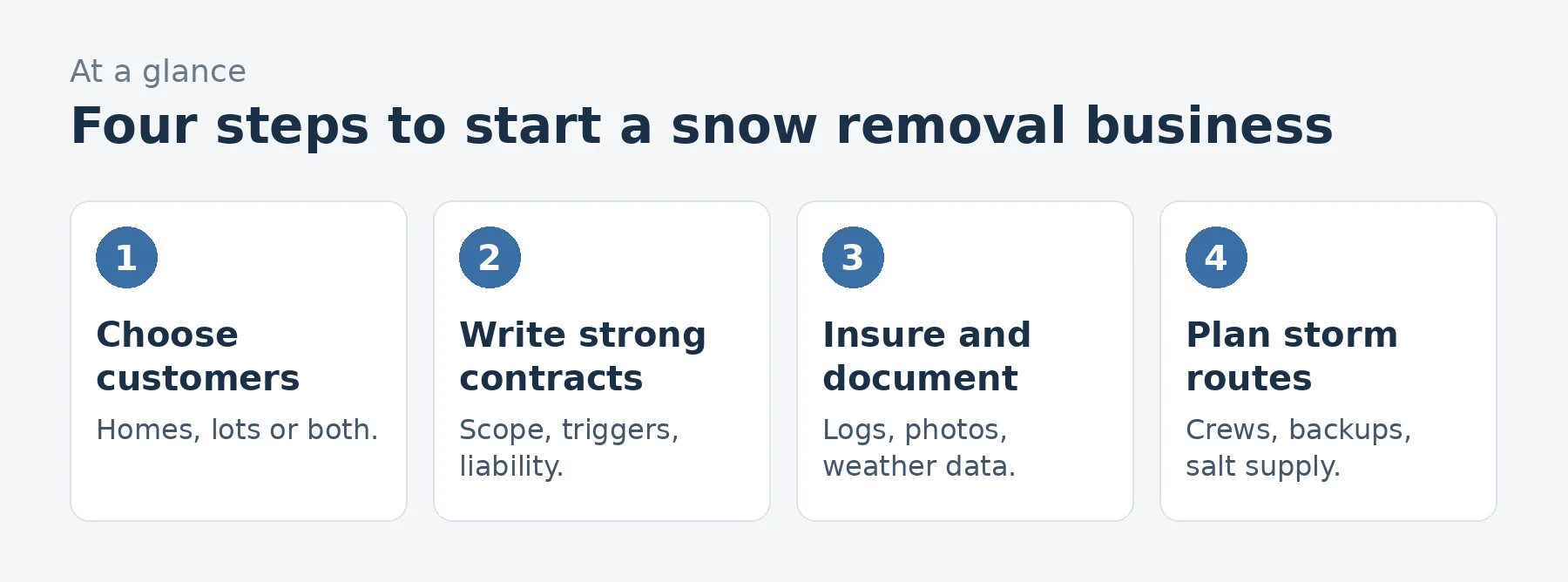
Build routes before the season, ordering properties by priority and response time, and plan crews, backup drivers and backup equipment. Watch forecasts, pre-treat when appropriate and keep a salt supply, since salt can run short in heavy winters. Use our mileage log to track truck miles.
Startup costs for a snow removal business
| Item | What to budget for |
|---|---|
| Truck and plow | Used or new pickup, plow and mounts |
| Spreader | Tailgate or V-box spreader |
| Walkway equipment | Snow blowers and shovels |
| Insurance | Liability with snow coverage, auto, equipment |
| Salt | Pre-season supply and storage |
| Software | Logging, routing and invoicing |
Use our startup cost calculator for your total.
A worked example: one truck, two-person crew
These are illustrative assumptions for one truck and a two-person crew during an average winter month, not predictions.
| Assumption | Monthly | |
|---|---|---|
| Seasonal residential contracts | 60 driveways at $95 | $5,700 |
| Commercial plowing and salting | 8 lots averaging $1,150 | $9,200 |
| Sidewalk shoveling and extras | $1,300 | |
| Revenue | $16,200 | |
| Salt and de-icer | $(2,600) | |
| Crew wages | With payroll costs | $(3,800) |
| Truck payment, fuel and repairs | $(2,200) | |
| Insurance | $(1,100) | |
| Equipment wear and plow parts | $(500) | |
| Software and phone | $(150) | |
| Profit before owner pay and taxes | $5,850 |
That leaves about $5,850 a month before the owner’s pay and taxes, on about $16,200 of revenue in an average month. Seasonal contracts protect you in light winters; per-push pricing pays more in heavy ones.
Loading the calculator…
Working safely in winter
Cold stress, slippery surfaces and long hours are real hazards. Follow OSHA’s winter weather guidance: dress in layers, take warm-up breaks, watch for frostbite and hypothermia, and limit shifts to prevent fatigue. Use beacons and lights on trucks, check for people and parked cars before pushing snow, and train crews on safe snow blower and shovel use.
Subcontractors and growth
Many snow contractors grow by subcontracting routes to other plow operators. Require subcontractors to carry their own insurance and name you as an additional insured, put the work in a written agreement and check their records and logs. Make sure they aren’t treated as employees if they control their own equipment and methods.
Pricing for different storm sizes
Heavy storms take longer and use more salt, so per-push contracts often add a higher rate for deeper snow, such as one price for 2 to 6 inches and another for 6 to 12. Spell out what happens in blizzards, when snow must be hauled away and when ice-only events need salting without plowing. Clear storm tiers prevent arguments after big storms.
Marketing
- Sign seasonal contracts in fall, before the first snow.
- Offer snow removal to lawn care customers.
- Property managers and HOAs for multi-property contracts.
- A Google Business Profile with service areas.
- Door hangers in neighborhoods you already serve.
Common mistakes to avoid when starting a snow removal business
- Signing commercial contracts that put all liability on you.
- Not keeping visit logs and photos.
- Insurance that excludes snow and ice work.
- Taking on more properties than your trucks can clear on time.
- Overusing salt.
Your first 90 days as a snow removal business owner
- Days 1-30 (late summer): choose customers, buy or prepare equipment and line up insurance.
- Days 31-60 (early fall): write contracts, market to homeowners and property managers and plan routes.
- Days 61-90 (before the first snow): sign contracts, stock salt, test equipment and train crews.
Frequently asked questions about starting a snow removal business
How much does it cost to start a snow removal business?
A pickup, plow, spreader and insurance are the main costs; used equipment lowers the start-up cost.
Should I charge per push or seasonal?
Seasonal contracts give steady income in light winters; per-push pricing pays more in heavy ones. Many contractors offer both.
What is a trigger depth?
The snow depth, often 2 inches, at which plowing starts under the contract.
Do I need special insurance for snow removal?
Yes; make sure your general liability policy covers snow and ice work, and carry commercial auto coverage.
How do I protect myself from slip-and-fall claims?
Clear contracts, detailed visit logs, photos and weather records.
Do I need a CDL to plow snow?
Usually not for a pickup, but heavier trucks and trailer combinations can require one.
Can I combine snow removal with lawn care?
Yes; it keeps trucks and crews working year-round.
How much salt should I use?
Only what’s needed for conditions; calibrate spreaders and consider pre-treatment.
Do I need to haul snow away?
Only if the contract requires it or there’s nowhere to pile it; snow hauling is usually priced separately.
What happens in a winter with little snow?
Seasonal contracts still pay; per-push contracts pay only when it snows, so many contractors mix both.
Keep learning
- Snow removal industry data
- How to start a tree trimming service
- How to get landscaping leads
- Startup cost calculator
Sources
- Snow and Ice Management Association (SIMA)
- OSHA, Winter weather and cold stress
- FMCSA, Do I need a USDOT number?
- FMCSA, Commercial driver's license program
- US Small Business Administration, Apply for licenses and permits
- OSHA, Fall protection
Last reviewed November 4, 2026. Startup costs are estimates; check local prices, licensing and tax rules before you commit money.

