
Landscaping and lawn care businesses win by building dense routes of recurring customers. Every extra customer on a street you already service adds revenue with almost no extra driving. The best lead strategies focus on neighborhoods, seasons and recurring contracts.
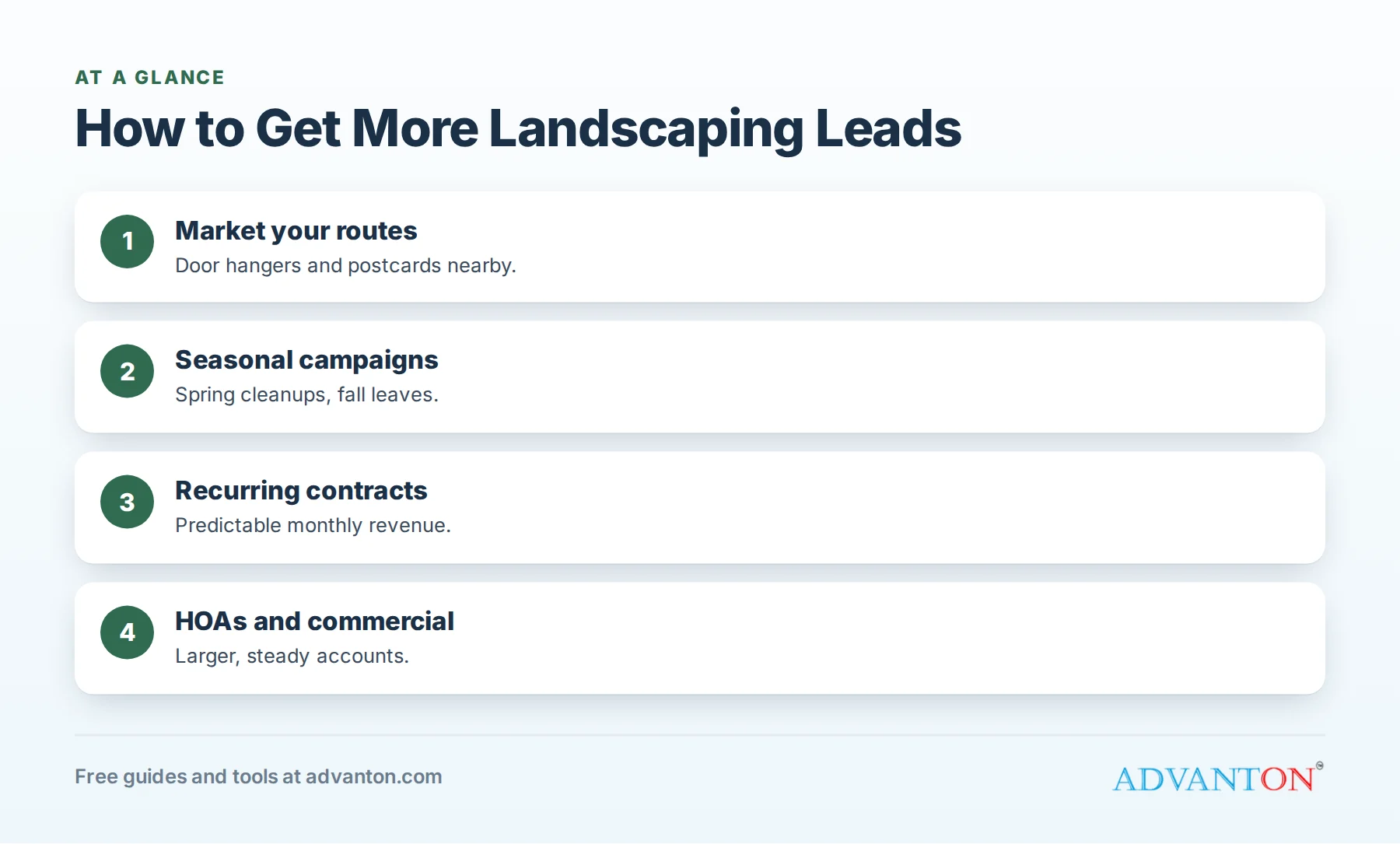
Lead sources at a glance
Table of Contents
| Lead source | Why it works |
|---|---|
| Neighborhood marketing | Door hangers and postcards around existing routes |
| Seasonal campaigns | Spring cleanups and fall leaf removal |
| Recurring contracts | Weekly or biweekly maintenance |
| HOAs and commercial | Larger, steady accounts |
| Reviews and local search | Homeowners compare online |
The landscaping playbook
- Market where you already work. Leave door hangers on homes near current customers and mail postcards to route neighborhoods with our free EDDM postcard maker.
- Run seasonal campaigns: spring cleanups, aeration and overseeding, fall leaf removal and winter services.
- Sell recurring contracts at the first visit, billed monthly for predictable revenue.
- Pursue HOAs, apartment complexes and commercial properties for larger, steady accounts.
- Collect reviews with photos of transformed yards.
- Build local search pages for each service and neighborhood. See local SEO for contractors.
Price for route density
Offer modest discounts for neighbors who sign up on the same street, and focus marketing on areas where you already have customers. Dense routes mean more mowing and less driving.
Build your route, street by street
Route density is the hidden profit engine in landscaping. A crew that mows ten lawns on one street earns far more per hour than one that drives across town between jobs. Build density deliberately:
- Map your current customers and identify the streets and neighborhoods where you already work.
- Door-hang the homes on both sides and across the street from every customer, every season.
- Offer a neighbor discount when two or more homes on the same street sign up.
- Decline far-away one-off jobs unless they’re profitable enough to justify the drive.
Sell recurring service, not one-time jobs
| Service | Recurring option |
|---|---|
| Mowing and edging | Weekly or biweekly through the season |
| Bed maintenance | Monthly weeding and mulching |
| Fertilization and weed control | A seasonal program of several visits |
| Shrub trimming | Two or three visits a year |
| Leaf removal | Scheduled fall visits |
| Snow removal (where relevant) | Seasonal contract |
Recurring contracts make revenue predictable, fill your schedule before the season starts and lower your marketing cost per dollar earned. Offer them at the first visit, and bill monthly.
Seasonal campaign calendar
| Months | Campaign |
|---|---|
| January to February | Book spring cleanups and season contracts early, with early-booking offers |
| March to April | Spring cleanups, mulching, aeration and overseeding |
| May to August | Maintenance contracts, irrigation checks, landscape installs |
| September to November | Aeration, overseeding, leaf removal, fall cleanups |
| December | Snow removal, holiday lighting, renewals for next season |
Send each campaign to past customers first, then to route neighborhoods by postcard and door hanger.
Win HOAs, apartments and commercial properties
Commercial and association accounts are larger and steadier, but they buy differently:
- Find the decision-maker: HOA boards, property managers and facility managers.
- Ask for the bid schedule: many accounts bid contracts annually.
- Show reliability: references, insurance certificates and a clear service schedule.
- Price carefully: larger accounts often expect lower per-visit prices, so know your costs.
- Report every visit: photos and short notes build trust and renewals.
Show your work
Landscaping is visual. Before-and-after photos of cleanups, installs and transformations are your best advertising on your website, Google Business Profile and social media. Ask customers for reviews with photos, and use our free review request kit.
Build local search pages
Create pages for each core service (lawn care, landscape design, hardscaping, irrigation, snow removal) and for the neighborhoods you serve most. Each page should include real photos, typical prices or ranges, your service schedule and reviews. See local SEO for contractors.
An illustrative season of lead sources
| Source | New customers | Cost | Cost per customer |
|---|---|---|---|
| Route door hangers and postcards | 25 | $900 | $36 |
| Referrals from existing customers | 18 | $360 in thank-you credits | $20 |
| Google Business Profile and reviews | 20 | $0 | $0 |
| Paid lead site | 8 | $640 | $80 |
These numbers are illustrative. Track your own with the lead source tracker, and remember that a recurring customer can be worth many visits a year.
Price and estimate with confidence
- Mowing: price by lot size, obstacles, slope and frequency; walk the property before quoting.
- Cleanups: price by hours and debris volume, including disposal.
- Installs and hardscaping: price by materials, labor and equipment, with a written scope.
- Programs: bundle fertilization, weed control and aeration into a seasonal package.
Track your actual time on every property. Many landscapers find a few properties lose money once drive time is counted, and raise prices or drop them.
Upsell installs and hardscaping
Your maintenance customers already trust you. Offer them design and installation work (new beds, plantings, patios, walkways, lighting and irrigation upgrades) during slower weeks. A short note with each invoice ("Thinking about a new patio this year? Ask us for a free design consult") brings higher-value projects with no ad spend.
Crew and equipment as you grow
Growth is limited by crews and equipment. Before adding a second crew, make sure your route is dense enough to keep it busy all season. Budget for a truck, trailer and mowers, plus payroll taxes and workers’ comp. Our hiring cost calculator shows the full cost of each employee.
Keep revenue coming in winter
In cold regions, winter options include snow removal contracts, holiday lighting installation, tree and shrub pruning during dormancy, and booking next season’s contracts with early-payment discounts.
A phone script for new inquiries
"Thanks for calling [Business]. Are you looking for weekly service or a one-time cleanup? What’s the address, so I can check whether you’re on one of our routes? We service your street on [day]. I can stop by [day] to give you a written quote."
Offer water-wise landscaping and irrigation services
Many homeowners want lower water bills and less maintenance. Drought-tolerant plantings, mulching, drip irrigation, smart controllers and seasonal irrigation checks are services you can add to maintenance routes. Many water utilities offer rebates for efficient irrigation or turf replacement; check current local programs before promoting them. These services set you apart from mow-and-go competitors and bring higher-value projects.
Communicate like a professional
Send a text the day before each visit, leave a short note or photo after service, and invoice consistently. If weather delays a visit, tell customers before they wonder. Consistent communication keeps customers on contracts for years, which is the real value of every lead you win.
Hire and keep good crews
Your crews are your brand: customers see them every week. Hire for reliability and care, train them on your standards (edging, cleanup, gate etiquette and safety), and give crew leaders a checklist for every property. Paying fairly, keeping schedules predictable and recognizing good work reduces turnover, which is costly in a seasonal business. Plan hiring before spring, when every landscaper is looking for help at once, and keep in touch with good seasonal workers through winter so they return.
Use your trucks and signs
Clean, lettered trucks parked on a street for an hour every week are free advertising. Show your business name, services, phone and website clearly. With permission, place small yard signs after installs and cleanups, and our free yard sign maker designs them.
Common mistakes
- Chasing scattered one-off jobs instead of building dense routes.
- Not selling contracts at the first visit.
- Marketing only in spring, when everyone else does.
- Underpricing commercial bids.
- No photos of finished work.
Your 30-day plan
| Week | Actions |
|---|---|
| 1 | Map current customers; choose three neighborhoods to target |
| 2 | Door-hang and mail postcards around current routes |
| 3 | Offer season contracts to every one-time customer |
| 4 | Contact five HOAs or property managers; request reviews from your best customers |
Respond fast and follow up
Answer calls live or text back within minutes, send written quotes the same day, and follow up two to three days later. See speed to lead and estimates that win.
Frequently asked questions about landscaping leads
What’s the best way to get landscaping customers?
Neighborhood marketing around existing routes, seasonal campaigns and recurring contracts.
How do landscapers stay busy in winter?
Snow removal, holiday lighting, tree work and booking spring contracts early.
How much should landscapers charge?
It depends on lot size, services and region; price from your real time and costs on each property, including drive time.
Should I offer contracts or one-time services?
Both, but recurring contracts build predictable revenue and dense routes.
How do landscapers get commercial accounts?
Contact property managers and HOA boards before bid season, provide references and insurance certificates, and report every visit with photos.
How Advanton helps
Advanton is a free resource for small businesses. Free tools that help: the website builder, yard signs and door hangers, the EDDM postcard maker and the review request kit. You can also add your business to the Advanton directory for free. Advanton earns money when you buy a domain or hosting through our store, which helps keep everything else free.
Keep learning
Last reviewed October 30, 2026. Startup costs are estimates; check local prices, licensing and tax rules before you commit money.
This article is general information, not financial, legal or tax advice. Check the rules that apply to you or talk to a qualified professional before making decisions. See our disclaimer.
Leave a Reply