
A professional organizer helps people take control of their spaces and time: decluttering and organizing closets, kitchens, garages and offices, setting up systems, managing paper and digital files, preparing homes for sale and helping families move or downsize. Clients include busy families, professionals, seniors and small businesses.
Organizing is personal work: clients may feel embarrassed or overwhelmed, and some face chronic disorganization or hoarding disorder, a recognized mental health condition that calls for collaboration with mental health professionals. Industry groups such as NAPO and the Board of Certification for Professional Organizers offer education and credentials. Advanton’s personal services data shows a median pay of $37,320 for concierges (May 2024), with about 45,600 jobs, and $35,110 across personal care and service occupations. Business owners serving affluent households, busy professionals and companies can earn more through higher rates and steady clients. This guide covers services, credentials, boundaries, operations, pricing, a worked example and a 90-day plan.
A professional organizer business at a glance
Table of Contents
| Topic | What to expect |
|---|---|
| Startup cost | Low: training, insurance, a basic toolkit, a website, scheduling and marketing |
| Credentials | NAPO membership and education, the Certified Professional Organizer (CPO) credential and ICD training for challenging situations |
| Key boundaries | Organizers are not therapists; hoarding disorder calls for collaboration with mental health professionals |
| How you charge | Hourly with minimums, project packages, and product sales or installation |
| Best for | Patient, nonjudgmental people who love systems and helping others |
Who organizing suits
It suits patient, empathetic and nonjudgmental people who love creating order and systems, can make quick decisions and are physically able to lift, sort and carry. Clients value discretion and encouragement.
Services to offer
- Closets, kitchens, pantries, garages and basements.
- Home offices, paper management and digital organizing.
- Move management: packing, unpacking and setting up new homes.
- Senior downsizing and estate transitions, often with families.
- Staging and decluttering before home sales.
- Office and small business organizing.
- Maintenance visits to keep systems working.
Credentials and training
NAPO (the National Association of Productivity and Organizing Professionals) offers membership, education and a referral directory. The Certified Professional Organizer (CPO) credential from the Board of Certification for Professional Organizers requires experience and an exam. The Institute for Challenging Disorganization (ICD) offers training for working with chronic disorganization, ADHD and hoarding.
Hoarding and chronic disorganization
Hoarding disorder is a mental health condition, and forcing quick cleanouts can harm clients and cause relapse. Work at the client’s pace, never discard items without permission and collaborate with therapists, family members and, when there are safety risks, appropriate professionals. Severe situations may involve health hazards that need specialized cleanup services. Know your limits and refer when needed.
Donation, recycling and disposal
Organizing creates items to donate, sell, recycle or discard. Build relationships with donation centers, consignment shops, junk removal and recycling services, and follow local rules for electronics, paint and hazardous materials. Many organizers charge for hauling or include it in packages.
Trust and insurance
Clients let you into their homes, schedules and finances, so trust is the product. Carry general liability insurance and consider a bond (which reassures clients about theft), run background checks on anyone you hire, sign confidentiality agreements, keep receipts for every purchase and never mix client money with your own. With older clients, be alert to financial exploitation risks: document everything, involve family where appropriate and never accept gifts, loans or power of attorney from clients.
Startup costs to plan for
| Item | What to budget for |
|---|---|
| Training and certification | NAPO, CPO and ICD courses |
| Insurance and bond | General liability, bond |
| Toolkit | Labels, label maker, tools, measuring tape, gloves |
| Vehicle | Space for supplies and donations |
| Website and photos | Before-and-after photos with permission |
| Software | Scheduling, invoicing |
Use our startup cost calculator for your total.
Pricing
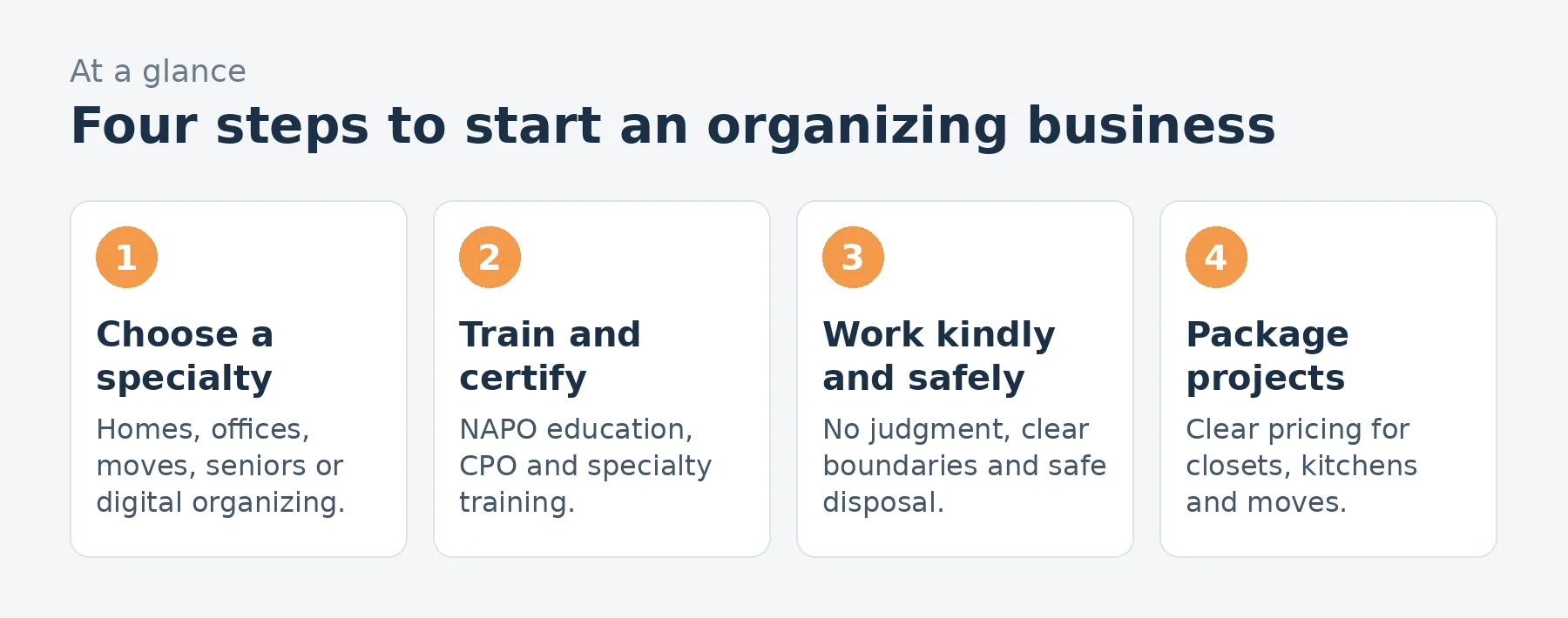
Most organizers charge hourly with a minimum session (often three or four hours), with packages for common projects such as a closet or kitchen and project quotes for moves and whole homes. Products are billed separately, either at cost or with a markup disclosed to clients. Use our pricing calculator.
A worked example: an established organizer
These are illustrative assumptions for an established organizer with a part-time assistant, not predictions.
| Assumption | Monthly | |
|---|---|---|
| Organizing sessions | 90 hours at $85 | $7,650 |
| Move and downsizing projects | $3,000 | |
| Product markup and installation | Bins, shelving and closet systems | $900 |
| Revenue | $11,550 | |
| Assistant wages | With payroll costs | $(2,200) |
| Donation hauling and disposal | Partly passed to clients | $(400) |
| Insurance and certifications | Averaged monthly | $(150) |
| Vehicle and supplies | $(400) | |
| Marketing | $(400) | |
| Profit before owner pay and taxes | $8,000 |
That leaves about $8,000 a month before the organizer’s pay and taxes, on about $11,550 of revenue. Larger projects such as moves and whole-home organizing raise revenue per client.
Loading the calculator…
A typical organizing project
- Consultation: goals, problem areas, budget and timeline.
- Sort items into keep, donate, sell, recycle and discard.
- Plan zones based on how the space is used.
- Install containers and systems that fit the client’s habits.
- Label and explain the system.
- Schedule a follow-up or maintenance session.
Senior downsizing
Helping older adults move to smaller homes or senior communities is sensitive and valuable work: sorting decades of belongings, coordinating with family, arranging sales and donations and setting up the new home. Specialized senior move management training helps, and partnerships with senior living communities and real estate agents bring referrals.
Finding clients
- Real estate agents preparing homes for sale.
- Senior living communities and senior move managers.
- Moving companies.
- Social media with before-and-after photos (with permission).
- NAPO’s directory and referrals.
Paper and digital organizing
Paper piles and digital chaos frustrate many clients. Services include setting up filing systems, scanning important documents, organizing photos and creating digital folder structures. Handle personal and financial documents securely, and never discard documents without client approval.
Move management
Move managers plan and coordinate moves: sorting belongings, coordinating movers, packing, unpacking and setting up the new home so it is livable on day one. Partnerships with moving companies and real estate agents bring steady referrals.
Choosing products
Recommend containers and systems after decluttering, not before, and choose products that fit the client’s space, habits and budget. Some organizers earn product commissions or markups; be transparent with clients about pricing.
Virtual organizing
Virtual sessions by video let organizers coach clients through decluttering and planning anywhere. Virtual organizing suits motivated clients and lets you serve people outside your local area at lower cost.
Working with families
Downsizing and decluttering often involve family members with different opinions. Clarify who makes decisions, communicate respectfully with everyone and keep the client’s wishes at the center, especially with older adults.
Maintenance plans
Systems need upkeep. Offer quarterly or seasonal maintenance visits to keep spaces organized, which also creates recurring revenue and long-term client relationships.
Physical safety
Organizing involves lifting, ladders, dust and sometimes hazards in cluttered homes. Use proper lifting techniques, gloves and masks when needed, avoid unsafe spaces and bring an assistant for heavy or large projects.
Common mistakes to avoid
- Judging clients or rushing decisions.
- Discarding items without permission.
- Treating hoarding as a simple cleanout.
- No minimum session length.
- Unclear product and hauling charges.
Your first 90 days
- Days 1-30: choose a specialty, join NAPO, buy insurance and assemble a toolkit.
- Days 31-60: organize a few spaces at reduced rates for photos and testimonials, and set pricing.
- Days 61-90: partner with real estate agents and movers, and launch your website and social media.
Frequently asked questions
Do professional organizers need certification?
Not legally, but NAPO education and the CPO credential build credibility.
How much do professional organizers charge?
Many charge hourly with a minimum session, plus packages and project quotes.
Can organizers help people who hoard?
With specialized training and in collaboration with mental health professionals, working at the client’s pace.
Do organizers buy products for clients?
Many do, billing at cost or with a disclosed markup, and installing systems.
What insurance do organizers need?
General liability insurance and often a bond, since you work in clients’ homes.
Is senior downsizing a good niche?
Yes. Older adults moving to smaller homes often need help sorting, selling and setting up new spaces.
How long does it take to organize a room?
It depends on size and volume; many single rooms take one or two sessions, while whole homes take longer.
Should I offer virtual organizing?
It works well for motivated clients and digital or paper projects, and expands your market beyond your area.
What tools do professional organizers use?
Label makers, bins and containers, measuring tapes, basic tools, gloves and supplies for donation and disposal.
How do I find organizing clients?
Through real estate agents, movers, senior living communities, social media before-and-after posts and the NAPO directory.
Can organizers help small businesses?
Yes. Offices, storage rooms, inventory areas and paperwork systems benefit from professional organizing.
Do organizers need to be bonded?
Not usually required, but a bond and insurance reassure clients when you work in their homes.
Keep learning
- Personal services industry data
- How to start a home staging business
- How to start a moving company
- Pricing calculator
Sources
- NAPO (National Association of Productivity and Organizing Professionals)
- Board of Certification for Professional Organizers (CPO certification)
- Institute for Challenging Disorganization (ICD)
- International OCD Foundation, Hoarding disorder resources
- EPA, Reducing and reusing basics (donation and reuse)
- US Bureau of Labor Statistics, Personal care and service occupations
Last reviewed November 3, 2026. Startup costs are estimates; check local prices, licensing and tax rules before you commit money.

