
A pickleball facility offers dedicated courts for open play, reservations, leagues, lessons, clinics, tournaments and social events, often with a pro shop, cafe or bar. Pickleball’s rapid growth has created demand for indoor courts where players can play year-round.
Many facilities convert warehouses or vacant big-box retail buildings, which brings zoning, change-of-use and building code reviews. Noise has become a major issue with outdoor courts near homes, so location and sound mitigation matter. Food and drink add revenue but require permits and liquor licenses. Advanton’s fitness data shows a median pay of $46,180 for fitness trainers and instructors, the closest occupation for pickleball coaches. This guide covers buildings, courts, rules, revenue models, a worked example and a 90-day plan.
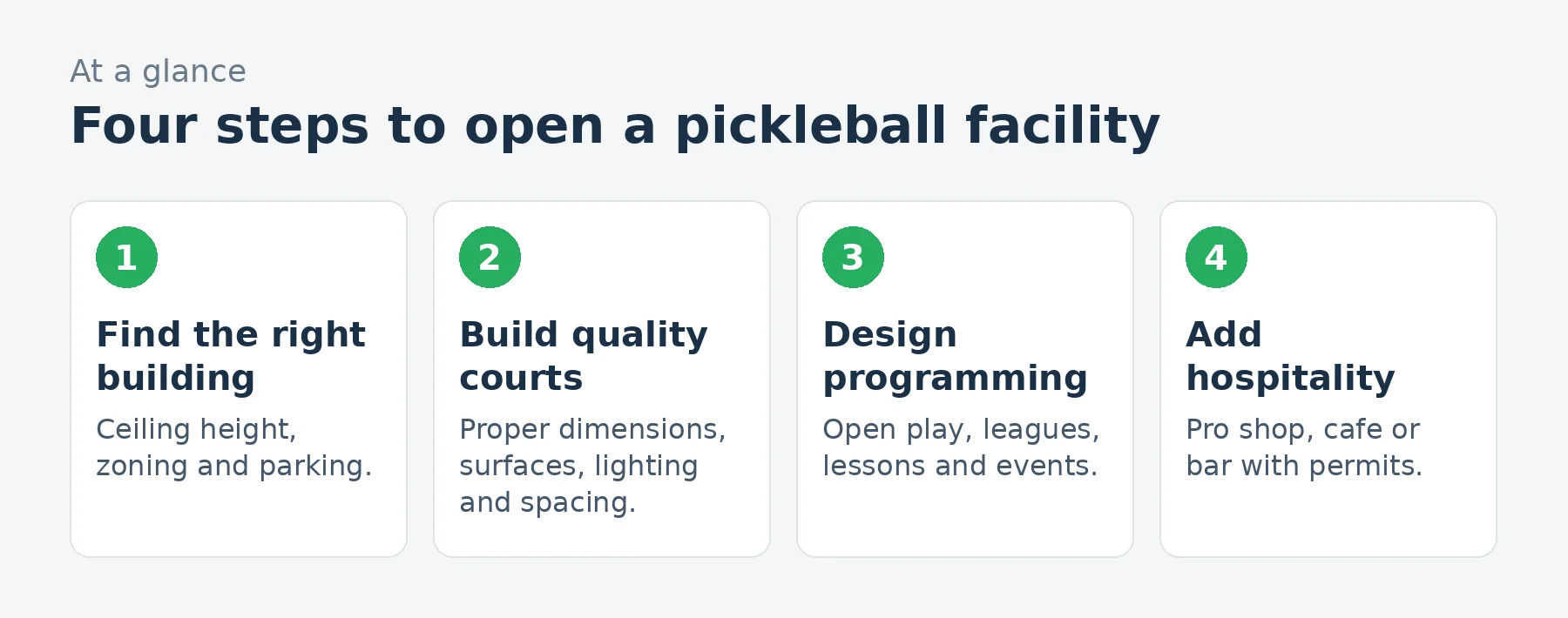
A pickleball facility at a glance
Table of Contents
| Topic | What to expect |
|---|---|
| Startup cost | High: lease and building improvements, court surfaces, nets, lighting, HVAC, restrooms, reservation software and possibly a bar or cafe |
| Approvals | Zoning and change of use, building and fire codes, occupancy limits and accessibility |
| Courts | Standard courts are 20 by 44 feet, with extra space around each court for safe play |
| Revenue | Memberships, court reservations, open play, leagues, lessons, tournaments, events, pro shop and food and beverage |
| Best for | Operators with real estate access, community-building skills and capital |
Who a pickleball facility suits
It suits community-minded operators with access to capital and real estate, who enjoy running events, leagues and hospitality. Players come for courts, but stay for community.
Finding a building
Look for buildings with high ceilings (indoor play needs clear height for lobs), open floor space without columns in court areas, good parking and easy access. Former big-box stores and warehouses are common choices. Confirm zoning allows indoor recreation, and plan for change-of-use reviews, fire code occupancy, restrooms and accessibility upgrades.
Courts, surfaces and lighting
USA Pickleball specifies a court of 20 by 44 feet, with recommended extra space around each court for safe play. Choose durable cushioned or hard surfaces, quality permanent nets and even, glare-free lighting. Barriers or curtains between courts keep balls from interrupting other games.
Noise and neighbors
The sound of pickleball paddles has led to complaints and restrictions for some outdoor courts near homes. Indoor facilities in commercial areas avoid most issues, but sound-absorbing materials improve the experience inside. For outdoor courts, check local noise ordinances and consider sound barriers and distances from homes.
Accessibility
As a public facility, follow ADA requirements for accessible routes, parking, restrooms and seating, and consider adaptive play programs. The U.S. Access Board’s recreation facility guidance covers sports facilities.
Food, drink and alcohol
Cafes, snack bars and bars increase revenue and social time. Food requires health permits, and selling alcohol requires state and local liquor licenses, with responsible service training. Some facilities partner with food trucks or local vendors instead.
Memberships, waivers and insurance
Membership billing should follow state automatic renewal laws, with clear terms and easy cancellation. Require waivers for players, carry general liability insurance (and liquor liability if serving alcohol) and keep first aid supplies and an AED available.
Startup costs to plan for
| Item | What to budget for |
|---|---|
| Lease and improvements | HVAC, restrooms, accessibility, fire code |
| Courts | Surfaces, nets, lines, barriers |
| Lighting | Even, glare-free indoor lighting |
| Software | Reservations, memberships, leagues |
| Hospitality | Pro shop, cafe or bar equipment and permits |
| Pre-opening marketing | Founding memberships, events |
Use our startup cost calculator for your total.
Pricing
Common models include memberships with included court time or discounted reservations, hourly court rentals, open play fees, leagues and clinics, and private lessons. Price prime-time courts higher, and offer daytime and off-peak discounts. Use our pricing calculator.
A worked example: an eight-court facility
These are illustrative assumptions for an indoor facility with eight courts, not predictions.
| Assumption | Monthly | |
|---|---|---|
| Memberships | 450 members averaging $75 a month | $33,750 |
| Court reservations and open play | Non-members and extra hours | $9,000 |
| Leagues, clinics and lessons | $8,000 | |
| Food, beverage and pro shop | Net of cost of goods | $6,000 |
| Revenue | $56,750 | |
| Staff | Desk, coaches, managers, with payroll costs | $(18,000) |
| Rent | Large warehouse or retail space | $(16,000) |
| Utilities | HVAC and lighting | $(4,500) |
| Build-out loan payments | $(5,000) | |
| Software, insurance and maintenance | $(2,800) | |
| Marketing and events | $(2,000) | |
| Profit before owner pay and taxes | $8,450 |
That leaves about $8,450 a month before the owner’s pay and taxes, on about $56,750 of revenue. Court utilization in evenings and weekends drives revenue, so programming for daytime and off-peak hours matters.
Loading the calculator…
Programming
- Open play sessions by skill level.
- Leagues for regular competitive play.
- Beginner clinics to grow the player base.
- Private and group lessons.
- Tournaments and social events.
- Youth, senior and corporate programs.
Leagues and skill levels
Organize play by skill rating so games stay fun and competitive. Leagues bring regular weekly visits, while beginner clinics grow the player base. Use reservation software to manage skill-based open play.
Coaching staff
Hire certified or experienced coaches for clinics and lessons, set rates and revenue splits and schedule coaching during off-peak hours to use courts efficiently.
Tournaments and events
Tournaments, corporate events, birthday parties and fundraisers fill courts and introduce new players. Sanctioned tournaments may follow USA Pickleball rules and require planning for brackets, officials and spectators.
Community and amenities
Seating areas, social lounges, lockers, a pro shop and food and drink keep players around longer and build community. Social events matter as much as courts.
Daytime and off-peak programming
Seniors, retirees, homeschool groups, shift workers and youth programs can fill daytime courts. Off-peak pricing and programs balance utilization across the week.
Reservation and membership software
Court booking software manages reservations, open play sign-ups, leagues, lessons, payments and memberships. Clear booking rules and cancellation policies prevent conflicts over prime-time courts.
Financing the build-out
Facilities often need substantial capital for building improvements and courts. Options include SBA loans, investors, landlord improvement allowances and founding membership presales. Model several scenarios with our business planner.
Safety and injury prevention
Pickleball is popular with older players, and falls, sprains and other injuries happen. Keep courts clean and well lit, maintain spacing between courts, post etiquette and safety rules, keep first aid supplies and an AED and train staff in CPR.
Outdoor courts and partnerships
Some operators build outdoor courts or partner with parks, schools and clubs. Outdoor courts cost less but face weather and noise issues. Partnerships with cities can provide land in exchange for public access programs.
Etiquette and player experience
Clear rules for open play rotations, paddle stacking, court time limits and sportsmanship keep sessions fair and fun. Staff or volunteer ambassadors who welcome new players help build a friendly culture.
Common mistakes to avoid
- Buildings with low ceilings or columns.
- Underestimating change-of-use and code upgrades.
- Ignoring noise concerns for outdoor courts.
- Serving alcohol without licenses.
- Empty courts during daytime hours.
Your first 90 days
- Days 1-30: research zoning, find buildings and model costs and demand.
- Days 31-60: sign a lease, complete design and permits and sell founding memberships.
- Days 61-90: build courts, hire coaches and staff and launch with clinics and events.
Frequently asked questions
How big is a pickleball court?
USA Pickleball specifies 20 by 44 feet, with extra space around the court recommended.
What ceiling height do indoor pickleball courts need?
High ceilings are needed for lobs; many facilities look for warehouses and former big-box stores.
Is noise a problem for pickleball facilities?
Noise has caused complaints at outdoor courts near homes; indoor facilities in commercial areas avoid most issues.
How do pickleball facilities make money?
Memberships, court rentals, open play, leagues, lessons, events, pro shops and food and beverage.
Do I need a liquor license for a pickleball bar?
Yes. Selling alcohol requires state and local liquor licenses.
Do pickleball players sign waivers?
Most facilities require waivers, plus general liability insurance.
How many courts does a facility need?
It depends on space and demand; many indoor facilities start with six to twelve courts.
Can pickleball facilities host corporate events?
Yes. Corporate team building and parties are a strong revenue source.
Is a pickleball facility profitable?
It can be with strong memberships, high court utilization and food and beverage, though build-out and rent are major costs.
Do I need permits to convert a building for pickleball?
Usually yes, including zoning approval, building permits and fire code review for a change of use.
What surface is best for indoor pickleball?
Cushioned sport surfaces or hard courts designed for pickleball; choose for player comfort and durability.
Who plays pickleball?
Players of all ages, with especially strong participation among adults and older adults, plus growing youth interest.
Should I sell memberships or court time?
Many facilities offer both: memberships for regulars and hourly court rentals for occasional players.
Do pickleball facilities need insurance?
Yes, general liability and property coverage, plus liquor liability if serving alcohol.
How do I attract beginners?
With beginner clinics, intro nights, equipment rentals and friendly open play sessions.
Can pickleball facilities offer lessons?
Yes. Lessons and clinics are a major revenue source and help grow the player base.
Keep learning
- Fitness industry data
- How to start a climbing gym
- How to start a batting cage or training facility
- Pricing calculator
Sources
- USA Pickleball, Court dimensions and official rules
- U.S. Access Board, Accessible sports and recreation facilities
- ADA.gov, Title III regulations for public accommodations
- FTC, Negative option and automatic renewal guidance
- US Small Business Administration, Apply for licenses and permits
Last reviewed November 4, 2026. Startup costs are estimates; check local prices, licensing and tax rules before you commit money.

