
A music production business creates and shapes recorded music for artists, brands, podcasts, games and media: producing songs, writing and arranging, mixing and mastering, composing for video and selling beats or library music. Many producers start in a home studio and build careers through credits, relationships and a recognizable sound.
Producers earn from upfront fees and, importantly, from royalties when music they help create earns money. That makes contracts and copyright knowledge essential: who owns the recording, who wrote the song and how royalties are split. The Bureau of Labor Statistics reports a median pay of $63,670 for music directors and composers (May 2024). This guide covers gear, services, deals, royalties, samples, licensing, pricing, a worked example and a 90-day plan.
A music production business at a glance
Table of Contents
| Topic | What to expect |
|---|---|
| Startup cost | Low to moderate: a computer, digital audio workstation, interface, monitors, microphones, plugins and acoustic treatment |
| Key rights | Composition and sound recording copyrights; split sheets, producer agreements and sample clearance |
| Royalty sources | Performance royalties (ASCAP, BMI and others), mechanical royalties (The MLC), digital performance of recordings (SoundExchange) |
| How you earn | Production fees, master points, songwriting royalties, beat licenses, mixing and mastering, sync and library placements |
| Best for | Creative, technically skilled musicians who collaborate well and build relationships |
Who music production suits
It suits musicians with strong ears, technical skill and patience, who enjoy helping artists realize their ideas. Collaboration, reliability and meeting deadlines matter as much as talent.
Services to offer
- Production: arranging, programming and guiding recordings for artists.
- Songwriting and co-writing.
- Mixing and mastering.
- Beat sales and licensing to artists and creators.
- Composition for media: ads, podcasts, games and video.
- Library and sync music placed through music libraries.
- Vocal production and editing.
Studio gear
- A capable computer and a digital audio workstation (DAW).
- An audio interface and studio monitors.
- Headphones for checking mixes.
- Microphones and preamps for vocals and instruments.
- Acoustic treatment: panels and bass traps.
- Plugins and sample libraries with proper licenses.
Room acoustics often improve sound more than expensive gear.
Copyright and royalties
Every song has two copyrights: the composition (melody and lyrics, owned by songwriters and publishers) and the sound recording (owned by whoever owns the master, often the artist or label). Royalties flow through different organizations: performing rights organizations such as ASCAP and BMI for public performance of compositions, The MLC for digital mechanical royalties in the U.S. under the Music Modernization Act and SoundExchange for digital performance of sound recordings. Producers commonly negotiate a share of master royalties and sometimes songwriting credit, which should be documented in writing.
Producer agreements and split sheets
Before a song is released, sign a split sheet recording each writer’s share of the composition and a producer agreement covering the production fee, master royalty points, credit, ownership and who handles registrations. Many producers send a letter of direction so SoundExchange pays their share of digital performance royalties directly. Unclear splits are one of the most common sources of disputes in music.
Samples and loops
Sampling an existing recording usually requires permission from both the master owner and the publisher. Unlicensed samples can lead to takedowns or lawsuits after a song becomes successful. Royalty-free sample libraries and loops are licensed for use in your productions, but read each license’s terms, especially for exclusive uses.
Beat licensing
Producers often sell non-exclusive leases (an artist can use the beat with limits on streams or sales, while you keep selling it) and exclusive licenses (one artist gets exclusive use, often at a higher price). Write clear license terms covering usage limits, credit, publishing splits and what happens to existing leases when an exclusive is sold.
Startup costs to plan for
| Item | What to budget for |
|---|---|
| Computer and DAW | Software and a capable machine |
| Interface and monitors | Core recording and listening gear |
| Microphones | Vocal and instrument mics, stands, pop filters |
| Acoustic treatment | Panels and bass traps |
| Plugins and samples | Licensed instruments, effects and libraries |
| Website and beat store | Portfolio and online sales |
Use our startup cost calculator for your total.
Pricing
Charge per song or per project for production, per song for mixing and mastering, tiered prices for beat leases and exclusives and custom quotes for media composition. Negotiate royalty points or songwriting shares alongside fees. Use our pricing calculator.
A worked example: an independent producer
These are illustrative assumptions for an established independent producer, not predictions.
| Assumption | Monthly | |
|---|---|---|
| Production fees | 4 songs at $900 | $3,600 |
| Mixing and mastering | 10 songs at $200 | $2,000 |
| Beat licenses | 30 leases averaging $45 | $1,350 |
| Royalties | Producer points, songwriting and SoundExchange, averaged | $700 |
| Sync and library placements | $500 | |
| Revenue | $8,150 | |
| Plugins, sample libraries and software | $(150) | |
| Beat store and distribution fees | $(80) | |
| Marketing and collaboration costs | $(300) | |
| Profit before owner pay and taxes | $7,620 |
That leaves about $7,620 a month before the producer’s pay and taxes, on about $8,150 of revenue. Royalties grow slowly with a catalog, so upfront fees and services carry most producers in the early years.
Loading the calculator…
Registering your work
- Join a performing rights organization as a writer (and publisher if appropriate).
- Register songs with your PRO and The MLC, with correct splits.
- Register with SoundExchange and use letters of direction for producer shares.
- Keep split sheets and agreements for every song.
- Consider copyright registration for valuable works.
Finding clients
- Independent artists in your genre and local scene.
- Online communities and beat marketplaces.
- Social media showing your process and productions.
- Collaborations with other producers, writers and engineers.
- Brands, podcasts and video creators needing original music.
Sync and library music
Sync licensing places music in films, TV, ads, games and online video. Music libraries accept tracks and license them to media users, paying upfront fees and royalties. Write tracks that fit common needs, keep stems available and ensure you control all rights in the tracks you submit.
Building a catalog
Royalties grow with your catalog. Keep producing, track every song you contribute to, register each release correctly and check royalty statements for missing income. A catalog of well-registered songs can earn for years.
Collaborating remotely
Many producers collaborate with artists and writers in other cities. Use cloud file sharing, consistent session formats and clear communication about versions and deadlines. Confirm splits before sessions, even remote ones.
Publishing and production deals
Successful producers may be offered publishing deals (advances in exchange for a share of songwriting income) or production deals with labels. Have a music attorney review offers, since terms on ownership, term and recoupment have long-lasting effects.
Business setup and taxes
Treat production as a business: separate bank accounts, invoices, contracts and records of royalty income. Royalties and fees are taxable, and equipment purchases may be deductible; talk to an accountant familiar with musicians.
Mixing and mastering as a service
Mixing and mastering services are easier to sell remotely than full production and bring steady project work. Offer clear turnaround times, revision limits and file delivery standards, and show before-and-after examples with permission.
Developing artists
Some producers build long-term relationships with developing artists, shaping their sound across many songs. These partnerships can bring larger rewards through points and writing credits if the artist succeeds, but agreements should be clear from the start.
Common mistakes to avoid
- Releasing songs without split sheets or agreements.
- Using uncleared samples.
- Failing to register with royalty organizations.
- Unclear beat license terms.
- Overspending on gear instead of improving skills.
Your first 90 days
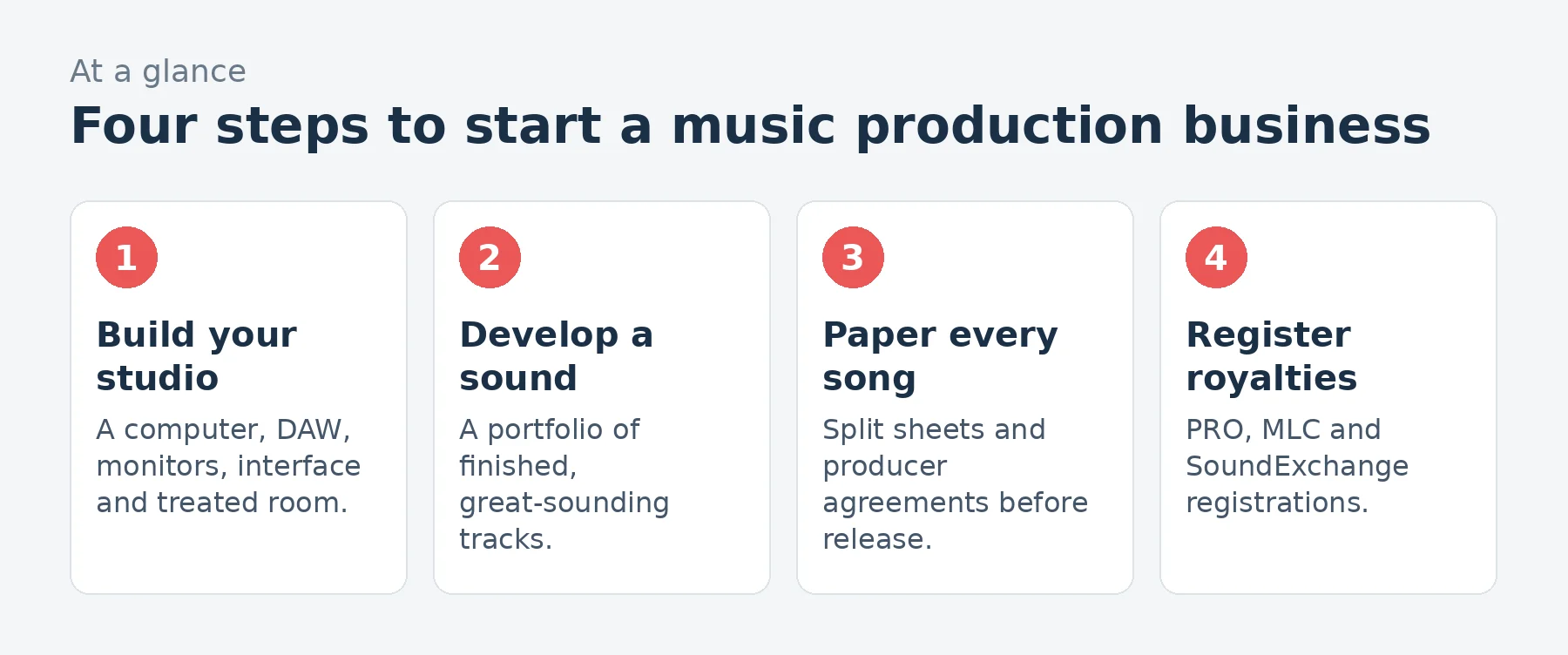
- Days 1-30: set up and treat your studio, finish five strong tracks and write agreement templates.
- Days 31-60: join a PRO, register with The MLC and SoundExchange, and launch a portfolio and beat store.
- Days 61-90: collaborate with five artists, deliver paid projects and pitch music libraries.
Frequently asked questions
How do music producers get paid?
Through production fees and royalties, including master points, songwriting shares and digital performance royalties.
What is a split sheet?
A written agreement recording each writer’s share of a song’s composition.
Do I need permission to sample a song?
Usually yes, from both the master owner and the publisher.
What is SoundExchange?
The organization that collects digital performance royalties for sound recordings, including shares directed to producers.
What is The MLC?
The Mechanical Licensing Collective, which collects and pays U.S. digital mechanical royalties to songwriters and publishers.
Can I produce music at home?
Yes. Many producers work from home studios with good acoustic treatment and quality gear.
Should I register my songs for copyright?
Copyright exists when a work is fixed, but registration with the U.S. Copyright Office provides important legal benefits for valuable works.
What are producer points?
A percentage of the master recording’s royalties paid to the producer, negotiated in the producer agreement.
How do I price beats?
Many producers sell tiered non-exclusive leases with usage limits and higher-priced exclusive licenses, with clear written terms.
Do producers need a music attorney?
For significant deals, such as publishing, label or exclusive production agreements, a music attorney is strongly recommended.
Keep learning
- Music and entertainment industry data
- How to start a recording studio
- How to start a DJ business
- Pricing calculator
Sources
- US Copyright Office, Copyright basics and works made for hire
- The Mechanical Licensing Collective (MLC)
- SoundExchange, Royalties for sound recordings
- ASCAP, Performing rights for songwriters and publishers
- US Bureau of Labor Statistics, Music directors and composers
Last reviewed November 3, 2026. Startup costs are estimates; check local prices, licensing and tax rules before you commit money.

