
A membership community business charges members a recurring fee for access to a group: professional networks, hobby communities, learning communities, mastermind groups, industry peer groups and fan communities. Members pay for connection, expertise, events, resources and belonging.
Recurring revenue is attractive, but communities succeed only when members stay, which depends on regular value, active programming and good moderation. Subscription businesses must also follow automatic renewal laws that require clear terms and easy cancellation. Advanton’s data on courses and coaching shows a median pay of $65,850 for training and development specialists, with employment projected to grow about 11%. This guide covers niche, platforms, pricing, programming, moderation, rules, a worked example and a 90-day plan.
A membership community business at a glance
Table of Contents
| Topic | What to expect |
|---|---|
| Startup cost | Low: a community platform, payment processing, an email tool and your time to host and program |
| Key rules | State automatic renewal laws for subscriptions, honest claims and testimonials, privacy and COPPA if minors could join |
| How you earn | Monthly or annual memberships, premium tiers, events, sponsorships and courses |
| Key metric | Retention: the share of members who renew each month or year |
| Best for | Hosts with expertise or passion who enjoy connecting people and running regular programming |
Who a membership business suits
It suits people with expertise or a passion that others share, who enjoy hosting, facilitating and connecting people. Running a community is ongoing work: members expect fresh value every month.
Choosing a niche and promise
Strong communities serve a specific group with a specific need: "independent bookkeepers growing their practices," "first-time homeschool parents" or "woodworkers building furniture." State what members get, such as weekly expert sessions, peer feedback, templates, job leads or introductions, so people know exactly why to join and stay.
Choosing a platform
Community platforms offer discussions, events, courses, chat, member directories and paid memberships, with monthly fees or revenue shares. Consider the experience on mobile, payment features, moderation tools, integrations with email and whether you can export member data. Some communities run on chat apps or forums, while others use dedicated platforms.
Pricing
Offer monthly and annual plans, with a discount for annual commitment, and consider tiers (community only vs community plus coaching or courses). Founding member pricing rewards early members and helps you launch with energy. Price on the value of what members gain, such as clients, skills or time saved. Use our pricing calculator.
Automatic renewal rules
Recurring memberships must follow state automatic renewal laws: show the price and renewal terms clearly before purchase, get affirmative consent, send required notices and provide an easy way to cancel, often online. California’s law is among the most detailed. Your platform may handle billing, but you are responsible for clear terms.
Honest marketing
Do not promise income or specific outcomes you cannot support; the FTC has warned that unsupported earnings claims can lead to penalties, and its 2024 rule bans fake reviews and testimonials. Share real member stories with permission and context about typical experiences.
Moderation and safety
Write community guidelines covering respectful behavior, self-promotion, confidentiality and consequences, and enforce them consistently. Moderate discussions, protect members’ privacy and have a process for reporting problems. If minors could join, consider COPPA rules for children under 13 and extra safeguards for teens, or set an adult-only policy.
Startup costs to plan for
| Item | What to budget for |
|---|---|
| Platform | Community software subscription or revenue share |
| Payments | Payment processing fees |
| Newsletter and onboarding sequences | |
| Content | Templates, resources and recordings |
| Events | Video tools, guest expert fees |
| Legal | Terms, privacy policy, guidelines |
Use our startup cost calculator for your total.
Programming members love
- Weekly or monthly live sessions with you or guest experts.
- Member spotlights and introductions.
- Challenges, accountability groups and peer feedback.
- Resource libraries: templates, recordings and guides.
- In-person meetups or an annual event.
- Clear channels so discussions stay useful.
A worked example: a professional community
These are illustrative assumptions for an established professional community, not predictions.
| Assumption | Monthly | |
|---|---|---|
| Monthly memberships | 320 members at $39 | $12,480 |
| Annual members (monthly equivalent) | 80 members at $390 a year | $2,600 |
| Event tickets and sponsorships | $1,500 | |
| Revenue | $16,580 | |
| Community platform and tools | $(350) | |
| Payment processing | $(500) | |
| Community manager | Part-time | $(2,200) |
| Guest experts and event costs | $(800) | |
| Marketing | $(900) | |
| Profit before owner pay and taxes | $11,830 |
That leaves about $11,830 a month before the host’s pay and taxes, on about $16,580 of revenue. Each percentage point of monthly churn matters, so onboarding and steady value are the main drivers of profit.
Loading the calculator…
Onboarding and retention
Most cancellations happen early, when new members do not find value quickly. Welcome every member personally, guide them to one valuable action in their first week (an introduction, an event, a resource) and check in after the first month. Track active members, event attendance and churn, and ask leaving members why.
Growing membership
- Free content and an email list that showcase the community’s value.
- Open enrollment periods or waitlists that create urgency.
- Member referrals with rewards.
- Partnerships with associations, brands and creators in your niche.
- Free events that let prospects experience the community.
Sponsorships and partnerships
Brands may sponsor events or resources to reach your members. Choose sponsors that genuinely help members, disclose sponsorships clearly and avoid overwhelming the community with promotions.
Community roles and moderators
As the community grows, recruit trusted members as moderators or ambassadors, give them clear guidelines and recognition and meet with them regularly. Shared leadership keeps conversations active when you are busy and helps new members feel welcome.
Building a resource library
Recordings of past sessions, templates, guides and curated links give members lasting value between live events. Organize the library so new members can find the best resources quickly, and update it as topics change.
Metrics that matter
Track monthly active members, new joins, cancellations, event attendance and engagement in discussions. Look for early warning signs, such as members who have not logged in for weeks, and reach out personally before they cancel.
In-person meetups
Even online communities benefit from occasional in-person gatherings: local meetups, an annual retreat or conference sessions. Face-to-face connection deepens loyalty and can be a separate revenue source.
Annual plans and cash flow
Annual memberships bring cash upfront and reduce churn, since members commit for a year. Offer a meaningful annual discount, send renewal reminders as required by law and remind annual members of the value they received before renewal dates.
Choosing between chat and forum formats
Real-time chat feels lively but can bury valuable discussions; forum-style threads keep knowledge searchable. Many communities combine both: chat for quick connection, threads for questions and resources, and events for depth.
Pricing increases
As the community adds value, raise prices for new members while keeping current members at their rate for a period, which rewards loyalty and encourages people to join sooner. Communicate changes clearly and follow renewal notice requirements.
Common mistakes to avoid
- Launching to an empty community without founding members.
- Irregular programming.
- Hidden renewal terms or difficult cancellation.
- Letting spam and self-promotion take over.
- Promising income or outcomes you cannot support.
Your first 90 days
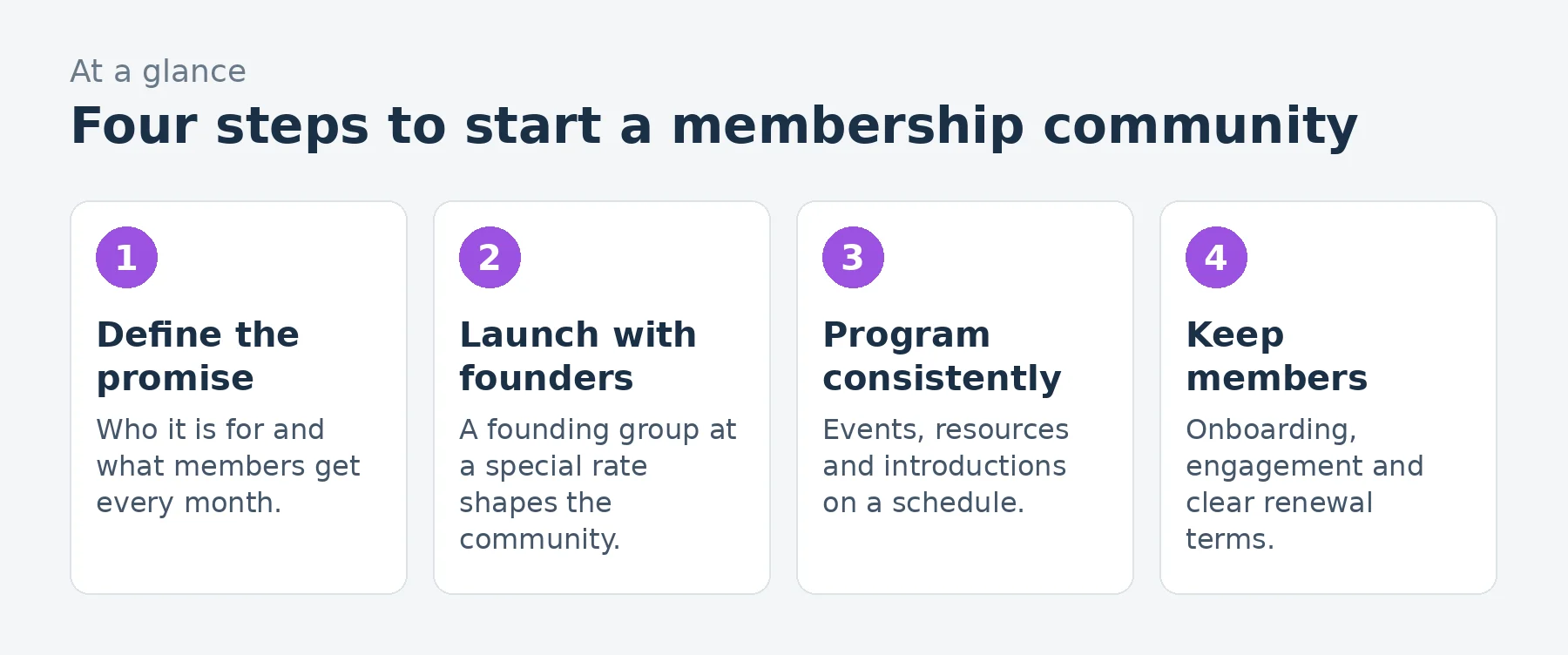
- Days 1-30: define the promise, choose a platform, write guidelines and terms and recruit 20 to 50 founding members.
- Days 31-60: run weekly programming, onboard members personally and collect feedback.
- Days 61-90: open wider enrollment, add a referral program and track retention.
Frequently asked questions
How much should a membership community cost?
It depends on the value and audience; professional communities often charge more than hobby groups. Offer monthly and annual options.
What laws apply to paid memberships?
State automatic renewal laws require clear terms, consent and easy cancellation, plus general consumer protection and privacy rules.
What platform should I use?
Compare community features, mobile experience, payments, moderation tools and data export.
How do I keep members from canceling?
Strong onboarding, regular valuable programming, personal engagement and asking leaving members for feedback.
Can minors join my community?
If children under 13 could join, COPPA applies; many communities set an adult-only policy.
How many members do I need?
It depends on price and costs; many niche communities are profitable with a few hundred members.
Should I offer a free tier?
A free tier can grow awareness but may dilute engagement; many communities offer free content outside the community and keep the community paid.
How do I handle members who break the rules?
Follow your published guidelines consistently: warn, restrict and remove if needed, and document decisions.
Can I run a membership community part-time?
Yes, especially with a clear schedule of programming and help from moderators or a part-time community manager.
How do I find founding members?
Invite your email list, social followers, past clients and peers, offering a founding rate and a voice in shaping the community.
What makes members stay?
Regular valuable programming, relationships with other members, quick wins in the first weeks and a host who shows up consistently.
Do I need terms of service?
Yes. Terms, community guidelines and a privacy policy set expectations and protect you and members.
Keep learning
- Online courses and coaching industry data
- How to start an online course business
- How to start a newsletter business
- Pricing calculator
Sources
- California Automatic Renewal Law (Business and Professions Code section 17600 and following)
- FTC, Notice of penalty offenses concerning money-making opportunities and earnings claims
- FTC, Final rule banning fake reviews and testimonials (2024)
- FTC, Children's Online Privacy Protection Rule (COPPA)
- US Bureau of Labor Statistics, Training and development specialists
Last reviewed November 3, 2026. Startup costs are estimates; check local prices, licensing and tax rules before you commit money.

