
A newsletter business delivers regular emails to subscribers who want a writer’s insight, curation or news on a topic, and earns from paid subscriptions, sponsorships, ads and related products. Newsletters give creators a direct relationship with readers that does not depend on search or social media algorithms.
The business depends on trust and deliverability: readers must want every issue, and emails must reach inboxes. Email rules apply, including CAN-SPAM, and major inbox providers such as Gmail and Yahoo now require bulk senders to authenticate email, offer easy unsubscribes and keep spam complaints low. Paid subscriptions also bring automatic renewal rules. The Bureau of Labor Statistics reports a median pay of $72,270 for writers and authors (May 2024), with about 135,400 jobs and employment projected to grow about 4% over the decade. Independent creators’ income varies enormously, from nothing to substantial businesses. This guide covers niche, platforms, growth, monetization, rules, a worked example and a 90-day plan.
A newsletter business at a glance
Table of Contents
| Topic | What to expect |
|---|---|
| Startup cost | Very low: a newsletter platform (often free to start), a domain and your time |
| Email rules | CAN-SPAM requirements plus Gmail and Yahoo bulk sender rules: authentication, one-click unsubscribe and low spam rates |
| Revenue streams | Paid subscriptions, sponsorships and ads, products, events and services |
| Paid plans | State automatic renewal laws require clear renewal terms and easy cancellation |
| Best for | Consistent writers or curators with a clear point of view on a niche |
Who a newsletter business suits
It suits writers, analysts and curators who can publish reliably on a schedule, have a distinctive voice or expertise and enjoy building community. Many successful newsletters serve professionals in a specific industry.
Making a clear promise
Define who the newsletter is for, what they get (analysis, curated links, deals, local news, data) and how often. A specific promise, such as "a weekly briefing on commercial real estate in Texas," grows faster than a general one, because readers know exactly why to subscribe and share.
Choosing a platform
Newsletter platforms differ in fees, paid subscription features, ad networks, referral programs and how much control you have over your list and website. Some take a percentage of paid subscription revenue; others charge monthly by list size. Make sure you can export your subscriber list.
Email rules: CAN-SPAM
Every commercial email must follow CAN-SPAM: accurate sender and subject line information, identification of ads where applicable, a valid physical postal address and a working unsubscribe link, with opt-outs honored promptly (within 10 business days under the law). Never buy email lists.
Inbox provider requirements
Since 2024, Gmail and Yahoo require bulk senders to authenticate email with SPF, DKIM and DMARC, provide one-click unsubscribe and keep spam complaint rates low. Use a custom sending domain, remove inactive subscribers periodically and send only to people who asked to receive your emails.
Paid subscriptions and renewal laws
Paid newsletters are subscriptions, so state automatic renewal laws (California’s is detailed) require clear disclosure of price and renewal terms before purchase, affirmative consent and an easy way to cancel. Most platforms handle billing, but you are responsible for clear terms.
Monetization
- Paid tiers: premium issues, archives, community access or extra analysis.
- Sponsorships: placements priced by audience size and niche value.
- Ad networks that place sponsors automatically.
- Products and services: courses, reports, consulting or events.
- Affiliate recommendations with clear disclosure.
Disclosures
Sponsorships, affiliate links, free products and paid partnerships must be clearly disclosed under the FTC’s Endorsement Guides: disclosures should be easy to notice, in plain language (such as "sponsored" or "I earn a commission"), and placed where audiences will see them, not buried in a link or at the end.
Startup costs to plan for
| Item | What to budget for |
|---|---|
| Platform | Free tiers to start; costs grow with list size or revenue share |
| Domain | Custom domain for sending and a website |
| Design | Simple template and logo |
| Growth | Referral rewards, cross-promotions |
| Tools | Research, writing and analytics |
| Legal | Terms of service and privacy policy |
Use our startup cost calculator for your total.
Growing subscribers
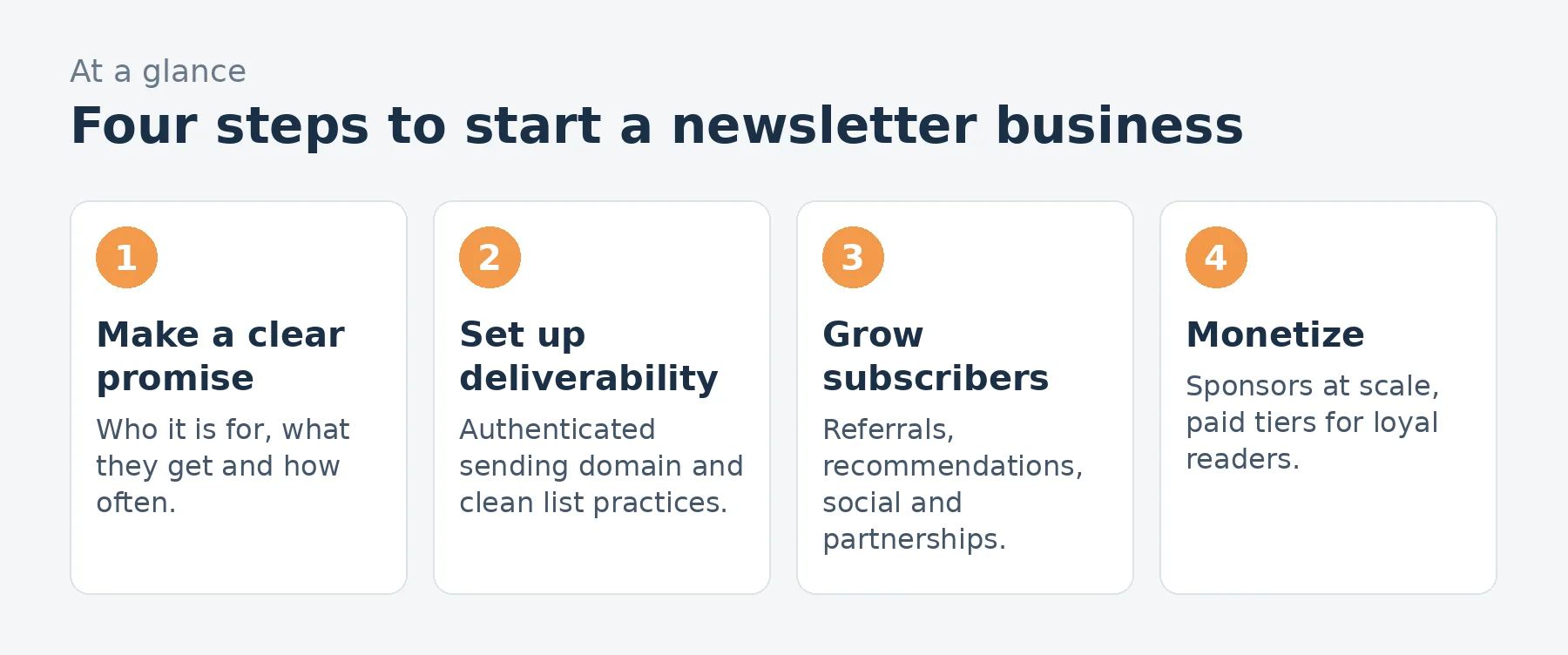
- A clear signup page and a strong welcome email.
- Referral programs that reward readers for sharing.
- Recommendations and cross-promotions with similar newsletters.
- Social media posts and short excerpts.
- Guest appearances on podcasts and in other newsletters.
- A useful free resource for new subscribers.
A worked example: a niche newsletter
These are illustrative assumptions for an established niche newsletter with 15,000 free subscribers, not predictions.
| Assumption | Monthly | |
|---|---|---|
| Paid subscriptions | 600 paying readers at $8 a month | $4,800 |
| Sponsorships | 4 sponsored placements at $600 | $2,400 |
| Revenue | $7,200 | |
| Platform and payment fees | Varies by platform | $(720) |
| Email and tools | $(150) | |
| Freelance research or editing help | $(600) | |
| Growth and referral rewards | $(300) | |
| Profit before owner pay and taxes | $5,430 |
That leaves about $5,430 a month before the writer’s pay and taxes, on about $7,200 of revenue. Newsletters scale well because each issue reaches every subscriber at little extra cost.
Loading the calculator…
Pricing sponsorships
Sponsors pay for attention from a specific audience, so niche business newsletters often earn more per subscriber than general ones. Share open and click data honestly, offer clear placements (primary, secondary, classified) and report results after each sponsorship.
Consistency and quality
Publish on the same schedule, keep issues scannable, deliver your promise every time and invite reader replies. Track opens, clicks, growth and unsubscribes to learn what readers value.
The welcome sequence
A short series of welcome emails introduces you, sets expectations, shares your best past content and asks new readers to reply or whitelist your address. Replies and engagement early help deliverability and build relationships.
Keeping subscribers
Readers stay when every issue delivers value. Survey subscribers, track which sections get clicks, trim what readers skip and stay consistent. For paid tiers, give subscribers clear benefits and remind them of value before renewals.
Writing a great issue
Lead with the most useful item, write scannable sections with clear headlines, keep a consistent structure readers recognize and end with a simple call to action, such as replying, sharing or upgrading. Personality and clear opinions make newsletters memorable.
Selling a newsletter
Newsletters with engaged subscribers and steady revenue can be valuable assets. Clean data, consistent growth and documented processes make a newsletter attractive to buyers or partners.
Free and paid tiers
Many newsletters keep a free tier for growth and offer paid tiers for extra issues, deeper analysis, archives or community. The free version should be valuable enough to share; the paid version should be clearly worth more.
Choosing a niche
Newsletters for professionals, such as industry news, analysis for investors or local business coverage, often monetize better than general interest topics, because sponsors and readers pay for information that helps them work or decide.
Deliverability habits
Ask new subscribers to confirm their address (double opt-in), send consistently, avoid misleading subject lines, clean out subscribers who never open and monitor complaint and bounce rates. Good habits keep issues landing in inboxes rather than spam folders.
Common mistakes to avoid
- Buying or scraping email lists.
- Skipping email authentication.
- Hiding sponsored content.
- Confusing renewal terms for paid plans.
- Publishing irregularly.
Your first 90 days
- Days 1-30: define the promise, choose a platform, set up a custom domain with authentication and publish three issues.
- Days 31-60: publish weekly, launch a referral program and partner with two similar newsletters.
- Days 61-90: test a paid tier or first sponsorship and survey readers.
Frequently asked questions
How do newsletters make money?
Through paid subscriptions, sponsorships and ads, products, events and services.
What email rules apply to newsletters?
CAN-SPAM requirements, plus Gmail and Yahoo bulk sender rules on authentication, one-click unsubscribe and low spam rates.
How many subscribers do I need to get sponsors?
It depends on the niche; specialized business audiences can attract sponsors with smaller lists.
Do paid newsletters have special rules?
Yes. State automatic renewal laws require clear renewal terms, consent and easy cancellation.
Can I buy an email list to grow faster?
No. Buying lists harms deliverability and can violate rules; grow with people who choose to subscribe.
Which platform should I use?
Compare fees, paid subscription tools, growth features and whether you can export your list.
What is a good open rate?
It varies by niche and measurement changes in email apps; focus on clicks, replies and growth as well as opens.
How often should a newsletter go out?
Weekly is common, but the right frequency is one you can keep consistently with quality.
Can I move my newsletter to another platform later?
Usually yes, if the platform lets you export your subscriber list; check before choosing.
Do I need a physical address in my emails?
Yes. CAN-SPAM requires a valid physical postal address, which can be a P.O. box or registered mailbox.
Should I use double opt-in?
Double opt-in confirms addresses, improves list quality and helps deliverability, though it may slow growth slightly.
Can I run ads in a free newsletter?
Yes. Many free newsletters earn from sponsorships and ad networks, with ads clearly labeled.
Keep learning
- Content creation industry data
- How to start a blogging business
- How to start a podcast business
- Pricing calculator
Sources
- FTC, CAN-SPAM Act: a compliance guide for business
- Google, Email sender guidelines for bulk senders
- California Automatic Renewal Law (Business and Professions Code section 17600 and following)
- FTC, Endorsement Guides: what people are asking
- US Bureau of Labor Statistics, Writers and authors
Last reviewed November 3, 2026. Startup costs are estimates; check local prices, licensing and tax rules before you commit money.

