
A legal document preparation business helps people who represent themselves complete legal paperwork: uncontested divorce forms, name changes, small claims filings, simple wills where allowed, business formations, eviction paperwork, bankruptcy petitions under specific rules and court forms. Many people cannot afford an attorney for routine matters, and they need help filling out forms correctly.
This business is heavily regulated, because helping with legal documents can cross into practicing law. Some states have specific programs: California registers Legal Document Assistants, Arizona certifies legal document preparers and runs a legal paraprofessional program, Nevada registers document preparation services, and Utah and Oregon license paralegal practitioners for limited services. The Bureau of Labor Statistics reports a median pay of $61,010 for paralegals and legal assistants (May 2024), across about 376,200 jobs, with little change projected over the decade. This guide covers the rules, services, pricing, a worked example and a 90-day plan.
A legal document preparation business at a glance
Table of Contents
| Topic | What to expect |
|---|---|
| Startup cost | Low: training, state registration and any bond, insurance, forms resources, an office or virtual setup and marketing |
| Key rules | No legal advice; state-specific registration, bonds, disclosures and education requirements where they exist |
| State examples | California LDA registration with a $25,000 bond, Arizona certification, Nevada registration, Utah and Oregon paralegal practitioner licenses |
| How you charge | Flat fees per document package, plus filing fees passed through to the court or agency |
| Best for | Careful, organized people who enjoy paperwork and helping people through stressful processes |
Who this business suits
It suits careful, patient people with strong attention to detail who enjoy guiding people through bureaucratic processes. Many come from paralegal or court clerk backgrounds. You must be comfortable saying "I can’t advise you on that, but an attorney can."
The unauthorized practice of law
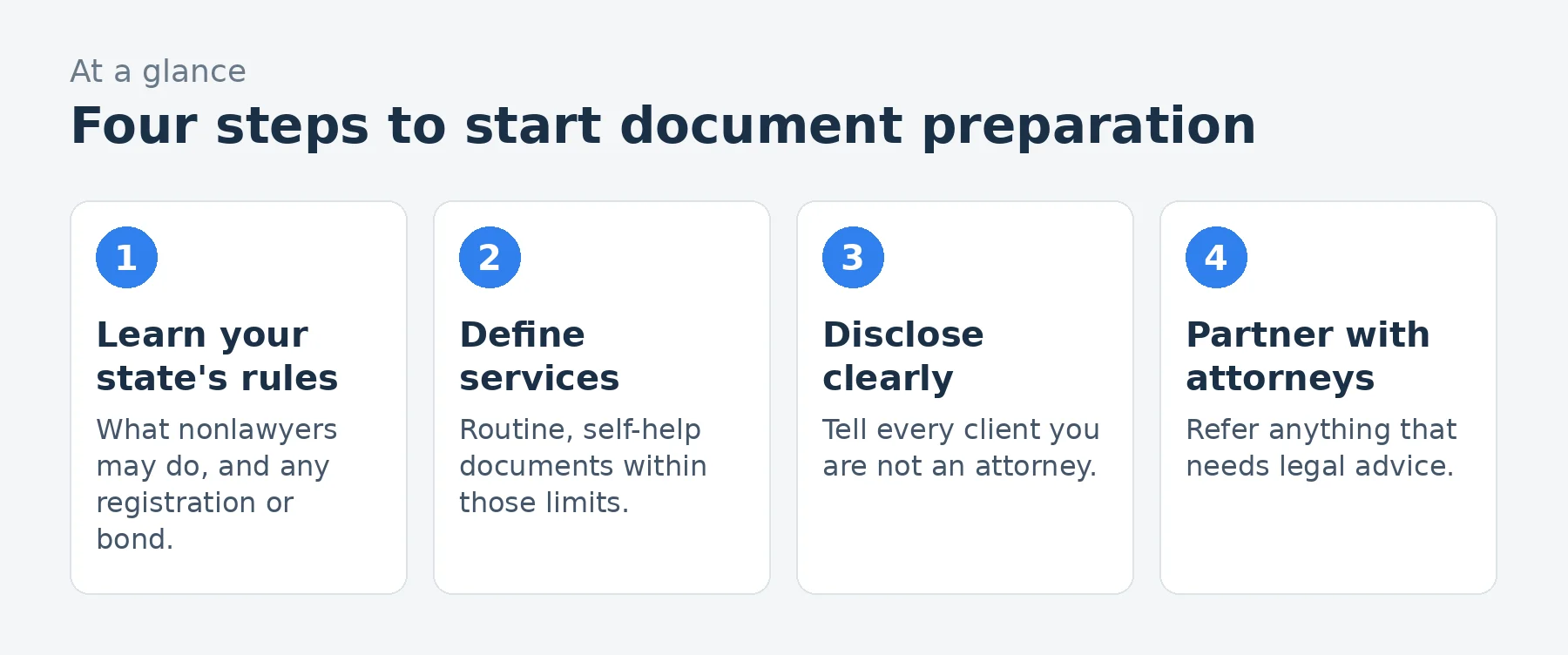
Every state prohibits the unauthorized practice of law: only licensed attorneys may give legal advice, choose legal strategies for someone, draft legal documents as legal counsel or represent people in court. What counts as practicing law differs by state, and penalties can be serious. Nonlawyer services must stay within what your state allows, and you should never present yourself as a lawyer.
In general, document preparers may type or prepare documents with information the customer provides, at the customer’s direction, and may provide published legal information, but may not tell customers which forms to choose for their situation, what their rights are or how to proceed in a case, unless state rules specifically allow it.
State programs to know
- California: Legal Document Assistants must register with the county, post a $25,000 bond, meet education or experience requirements and use required disclosures stating they are not attorneys.
- Arizona: legal document preparers are certified through the Arizona Supreme Court, and the state also licenses legal paraprofessionals for limited legal services.
- Nevada: document preparation services must register with the Secretary of State.
- Utah and Oregon: licensed paralegal practitioners may provide limited legal services in specified practice areas.
- Other states: many have no specific program, which means the general unauthorized practice of law rules apply strictly.
Programs change, so confirm current rules with your state’s courts and bar before starting.
Services to offer
- Family law forms: uncontested divorce, custody and support paperwork, where permitted.
- Name changes and other court petitions.
- Small claims and civil court forms.
- Landlord-tenant paperwork.
- Business documents: LLC formation filings with the state.
- Estate documents: simple wills and powers of attorney only where state rules permit nonlawyer preparation.
- Notary services, if commissioned as a notary.
Bankruptcy petition preparers are regulated by federal bankruptcy law, with fee limits and disclosure rules; learn them before offering bankruptcy forms.
Disclosures and contracts
Tell every client in writing that you are not an attorney and cannot give legal advice, as many state programs require. Use written service agreements describing the documents you will prepare, fees, what the client is responsible for (including accuracy of information and court appearances) and your refund policy. Keep copies of documents as your state requires.
Startup costs to plan for
| Item | What to budget for |
|---|---|
| Registration and bond | State or county registration and any required bond |
| Training | Required education or paralegal coursework |
| Insurance | Errors and omissions |
| Forms and research | Current court forms and procedure guides |
| Office | Private space for client meetings, or virtual tools |
| Marketing | Website, directories and community outreach |
Use our startup cost calculator for your total.
Pricing
Most document preparers charge flat fees per document package, such as an uncontested divorce package or a name change, with court filing fees paid separately. Flat fees are clear for clients and reward efficiency. Research local prices, and check whether your state or federal rules (such as for bankruptcy petition preparers) limit fees. Use our pricing calculator.
A worked example: a small office
These are illustrative assumptions for a small office in a state that permits document preparers, not predictions.
| Assumption | Monthly | |
|---|---|---|
| Document packages | 45 packages at $350 average | $15,750 |
| Notary and filing assistance | $800 | |
| Revenue | $16,550 | |
| Assistant wages | Part-time, with payroll costs | $(2,600) |
| Office rent and utilities | $(1,400) | |
| Forms software and research | $(250) | |
| Bond and insurance | Required bond where applicable, errors and omissions | $(150) |
| Marketing | $(900) | |
| Profit before owner pay and taxes | $11,250 |
That leaves about $11,250 a month before the owner’s pay and taxes, on about $16,550 of revenue. Court filing fees are passed through to clients and are not your revenue.
Loading the calculator…
A client process
- Explain your services and limits, and provide written disclosures.
- Have the client choose the documents they need (or refer them to an attorney).
- Collect information through a questionnaire.
- Prepare documents exactly as directed and review them with the client for accuracy.
- Explain filing logistics and deadlines using published court information.
- Deliver documents and keep records as required.
Working with attorneys
Build referral relationships with family, estate and business attorneys, including limited-scope (unbundled) attorneys who can advise clients on specific questions. Referring out complex matters protects clients and builds trust with attorneys, who may refer routine paperwork to you.
Finding clients
- Self-represented litigants looking for affordable help.
- Community organizations and legal aid referrals for matters they cannot take.
- Landlords and small businesses with routine filings.
- Spanish-language and other language services, where needed.
- Google Business Profile and reviews.
Protecting client information
Clients share sensitive family, financial and identity information. Store documents securely, limit access and follow your state’s confidentiality requirements. The FTC expects businesses to protect personal information they collect.
Keeping forms current
Courts update forms regularly, and an outdated form can delay a case. Check court websites for current versions before every job, subscribe to court update notices where available and keep a dated library of forms by court.
Language access
Many self-represented people need help in languages other than English. Bilingual services are valuable, but documents filed with courts generally must be in English, and translations or interpretation for court have their own rules. Be clear about what you provide.
Honest marketing
Advertising must not suggest you are a lawyer or law firm. Avoid terms like "legal advice" or "legal counsel," include required disclosures in ads where your state requires them and describe services as document preparation for people representing themselves. Honest marketing protects you and builds trust.
Common mistakes to avoid
- Giving legal advice or choosing forms for clients without authorization.
- Operating without required registration or bond.
- Missing required disclosures.
- Calling yourself a lawyer or using misleading titles.
- Offering complex matters that need an attorney.
Your first 90 days
- Days 1-30: research your state’s rules, complete required training and register and bond if required.
- Days 31-60: define services, write disclosures and agreements and buy insurance.
- Days 61-90: build attorney referral partnerships and launch locally.
Frequently asked questions
Can I prepare legal documents without being a lawyer?
In some states, yes, within strict limits and often with registration. You cannot give legal advice anywhere without a license.
What is a Legal Document Assistant?
A California registered professional who prepares documents for self-represented people, with a $25,000 bond and required disclosures.
What is the unauthorized practice of law?
Providing legal services only licensed attorneys may provide, such as legal advice or representation; rules vary by state.
Can document preparers help with divorce papers?
In many states they can prepare forms at the client’s direction for uncontested cases, without advising on legal strategy.
How do document preparers charge?
Usually flat fees per document package, with court filing fees paid separately.
Do I need insurance?
Errors and omissions insurance is strongly recommended, and some states require a bond.
Can I help with immigration forms?
Immigration assistance is heavily regulated, and federal rules allow only attorneys and accredited representatives to provide legal services; nonlawyer help is very limited. Check the rules carefully before offering anything.
Can I advertise as a legal service?
Describe your business as document preparation, include required disclosures and never imply you are an attorney.
Keep learning
- Legal services industry data
- How to start a paralegal services business
- How to start a process server business
- Pricing calculator
Sources
- California Business and Professions Code, Legal Document Assistants (sections 6400-6415)
- Arizona Judicial Branch, Legal document preparer and legal paraprofessional programs
- Nevada Secretary of State, Document preparation services registration
- Utah State Bar, Licensed Paralegal Practitioner program
- US Bureau of Labor Statistics, Paralegals and legal assistants
Last reviewed November 3, 2026. Startup costs are estimates; check local prices, licensing and tax rules before you commit money.

