
A home inspection business evaluates the condition of homes, usually for buyers before closing: roofs, structure, electrical, plumbing, heating and cooling, insulation, windows, doors and more, delivered in a detailed report. Inspectors also serve sellers (pre-listing inspections), homeowners and investors.
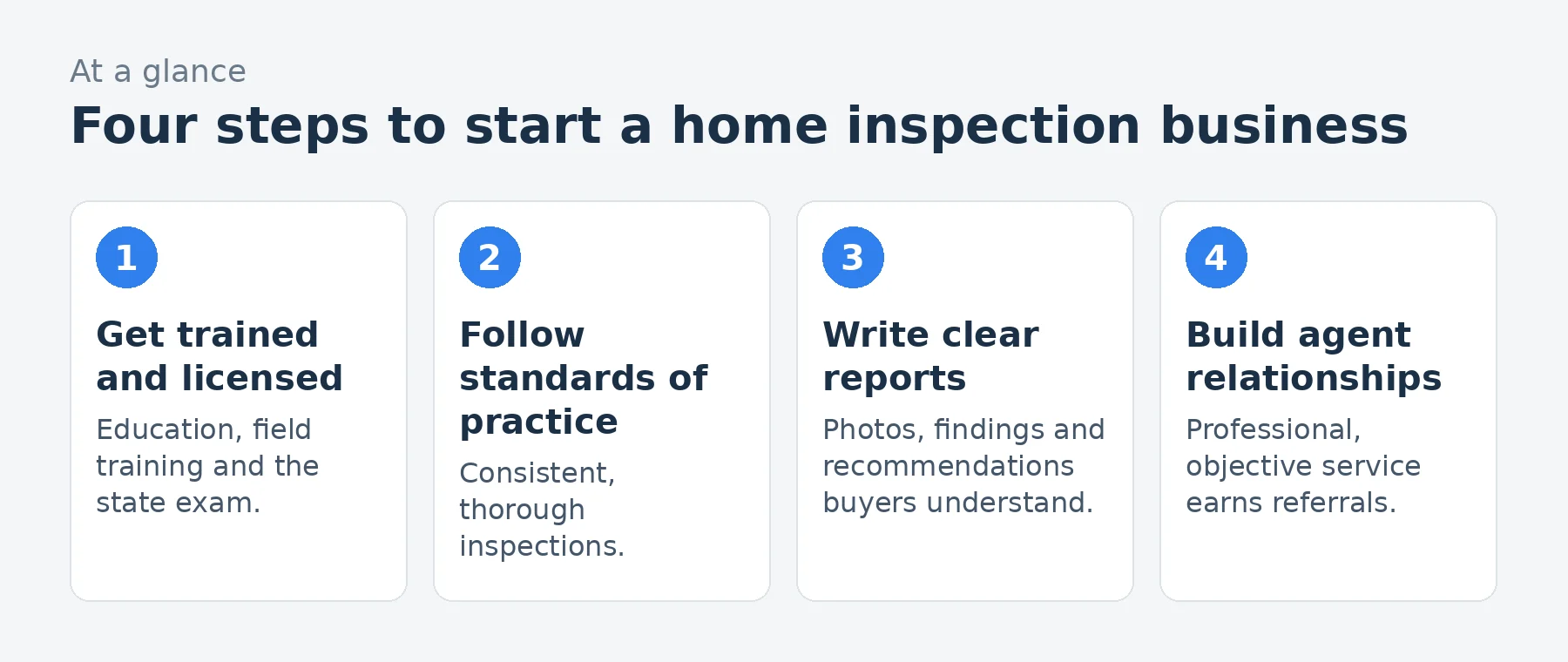
Most states license home inspectors, typically requiring education, field training and an exam such as the National Home Inspector Examination, plus insurance in some states. Inspectors follow standards of practice and must avoid conflicts of interest, such as repairing homes they inspect. Ancillary services like radon and termite inspections can add revenue, sometimes with separate licenses. The Bureau of Labor Statistics reports a median pay of $72,120 for construction and building inspectors (May 2024), a group that includes home inspectors. This guide covers licensing, standards, tools, insurance, services, pricing, a worked example and a 90-day plan.
A home inspection business at a glance
Table of Contents
| Topic | What to expect |
|---|---|
| Startup cost | Low to moderate: training and licensing, tools, ladder, report software, insurance, a vehicle and marketing |
| Licensing | Most states license home inspectors, with education, field experience and exams such as the NHIE |
| Standards | State standards of practice or those of ASHI and InterNACHI define what inspections cover |
| Insurance | Errors and omissions and general liability insurance, required by some states |
| Best for | Detail-oriented people with construction knowledge who write clearly and stay objective |
Who home inspection suits
It suits people with construction, trades or engineering knowledge who are observant, physically able to climb ladders and crawl spaces, write clear reports and stay calm and objective under pressure from tight real estate deadlines.
Licensing
Most states regulate home inspectors, often requiring a set number of education hours, supervised or field inspections, a passing score on the National Home Inspector Examination or a state exam, background checks and continuing education. Some states also require insurance. A few states do not license inspectors, but certification from professional associations is still valued.
Standards of practice
Standards of practice from your state, ASHI or InterNACHI describe the systems to inspect, what to report and what is excluded (for example, inspections are visual and non-invasive). Following a standard protects clients and you, and your report should state which standard you follow.
Conflicts of interest
Many states and association codes of ethics prohibit inspectors from performing repairs on homes they inspect, and some restrict payments or referral arrangements with real estate agents. Stay objective, report what you find and never shade findings to help a sale close.
Tools
- Flashlights, ladders and a moisture meter.
- Electrical testers and GFCI testers.
- Infrared camera for moisture and insulation issues.
- Drone or pole camera for roofs where safe and legal.
- Gas leak detector and carbon monoxide meter.
- Report software for photos and clear findings.
Insurance
Carry errors and omissions insurance, which covers claims that you missed defects, plus general liability for damage during inspections. Use a pre-inspection agreement that defines scope, limits and dispute processes, as allowed by state law.
Ancillary services
- Radon testing: EPA recommends testing, and some states license radon measurement professionals.
- Wood-destroying organism (termite) inspections: often require a pest control license.
- Sewer scopes with cameras.
- Mold, pool, septic and well inspections, where qualified and licensed.
- Pre-listing, new construction and warranty inspections.
- Commercial property inspections.
Startup costs for a home inspection business
| Item | What to budget for |
|---|---|
| Education and licensing | Courses, exam, license fees |
| Tools | Ladders, meters, infrared camera, testers |
| Report software | Inspection report and scheduling platform |
| Insurance | Errors and omissions, general liability |
| Vehicle | Space for ladders and tools |
| Marketing | Website, business cards, agent outreach |
Use our startup cost calculator for your total.
Pricing
Price inspections by square footage, home age and features (crawl spaces, pools, outbuildings), with add-ons for radon, sewer scopes and termite inspections. Research local rates and price for the time an inspection and report actually take. Use our pricing calculator.
A worked example: a solo inspector
These are illustrative assumptions for an established solo inspector in a busy month, not predictions.
| Assumption | Monthly | |
|---|---|---|
| Home inspections | 40 inspections averaging $425 | $17,000 |
| Ancillary services | Radon tests, sewer scopes and termite inspections where licensed | $3,200 |
| Revenue | $20,200 | |
| Report software and tools | $(250) | |
| Vehicle and fuel | $(700) | |
| Insurance | Errors and omissions and general liability | $(500) |
| Radon lab fees and supplies | $(500) | |
| Marketing and association dues | $(800) | |
| Scheduling assistant | Part-time | $(1,200) |
| Profit before owner pay and taxes | $16,250 |
That leaves about $16,250 a month before the inspector’s pay and taxes, on about $20,200 of revenue. Inspection volume follows the housing market, so diversifying with ancillary and commercial services helps in slower periods.
Loading the calculator…
Writing reports
Reports should be clear, organized and photo-rich, separating safety issues, major defects and maintenance items, with recommendations for qualified contractors to evaluate further. Deliver reports quickly, often within 24 hours, to meet contract deadlines.
Finding clients
- Real estate agents, following state rules on referrals.
- Direct-to-buyer marketing through local search and reviews.
- Sellers for pre-listing inspections.
- Investors and property managers.
- Builders and warranty companies for new construction inspections.
The inspection day
Arrive early, review the agreement with the client, inspect systematically from roof to foundation, take photos of every finding and invite buyers to walk through key items at the end. Explain findings calmly, separating safety issues and major defects from routine maintenance.
New construction inspections
Buyers of new homes increasingly hire inspectors at key stages: pre-pour foundation, pre-drywall framing and final walkthrough, plus 11-month warranty inspections. Phase inspections catch problems while builders can still fix them easily.
Commercial property inspections
Commercial property condition assessments for small offices, retail buildings and apartments are larger, more detailed projects, often following industry standards. They need broader expertise and higher insurance limits, but command higher fees.
Growing to a multi-inspector firm
Growth means hiring licensed inspectors, standardizing reports and processes, adding a scheduler and offering more ancillary services. Quality control matters: review reports and accompany new inspectors until they meet your standards.
Handling complaints
Some clients will discover problems after closing. Respond professionally, review your report and photos, explain the scope of a visual inspection and follow your agreement’s dispute process. Clear reports and pre-inspection agreements prevent many disputes.
Pre-listing inspections
Sellers increasingly order inspections before listing to find and fix problems early, reducing surprises during negotiations. Pre-listing inspections smooth the market cycle and build relationships with listing agents.
Safety on the job
Inspectors face hazards: ladders and roofs, electrical panels, attics with exposed wiring, crawl spaces with pests and mold. Use ladder safety, protective gear and judgment, and do not enter unsafe areas; note limitations in the report.
Report turnaround and technology
Real estate deadlines are tight. Use report software that lets you add photos and notes on site, deliver reports within 24 hours and offer online scheduling and payment. Fast, clear reports are one of the main reasons agents and buyers recommend an inspector.
Common mistakes to avoid when starting a home inspection business
- Inspecting without a required license.
- Repairing homes you inspected.
- Unclear reports full of jargon.
- No errors and omissions insurance.
- Offering termite or radon services without required licenses.
Your first 90 days as a home inspection business owner
- Days 1-30: complete required education and field training and schedule the exam.
- Days 31-60: get licensed, buy tools, report software and insurance and write your agreement.
- Days 61-90: introduce yourself to agents and buyers and add radon or sewer scope services.
Frequently asked questions about starting a home inspection business
Do I need a license to be a home inspector?
Most states require licensing, usually with education, field training and an exam such as the NHIE.
What is the National Home Inspector Examination?
A standardized exam used by many states to license home inspectors.
Can home inspectors fix problems they find?
Many states and association codes prohibit repairing homes you inspect, to avoid conflicts of interest.
Do home inspectors need insurance?
Errors and omissions and general liability insurance are important, and some states require them.
Can home inspectors do termite inspections?
Often only with a pest control license; check your state’s rules.
How much do home inspectors charge?
By home size, age and features, plus add-ons such as radon testing and sewer scopes.
How long does a home inspection take?
Often two to four hours on site for a typical home, plus time to write the report.
Do home inspectors need continuing education?
Most licensing states require continuing education to renew licenses.
Is home inspection a good career?
It can be for detail-oriented people with construction knowledge, though volume follows the housing market.
What tools does a home inspector need?
Ladders, flashlights, moisture meters, electrical testers, an infrared camera and inspection report software.
How do I get my first inspection clients?
Introduce yourself to agents, list your business online, collect reviews and offer pre-listing inspections to sellers.
Can I inspect homes part-time?
Some inspectors start part-time, but real estate deadlines require flexible availability and fast reports.
What is a pre-inspection agreement?
A contract defining the inspection’s scope, limitations, fees and dispute process, signed before the inspection.
Do I need construction experience to inspect homes?
It helps greatly; training and field inspections build the knowledge licensing requires.
Keep learning
- Home inspection industry data
- How to start a home energy audit business
- How to start a property management company
- Pricing calculator
Sources
- US Bureau of Labor Statistics, Construction and building inspectors
- National Home Inspector Examination (NHIE)
- ASHI, Standard of practice for home inspections
- InterNACHI, Home inspection standards of practice
- EPA, Radon in real estate transactions
Last reviewed November 3, 2026. Startup costs are estimates; check local prices, licensing and tax rules before you commit money.

