
A property management company manages rental properties for owners: marketing vacancies, screening tenants, signing leases, collecting rent, handling maintenance, inspecting properties and dealing with problems and evictions. Owners pay monthly fees so they do not have to manage tenants themselves.
In most states, managing property for others requires a real estate broker license (or a property management license), and rents and deposits must be held in trust accounts with careful accounting. Managers must also follow fair housing, tenant screening, lead paint and landlord-tenant laws. The Bureau of Labor Statistics reports a median pay of $66,700 for property, real estate and community association managers (May 2024), across about 466,100 jobs, with employment projected to grow about 4% over the decade. This guide covers licensing, trust accounting, compliance, fees, operations, a worked example and a 90-day plan.
A property management company at a glance
Table of Contents
| Topic | What to expect |
|---|---|
| Startup cost | Low to moderate: licensing, software, insurance, a website, marketing and an office or virtual setup |
| Licensing | A real estate broker license or property management license in most states to manage property for others |
| Trust accounts | Rents and security deposits held in separate trust accounts, reconciled regularly |
| Key rules | Fair housing laws, tenant screening rules, lead paint disclosure and state and local landlord-tenant law |
| Best for | Organized, calm problem-solvers who communicate well with owners and tenants |
Who property management suits
It suits organized, patient people who stay calm in conflicts, communicate clearly and enjoy problem-solving. Managers handle late-night emergencies, difficult tenants and demanding owners, so systems and boundaries matter.
Licensing
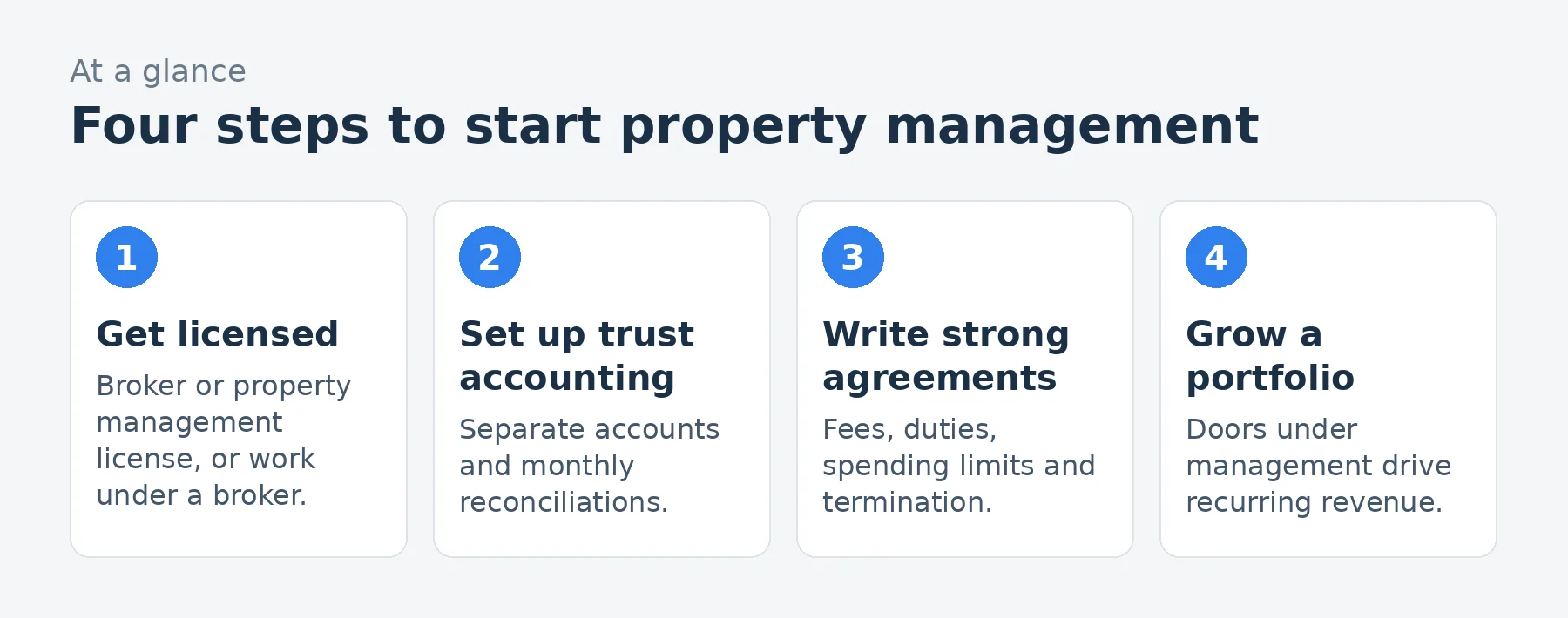
Most states require a real estate broker license to manage rental property for others for compensation, because leasing and collecting rent are real estate activities. Some states have separate property management licenses, and a few have exemptions. Many new managers start under a licensed broker while earning their own broker license. Check your state real estate commission’s rules.
Trust accounts
Rents, security deposits and owner funds must generally be held in trust (escrow) accounts separate from your business funds, with detailed records and regular reconciliations. Commingling or misusing client funds is a leading cause of license discipline. Use property management software with trust accounting, and reconcile monthly.
Landlord and tenant rules
- Fair housing: the federal Fair Housing Act prohibits discrimination based on race, color, religion, sex, national origin, familial status and disability, and many states and cities add protections such as source of income.
- Lead paint disclosure: for housing built before 1978, landlords and sellers must disclose known lead-based paint hazards and provide the EPA pamphlet.
- Tenant screening: using credit or background reports triggers Fair Credit Reporting Act duties, including adverse action notices.
- Security deposits, habitability and evictions: state and local landlord-tenant laws set deposit limits, repair duties, notice periods and eviction procedures.
- Local rental rules: some cities require rental registration, inspections or licenses, and many regulate short-term rentals.
Management agreements
Agreements with owners should cover services, management and leasing fees, maintenance spending limits without approval, reserves, how rent is disbursed, insurance requirements, responsibilities for legal compliance, term and termination. Clear agreements prevent most owner disputes.
Fee models
- Monthly management fee: a percentage of collected rent or a flat fee per unit.
- Leasing fee: for finding and placing a new tenant.
- Lease renewal fee.
- Maintenance coordination or markups, disclosed in agreements.
- Eviction or court appearance fees.
Use our pricing calculator to compare models.
Startup costs to plan for
| Item | What to budget for |
|---|---|
| Licensing | Pre-licensing courses, exams, broker license |
| Software | Property management, trust accounting, screening, maintenance |
| Insurance | Errors and omissions, general liability, crime coverage |
| Website and marketing | Owner services and vacancy listings |
| Office | Office or virtual setup, phone system |
| Legal | Agreement templates, lease forms |
Use our startup cost calculator for your total.
Day-to-day operations
- Market vacancies and show properties.
- Screen applicants consistently with written criteria.
- Sign leases and complete move-in inspections.
- Collect rent and enforce lease terms.
- Handle maintenance with vetted, insured vendors.
- Send owners monthly statements and handle renewals and move-outs.
A worked example: a 150-unit portfolio
These are illustrative assumptions for a company managing about 150 single-family and small multifamily units, not predictions.
| Assumption | Monthly | |
|---|---|---|
| Management fees | 150 units averaging $1,600 rent at 8% | $19,200 |
| Leasing and renewal fees | $4,500 | |
| Maintenance coordination and other fees | As allowed by agreements | $1,500 |
| Revenue | $25,200 | |
| Staff | Property manager and leasing assistant, with payroll costs | $(11,000) |
| Software and screening tools | $(900) | |
| Office, phones and vehicle | $(1,800) | |
| Insurance | Errors and omissions, general liability | $(500) |
| Marketing | Owner acquisition and vacancy advertising | $(1,200) |
| Profit before owner pay and taxes | $9,800 |
That leaves about $9,800 a month before the owner’s pay and taxes, on about $25,200 of revenue. Each new door adds recurring income, so owner retention and referrals drive growth.
Loading the calculator…
Maintenance and vendors
Build a network of licensed, insured contractors for plumbing, electrical, HVAC, appliances and turnovers, with 24-hour emergency response. Use renovation contractors certified under the EPA’s lead-safe rules for pre-1978 properties.
Finding owners
- Real estate agents and investors who refer clients.
- Accidental landlords who inherited or moved.
- Local investor groups.
- Online search and reviews.
- Referrals from satisfied owners.
Evictions
Evictions must follow state and local procedures exactly: proper notices, court filings and hearings, with no self-help such as changing locks or removing belongings. Many areas have additional tenant protections and notice periods. Work with landlord-tenant attorneys, and document every step.
Owner reporting
Owners want clear monthly statements showing rent collected, expenses, reserves and distributions, plus year-end tax forms. Owner portals and prompt answers to questions build trust and retention.
Pricing maintenance fairly
If you add markups or coordination fees to maintenance, disclose them in the management agreement. Transparent pricing prevents disputes and protects your reputation with owners.
Short-term rental management
Managing vacation rentals involves guest communication, dynamic pricing, cleaning turnovers, local permits and occupancy taxes. It earns higher fees but requires different systems and, in some places, specific licensing.
Inspections and documentation
Document property condition with photos and checklists at move-in, during periodic inspections and at move-out. Good documentation supports fair security deposit deductions, which many states regulate closely, and protects owners and managers in disputes.
Choosing a niche
Managers often specialize in single-family homes, small multifamily buildings, student housing, affordable housing programs or commercial properties. A niche shapes your systems, marketing and licensing needs. Affordable housing programs bring additional compliance, such as housing voucher inspections.
Growing and staffing
As the portfolio grows, add leasing agents, maintenance coordinators and accounting staff, and assign portfolios so each manager knows their owners and properties. Documented procedures keep service consistent and protect against mistakes with trust funds.
Common mistakes to avoid
- Managing without the required license.
- Mixing trust funds with business money.
- Inconsistent screening that risks fair housing claims.
- Vague management agreements.
- Slow responses to maintenance and owners.
Your first 90 days
- Days 1-30: confirm licensing requirements and start licensing or join a broker.
- Days 31-60: set up software, trust accounts, insurance and agreement templates.
- Days 61-90: sign first owners, build a vendor network and set screening criteria.
Frequently asked questions
Do I need a license to be a property manager?
In most states, managing property for others requires a real estate broker or property management license.
What is a trust account?
A separate account for tenants’ deposits and owners’ rents, kept apart from your business funds.
How much do property managers charge?
Often a percentage of collected rent or a flat fee per unit, plus leasing and renewal fees.
What fair housing rules apply?
The federal Fair Housing Act and state and local laws prohibit discrimination in renting, screening and advertising.
Do property managers need insurance?
Yes: errors and omissions, general liability and often crime or fidelity coverage.
Can I manage my own rentals without a license?
Owners generally can manage their own properties; licenses are usually required to manage others’ properties.
How many doors do I need to make a living as a property manager?
It depends on fees and costs; many managers need well over 100 units before hiring staff makes sense.
Can property managers handle evictions?
They can coordinate them, but evictions must follow legal procedures, often with an attorney.
What software do property managers use?
Property management platforms with trust accounting, online rent payments, maintenance requests, screening and owner portals.
Should property managers specialize?
Many do, in single-family homes, small multifamily, student housing or affordable housing, which helps with systems and marketing.
How do property managers find new owners?
Through agent and investor referrals, local investor groups, online search and satisfied owners.
Can I start property management part-time?
Some start small, but tenants and emergencies need responsive service, so plan coverage carefully.
What screening criteria should I use?
Written, consistent criteria for income, credit, rental history and background, applied equally and following fair housing and local laws.
Do I need a separate trust account for each owner?
Rules vary by state; many allow pooled trust accounts with detailed ledgers, while some require separate accounts.
Keep learning
- Property management industry data
- How to start a rental property business
- How to start an HOA management company
- Pricing calculator
Sources
- US Bureau of Labor Statistics, Property, real estate and community association managers
- ARELLO, State real estate licensing authorities
- HUD, Fair Housing Act overview
- EPA, Lead-based paint disclosure rule for sales and rentals
- FTC, Using consumer reports: what landlords need to know
- NARPM (National Association of Residential Property Managers)
Last reviewed November 3, 2026. Startup costs are estimates; check local prices, licensing and tax rules before you commit money.

