
An HOA (community association) management company helps homeowners associations, condominium associations and cooperatives run their communities: financial management and budgets, collecting assessments, vendor and maintenance management, enforcing rules, organizing board meetings and elections and keeping records. Volunteer boards rely on professional managers to keep communities running smoothly.
Some states license community association managers, including Florida, Nevada, Illinois and Virginia, and the Community Associations Institute (CAI) offers widely recognized credentials. Managers handle association money and act on behalf of boards, so fiduciary duties, careful accounting and fair collection practices are essential. The Bureau of Labor Statistics reports a median pay of $66,700 for property, real estate and community association managers (May 2024), across about 466,100 jobs, with employment projected to grow about 4% over the decade. This guide covers licensing, services, accounting, collections, pricing, a worked example and a 90-day plan.
An HOA management company at a glance
Table of Contents
| Topic | What to expect |
|---|---|
| Startup cost | Low to moderate: licensing, association management software, insurance and bonding, staff and marketing |
| Licensing | Manager licenses or registration in some states, such as Florida, Nevada, Illinois and Virginia |
| Credentials | CAI’s CMCA, AMS and PCAM credentials are widely recognized |
| Key duties | Fiduciary care of association funds, accurate accounting, fair collections and following governing documents and state laws |
| Best for | Organized, diplomatic people who enjoy finance, operations and working with volunteer boards |
Who HOA management suits
It suits organized, patient people who are comfortable with budgets and accounting, can stay calm in heated meetings and enjoy helping volunteers lead their communities. Diplomacy matters, since managers work between boards, owners and vendors.
Services to offer
- Full-service management: finances, vendors, maintenance, rule enforcement, meetings and communications.
- Financial-only management: accounting, budgets, assessments and collections for self-managed boards.
- On-site management for large communities and condos.
- Developer transition support when new communities turn over to homeowner boards.
Licensing and credentials
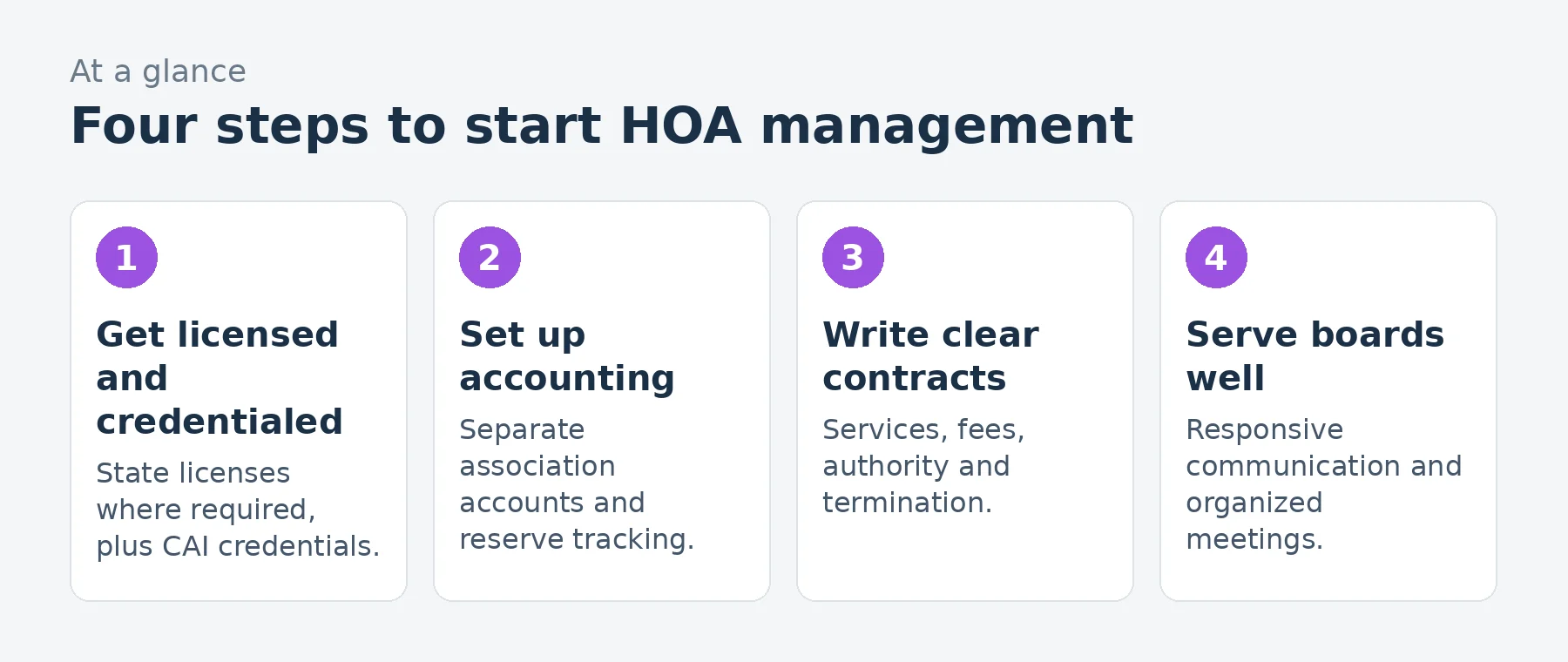
Several states license or register community association managers or management companies: Florida licenses community association managers, and Nevada, Illinois and Virginia have licensing or certification requirements, among others. Some states regulate managers through real estate licensing. CAI credentials, such as the CMCA, AMS and PCAM, show training and ethics commitments that boards value.
Fiduciary duties and governing documents
Managers act on behalf of boards and handle association money, so they owe duties of care and loyalty under contracts and often state law. Follow the association’s governing documents (declarations, bylaws and rules), state community association laws and board decisions, and avoid conflicts of interest, such as undisclosed vendor relationships.
Association accounting and reserves
Keep association funds in separate accounts in the association’s name, with operating and reserve accounts, monthly financial statements and annual budgets. Many states require reserve studies and funding for major components such as roofs and paving, especially for condominiums. Strong accounting controls, such as dual approvals for payments, protect funds and your reputation.
Collections
Collecting assessments is essential, but third-party collection of consumer debts such as HOA assessments can fall under the federal Fair Debt Collection Practices Act, and states set rules on late fees, liens and foreclosure for associations. Follow the association’s collection policy, state law and fair practices, and involve attorneys for liens and legal actions.
Meetings, records and owner relations
Prepare agendas, notices and minutes, run elections according to governing documents and state law and respond to owners’ records requests within required timelines. Clear, timely communication prevents many conflicts.
Corporate Transparency Act update
In 2025, FinCEN issued an interim final rule exempting U.S. companies, including many associations, from beneficial ownership information reporting under the Corporate Transparency Act. Rules can change, so confirm current requirements for clients.
Startup costs to plan for
| Item | What to budget for |
|---|---|
| Licensing and credentials | State licenses, CAI courses |
| Software | Association accounting, owner portals, violation tracking |
| Insurance and bonds | Errors and omissions, general liability, fidelity or crime coverage |
| Staff | Community managers and accounting staff |
| Office | Meeting space or virtual meeting tools |
| Marketing | Proposals, website, industry events |
Use our startup cost calculator for your total.
Pricing
Management fees are commonly priced per door (home) per month, with higher rates for small communities, condos and on-site services. Contracts may allow ancillary fees, such as resale certificates and extra meetings, which must be disclosed clearly. Use our pricing calculator.
A worked example: an 18-community portfolio
These are illustrative assumptions for a company managing about 2,400 homes across 18 associations, not predictions.
| Assumption | Monthly | |
|---|---|---|
| Management fees | 2,400 doors averaging $14 per door | $33,600 |
| Ancillary fees | Resale certificates, collections and extra meetings, as contracts allow | $4,500 |
| Revenue | $38,100 | |
| Community managers and accounting staff | With payroll costs | $(24,000) |
| Software and banking tools | $(1,800) | |
| Office and technology | $(3,000) | |
| Insurance and fidelity bonds | $(900) | |
| Marketing and credentials | $(800) | |
| Profit before owner pay and taxes | $7,600 |
That leaves about $7,600 a month before the owner’s pay and taxes, on about $38,100 of revenue. Association contracts renew year after year when service is good, so retention is the core of growth.
Loading the calculator…
Management contracts
Contracts should define services, fees, authority to spend without board approval, meeting attendance, insurance, termination and transition of records and funds when contracts end. Clear limits of authority protect managers and boards alike.
Finding clients
- Self-managed associations ready for professional help.
- Associations unhappy with current managers.
- Developers of new communities.
- CAI chapters and events.
- Attorneys, accountants and vendors who serve associations.
Violations and architectural review
Managers help boards enforce rules fairly: inspecting communities, sending notices, scheduling hearings where governing documents require them and processing architectural change requests. Consistent, documented enforcement reduces disputes and legal risk.
Vendor management
Associations rely on landscapers, pool companies, security, cleaning and repair vendors. Bid major contracts, verify licenses and insurance, monitor performance and disclose any relationships with vendors to the board.
Condominium safety laws
Some states, including Florida after the 2021 Surfside collapse, now require condominium structural inspections, milestone inspections and fully funded reserves for critical components. Managers in these states help boards plan inspections, studies and funding.
Transitions and turnover
When a new management company takes over, records, funds, vendor contracts and owner data must transfer smoothly. Build a transition checklist, and handle departing clients professionally too.
Budgets and assessments
Managers prepare annual budgets with boards, projecting operating costs, insurance, utilities, contracts and reserve contributions, then set assessments. Explain budgets clearly to owners, since rising insurance and reserve requirements have increased assessments in many communities.
Technology for associations
Owner portals, online payments, violation tracking apps, digital voting where allowed and email communication tools save staff time and improve transparency for owners and boards.
Serving boards well
Boards change every year, and new volunteers need guidance. Provide orientation materials, explain governing documents and responsibilities, deliver financial reports on time and respond promptly. Boards that feel supported renew contracts and refer other communities.
Common mistakes to avoid
- Managing without required state licenses.
- Commingling association funds.
- Collection practices that violate the FDCPA or state law.
- Undisclosed vendor relationships.
- Taking on more communities than staff can serve.
Your first 90 days
- Days 1-30: confirm state licensing, start CAI credentials and choose association software.
- Days 31-60: buy insurance and bonds, write contracts and accounting procedures.
- Days 61-90: pitch self-managed associations and transition first clients carefully.
Frequently asked questions
Do HOA managers need a license?
Some states, such as Florida, Nevada, Illinois and Virginia, license or regulate community association managers.
What credentials do HOA managers have?
CAI’s CMCA, AMS and PCAM credentials are widely recognized.
How do HOA management companies charge?
Usually per door per month, with disclosed ancillary fees.
Do debt collection rules apply to HOA assessments?
Third-party collection of HOA assessments can be covered by the FDCPA, plus state laws on fees and liens.
What is a reserve study?
An analysis of major components and funding needed to repair or replace them over time.
Who owns association funds?
The association; funds should be held in accounts in its name, separate from the manager’s money.
What is a community association manager?
A professional who manages an HOA’s or condo association’s finances, operations and communications for the board.
How many associations can one manager handle?
It depends on community size and complexity; portfolio managers often handle several associations.
Do HOA management companies need insurance?
Yes: errors and omissions, general liability and fidelity or crime coverage to protect association funds.
Can HOA managers collect late assessments?
Yes, following governing documents, state laws and, for third-party collection, fair debt collection rules.
What is the difference between HOA and condo management?
Condo management often involves shared building systems, insurance and reserve requirements, while HOA management focuses more on common areas and rules.
How much do HOA management companies charge?
Usually a monthly fee per door, varying by community size, services and location.
Can I start an HOA management company alone?
Yes, many start with a few small associations and add staff as the portfolio grows.
What software do HOA managers use?
Association management platforms for accounting, owner portals, payments, violations and communications.
Keep learning
- Property management industry data
- How to start a property management company
- How to start a bookkeeping business
- Pricing calculator
Sources
- Florida DBPR, Community association manager licensing
- Community Associations Institute (CAI), Manager credentials
- FTC, Fair Debt Collection Practices Act
- FinCEN, Beneficial ownership information reporting (2025 interim final rule exempting domestic companies)
- US Bureau of Labor Statistics, Property, real estate and community association managers
Last reviewed November 3, 2026. Startup costs are estimates; check local prices, licensing and tax rules before you commit money.

