
A rental property business buys homes, condos or small apartment buildings and rents them to tenants, earning monthly cash flow and building equity over time. Investors may self-manage or hire property managers, and some focus on long-term rentals while others try short-term vacation rentals.
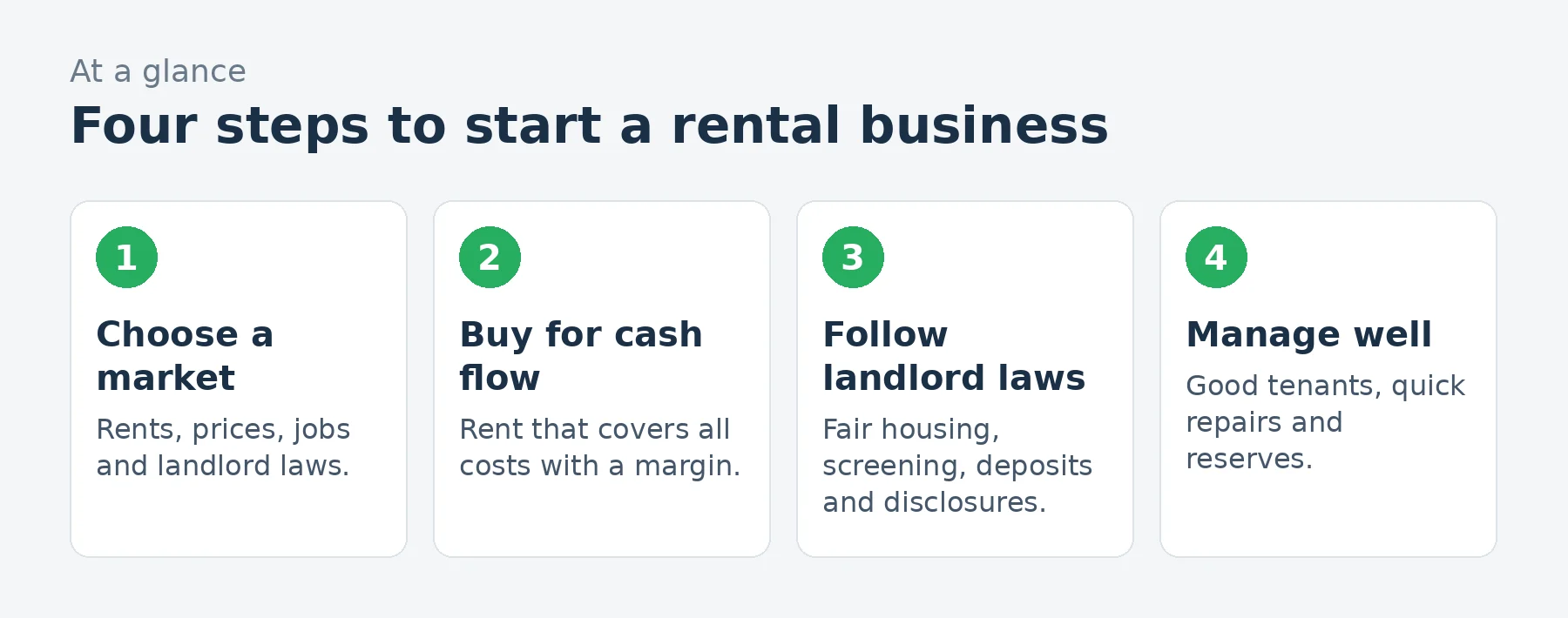
Success depends on buying properties where rent covers all costs with room to spare, keeping good tenants and following landlord-tenant law, fair housing rules, tenant screening requirements and lead paint disclosure for older homes. Rental income has specific tax rules, including depreciation. The Bureau of Labor Statistics reports a median pay of $66,700 for property, real estate and community association managers (May 2024), across about 466,100 jobs, with employment projected to grow about 4% over the decade. This guide covers markets, financing, cash flow, laws, management, taxes, a worked example and a 90-day plan.
A rental property business at a glance
Table of Contents
| Topic | What to expect |
|---|---|
| Startup cost | High: down payments, closing costs, repairs before renting, reserves and insurance |
| Key rules | Fair housing, tenant screening rules, lead paint disclosure for pre-1978 homes, security deposit and eviction laws |
| Local rules | Rental registration or licensing in some cities and short-term rental ordinances |
| How you earn | Monthly rent minus mortgage, taxes, insurance, repairs, vacancies and management, plus long-term appreciation |
| Best for | Patient, financially disciplined people who think long term |
Who rental investing suits
It suits patient, financially disciplined people who think in years, not months, and can handle tenant issues or hire someone who can. Reserves and steady cash flow matter more than quick appreciation.
Choosing a market and property
Look at rents relative to prices, job growth, population trends, property taxes, insurance costs and landlord-tenant laws. Single-family homes attract longer-term tenants; small multifamily properties spread vacancy risk. Inspect carefully, since major repairs can erase years of cash flow.
Financing
Investment property loans usually require larger down payments than primary homes. Options include conventional investor loans, portfolio loans from local banks and DSCR loans, which qualify based on the property’s rental income. Model interest rates, taxes and insurance carefully before buying.
Cash flow analysis
Estimate rent from comparable rentals, then subtract mortgage, taxes, insurance, repairs, vacancies, capital expenditure reserves, management (even if you self-manage, value your time) and any HOA fees. Aim for positive cash flow with a margin of safety. Use our break-even calculator to test assumptions.
Landlord laws
- Fair housing: the federal Fair Housing Act prohibits discrimination based on race, color, religion, sex, national origin, familial status and disability, and many states and cities add protections such as source of income.
- Lead paint disclosure: for housing built before 1978, landlords and sellers must disclose known lead-based paint hazards and provide the EPA pamphlet.
- Tenant screening: using credit or background reports triggers Fair Credit Reporting Act duties, including adverse action notices.
- Security deposits, habitability and evictions: state and local landlord-tenant laws set deposit limits, repair duties, notice periods and eviction procedures.
- Local rental rules: some cities require rental registration, inspections or licenses, and many regulate short-term rentals.
Short-term rentals
Short-term vacation rentals can earn more per night but face strict local rules in many cities: permits, occupancy taxes, limits on non-owner-occupied rentals and HOA restrictions. Check rules before buying for short-term use, and plan for higher cleaning, furnishing and management costs.
Insurance and LLCs
Buy landlord insurance (dwelling policies) rather than homeowners insurance, and consider umbrella liability coverage. Many investors hold properties in LLCs for liability protection, with advice from an attorney about financing and title implications.
Startup costs to plan for
| Item | What to budget for |
|---|---|
| Down payment | Investor loans often require larger down payments |
| Closing costs | Lender fees, title, inspections, appraisal |
| Make-ready repairs | Repairs and upgrades before renting |
| Reserves | Months of expenses plus repair reserves |
| Insurance | Landlord and umbrella coverage |
| Legal and software | Lease templates, LLC setup, rent collection tools |
Use our startup cost calculator for your total.
Self-managing or hiring a manager
Self-managing saves fees but takes time for showings, screening, repairs and tenant issues. Property managers typically charge a percentage of rent plus leasing fees, and can be worth it for out-of-town investors or larger portfolios. See our property management guide.
A worked example: five rental homes
These are illustrative assumptions for an investor owning five single-family rentals, not predictions.
| Assumption | Monthly | |
|---|---|---|
| Rent collected | 5 homes averaging $1,750 | $8,750 |
| Revenue | $8,750 | |
| Mortgage payments | Principal and interest | $(4,600) |
| Property taxes and insurance | $(1,550) | |
| Repairs and maintenance reserve | About 8% of rent | $(700) |
| Vacancy reserve | About 5% of rent | $(440) |
| Capital expenditure reserve | Roofs, HVAC, appliances | $(450) |
| Software, screening and miscellaneous | $(100) | |
| Profit before owner pay and taxes | $910 |
That leaves about $910 a month in cash flow before income taxes, on about $8,750 of rent, while mortgage principal paydown builds equity. Reserves for repairs, vacancies and big replacements are what keep rentals profitable over time.
Loading the calculator…
Rental taxes
Rental income is taxable, but you can deduct expenses such as mortgage interest, property taxes, insurance, repairs and management, and depreciate the building (not land) over 27.5 years for residential property, as IRS Publication 527 explains. Passive activity rules can limit losses. Work with a tax professional.
Keeping good tenants
Good tenants are worth keeping: respond quickly to repairs, communicate respectfully, renew leases with fair increases and maintain properties well. Turnovers cost lost rent, cleaning, repairs and leasing time.
Written screening criteria
Set written criteria for income, credit, rental history and background, and apply them the same way to every applicant. Consistent criteria reduce fair housing risk and help you choose reliable tenants. Follow local rules on criminal history screening and application fees.
Strong leases
Use a lease that complies with your state’s laws, covering rent, deposits, late fees, maintenance responsibilities, entry notice, pets, subletting and renewal. Local landlord associations often provide state-specific lease forms.
Growing a portfolio
Many investors grow by saving cash flow, refinancing properties to pull out equity or buying small multifamily buildings. Growth adds risk, so maintain reserves and avoid stretching financing too far.
Records and bookkeeping
Track income and expenses by property, keep receipts and leases and use separate bank accounts for rental business. Good records make taxes, refinancing and selling much easier.
Handling maintenance
Respond to repair requests quickly, especially for heat, water, electrical and safety issues, which most states require landlords to fix promptly. Build relationships with reliable contractors, and schedule preventive maintenance such as HVAC service and gutter cleaning.
Evictions and legal help
If a tenant stops paying or violates the lease, follow your state’s eviction process exactly, with proper notices and court filings. Never use self-help evictions such as changing locks or shutting off utilities. Local landlord attorneys and associations can guide you.
Common mistakes to avoid
- Buying without positive cash flow.
- No reserves for repairs and vacancies.
- Inconsistent screening that risks fair housing violations.
- Ignoring local rental registration and short-term rental rules.
- Using homeowners insurance on rentals.
Your first 90 days
- Days 1-30: choose a market, research rents, prices and landlord laws and get preapproved.
- Days 31-60: analyze properties, build a team (agent, lender, inspector, insurance agent) and write screening criteria.
- Days 61-90: buy a first property, complete repairs and rent it legally and carefully.
Frequently asked questions
How much money do I need to buy a rental property?
Enough for an investor down payment, closing costs, repairs and reserves; amounts vary by price and loan type.
What fair housing rules apply to landlords?
The federal Fair Housing Act and state and local laws prohibit discrimination in advertising, screening and renting.
Do landlords need to disclose lead paint?
Yes, for homes built before 1978, landlords must disclose known lead-based paint hazards and provide the EPA pamphlet.
Can I deduct rental expenses?
Yes, including interest, taxes, insurance, repairs and depreciation of the building over 27.5 years for residential rentals.
Should I put rentals in an LLC?
Many investors do for liability protection; get legal and tax advice first.
Are short-term rentals allowed everywhere?
No. Many cities restrict or regulate short-term rentals with permits, taxes and limits.
How much should I keep in reserves?
Many investors keep several months of expenses per property plus repair and capital expenditure reserves.
Do I need a property manager?
Not necessarily; self-managing saves fees, while managers save time and help with out-of-area properties.
Can I rent to housing voucher holders?
Yes, and in some states and cities landlords cannot refuse tenants because they use vouchers or other lawful income sources.
What is a DSCR loan?
A loan that qualifies based on the property’s rental income relative to its debt payments, rather than mainly the borrower’s personal income.
How do I find good tenants?
Market widely, apply written screening criteria consistently and verify income, rental history and references.
Are rental properties a good investment?
They can provide cash flow and long-term equity, but success depends on buying well, reserves and good management.
Do I need a business license to rent property?
Some cities require rental licenses, registration or inspections; check local rules.
Keep learning
- Rental property industry data
- How to start a property management company
- How to start a house flipping business
- Break-even calculator
Sources
- HUD, Fair Housing Act overview
- EPA, Lead-based paint disclosure rule for sales and rentals
- FTC, Using consumer reports: what landlords need to know
- CFPB, Tenant background checks and your rights
- IRS, Residential rental property (Publication 527)
- US Bureau of Labor Statistics, Property, real estate and community association managers
Last reviewed November 3, 2026. Startup costs are estimates; check local prices, licensing and tax rules before you commit money.

