
A house flipping business buys homes that need work, renovates them and resells them for a profit. Successful flippers find properties below market value, estimate repairs accurately, manage contractors and timelines and sell quickly.
Flipping is capital-intensive and risky: profits can disappear with underestimated repairs, delays, rising interest costs or a softening market. Renovations need permits and licensed contractors, homes built before 1978 bring lead-safe renovation rules, and profits are often taxed as ordinary business income. Advanton’s house flipping data shows a median pay of $59,310 for carpenters, a key trade on every flip. This guide covers deals, budgets, financing, renovation rules, taxes, a worked deal example and a 90-day plan.
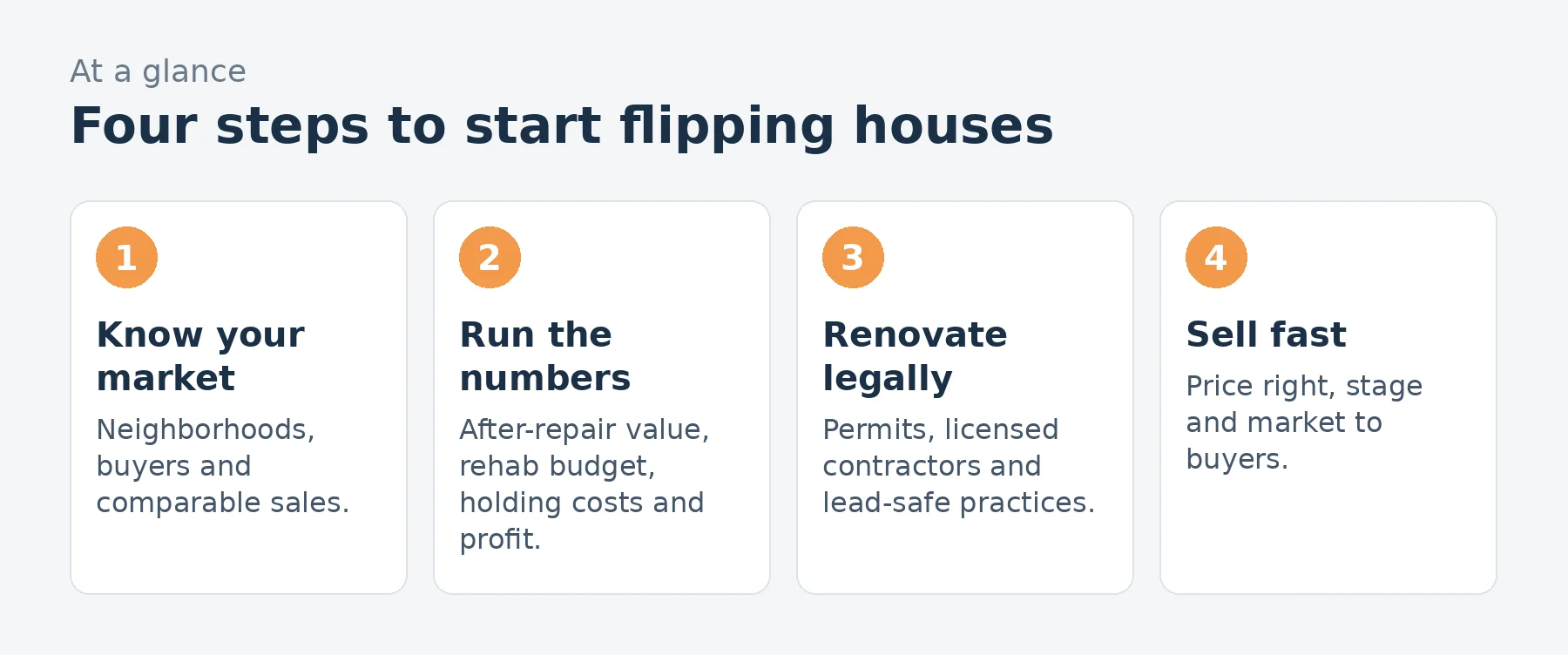
A house flipping business at a glance
Table of Contents
| Topic | What to expect |
|---|---|
| Startup cost | High: purchase down payments, renovation budgets, holding costs, closing costs and reserves |
| Key rules | Building permits and licensed contractors, EPA lead-safe renovation rules and lead disclosure for pre-1978 homes |
| Financing | Cash, hard money loans, private lenders, lines of credit or partners |
| Taxes | Frequent flippers are often treated as dealers, with profits taxed as ordinary income and possibly self-employment tax |
| Best for | Disciplined, numbers-driven people who manage projects and risk carefully |
Who flipping suits
It suits disciplined, numbers-focused people who can manage contractors, budgets and timelines, and who have access to capital and tolerance for risk. Construction knowledge helps avoid costly surprises.
Finding deals
- Listed properties that need work and sit on the market.
- Auctions and foreclosures, with careful due diligence.
- Direct-to-seller marketing to owners of distressed properties.
- Wholesalers who sell contracts to investors.
- Agents and probate attorneys who know motivated sellers.
Running the numbers
Estimate the after-repair value (ARV) from comparable recent sales, then subtract renovation costs (with a contingency), financing, holding, buying and selling costs and your target profit to find your maximum offer. Many investors use the "70% rule" (offer no more than about 70% of ARV minus repairs) as a quick screen, but detailed numbers decide.
Financing
Options include cash, hard money loans (short-term, asset-based loans with higher rates and points), private lenders, home equity lines and partnerships. Model interest and points carefully, since every extra month costs money. Lenders want experience, a clear budget and a realistic exit plan.
Permits and contractors
Most significant renovations need building permits and inspections, and electrical, plumbing and HVAC work usually requires licensed contractors. Unpermitted work can delay sales, scare buyers and create liability. Use written contracts with scope, schedule, payment draws and lien waivers.
Lead-safe renovation rules
For homes built before 1978, renovation that disturbs painted surfaces must follow the EPA’s Renovation, Repair and Painting (RRP) Rule, using certified firms and lead-safe practices. When selling, you must disclose known lead-based paint hazards and provide the EPA pamphlet.
Taxes
Profits from frequent flipping are often treated as dealer income, meaning ordinary income tax rates and possibly self-employment tax, rather than capital gains, and dealers generally cannot use like-kind exchanges for flipped properties. Work with a tax professional familiar with real estate.
Wholesaling laws
Some investors wholesale properties by assigning purchase contracts to other buyers for a fee. Several states, including Illinois and Oklahoma, now regulate wholesaling, sometimes requiring a real estate license or disclosures. Check your state’s rules before marketing contracts.
Startup costs to plan for
| Item | What to budget for |
|---|---|
| Down payments | Required by lenders |
| Renovation budget | With a contingency of 10% or more |
| Holding costs | Interest, taxes, insurance, utilities |
| Closing costs | Buying and selling |
| Inspections and permits | Before and during renovations |
| Reserves | For delays and surprises |
Use our startup cost calculator for your total.
Managing the renovation
Focus spending on what buyers value in your market (kitchens, baths, flooring, paint, curb appeal) and fix systems and safety issues first. Keep a detailed schedule, visit the site often, approve change orders in writing and track spending against budget weekly.
A worked deal example
These are illustrative assumptions for a single flip completed over about five months, not predictions; this example shows one deal rather than a monthly total.
| Assumption | Monthly | |
|---|---|---|
| Sale price | After renovation | $320,000 |
| Revenue | $320,000 | |
| Purchase price | $(205,000) | |
| Renovation | Including a 10% contingency | $(48,000) |
| Financing costs | Hard money interest and points | $(12,500) |
| Holding costs | Taxes, insurance, utilities for five months | $(4,500) |
| Buying and selling costs | Closing costs, agent commissions and concessions | $(24,000) |
| Profit before owner pay and taxes | $26,000 |
That leaves about $26,000 before taxes on about $320,000 of sale price for this one deal. A few thousand dollars of unexpected repairs or an extra two months on the market can cut that profit sharply, so conservative estimates matter.
Loading the calculator…
Selling the home
Price based on current comparable sales, stage the home, use professional photos and choose an experienced agent. Disclose required information honestly, including known defects and lead paint for older homes. Fast sales reduce holding costs.
Insurance and entities
Use builder’s risk or vacant property insurance during renovations, require contractors to carry liability and workers’ compensation insurance and consider holding properties in an LLC, with advice from an attorney and accountant.
Building a deal team
A strong team makes flips work: an investor-friendly agent, a lender, a reliable general contractor, a home inspector, a title company, an attorney and a tax professional. Good contractors are especially valuable; treat them well and pay on time.
Inspections before buying
Inspect for structural problems, roofs, foundations, plumbing, electrical, HVAC, sewer lines, mold and pests before closing whenever possible. Hidden problems are the main reason flips lose money.
Staging and presentation
Staged homes with professional photos often sell faster. Neutral finishes, good lighting, clean landscaping and fresh paint help buyers picture themselves in the home.
Scaling the business
Experienced flippers scale by running several projects at once with project managers, standard material choices and repeat contractor crews. Scaling multiplies risk too, so keep reserves and avoid overextending.
Knowing your exit options
Plan backup exits before buying: if the home does not sell quickly, could you rent it for cash flow or refinance? Deals that work only with a quick sale at a high price leave little room for error.
Market timing and interest rates
Rising interest rates reduce buyer demand and raise holding costs, while slow markets extend sale times. Track local inventory, days on market and price trends, and adjust offers and renovation plans accordingly.
Tracking every dollar
Use a project budget spreadsheet or software, record every invoice and change order and compare actual costs to estimates weekly. Detailed records reveal problems early and improve estimates on future flips.
Common mistakes to avoid
- Overestimating after-repair value.
- Underestimating repairs and timelines.
- Skipping permits.
- Ignoring lead-safe rules on older homes.
- Over-improving for the neighborhood.
Your first 90 days
- Days 1-30: choose target neighborhoods, study comparable sales and line up financing.
- Days 31-60: build a team: agent, lender, inspector, contractors and a tax professional.
- Days 61-90: analyze dozens of deals and make conservative offers until one fits your numbers.
Frequently asked questions
How much money do I need to flip a house?
Enough for down payments, renovation, holding and closing costs and reserves; lenders often require cash contributions.
What is the 70% rule?
A screening guideline to offer no more than about 70% of after-repair value minus repairs; detailed numbers should decide.
Do I need permits to renovate a flip?
Usually yes for significant work, plus licensed contractors for electrical, plumbing and HVAC.
What rules apply to older homes?
Homes built before 1978 require EPA lead-safe renovation practices and lead disclosure when sold.
How are house flipping profits taxed?
Often as ordinary dealer income, possibly with self-employment tax; consult a tax professional.
Is wholesaling legal?
In many states, yes, but some states regulate it and may require licenses or disclosures.
How long does a typical flip take?
Often a few months for purchase, renovation and sale, though delays in permits, contractors or selling can extend it.
Can I flip houses without construction experience?
Yes, with a reliable contractor and careful oversight, but knowledge of renovation costs helps avoid mistakes.
Do house flippers need a real estate license?
Not generally to buy and sell their own properties, but licensing can save commissions and some states regulate wholesaling.
What renovations add the most value?
It depends on the market, but kitchens, bathrooms, flooring, paint and curb appeal are common priorities.
Should I flip houses through an LLC?
Many flippers use LLCs for liability protection, with advice from an attorney and tax professional.
What is after-repair value?
The estimated market value of a home after renovation, based on comparable recent sales.
How much profit does a flip make?
It varies widely by market and deal; careful estimates and contingencies are essential, since unexpected costs can erase profit.
What insurance does a flip need?
Builder’s risk or vacant property insurance during renovation, plus liability coverage and contractors’ own insurance.
Where do I find contractors?
Through referrals from other investors, agents, suppliers and local investor groups; check licenses, insurance and references.
Keep learning
- House flipping industry data
- How to start a rental property business
- How to start a property management company
- Startup cost calculator
Sources
- EPA, Renovation, Repair and Painting (RRP) Rule
- EPA, Lead-based paint disclosure rule for sales and rentals
- IRS, Sales and other dispositions of assets (Publication 544)
- US Bureau of Labor Statistics, Construction managers
- US Small Business Administration, Apply for licenses and permits
Last reviewed November 3, 2026. Startup costs are estimates; check local prices, licensing and tax rules before you commit money.

