
House flipping means buying a property below its potential value, renovating it and selling it for a profit. Television makes it look quick, but successful flippers succeed on careful math: purchase price, renovation costs, holding costs, selling costs and an accurate after-repair value. The work depends on skilled trades; carpenters earned a median of $59,310 in May 2024, and construction managers earned about $114,980 in May 2025, according to BLS data as reported in a 2026 wage benchmark.
Flipping businesses range from cosmetic updates to full renovations and wholesaling, where investors sell contracts to other buyers without renovating. In this profile, models are shown as monthly pipelines to fit the Advanton framework, but real flipping income arrives at each sale.
The workforce
| Occupation | Jobs (2024) | Median pay (May 2024) | Projected growth, 2024 to 2034 |
|---|---|---|---|
| Carpenters | n/a | $59,310 | n/a |
| Construction managers (median wage, May 2025, as reported) | n/a | $114,980 | n/a |
Source: U.S. Bureau of Labor Statistics, Occupational Outlook Handbook and Occupational Employment and Wage Statistics.
Business models compared
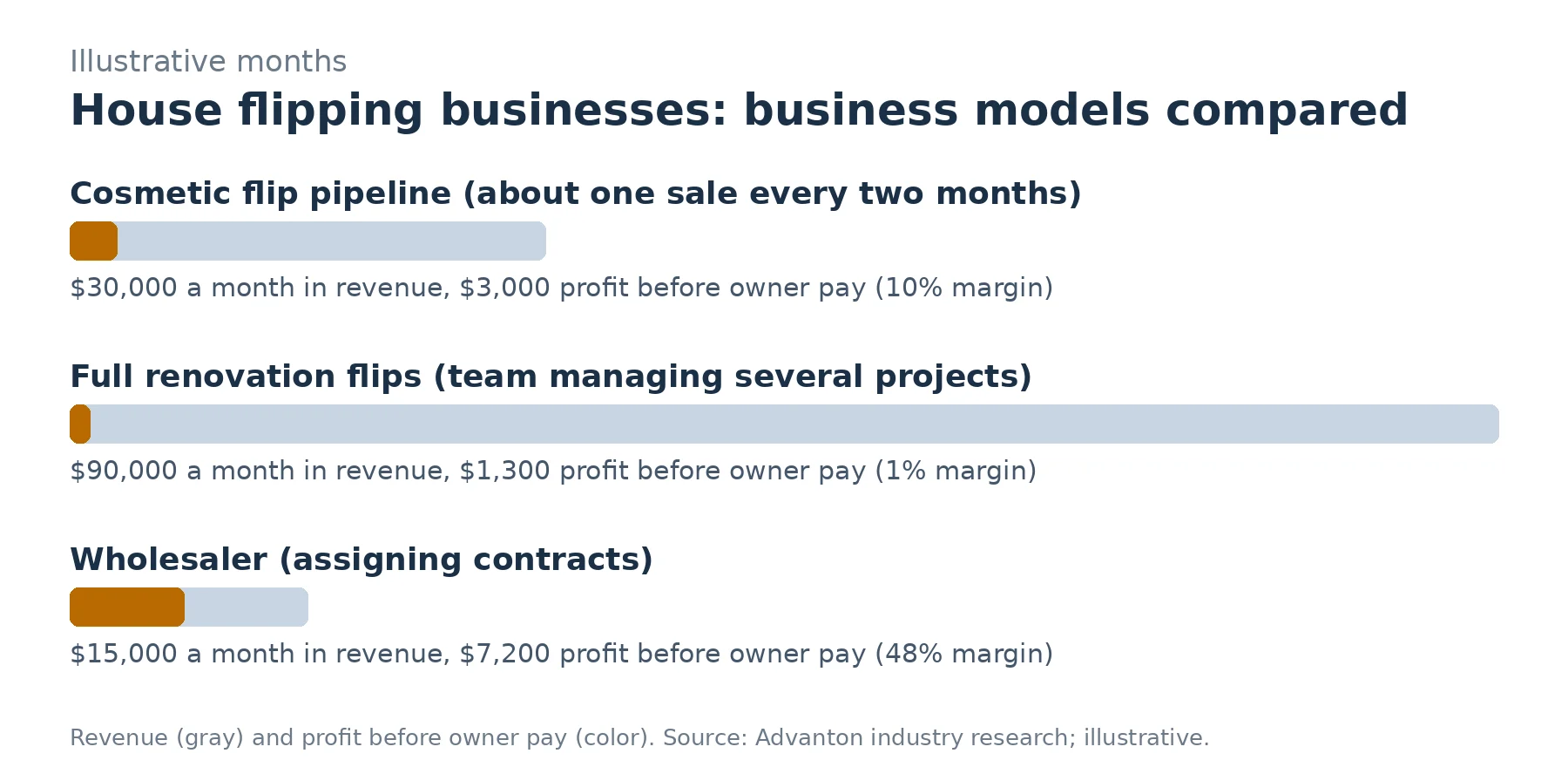
The figures below are illustrative months from our research, not industry averages. They show how revenue and costs typically fit together; your market, prices and costs will differ.
| Business model | Startup costs | Example monthly revenue | Costs | Profit before owner pay | Margin |
|---|---|---|---|---|---|
| Cosmetic flip pipeline (about one sale every two months) | High: purchase capital, renovation budget, reserves | $30,000 | $27,000 | $3,000 | 10% |
| Full renovation flips (team managing several projects) | Very high: financing, contractors, project management | $90,000 | $88,700 | $1,300 | 1% |
| Wholesaler (assigning contracts) | Low to moderate: marketing budget, earnest money, legal review | $15,000 | $7,800 | $7,200 | 48% |
Fixed and variable costs
For projections, the most useful split is between variable costs, which rise and fall with sales (materials, supplies, hourly labor, fees), and fixed costs, which you pay every month regardless (rent, salaried staff, insurance, loan payments).
| Business model | Variable costs (% of revenue) | Fixed costs per month | What it means |
|---|---|---|---|
| Cosmetic flip pipeline (about one sale every two months) | 83.7% | $1,900 | Mostly variable: profitable early, but watch cash flow |
| Full renovation flips (team managing several projects) | 84.8% | $12,400 | Mostly variable: profitable early, but watch cash flow |
| Wholesaler (assigning contracts) | 20.7% | $4,700 | Mostly fixed: needs steady volume to cover overhead |
What the numbers say
The purchase price decides profit before a single hammer swings. Paying too much can’t be fixed with renovation.
Holding costs add up every month a project runs long, so speed and schedules matter.
Wholesaling has low overhead but depends on marketing and finding motivated sellers, and it carries legal considerations in some states.
The three models in brief
Cosmetic flip. Paint, flooring, fixtures and landscaping on homes with good bones. See real estate services data.
Full renovation flips. Kitchens, baths, systems and layout changes managed by a team. See remodeling data.
Wholesaler. Contracts properties and assigns the contracts to other investors for a fee.
Cost structure: full renovation flips (team managing several projects)
Each cost as a share of the example month’s revenue ($90,000):
| Cost | Monthly amount | Share of revenue | Type |
|---|---|---|---|
| Property cost share | $52,000 | 57.8% | Variable |
| Renovation and contractors | $18,000 | 20.0% | Variable |
| Selling costs | $6,300 | 7.0% | Variable |
| Project manager | $6,000 | 6.7% | Fixed |
| Holding and financing costs | $4,500 | 5.0% | Fixed |
| Office and marketing | $1,200 | 1.3% | Fixed |
| Insurance | $700 | 0.8% | Fixed |
| Profit before owner pay | $1,300 | 1% |
A first-year projection: full renovation flips (team managing several projects)
New businesses rarely start at full speed. This projection assumes revenue ramps from 35% of the example month in month 1 to 100% by month 12, variable costs move with revenue, and fixed costs stay the same every month. It’s a planning illustration, not a forecast.
| Month | Revenue | Variable costs | Fixed costs | Profit | Cumulative |
|---|---|---|---|---|---|
| 1 | $31,500 | $26,712 | $12,400 | -$7,612 | -$7,612 |
| 2 | $40,500 | $34,344 | $12,400 | -$6,244 | -$13,856 |
| 3 | $49,500 | $41,976 | $12,400 | -$4,876 | -$18,732 |
| 4 | $55,800 | $47,318 | $12,400 | -$3,918 | -$22,650 |
| 5 | $63,000 | $53,424 | $12,400 | -$2,824 | -$25,474 |
| 6 | $68,400 | $58,003 | $12,400 | -$2,003 | -$27,477 |
| 7 | $73,800 | $62,582 | $12,400 | -$1,182 | -$28,659 |
| 8 | $78,300 | $66,398 | $12,400 | -$498 | -$29,157 |
| 9 | $81,900 | $69,451 | $12,400 | $49 | -$29,108 |
| 10 | $85,500 | $72,504 | $12,400 | $596 | -$28,512 |
| 11 | $88,200 | $74,794 | $12,400 | $1,006 | -$27,506 |
| 12 | $90,000 | $76,320 | $12,400 | $1,280 | -$26,226 |
Year one: revenue $806,400, profit before owner pay -$26,226. The first profitable month is month 9. Cumulative results bottom out at -$29,157, which is the minimum cash cushion this plan would need, before any startup costs.
Here the months represent a pipeline of projects rather than steady sales. With a project manager and holding costs running from the start, this illustration turns profitable in month 9, with a cumulative low of about $29,200, before the large purchase and renovation capital each flip requires.
The core math
Many investors start with a rule of thumb: pay no more than about 70% of the after-repair value (ARV) minus repair costs. The rule is only a screen. Calculate every cost: purchase, closing, renovation, holding, financing, selling commissions and a contingency for surprises, then decide whether the profit justifies the risk.
Estimating the after-repair value
ARV is what the renovated home should sell for, based on recent comparable sales nearby. Use sold homes, not listings, similar in size, age, condition and location. Overestimating ARV is the most common way flips lose money.
Financing
Flippers use cash, hard money loans, private lenders or lines of credit. Hard money is fast but expensive, with points and higher interest. Every month a project runs long increases financing costs, so build realistic timelines and reserves into every deal.
A startup checklist
- Learn your local market and comparable sales.
- Build a reliable contractor team.
- Line up financing before making offers.
- Understand permits, lead rules and disclosures.
- Talk to a tax professional about dealer status and entity structure.
Permits and inspections
Unpermitted work can derail sales, lower appraisals and expose buyers to safety risks. Pull permits for structural, electrical, plumbing and mechanical work, and keep records to share with buyers and appraisers.
Renovation scope
Focus on improvements buyers value in your market: kitchens, bathrooms, flooring, paint, curb appeal and systems that inspectors will flag. Avoid over-improving beyond neighborhood standards.
Where the opportunities are
- Estate sales and inherited homes.
- Dated homes in strong school districts.
- Distressed properties needing systems updates.
- Small multifamily properties to renovate and sell.
- Accessory dwelling unit additions where allowed.
Key terms
| Term | Meaning |
|---|---|
| ARV | After-repair value |
| Hard money loan | Short-term, asset-based financing at higher cost |
| Holding costs | Interest, taxes, insurance and utilities while you own the property |
| Wholesaling | Contracting a property and assigning the contract to another buyer |
Managing contractors
Clear scopes, written contracts, payment schedules tied to completed work and lien waivers protect your budget and timeline. Visit the job site often and keep a punch list.
Selling the flip
Professional photos, staging and pricing based on solid comparables shorten time on market. Pre-listing inspections can reduce surprises during escrow.
Key numbers to track
Track purchase price versus ARV, renovation budget versus actual, days from purchase to sale, holding cost per month and net profit per flip.
Common mistakes
- Overestimating ARV.
- Underestimating renovation and holding costs.
- Skipping permits.
- Hiring contractors without references.
- No contingency budget.
Marketing to find deals
Direct mail, driving for dollars, agent relationships, probate leads and wholesalers bring opportunities. Follow consumer protection rules in seller marketing, including text and call regulations.
Taxes and entities
Frequent flippers may be treated as dealers, meaning profits are ordinary income subject to self-employment tax rather than capital gains. Many hold flips in LLCs. See how to start an LLC.
Lead-based paint
Homes built before 1978 may contain lead paint. Renovators must follow EPA lead-safe practices, and sellers must provide lead disclosures to buyers.
Risk management
Insure each property with a builder’s risk or vacant property policy, keep reserves and diversify projects to avoid having everything tied up in one deal.
Test these numbers with your own plan
Open this industry in our free Business Idea Reality Check to start from any model above, change prices, costs, startup budget and your own pay, and see your break-even month, the cash you’d need, three scenarios and how new businesses in this sector survive in your state.
- Start with the closest model and its cost structure.
- Replace every price and cost with local quotes.
- Estimate your ramp: how fast customers will realistically come in year one.
- Map cash month by month with the free Cash & Payroll Planner.
- Build the full plan in the free Business Planner.
About this data
Workforce figures come from the U.S. Bureau of Labor Statistics (Occupational Outlook Handbook and Occupational Employment and Wage Statistics, May 2024 wages and the 2024 to 2034 projections, unless noted). Market figures cite their sources above. Business model figures are illustrative months built from typical prices and costs to show how revenue, fixed costs and variable costs fit together; they are not industry averages or guarantees. We review these profiles when new government data is released, at least once a year, and the same figures power the Business Idea Reality Check.
Licensing and rules
Renovations require building permits and inspections for structural, electrical, plumbing and mechanical work, and licensed trades where required; homes built before 1978 trigger EPA lead-safe renovation rules and federal lead-based paint disclosures at sale; sellers must follow state disclosure laws; wholesaling is regulated in some states, and marketing or negotiating deals for others can require a real estate license; flippers who buy and sell frequently may be treated as dealers for tax purposes, with profits taxed as ordinary income, so consult a tax professional. Requirements change; confirm with your state and local agencies before you start.
Frequently asked questions
Is house flipping profitable?
It can be, but profits depend on buying right, controlling renovation and holding costs and selling quickly.
What is the 70% rule?
A rule of thumb to pay no more than about 70% of after-repair value minus repairs; always calculate all costs.
How do flippers finance deals?
Cash, hard money loans, private lenders or lines of credit.
Do I need permits to flip a house?
Yes, for structural, electrical, plumbing and mechanical work.
How are flipping profits taxed?
Frequent flippers may be treated as dealers with ordinary income; consult a tax professional.
Is wholesaling legal?
It is in many places, but some states regulate it; marketing deals for others may require a real estate license.
How long does a flip take?
Often several months from purchase to sale, depending on scope and market.
How can I test these numbers?
Open house flipping in the Business Idea Reality Check and enter your own deal numbers.
Keep learning
- Rental property investing data
- Real estate services data
- Custom home builders data
- Business Idea Reality Check
Sources
- U.S. Bureau of Labor Statistics, Carpenters
- Construction managers median wage, BLS OEWS May 2025 (as reported)
Last reviewed November 1, 2026. Startup costs are estimates; check local prices, licensing and tax rules before you commit money.

