
Rental property has built wealth for generations of small investors: monthly rent, gradual mortgage paydown, potential appreciation and tax benefits. It’s also a real business, with tenants, repairs, financing, legal obligations and vacancies. Properties are run by owners or professional managers; the Bureau of Labor Statistics counted about 466,100 property, real estate and community association managers in 2024, with a median wage of $66,700 in May 2024, 4% projected growth, and about a third self-employed.
Investors typically start with a single-family home or condo, a small multifamily building such as a duplex or fourplex, or a short-term rental where allowed. Cash flow after every expense, not rent alone, decides whether a property works.
The workforce
| Occupation | Jobs (2024) | Median pay (May 2024) | Projected growth, 2024 to 2034 |
|---|---|---|---|
| Property, real estate and community association managers | 466,100 | $66,700 | +4% |
Source: U.S. Bureau of Labor Statistics, Occupational Outlook Handbook and Occupational Employment and Wage Statistics.
Market data
| Measure | Value |
|---|---|
| Share of property managers who are self-employed (2024) | 34% |
Business models compared
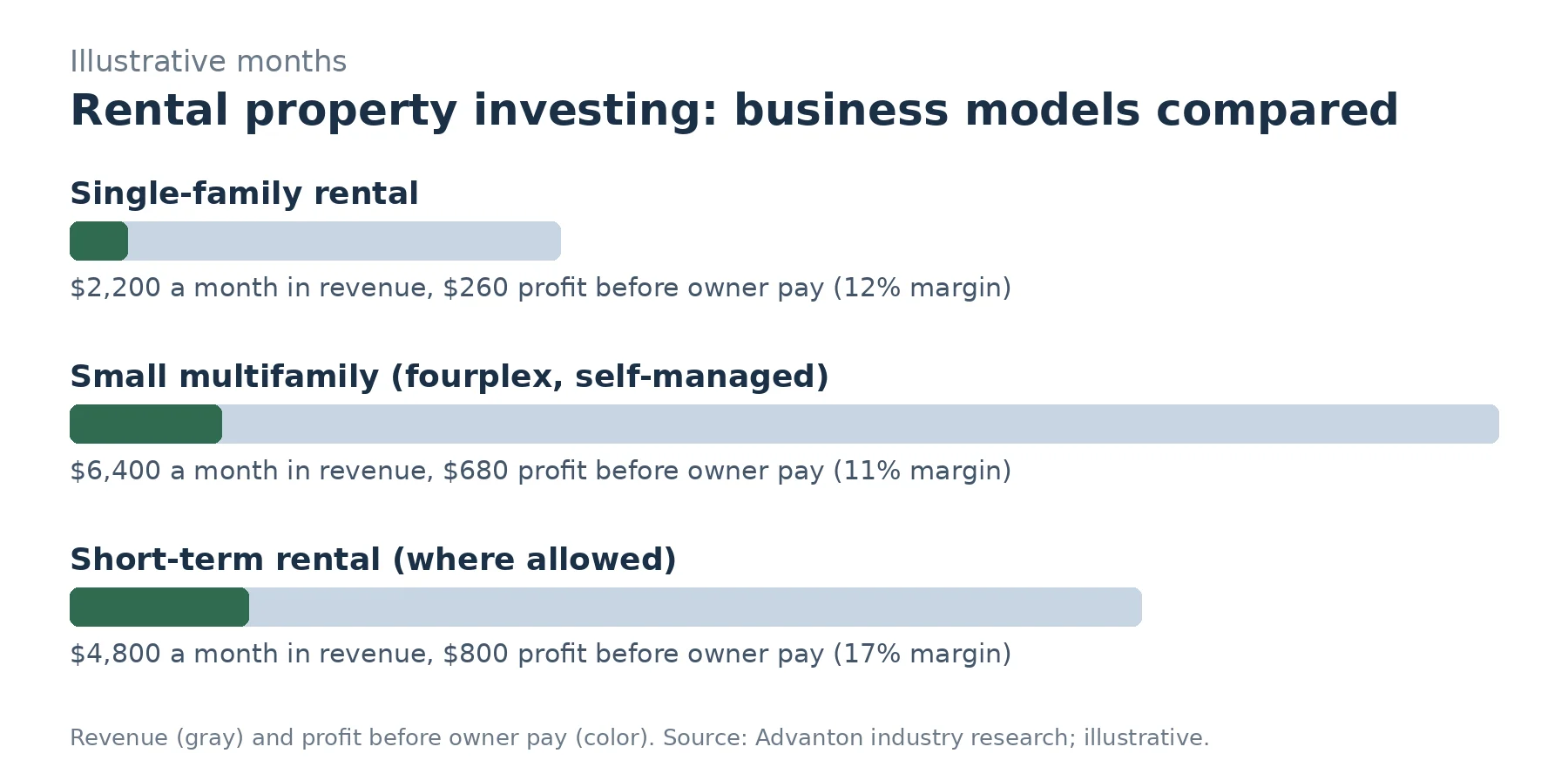
The figures below are illustrative months from our research, not industry averages. They show how revenue and costs typically fit together; your market, prices and costs will differ.
| Business model | Startup costs | Example monthly revenue | Costs | Profit before owner pay | Margin |
|---|---|---|---|---|---|
| Single-family rental | High: down payment, closing costs, repairs, reserves | $2,200 | $1,940 | $260 | 12% |
| Small multifamily (fourplex, self-managed) | High: down payment, closing costs, reserves | $6,400 | $5,720 | $680 | 11% |
| Short-term rental (where allowed) | High: purchase, furnishing, permits | $4,800 | $4,000 | $800 | 17% |
Fixed and variable costs
For projections, the most useful split is between variable costs, which rise and fall with sales (materials, supplies, hourly labor, fees), and fixed costs, which you pay every month regardless (rent, salaried staff, insurance, loan payments).
| Business model | Variable costs (% of revenue) | Fixed costs per month | What it means |
|---|---|---|---|
| Single-family rental | 13.2% | $1,650 | Mostly fixed: needs steady volume to cover overhead |
| Small multifamily (fourplex, self-managed) | 12.8% | $4,900 | Mostly fixed: needs steady volume to cover overhead |
| Short-term rental (where allowed) | 20.8% | $3,000 | Mostly fixed: needs steady volume to cover overhead |
What the numbers say
Most rental costs are fixed: mortgage, taxes and insurance are due whether units are full or empty, so occupancy and rent level decide cash flow.
Reserves for repairs, vacancies and big-ticket items turn paper profit into real cash flow; skipping them makes properties look better than they are.
Short-term rentals earn more gross revenue but add cleaning, platform fees, furnishings, management time and regulatory risk.
The three models in brief
Single-family rental. One home rented to one household, often the easiest place to start. See property management data.
Small multifamily. Two to four units under one roof, spreading vacancy risk.
Short-term rental. Furnished stays booked through platforms, where local rules allow.
Cost structure: small multifamily (fourplex, self-managed)
Each cost as a share of the example month’s revenue ($6,400):
| Cost | Monthly amount | Share of revenue | Type |
|---|---|---|---|
| Mortgage payment | $3,300 | 51.6% | Fixed |
| Property taxes | $650 | 10.2% | Fixed |
| Repairs and maintenance | $500 | 7.8% | Variable |
| Capital expenditure reserve | $400 | 6.2% | Fixed |
| Vacancy reserve | $320 | 5.0% | Variable |
| Insurance | $300 | 4.7% | Fixed |
| Water, sewer and trash | $250 | 3.9% | Fixed |
| Profit before owner pay | $680 | 11% |
A first-year projection: small multifamily (fourplex, self-managed)
New businesses rarely start at full speed. This projection assumes revenue ramps from 35% of the example month in month 1 to 100% by month 12, variable costs move with revenue, and fixed costs stay the same every month. It’s a planning illustration, not a forecast.
| Month | Revenue | Variable costs | Fixed costs | Profit | Cumulative |
|---|---|---|---|---|---|
| 1 | $2,240 | $287 | $4,900 | -$2,947 | -$2,947 |
| 2 | $2,880 | $369 | $4,900 | -$2,389 | -$5,336 |
| 3 | $3,520 | $451 | $4,900 | -$1,831 | -$7,167 |
| 4 | $3,968 | $508 | $4,900 | -$1,440 | -$8,607 |
| 5 | $4,480 | $573 | $4,900 | -$993 | -$9,600 |
| 6 | $4,864 | $623 | $4,900 | -$659 | -$10,259 |
| 7 | $5,248 | $672 | $4,900 | -$324 | -$10,583 |
| 8 | $5,568 | $713 | $4,900 | -$45 | -$10,628 |
| 9 | $5,824 | $745 | $4,900 | $179 | -$10,449 |
| 10 | $6,080 | $778 | $4,900 | $402 | -$10,047 |
| 11 | $6,272 | $803 | $4,900 | $569 | -$9,478 |
| 12 | $6,400 | $819 | $4,900 | $681 | -$8,797 |
Year one: revenue $57,344, profit before owner pay -$8,797. The first profitable month is month 9. Cumulative results bottom out at -$10,628, which is the minimum cash cushion this plan would need, before any startup costs.
Here, revenue is monthly rent rather than sales, and the illustration assumes the units fill over the first months, so this fourplex turns cash-flow positive in month 9, with a cumulative low of about $10,600, before the down payment and closing costs. Real properties typically start with tenants in place or lease up within a few weeks.
How rental properties earn
- Monthly rent.
- Fees: late fees, pet rent and parking where legal.
- Mortgage paydown that builds equity.
- Potential appreciation over time.
- Tax benefits such as depreciation.
Cash flow math
Cash flow equals rent minus mortgage, taxes, insurance, repairs, vacancy, capital reserves, utilities you pay and management. Run conservative numbers before buying, and walk away from deals that only work with perfect occupancy and no repairs.
Taxes and depreciation
Residential rental buildings are generally depreciated over 27.5 years for federal income tax purposes, which can offset rental income. Rental income and expenses are typically reported on Schedule E, and passive activity rules may limit losses. Work with a tax professional familiar with rental property.
A startup checklist
- Study local rents, vacancies and landlord laws before buying.
- Get financing and keep cash reserves for repairs and vacancies.
- Insure the property with landlord coverage.
- Use written leases and a consistent, fair screening process.
- Set up bookkeeping separate from personal finances.
Fair housing and screening
Apply the same written screening criteria to every applicant, such as income, rental history and background checks where allowed, and never ask about or act on protected characteristics. Fair housing violations are serious and costly.
Self-manage or hire a manager?
Self-managing saves management fees but takes time for showings, repairs, collections and emergencies. Professional managers charge a share of rent and fees for leasing; many investors hire one as their portfolio grows or if they live far away.
Where the opportunities are
- Small multifamily properties in stable neighborhoods.
- House hacking: living in one unit and renting the others.
- Value-add renovations that justify higher rent.
- Mid-term furnished rentals for traveling professionals.
- Accessory dwelling units where allowed.
Key terms
| Term | Meaning |
|---|---|
| Cash flow | Money left after all property expenses |
| Cap rate | Net operating income divided by property price |
| Capital expenditure reserve | Savings for roofs, HVAC and other big replacements |
| Depreciation | A tax deduction spreading the building’s cost over time |
Key numbers to track
Track occupancy, rent collected, maintenance cost per unit, turnover costs, net operating income, cash flow and equity.
Common mistakes
- Underestimating repairs and vacancies.
- Buying with no cash reserves.
- Inconsistent tenant screening.
- Ignoring local landlord laws.
- Mixing personal and rental finances.
Maintenance and turnover
Prompt repairs keep good tenants, and good tenants are the best investment protection. Build a list of reliable contractors, inspect units regularly with proper notice and plan turnovers to minimize vacant weeks. See property manager work for contractors for the contractor side of that relationship.
Short-term rental rules
Many cities limit short-term rentals with permits, owner-occupancy requirements, caps or bans, and most require collecting occupancy taxes. Check rules before buying a property for short-term use; regulations change frequently.
Financing your first property
Conventional loans, government-backed loans for owner-occupants and portfolio loans each have different down payments and rules. Owner-occupied small multifamily properties can offer lower down payments than investment purchases; compare options with lenders.
Entity and insurance
Many investors hold rentals in LLCs for liability separation, though financing and tax effects vary. Landlord insurance and umbrella liability coverage protect against claims. See how to start an LLC in your state.
Tenant relationships
Clear communication, fair policies, prompt responses and respect keep tenants longer, which reduces turnover costs, the biggest hidden expense in rental property.
Test these numbers with your own plan
Open this industry in our free Business Idea Reality Check to start from any model above, change prices, costs, startup budget and your own pay, and see your break-even month, the cash you’d need, three scenarios and how new businesses in this sector survive in your state.
- Start with the closest model and its cost structure.
- Replace every price and cost with local quotes.
- Estimate your ramp: how fast customers will realistically come in year one.
- Map cash month by month with the free Cash & Payroll Planner.
- Build the full plan in the free Business Planner.
About this data
Workforce figures come from the U.S. Bureau of Labor Statistics (Occupational Outlook Handbook and Occupational Employment and Wage Statistics, May 2024 wages and the 2024 to 2034 projections, unless noted). Market figures cite their sources above. Business model figures are illustrative months built from typical prices and costs to show how revenue, fixed costs and variable costs fit together; they are not industry averages or guarantees. We review these profiles when new government data is released, at least once a year, and the same figures power the Business Idea Reality Check.
Licensing and rules
The federal Fair Housing Act prohibits discrimination in renting based on race, color, religion, sex, national origin, familial status and disability, and many states and cities add protections; landlords of most housing built before 1978 must give federal lead-based paint disclosures; many cities require rental registration, licensing or inspections; state laws govern security deposits, leases, notices and evictions; short-term rentals often need permits and pay occupancy taxes, and some places restrict them; landlord insurance and building codes apply. Requirements change; confirm with your state and local agencies before you start.
Frequently asked questions
Is rental property a good investment?
It can be, when rent covers all costs with reserves and you manage it well; results depend on price, financing and location.
What laws do landlords need to follow?
The Fair Housing Act, lead-paint disclosure for pre-1978 housing, state landlord-tenant laws and local rental rules.
How is rental property depreciated?
Residential rental buildings are generally depreciated over 27.5 years for federal taxes.
Should I use an LLC for rentals?
Many investors do for liability separation; consider financing and tax effects with advisors.
Are short-term rentals allowed everywhere?
No. Many cities restrict or ban them; check local rules.
What do property managers earn?
BLS reported a median of $66,700 in May 2024.
How can I test these numbers?
Open rental property investing in the Business Idea Reality Check and enter your own rents and costs.
Keep learning
- Property management industry data
- Real estate services industry data
- Self storage industry data
- Business Idea Reality Check
Sources
Last reviewed November 1, 2026. Startup costs are estimates; check local prices, licensing and tax rules before you commit money.

