
A home health agency provides skilled medical care at home under a physician’s or allowed practitioner’s orders: nursing, physical, occupational and speech therapy, medical social work and home health aide services for patients recovering from illness, surgery or managing chronic conditions. This differs from non-medical home care, which helps with daily activities and has lighter rules.
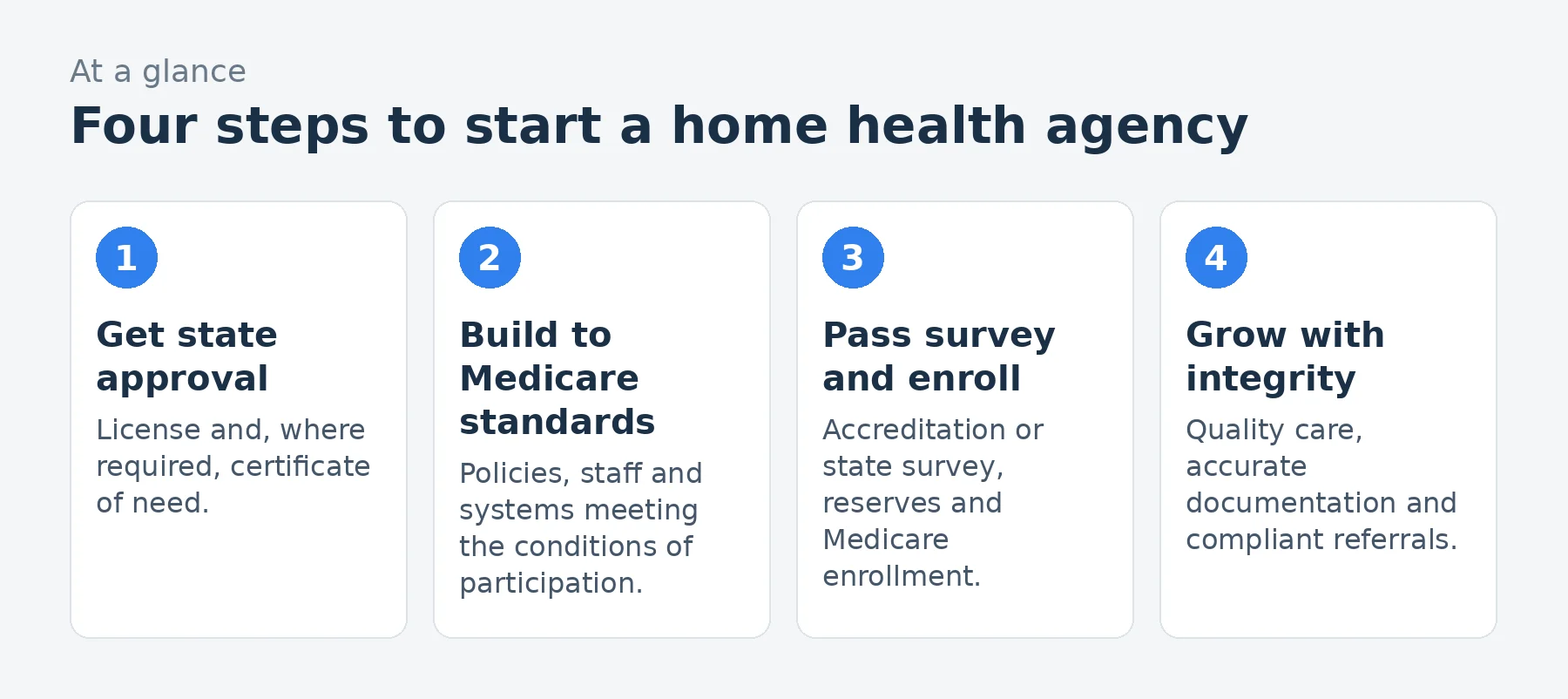
Most home health agencies serve Medicare patients, which requires a state license (and in some states a certificate of need), meeting Medicare’s conditions of participation, passing an accreditation or state survey, proving initial operating reserves and enrolling in Medicare. The process takes time and capital, and compliance must be excellent. The Bureau of Labor Statistics reports a median pay of $34,900 for home health and personal care aides (May 2024), across about 4.35 million jobs, with employment projected to grow about 17% over the decade as the population ages. This guide covers licensing, certification, operations, payment, compliance, a worked example and a 90-day plan.
A home health agency at a glance
Table of Contents
| Topic | What to expect |
|---|---|
| Startup cost | High: licensing, accreditation, required operating reserves, clinical staff before revenue, software, insurance and compliance support |
| Licensing | State home health license, certificate of need in some states, Medicare enrollment and certification |
| Medicare rules | Conditions of participation (42 CFR Part 484), accreditation or state survey, proof of initial reserve operating funds |
| Payment | Medicare home health payment under the patient-driven groupings model (PDGM), plus Medicaid and private insurers |
| Best for | Experienced clinicians and healthcare administrators committed to quality and compliance |
Who a home health agency suits
It suits experienced registered nurses, therapists and healthcare administrators who understand Medicare, clinical documentation and staff management. Owners without clinical backgrounds need strong clinical leadership: Medicare requires qualified administrators and clinical managers.
Home health vs home care
Home health provides skilled, medically necessary services ordered by a physician or allowed practitioner and billed to Medicare and insurers. Non-medical home care helps with bathing, meals, companionship and errands, usually paid privately. Many owners start with home care, which has lower barriers; see our non-medical home care guide.
State licensing and certificate of need
Most states license home health agencies, with requirements for administrators, clinical staff, policies and inspections. Some states require a certificate of need, limiting new agencies to areas where the state finds a need. Check your state health department’s rules first, since these determine whether and where you can open.
Medicare certification
- Meet the conditions of participation in 42 CFR Part 484, covering patient rights, care planning, clinical records, quality improvement, infection control, emergency preparedness and staff qualifications.
- Pass an initial survey by a CMS-approved accrediting organization or the state survey agency.
- Show proof of initial reserve operating funds, enough capital to operate for the first months, as Medicare requires for new agencies.
- Enroll in Medicare and obtain billing privileges.
Agencies typically must serve a minimum number of patients before the initial survey. The 36-month rule limits selling or transferring a new agency’s Medicare billing privileges soon after enrollment or ownership changes, with exceptions.
OASIS and payment
Agencies complete OASIS assessments for Medicare and Medicaid patients, which drive quality measures and payment. Medicare pays home health under the patient-driven groupings model (PDGM), using 30-day periods and patient characteristics, with value-based purchasing adjustments based on quality. Accurate assessments and documentation are essential.
Compliance and fraud prevention
Healthcare businesses that bill Medicare and Medicaid are closely watched for fraud. The Anti-Kickback Statute prohibits paying or receiving anything of value for patient referrals, the Stark Law limits physician self-referrals and the False Claims Act imposes heavy penalties for false billing. Build a compliance program following HHS Office of Inspector General guidance, train staff, document medical necessity carefully and never pay referral sources. Healthcare attorneys and consultants are worth the cost.
Some states, including Illinois, Ohio, Texas, North Carolina and Florida, participate in CMS’s Review Choice Demonstration, which adds pre-claim or post-payment review for home health claims.
Staffing
Agencies need registered nurses, licensed practical nurses, physical, occupational and speech therapists, medical social workers and trained home health aides who meet competency requirements, plus a qualified administrator and clinical manager. Recruiting and retaining clinicians is the biggest operational challenge.
Startup costs to plan for
| Item | What to budget for |
|---|---|
| Licensing and certificate of need | Applications, consultants, legal |
| Accreditation | Survey and accreditation fees |
| Operating reserves | Capital Medicare requires new agencies to hold |
| Staff before revenue | Administrator, clinical manager, nurses |
| Software | Electronic health records, OASIS, scheduling, billing |
| Insurance | Professional, general liability, workers’ compensation, auto |
Use our startup cost calculator for your total.
Referral sources
Patients come through referrals from hospitals, physicians, skilled nursing facilities and community organizations. Build relationships through education and reliable, high-quality care, and never offer anything of value in exchange for referrals, which violates the Anti-Kickback Statute.
A worked example: an established agency
These are illustrative assumptions for an established agency with about 120 patients under care, not predictions; Medicare rates vary by patient and area.
| Assumption | Monthly | |
|---|---|---|
| Medicare home health payments | About 70 payment periods a month averaging $2,000 | $140,000 |
| Medicaid and private insurance | $30,000 | |
| Revenue | $170,000 | |
| Clinical staff | Nurses, therapists and aides, with payroll costs | $(102,000) |
| Administrator, clinical manager and office staff | $(22,000) | |
| Software, billing and OASIS tools | $(4,000) | |
| Mileage and travel reimbursement | $(6,000) | |
| Office rent and utilities | $(3,500) | |
| Insurance, compliance and accreditation | Averaged monthly | $(4,500) |
| Community education and outreach | $(2,500) | |
| Profit before owner pay and taxes | $25,500 |
That leaves about $25,500 a month before the owner’s pay and taxes, on about $170,000 of revenue. Agencies often take a year or more to reach this scale, so the required reserves and patience matter.
Loading the calculator…
Quality and ratings
Medicare publishes home health quality measures and star ratings on Care Compare, and value-based purchasing adjusts payments based on quality. Strong outcomes, patient satisfaction (HHCAHPS surveys) and low rehospitalization rates attract referrals and protect revenue.
Emergency preparedness
Medicare requires home health agencies to have emergency preparedness plans, including risk assessments, communication plans, training and testing. Plan how you will reach patients during storms, power outages and disease outbreaks, and coordinate with local emergency management.
Telehealth and remote monitoring
Remote patient monitoring and telecommunications can support care between visits, such as tracking vital signs for heart failure patients. Medicare rules on how these services count toward home health care are specific, so use them to improve care while following documentation requirements.
Buying an existing agency
Some owners buy existing licensed and certified agencies instead of starting new ones, especially in certificate of need states. Purchases involve due diligence on compliance history, surveys, billing and staff, plus the 36-month rule and CMS change of ownership requirements. Use experienced healthcare attorneys.
Retaining clinicians
Nurses and therapists can choose among many employers. Offer competitive pay, reasonable caseloads, mileage reimbursement, good documentation tools and supportive clinical leadership. Low turnover improves care quality and keeps referral sources confident.
Common mistakes to avoid
- Underestimating the capital and time needed for certification.
- Weak clinical documentation and OASIS accuracy.
- Paying or rewarding referral sources.
- Not enough qualified clinical staff.
- Skipping a compliance program.
Your first 90 days
- Days 1-30: check state licensing and certificate of need rules, hire a healthcare attorney or consultant and build a financial plan with required reserves.
- Days 31-60: apply for the state license, recruit an administrator and clinical manager and write policies to the conditions of participation.
- Days 61-90: choose an accrediting organization, set up EHR and billing systems and prepare for initial patients and survey.
Frequently asked questions
What is the difference between home health and home care?
Home health provides skilled medical services billed to Medicare and insurers; home care provides non-medical help with daily activities.
How do I get Medicare certified as a home health agency?
Get a state license, meet the conditions of participation, pass an accreditation or state survey, prove initial operating reserves and enroll in Medicare.
Do I need a certificate of need?
In some states, yes; check your state health department.
What is OASIS?
The Outcome and Assessment Information Set, a standardized assessment used for quality measures and payment.
What is the 36-month rule?
A Medicare rule limiting the sale or transfer of a new home health agency’s billing privileges within 36 months, with exceptions.
Can I pay for patient referrals?
No. The Anti-Kickback Statute prohibits paying or rewarding referrals for Medicare and Medicaid patients.
How long does it take to open a Medicare-certified home health agency?
Often many months or more, including licensing, staffing, initial patients, survey and Medicare enrollment.
Does Medicare require capital to start a home health agency?
Yes. New agencies must show initial reserve operating funds sufficient to operate during the first months.
Who can order home health services?
Physicians and allowed practitioners such as nurse practitioners and physician assistants, following Medicare rules.
Do home health agencies need accreditation?
Medicare certification requires passing a survey, by a CMS-approved accrediting organization or the state survey agency.
Keep learning
- Home health industry data
- How to start a hospice care business
- How to start a non-medical home care agency
- How to start a healthcare staffing agency
Sources
- CMS, Home health agency conditions of participation (42 CFR Part 484)
- CMS, Home health providers center
- 42 CFR 489.28, Initial reserve operating funds for new home health agencies
- 42 CFR 424.550, Prohibitions on the sale or transfer of billing privileges (36-month rule)
- CMS, OASIS data sets for home health
- CMS, Home health patient-driven groupings model (PDGM)
- HHS OIG, Fraud and abuse laws (Anti-Kickback Statute, Stark Law, False Claims Act)
- US Bureau of Labor Statistics, Home health and personal care aides
Last reviewed November 3, 2026. Startup costs are estimates; check local prices, licensing and tax rules before you commit money.

