
A digital marketing agency helps businesses get customers online: paid search and social ads, search engine optimization, social media, email marketing, websites and analytics. Agencies can start with one person and a laptop, which makes the business accessible, and competitive.
The agencies that grow fastest usually specialize (by industry or service), package their work clearly, report results honestly and keep clients on monthly retainers. Marketing also has legal rules your agency must follow on behalf of clients. The Bureau of Labor Statistics reports median pay of $76,950 for market research analysts and $69,780 for public relations specialists (May 2024), useful benchmarks for agency skills. Agency owners earn the profit after team, tools and overhead. This guide covers niche, services, pricing, contracts, compliance, delivery, a worked example and a 90-day plan.
A digital marketing agency at a glance
Table of Contents
| Topic | What to expect |
|---|---|
| Startup cost | Low: a computer, marketing and reporting tools, a website, contracts and insurance |
| Key rules | FTC endorsement disclosures, the 2024 fake review ban, CAN-SPAM for email and consent rules for texts |
| How you charge | Monthly retainers, projects, hourly consulting, and sometimes a share of ad spend |
| Best niches | One industry (such as dentists, contractors or restaurants) or one service done exceptionally well |
| Best for | Marketers who can sell, deliver measurable results and manage client relationships |
Who an agency suits
It suits marketers who can both sell and deliver: you will pitch prospects, manage campaigns, explain results and keep clients happy. Strong writing, analytics and communication skills matter as much as platform knowledge.
Choosing a niche
- By industry: dentists, home services, restaurants, law firms, e-commerce brands or SaaS companies.
- By service: paid search, Meta ads, SEO, email marketing or conversion optimization.
- By customer size: local businesses, growing startups or larger companies.
Specialists can charge more, write better proposals and get referrals within an industry. You can broaden later.
Services to offer
- Paid advertising: search, social and display campaigns.
- SEO: technical fixes, local SEO and content.
- Social media: content creation and community management.
- Email and SMS marketing: newsletters, automations and campaigns.
- Websites and landing pages built for conversions.
- Analytics and reporting: tracking, dashboards and insights.
Pricing models
- Monthly retainers for ongoing services with defined deliverables.
- Projects for websites, audits and campaign launches.
- Hourly consulting for advice and training.
- Ad management fees, sometimes a percentage of ad spend with a minimum.
- Performance bonuses tied to agreed results, used carefully.
Price by the value delivered and the time required, and include reporting and meetings in your estimate. Use our pricing calculator.
Rules your agency must follow
- Endorsements and influencers: the FTC’s Endorsement Guides require clear disclosure of paid or sponsored relationships, including in influencer posts you arrange for clients.
- Fake reviews: the FTC’s 2024 rule bans fake reviews and testimonials, buying reviews and certain review suppression. Never write or buy reviews for clients.
- Email marketing: CAN-SPAM requires accurate headers and subject lines, a physical address and a working unsubscribe that is honored promptly.
- Text messages: marketing texts generally need prior express written consent under the Telephone Consumer Protection Act.
Agencies can be held responsible alongside clients for deceptive marketing, so build compliance into every campaign.
Contracts
Every client needs a written agreement covering scope and deliverables, fees and payment terms, contract length and notice, who owns accounts, content and ad accounts, access and approvals, confidentiality, and limits on guarantees. Avoid promising specific rankings or sales; promise work, process and transparent reporting.
Startup costs to plan for
| Item | What to budget for |
|---|---|
| Tools | Ads platforms, SEO, social scheduling, reporting, project management |
| Website and portfolio | Case studies and service pages |
| Legal | Contract templates, business setup |
| Insurance | Professional liability (errors and omissions), general liability |
| Contractors | Designers, writers, specialists as needed |
| Marketing | Networking, content, outreach |
Use our startup cost calculator for your total.
Packaging your services
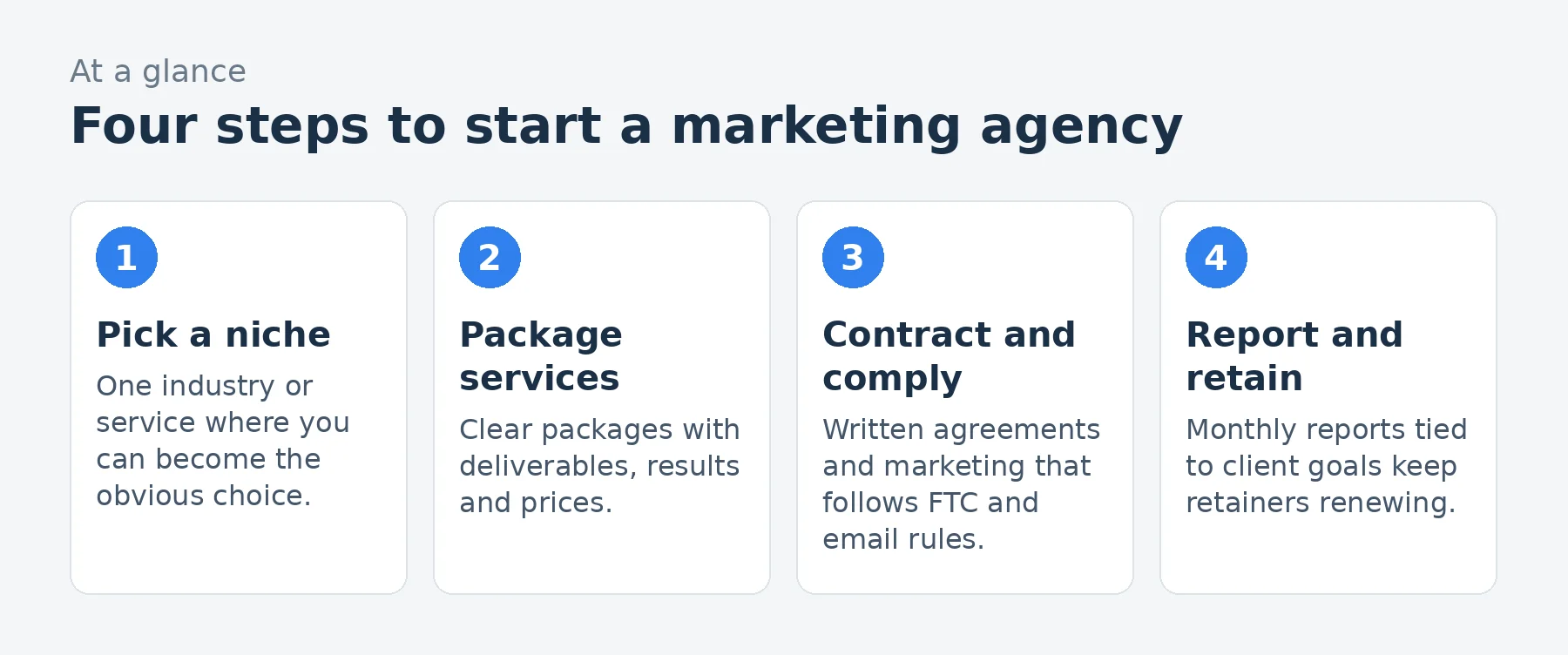
Clients buy outcomes, not hours. Package services into clear tiers (for example, a local visibility package or a lead generation package) with specific deliverables, reporting and a monthly price. Packages make sales easier and delivery repeatable.
A worked example: a small agency
These are illustrative assumptions for a small agency with a few contractors, not predictions.
| Assumption | Monthly | |
|---|---|---|
| Monthly retainers | 8 clients averaging $1,800 | $14,400 |
| Projects | Website and campaign setups | $3,500 |
| Revenue | $17,900 | |
| Contractors | Designers, ad specialists and writers | $(5,200) |
| Software and tools | Ads, SEO, reporting, project management | $(700) |
| Owner’s assistant or account manager | Part-time | $(1,800) |
| Marketing and sales | $(600) | |
| Insurance, legal and accounting | Professional liability, contracts | $(400) |
| Profit before owner pay and taxes | $9,200 |
That leaves about $9,200 a month before the owner’s pay and taxes, on about $17,900 of revenue. Retainers that renew month after month are the foundation; losing a single large client can hurt, so avoid depending on one account.
Loading the calculator…
Onboarding clients
- Kickoff meeting: goals, audience, offers and budget.
- Collect access to ad accounts, analytics, website and social profiles.
- Audit current marketing and tracking.
- Agree on key metrics and a 90-day plan.
- Set a reporting schedule and communication channel.
Make sure clients own their ad accounts and analytics, with your agency added as a user; it builds trust and avoids disputes.
Reporting results
Monthly reports should connect activity to the client’s goals: leads, calls, sales and cost per result, not only clicks and impressions. Explain what happened, why and what you will do next. Honest reporting, including what did not work, keeps clients longer than glossy charts.
Building a team
Most small agencies grow with freelancers and specialized partners before hiring employees. White-label partners can deliver services such as SEO or development under your brand. Document processes so quality stays consistent, and classify workers correctly as contractors or employees.
Finding clients
- Your network and referrals: the fastest first clients.
- Industry communities and associations in your niche.
- Case studies and content that show results.
- Partnerships with web developers, accountants and consultants.
- Outreach with specific, useful observations about a prospect’s marketing.
Keeping clients
Retention beats constant selling. Respond quickly, hold regular review calls, suggest improvements proactively and tie your work to revenue. Many agencies lose clients through poor communication rather than poor results.
Writing proposals that win
Strong proposals start with the prospect’s goals and current situation, then show a specific plan, timeline, deliverables, reporting and price. Include a relevant case study and a clear next step. Keep options simple, such as two or three packages, so prospects can choose rather than compare endless line items.
Ad budgets and billing
Clients should pay advertising platforms directly from their own accounts, while you bill for management. This keeps budgets transparent, avoids your agency carrying large ad charges and makes ownership clear if the relationship ends.
Tracking and attribution
Before running campaigns, set up conversion tracking for calls, forms, bookings and purchases, and agree on how results will be measured. Without tracking, you cannot prove results or improve campaigns, and clients may cancel even when marketing is working.
White-label partnerships
White-label partners deliver services under your brand, such as SEO, development or ad management, letting a small agency offer more without hiring. Vet partners carefully, start with small projects, keep quality control in-house and be clear in contracts about confidentiality and client ownership.
Common mistakes to avoid
- Offering every service to every type of business.
- Promising rankings or guaranteed sales.
- Running influencer campaigns without disclosures.
- Owning client ad accounts instead of the client.
- Underpricing retainers once reporting and meetings are counted.
Your first 90 days
- Days 1-30: choose a niche, define two or three packages and set up contracts and tools.
- Days 31-60: land two or three clients from your network, possibly at an introductory rate, and document results.
- Days 61-90: publish case studies, build referral partnerships and start consistent outreach.
Frequently asked questions
How much does it cost to start a marketing agency?
Usually little: a computer, tools, a website, contracts and insurance. Contractors are paid as work comes in.
Do I need a license to start a marketing agency?
Usually just a business license, but your marketing must follow FTC, email and text messaging rules.
How do agencies charge?
Mostly monthly retainers, plus projects, hourly consulting and sometimes ad management fees.
Can my agency write reviews for clients?
No. The FTC’s 2024 rule bans fake reviews and testimonials and buying reviews.
Should I specialize?
Specializing by industry or service usually makes selling easier and supports higher prices.
What insurance does an agency need?
Professional liability (errors and omissions) and general liability are common; cyber coverage helps if you handle client data.
How many clients does a small agency need?
It depends on retainer size and costs; many small agencies reach profitability with a handful of steady retainer clients.
Do I need certifications to run ads for clients?
Not legally, but platform certifications and partner programs help demonstrate skill and can bring support and credibility.
Should I offer a free trial month?
Many agencies avoid free months, preferring a paid audit or a short starter project that proves value without giving away work.
Keep learning
- Marketing agencies industry data
- How to start a social media management business
- How to start an SEO agency
- Pricing calculator
Sources
- US Bureau of Labor Statistics, Market research analysts
- US Bureau of Labor Statistics, Public relations specialists
- FTC, Endorsement Guides and influencer disclosures
- FTC, Final rule banning fake reviews and testimonials (2024)
- FTC, CAN-SPAM Act: a compliance guide for business
- FCC, Telephone Consumer Protection Act (robocalls and texts)
Last reviewed November 3, 2026. Startup costs are estimates; check local prices, licensing and tax rules before you commit money.

