
A social media manager plans, creates and posts content for businesses, responds to comments and messages, grows audiences and often runs paid social ads. Many small businesses know they should be active on social media but lack time, so they hire someone to do it consistently and well.
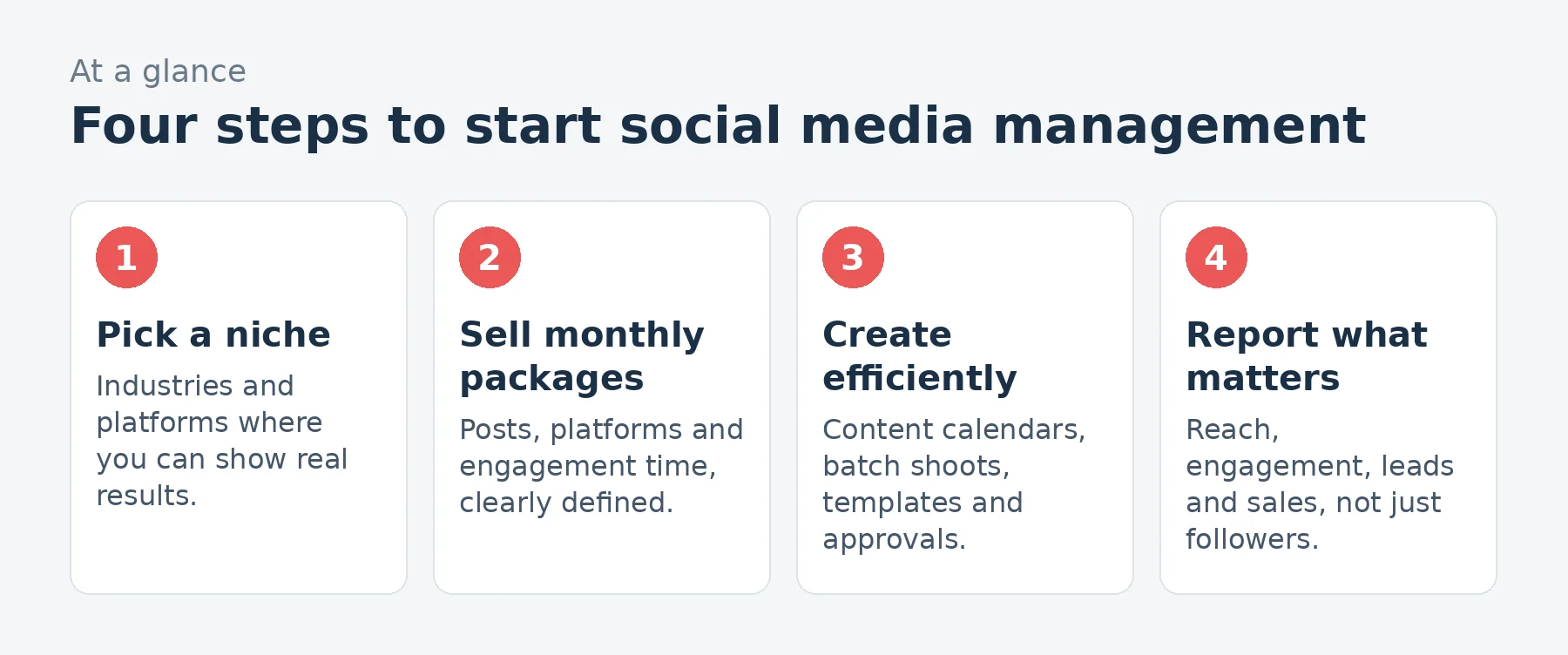
It is one of the most accessible marketing businesses to start, which also makes it competitive. Successful managers choose a niche, sell clear monthly packages, create content efficiently and show results beyond follower counts. Disclosure, copyright and review rules apply to the content you post for clients. The Bureau of Labor Statistics reports median pay of $76,950 for market research analysts and $69,780 for public relations specialists (May 2024), useful benchmarks for agency skills. Agency owners earn the profit after team, tools and overhead. This guide covers services, pricing, workflow, rules, reporting, a worked example and a 90-day plan.
A social media management business at a glance
Table of Contents
| Topic | What to expect |
|---|---|
| Startup cost | Low: a computer and phone, design and scheduling tools, a portfolio and contracts |
| Key rules | FTC disclosures for sponsored and influencer content, the fake review ban, and permission for music, images and user content |
| How you charge | Monthly packages by platforms, posts and community management, plus content shoots and ads management |
| Best clients | Local businesses, restaurants, salons, real estate agents, gyms and e-commerce brands |
| Best for | Creative, organized communicators who enjoy content, trends and analytics |
Who this business suits
It suits creative communicators who enjoy content, keep up with platform changes and are organized enough to manage many calendars and approvals. Basic photography, video editing and copywriting skills are essential.
Services to offer
- Content creation: photos, short videos, graphics and captions.
- Scheduling and posting on agreed platforms.
- Community management: replying to comments and messages.
- Strategy: content pillars, calendars and campaigns.
- Paid social ads: campaign setup and management.
- Influencer and creator partnerships, with proper disclosures.
Choosing platforms and clients
Focus on the platforms your clients’ customers use, rather than every network. A restaurant may need short video and local discovery; a B2B firm may need professional networking content. Specializing in an industry lets you reuse ideas and understand what drives results for that type of business.
Pricing your packages
Package by number of platforms, posts per week, content types (static, carousel, video), community management time and reporting. Offer content shoot days and ad management as add-ons. Count all your time, including planning, shooting, editing, approvals and replies. Use our pricing calculator.
Rules for client content
- Disclose sponsorships and partnerships: posts with paid creators or gifted products need clear disclosure under FTC guidance.
- No fake reviews or fake engagement: the FTC’s 2024 rule bans fake reviews and testimonials, and buying followers or engagement misleads customers.
- Use licensed music, images and fonts: platform music libraries may not cover business use on every platform; use commercial libraries and licensed stock.
- Get permission for customer content: ask before reposting photos or videos made by customers, and credit them.
Contracts and account ownership
Your agreement should cover deliverables, platforms, approval process, response times for community management, payment, term and notice, and ownership: the client should own their accounts, and you should have access as a manager or admin. Clarify who owns content you create and whether you can use it in your portfolio.
Startup costs to plan for
| Item | What to budget for |
|---|---|
| Equipment | Phone or camera, lighting, microphone, tripod |
| Software | Design, video editing, scheduling, stock media |
| Portfolio | Sample content and case studies |
| Contracts | Agreement template, approvals process |
| Insurance | Professional liability |
| Marketing | Your own social channels and website |
Use our startup cost calculator for your total.
A content workflow that scales
- Plan a monthly content calendar with themes and campaigns.
- Batch shoot photos and videos for the month in one or two sessions.
- Create posts from templates and write captions in batches.
- Send the calendar for client approval by a set date.
- Schedule posts and set aside daily time for comments and messages.
A worked example: a solo manager
These are illustrative assumptions for an established solo manager with a part-time assistant, not predictions.
| Assumption | Monthly | |
|---|---|---|
| Monthly packages | 10 clients averaging $950 | $9,500 |
| Content shoot days | 3 shoots at $450 | $1,350 |
| Ad management add-ons | 3 clients at $300 | $900 |
| Revenue | $11,750 | |
| Design, scheduling and stock tools | $(250) | |
| Part-time assistant | Community management and scheduling | $(1,600) |
| Equipment and props | Lighting, mics, props | $(150) |
| Insurance and accounting | $(200) | |
| Marketing | $(200) | |
| Profit before owner pay and taxes | $9,350 |
That leaves about $9,350 a month before the owner’s pay and taxes, on about $11,750 of revenue. Client count is limited by content workload, so efficient batching and templates directly raise earnings.
Loading the calculator…
Reporting results
Report on the metrics that matter for each client: reach, engagement rate, website clicks, messages, bookings, calls or sales from social. Explain trends and next steps. Followers alone rarely pay a client’s bills.
Community management
Set response time expectations, escalation rules for complaints and a list of approved answers for common questions. Handle negative comments calmly and professionally, and alert the client to serious issues quickly.
Short video
Short vertical video now drives much of the reach on major platforms. Learn simple shooting and editing, plan hooks for the first seconds and create series formats clients can repeat, such as tips, behind-the-scenes and customer stories.
Finding clients
- Local businesses you already know and visit.
- Referral partners such as web designers, photographers and business coaches.
- Your own content showing before-and-after results.
- Industry groups in your niche.
- Free audits with two or three specific improvements.
Content pillars
Content pillars are the few themes a brand posts about regularly, such as tips, behind the scenes, customer stories, products and community. Pillars make planning faster, keep content varied and help audiences know what to expect from each account.
Handling a crisis or complaint
Have a plan for negative viral posts, serious complaints or mistakes: pause scheduled posts, alert the client immediately, agree on a response and respond calmly and publicly where appropriate, then move details to private messages. Speed and honesty limit damage.
Content shoot days
Monthly or quarterly shoot days at the client’s business produce weeks of photos and videos at once. Plan a shot list in advance, capture many short clips and stills, and charge shoot days separately from management packages.
Pricing tiers
Simple tiers help clients choose: a starter tier for one or two platforms with a few posts each week, a growth tier with more video and community management and a premium tier with shoot days and ads. Clear tiers reduce scope creep.
Keeping up with platform changes
Platforms change features and algorithms often. Follow official platform business blogs, test new formats early and explain changes to clients when results shift. Your ability to adapt is part of what clients pay for.
Influencer and creator campaigns
Many brands work with local creators and influencers. Help clients choose creators whose audiences match, agree on deliverables and usage rights in writing and make sure every sponsored post includes clear disclosure, as FTC guidance requires.
Common mistakes to avoid
- Unlimited revisions and unclear approvals.
- Using unlicensed music in business posts.
- Running sponsored posts without disclosure.
- Reporting only follower counts.
- Taking more clients than you can create for.
Your first 90 days
- Days 1-30: choose a niche, build sample content and set packages and contracts.
- Days 31-60: sign two or three clients and set up calendars, approvals and reporting.
- Days 61-90: document results, ask for referrals and add an ad management or shoot-day add-on.
Frequently asked questions
How much should a social media manager charge?
It depends on platforms, posts, video and community management. Price monthly packages from the hours involved and the value delivered.
Do I need a license to be a social media manager?
Usually just a business license; follow FTC disclosure and review rules for client content.
Can I use popular music in client posts?
Only if properly licensed for business use; platform libraries may not cover commercial use. Use commercial music libraries.
Who should own the social media accounts?
The client. You should have manager or admin access.
How many clients can one manager handle?
It depends on package size, but efficient batching and templates help solo managers serve more clients.
Should I run ads for clients?
Ads management is a valuable add-on, priced separately from content packages.
Should social media managers create videos?
Yes. Short vertical video drives much of the reach on major platforms, so basic shooting and editing skills are important.
Is social media management profitable?
It can be when packages are priced for the real workload and content creation is efficient through batching and templates.
How often should businesses post?
It depends on the platform and audience; consistency matters more than volume, so agree on a sustainable schedule.
Do I need professional camera gear?
Not at first. A recent smartphone, good lighting and a microphone are enough for most small business content.
Keep learning
- Marketing agencies industry data
- How to start a digital marketing agency
- How to start a content marketing agency
- Pricing calculator
Sources
- FTC, Endorsement Guides and influencer disclosures
- FTC, Final rule banning fake reviews and testimonials (2024)
- US Copyright Office, Copyright basics and works made for hire
- US Bureau of Labor Statistics, Public relations specialists
- US Bureau of Labor Statistics, Market research analysts
Last reviewed November 3, 2026. Startup costs are estimates; check local prices, licensing and tax rules before you commit money.

