
A commercial laundry service washes linens and textiles for businesses: hotel sheets and towels, restaurant napkins and aprons, gym and spa towels, salon capes, uniforms and healthcare linens. Clients contract for regular pickup and delivery, which creates steady, recurring revenue.
Commercial laundry is an industrial operation: high-capacity machines, large utility demand, wastewater permits and, for healthcare clients, OSHA bloodborne pathogen rules and often accreditation. Some operators wash customer-owned goods, while others run linen rental programs that supply and maintain the linens. Advanton’s laundry data shows a median pay of $33,800 for laundry and dry-cleaning workers (May 2024), across about 202,600 jobs, with employment projected to grow about 5%. Owners earn the profit after equipment, utilities, rent and labor. This guide covers markets, models, plant setup, permits, healthcare rules, pricing, a worked example and a 90-day plan.
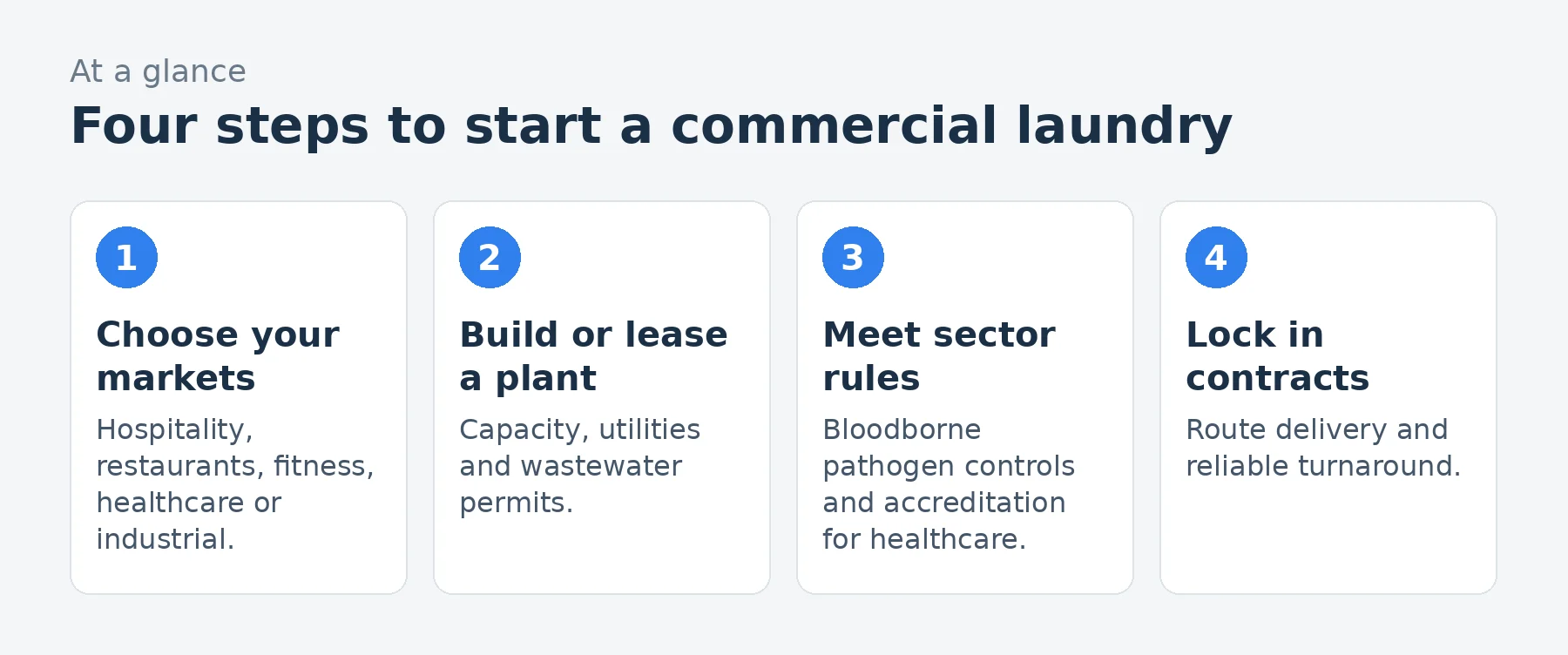
A commercial laundry service at a glance
Table of Contents
| Topic | What to expect |
|---|---|
| Startup cost | High: industrial washers, dryers, ironers and folders, utilities, a plant, delivery trucks and working capital |
| Permits | Wastewater discharge or pretreatment permits, boiler and air permits where required, building and zoning approvals |
| Healthcare rules | OSHA bloodborne pathogens standard for contaminated laundry, infection control and often HLAC accreditation |
| How you charge | Per pound or per piece for customer-owned goods, or rental fees for linen programs |
| Best for | Operations-focused owners who manage equipment, staff and route logistics well |
Who commercial laundry suits
It suits operations-minded owners who can manage industrial equipment, a production workforce, delivery routes and contracts. Many come from hospitality, manufacturing or existing laundries.
Markets to serve
- Hotels, motels and vacation rental operators: sheets, towels and robes.
- Restaurants: napkins, tablecloths, aprons and kitchen towels.
- Gyms, spas and salons: towels and capes.
- Healthcare: clinics, nursing homes and medical offices, with extra requirements.
- Industrial and uniforms: shop towels and workwear.
Customer-owned goods vs linen rental
With customer-owned goods, clients own their linens and pay you to process them. With linen rental, you own the linens, deliver clean ones and collect soiled ones, charging rental fees that include replacement. Rental programs earn more per client but need inventory investment and tracking.
Plant and equipment
- Washer-extractors (and tunnel washers for very high volume).
- Commercial dryers.
- Flatwork ironers and folders for sheets and tablecloths.
- Towel folders and sorting systems.
- Boilers or water heaters, compressors and chemical dosing systems.
- Delivery trucks and carts.
Plants need large water, gas and electrical capacity and industrial zoning.
Wastewater and other permits
Commercial laundries discharge large volumes of wastewater, and many local utilities require industrial wastewater discharge permits under pretreatment programs, with limits on temperature, pH and pollutants such as lint and oils. Boilers may need permits and inspections, and zoning and building approvals apply. Talk to your water utility early.
Healthcare linen requirements
Linens contaminated with blood or other potentially infectious materials are covered by OSHA’s bloodborne pathogens standard, requiring proper bagging, handling, protective equipment, training and hepatitis B vaccination offers for employees. Healthcare laundries separate soiled and clean areas and follow infection control practices. Accreditation by the Healthcare Laundry Accreditation Council (HLAC) and certifications from industry groups such as TRSA show clients you meet standards.
Startup costs for a commercial laundry service
| Item | What to budget for |
|---|---|
| Plant | Industrial lease and build-out |
| Equipment | Washers, dryers, ironers, folders, boilers |
| Utilities | Water, gas and electrical upgrades, wastewater systems |
| Trucks and carts | Route delivery vehicles |
| Linen inventory | For rental programs |
| Permits and insurance | Wastewater, boilers, liability, workers’ compensation |
Use our startup cost calculator for your total.
Pricing and contracts
Price customer-owned goods per pound or per piece, and rental programs per item or per delivery, including replacement costs. Contracts should cover pickup schedules, turnaround, minimum volumes, damaged and lost item policies, rejected items and term length. Use our pricing calculator.
A worked example: a small commercial plant
These are illustrative assumptions for a small plant serving hotels, restaurants and gyms, not predictions.
| Assumption | Monthly | |
|---|---|---|
| Customer-owned goods processing | 60,000 pounds at $0.95 | $57,000 |
| Linen rental programs | Restaurants and spas | $12,000 |
| Revenue | $69,000 | |
| Plant and route staff | With payroll costs | $(27,000) |
| Utilities | Water, sewer, gas and electricity | $(9,500) |
| Chemicals and supplies | $(3,200) | |
| Linen replacement for rental programs | $(2,500) | |
| Plant rent | $(6,500) | |
| Equipment and truck payments and maintenance | $(7,000) | |
| Insurance, permits and software | $(2,300) | |
| Profit before owner pay and taxes | $11,000 |
That leaves about $11,000 a month before the owner’s pay and taxes, on about $69,000 of revenue. Plant utilization drives profit, so filling capacity with steady contracts matters most.
Loading the calculator…
Quality and turnaround
Clients judge you by clean, stain-free, well-folded linens delivered on time. Track rejects, manage stain removal and replacement and keep enough capacity for peak seasons, such as summer tourism or holidays.
Workplace safety
Plants involve heavy equipment, heat, chemicals and lifting. Follow OSHA rules for machine guarding, lockout/tagout, chemical handling and ergonomics, and train every worker. Good safety practices reduce injuries and insurance costs.
Finding clients
- Independent hotels and vacation rental managers.
- Restaurants and catering companies.
- Gyms, spas and salons.
- Clinics and nursing homes, once healthcare processes are in place.
- Hospitality associations and local business networks.
Linen tracking
Rental programs lose money when linens disappear. Track inventory by client, use bar codes or RFID tags where practical, count deliveries and returns and charge clients for excessive losses under your contract.
Chemistry and stain management
Commercial laundries use dosing systems and chemistry programs from suppliers to remove stains, sanitize and protect fabrics. Work with chemical suppliers to tune formulas by soil type, such as kitchen grease, makeup or blood, and monitor results.
Energy and water efficiency
Water reuse systems, heat recovery from wastewater and efficient dryers can cut utility costs significantly. Efficiency also helps meet wastewater permit limits and clients’ sustainability expectations.
Growing the plant
Growth often means adding a second shift, larger equipment such as tunnel washers, more routes and new markets such as healthcare once processes and accreditation are in place.
Route logistics
Commercial clients need reliable pickup and delivery on schedule. Plan efficient routes, use carts that keep soiled and clean linens separate, load trucks to prevent contamination and communicate delivery windows clearly.
Staffing the plant
Plants need sorters, washer operators, ironer and folding staff, drivers and maintenance technicians. Cross-train employees, keep clear safety procedures and schedule shifts around client deadlines.
Hospitality seasonality
Hotels and vacation rentals have busy seasons. Plan capacity, staffing and linen inventory for peaks, and pursue year-round clients such as healthcare facilities, gyms and restaurants to smooth volume.
Contracts and rejects
Define in contracts how rejected items (stained or damaged linens) are handled, who pays for replacement and how losses are measured. Clear terms prevent disputes and protect margins.
Common mistakes to avoid when starting a commercial laundry service
- Underestimating utility and wastewater requirements.
- Accepting healthcare linens without bloodborne pathogen controls.
- Pricing that ignores linen replacement in rental programs.
- Contracts without volume minimums.
- Unsafe plant practices.
Your first 90 days as a commercial laundry service owner
- Days 1-30: choose markets, find an industrial site and meet the water utility about permits.
- Days 31-60: secure financing, equipment and permits, and set up safety programs.
- Days 61-90: sign first contracts with hotels, restaurants and gyms, and plan healthcare accreditation if relevant.
Frequently asked questions about starting a commercial laundry service
How much does it cost to start a commercial laundry?
It is capital-intensive; industrial equipment, utility upgrades and the plant are major costs.
Do commercial laundries need wastewater permits?
Often yes; many utilities require industrial discharge permits under pretreatment programs.
What rules apply to healthcare linens?
OSHA’s bloodborne pathogens standard, infection control practices and often HLAC accreditation.
What is linen rental?
A model where the laundry owns the linens, delivers clean ones and charges rental fees that include replacement.
How do commercial laundries price?
Per pound or per piece for customer-owned goods, or rental fees for linen programs.
Who are the best clients?
Hotels, restaurants, gyms, spas and healthcare facilities with steady volume.
What is a tunnel washer?
A high-capacity continuous batch washer used by large commercial laundries for efficiency.
Do I need accreditation to serve clinics?
It is not always legally required, but healthcare clients often expect HLAC accreditation or equivalent standards.
Can I start a commercial laundry in a laundromat?
Small operations sometimes begin in laundromats with large machines, but growth usually requires an industrial plant and permits.
How do commercial laundries win hotel contracts?
With reliable turnaround, quality, competitive pricing and enough capacity for peak occupancy.
Do commercial laundries need boilers?
Many use boilers or large water heaters for hot water and steam for ironers; boilers may require permits and inspections.
How do I find commercial laundry clients?
Through direct outreach to hotels, restaurants, gyms and spas, hospitality associations and referrals.
What equipment does a commercial laundry need?
Washer-extractors, commercial dryers, flatwork ironers, folders, boilers or water heaters and delivery trucks.
Is commercial laundry profitable?
It can be when the plant runs near capacity with steady contracts and controlled utility and labor costs.
What is customer-owned goods processing?
Washing linens that clients own, usually priced per pound or per piece.
Keep learning
- Laundry and dry cleaning industry data
- How to start a laundry pickup and delivery business
- How to start a laundromat
- Pricing calculator
Sources
- OSHA, Bloodborne pathogens standard (contaminated laundry)
- Healthcare Laundry Accreditation Council (HLAC)
- TRSA, Association for linen, uniform and facility services
- EPA, Industrial wastewater pretreatment program
- US Bureau of Labor Statistics, Laundry and dry-cleaning workers
Last reviewed November 3, 2026. Startup costs are estimates; check local prices, licensing and tax rules before you commit money.

