
Insulation contractors make homes and buildings more comfortable and cheaper to heat and cool, installing insulation in attics, walls, floors and crawl spaces and sealing the air leaks that waste energy. Customers include homeowners with high energy bills, builders who must meet energy codes, landlords and businesses. This guide explains how to start an insulation contractor business, from licensing and startup costs to pricing and finding customers.
It’s a practical trade with steady demand and modest startup costs for blown-in and batt work, and higher costs for spray foam. There are specific rules to follow: the FTC’s R-value Rule requires clear disclosures to customers, spray foam requires careful chemical safety, and old insulation such as vermiculite may contain asbestos. Note too that the federal 25C tax credit for insulation ended for work placed in service after 2025, so incentives now come mainly from state rebate and utility programs.
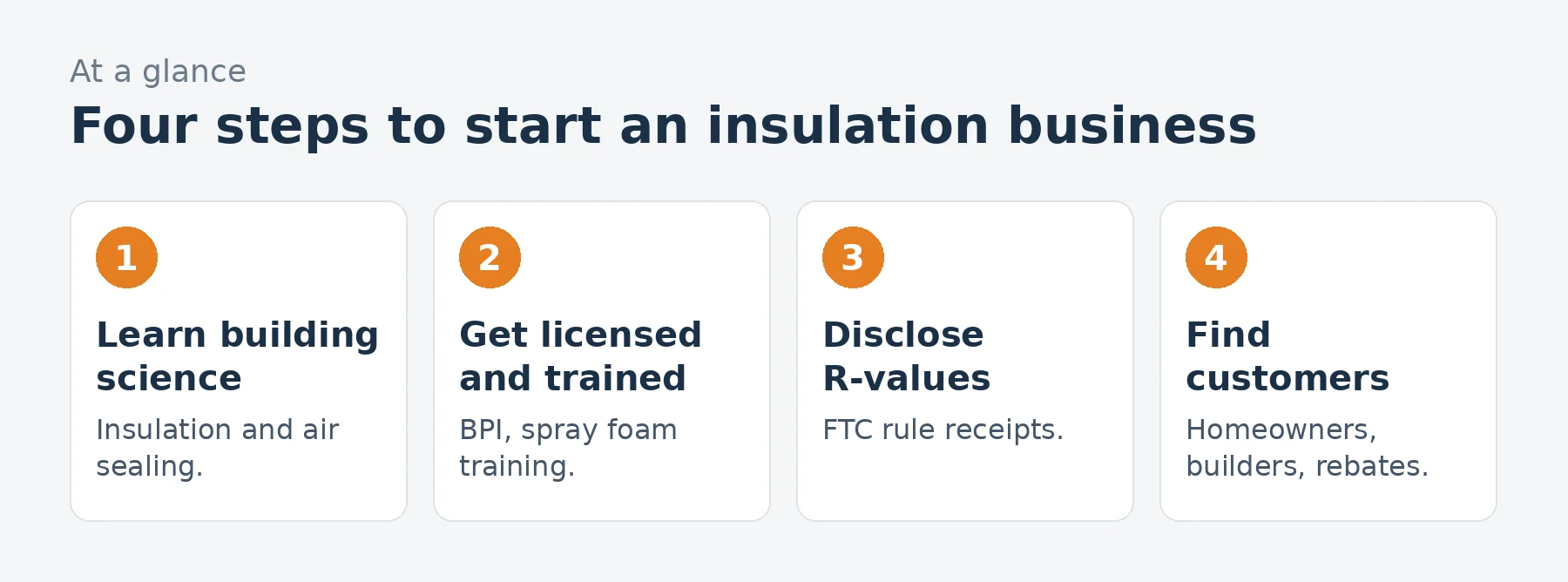
An insulation contractor business at a glance
Table of Contents
| Topic | What to expect |
|---|---|
| Startup cost | Moderate for blown-in and batts (machine, truck, tools); high for spray foam rigs |
| Key rules | FTC R-value Rule disclosures, spray foam chemical safety, asbestos caution, contractor licensing, energy codes |
| Revenue model | Priced per job or per square foot by material and R-value |
| How you earn | Retrofit insulation and air sealing, new construction, spray foam and removal |
| Best for | Practical, safety-minded people comfortable in attics and crawl spaces |
Who an insulation business suits
It suits practical people who don’t mind heat, dust and tight spaces, and who like solving problems such as drafts and cold rooms. Understanding building science, how heat, air and moisture move through a house, makes the difference between just adding insulation and actually fixing comfort and energy problems.
Services and materials
- Blown-in fiberglass and cellulose for attics and dense-packing walls.
- Fiberglass and mineral wool batts for new construction and open framing.
- Spray polyurethane foam (open- and closed-cell) for sealing and insulating in one step.
- Rigid foam board for basements, crawl spaces and exterior walls.
- Air sealing of attic bypasses, top plates, penetrations and rim joists.
- Removal of old or damaged insulation, with asbestos precautions.
The FTC R-value Rule
The FTC’s Labeling and Advertising of Home Insulation rule, known as the R-value Rule, protects customers by requiring accurate information about insulation’s thermal performance. Installers must give customers a receipt or contract showing the type and R-value of insulation installed, and for blown-in insulation, the coverage area, thickness and number of bags used, along with other required details. Advertising that mentions R-values or savings must follow the rule too. Keep copies of manufacturers’ fact sheets and your receipts.
Licensing, codes and contracts
Check contractor licensing with your state and city: many states license general or specialty contractors, some require registration for home improvement work, and others license above a project value. Most cities require a business license, and many projects need a building permit and inspections. Carry general liability and commercial auto insurance, get workers’ compensation once you hire (some states require it even for small crews), and put scope, price, schedule, payment terms and change-order rules in a written contract. Many states require specific contract terms and a right to cancel for home improvement contracts signed at a customer’s home, under state law and the FTC’s Cooling-Off Rule.
New construction and some retrofits must meet the energy code your jurisdiction has adopted, which sets minimum R-values by climate zone and may require inspections or testing.
Spray foam safety
Spray polyurethane foam is made by mixing chemicals that include isocyanates, which can cause asthma and severe respiratory and skin sensitization. Installers need training, proper respiratory protection (often supplied-air respirators), protective clothing, ventilation, and procedures to keep occupants out of the home during and after spraying for the time the manufacturer specifies. OSHA has resources on isocyanates, and manufacturers and industry groups offer spray foam training programs. Don’t offer spray foam without training and a written safety program.
Old insulation, asbestos and wiring
Vermiculite insulation, a pebble-like material found in some older attics, may contain asbestos. The EPA advises leaving it undisturbed and having it tested or handled by trained asbestos professionals; don’t remove or work in it without proper precautions. Old homes may also have knob-and-tube wiring, which generally shouldn’t be buried in insulation; have an electrician assess it. Look for signs of moisture, mold and pests before insulating.
Attic safety
Attics are hot, dusty and full of hazards: walk only on joists or boards to avoid falling through ceilings, watch for nails and wiring, wear respiratory protection and eye protection, and take heat seriously in summer, following OSHA’s heat illness guidance with water, rest and shade, and early starts.
Certification and energy audits
Building Performance Institute (BPI) certifications, such as Building Analyst and Air Leakage Control Installer, build credibility and are often required by utility and state efficiency programs. Offering blower door testing helps you find air leaks, prove results and qualify for program work.
Incentives after the 25C credit
The federal 25C Energy Efficient Home Improvement Credit, which covered part of the cost of insulation and air sealing, was terminated for improvements placed in service after December 31, 2025, under the July 2025 tax law. Don’t tell customers they can claim it for current work. Incentives now come mainly from state Home Energy Rebate programs (HOMES and HEAR), funded by federal grants and run by states, and from utility efficiency programs. Becoming a qualified contractor for your state’s programs and local utilities can bring steady work.
Pricing
Price by job or by square foot, based on material, target R-value, access, removal of old insulation and air sealing. Include R-value details in every quote and receipt, as the FTC rule requires. Use our pricing calculator.
Crawl spaces and moisture
Crawl spaces and basements cause many comfort and moisture problems. Depending on climate and local codes, solutions include insulating floors above vented crawl spaces, or sealing and conditioning the crawl space with ground vapor barriers and insulated walls. Moisture control comes first: fix drainage and leaks, and don’t trap moisture where it can cause mold or rot. Learn the approaches suited to your climate, and when a moisture or mold specialist is needed.
Startup costs for an insulation contractor business
| Item | What to budget for |
|---|---|
| Insulation blowing machine | Truck-mounted or trailer machine for blown-in insulation |
| Truck or box truck | To carry materials and equipment |
| PPE and safety equipment | Respirators, suits, eye protection, ladders, lighting |
| Spray foam rig (optional) | Proportioner, hoses, generator, and training |
| Testing equipment | Blower door and infrared camera |
| Insurance and licensing | General liability, commercial auto, workers’ compensation |
Use our startup cost calculator for your total.
A worked example: a blown-in and batt insulation business
These are illustrative assumptions for a blown-in and batt insulation business with a crew of two, not predictions.
| Assumption | Monthly | |
|---|---|---|
| Attic and wall insulation jobs | 14 jobs averaging $2,300 | $32,200 |
| Air sealing and crawl space work | $4,800 | |
| Revenue | $37,000 | |
| Insulation materials | $(11,200) | |
| Crew wages and payroll costs | 2 workers | $(9,200) |
| Truck, trailer and fuel | $(1,500) | |
| Equipment, PPE and maintenance | $(800) | |
| Insurance and licensing | $(1,000) | |
| Marketing and leads | $(1,800) | |
| Profit before owner pay and taxes | $11,500 |
That leaves about $11,500 a month before the owner’s pay and taxes, on about $37,000 of revenue. Spray foam jobs earn more each but need expensive equipment and strict safety programs.
Marketing
- Homeowners with high energy bills, through your website and local ads.
- State rebate and utility programs that list qualified contractors.
- Home builders for new construction.
- HVAC contractors, energy auditors and home inspectors who spot insulation problems.
- Before-and-after infrared photos that show results.
Common mistakes to avoid when starting an insulation contractor business
- Skipping the R-value receipt the FTC rule requires.
- Disturbing vermiculite without asbestos precautions.
- Spraying foam without training and respiratory protection.
- Insulating without air sealing first.
- Promising the expired 25C credit.
Your first 90 days as an insulation contractor business owner
- Days 1-30: get licensed and insured, buy a blowing machine and PPE, and study the FTC rule.
- Days 31-60: earn BPI certification and apply to state and utility programs.
- Days 61-90: complete first jobs with blower door results, and contact builders and HVAC contractors.
Frequently asked questions about starting an insulation contractor business
What is the FTC R-value Rule?
A federal rule requiring accurate R-value information, including receipts showing the insulation type, R-value and, for blown-in insulation, coverage and thickness.
Is the 25C insulation tax credit still available?
No; it ended for improvements placed in service after December 31, 2025. Look to state rebate and utility programs.
Is spray foam dangerous to install?
It involves isocyanates, so installers need training, respiratory protection and ventilation, and occupants must stay out as the manufacturer specifies.
What should I do about vermiculite insulation?
Leave it undisturbed and have it tested or handled by trained asbestos professionals.
Do I need BPI certification?
Not always, but it builds credibility and is often required for efficiency programs.
How do insulation contractors price?
By job or square foot, by material, R-value, access and removal.
Should I air seal before insulating?
Yes; air sealing first makes insulation far more effective.
Where do insulation jobs come from?
Homeowners, builders, rebate programs, utilities and referrals from HVAC contractors and auditors.
Should crawl spaces be sealed?
It depends on the climate, the home and local codes; fix moisture problems first.
Keep learning
- Insulation contractors industry data
- How to start a home inspection business
- How to start a solar installation business
- Pricing calculator
Sources
- FTC, Labeling and Advertising of Home Insulation (R-value Rule)
- OSHA, Isocyanates
- EPA, Protect your family from exposures to asbestos
- ENERGY STAR, Seal and insulate
- Building Performance Institute (BPI)
- US Department of Energy, Home Energy Rebates programs
Last reviewed November 7, 2026. Startup costs are estimates; check local prices, licensing and tax rules before you commit money.

