
Fence contractors install and repair wood, vinyl, chain link, aluminum and ornamental fences and gates for homes, businesses, farms and pools. Homeowners want privacy, security, pet and child safety, and better-looking yards, and many towns require fences around pools, so demand is steady across much of the country. This guide explains how to start a fence installation business, from licensing and startup costs to pricing and finding customers.
Fencing is a good trade to start with modest equipment and grow into crews. The work is straightforward, but mistakes are expensive: a fence on the wrong side of a property line, without a permit, or that fails a pool barrier inspection can mean tearing it out at your cost.
A fence installation business at a glance
Table of Contents
| Topic | What to expect |
|---|---|
| Startup cost | Moderate: truck and trailer, post hole auger or skid steer, tools, insurance and licensing |
| Key rules | Contractor licensing, permits and height limits, property lines, HOA rules, pool barrier codes, 811 |
| Revenue model | Priced per linear foot or per job, plus gates and repairs |
| How you earn | Residential and commercial installs, gates, repairs and replacements |
| Best for | Organized, practical people who like outdoor work and leading small crews |
Who a fence business suits
It suits people who are practical, precise and comfortable outdoors, with good customer skills for estimates and the patience to deal with permits and neighbors. Experience in construction, landscaping or carpentry helps, and you can learn fence-specific techniques quickly by working for an established installer.
Fence types and services
- Wood privacy and picket fences, including cedar and pressure-treated pine.
- Vinyl (PVC) fences, low-maintenance and popular for privacy.
- Chain link, for security, pets and commercial sites.
- Aluminum and ornamental steel, often around pools.
- Farm and ranch fencing, such as wire and split rail.
- Gates, automatic gate openers and repairs.
Licensing, permits and contracts
Check contractor licensing with your state and city: many states license general or specialty contractors, some require registration for home improvement work, and others license above a project value. Most cities require a business license, and many projects need a building permit and inspections. Carry general liability and commercial auto insurance, get workers’ compensation once you hire (some states require it even for small crews), and put scope, price, schedule, payment terms and change-order rules in a written contract. Many states require specific contract terms and a right to cancel for home improvement contracts signed at a customer’s home, under state law and the FTC’s Cooling-Off Rule.
Many cities and counties require a fence permit and limit height (for example, lower in front yards than back yards), set back fences from sidewalks, and require the finished side to face out. Check local rules before every job.
Property lines and HOA rules
Installing a fence on a neighbor’s land can lead to disputes and costly removal. Ask the homeowner for a survey or plat, locate property markers, and put the homeowner’s responsibility for the fence location in writing. In homeowners associations, get the HOA’s written approval for style, height and color before ordering materials.
Pool barriers
Pool fences save lives, and building codes require them in most places. The CPSC’s Pool Safely guidelines and local codes typically call for fences at least four feet high, without footholds, with self-closing, self-latching gates that open outward and latches out of children’s reach. Learn your local pool barrier code exactly, since pool fences are inspected and must pass.
Call 811 before digging post holes
Post holes can hit buried gas, electric and communication lines. Call 811 a few days before every job so utilities mark their lines; it’s free and required by law in most states. Hand-dig near marked lines.
Training and certification
The American Fence Association offers training and certification programs for fence professionals, along with industry events. Manufacturers of vinyl and aluminum systems also train installers on their products.
Equipment and suppliers
- Truck and trailer to carry materials.
- Post hole auger (one- or two-person, or a skid steer attachment).
- Post driver, levels, string lines and measuring tools.
- Saws, drills and fastening tools.
- Concrete mixing tools for setting posts.
- Supplier accounts with fence distributors, for contractor pricing and delivery.
Estimating and pricing
Measure every job yourself, count corners, ends and gates, and check slopes and obstacles. Price per linear foot by fence type and height, plus gates, removal of old fencing, difficult soil and permits. Show options at different price points, and collect a deposit to buy materials. Use our pricing calculator.
Warranties and quality
Offer a written workmanship warranty, and explain the manufacturer’s material warranty. Set posts deep enough for your frost line and soil, keep lines straight and tops level, and leave the site clean. Quality installs bring referrals from neighbors who see the work.
Gates and gate openers
Gates are where fences fail first, sagging, dragging or not latching. Use heavier posts and hinges for gates, set gate posts deeper, add anti-sag kits on wide wooden gates, and check that latches work smoothly. Automatic gate openers for driveways and commercial sites are a profitable add-on, but they involve electrical work and safety requirements: openers should meet the applicable safety standards with entrapment protection, such as photo eyes and edge sensors, and wiring may need a licensed electrician. Never install an automatic gate without the safety devices the manufacturer specifies.
Commercial fencing
Commercial work, such as chain link and ornamental steel for businesses, schools, warehouses and construction sites, offers larger jobs and repeat customers. It often requires bonding, certificates of insurance, prevailing wage rules on public projects, and safety programs. Temporary fencing rental for construction sites and events is another steady line of work. Start with smaller commercial jobs, then build references for larger bids.
Repairs and replacements
Storms, rot, cars and age damage fences constantly, so repair work is a steady source of income between installations. Common jobs include replacing broken posts and panels, rehanging sagging gates, and repairing storm damage. After major storms, homeowners and insurers need quick, documented repairs, so keep photos and itemized invoices. Repair customers often become installation customers later, when they’re ready to replace the whole fence.
Startup costs for a fence installation business
| Item | What to budget for |
|---|---|
| Truck and trailer | Work truck and materials trailer |
| Augers and tools | Post hole auger, post driver, saws and levels |
| Insurance | General liability, commercial auto, workers’ compensation |
| Licensing and bonds | Contractor license, bonds and permits |
| Initial materials | Often covered by customer deposits |
| Marketing | Website, yard signs and online listings |
Use our startup cost calculator for your total.
A worked example: an owner-operator with one crew
These are illustrative assumptions for an owner-operator with one crew of two, not predictions.
| Assumption | Monthly | |
|---|---|---|
| Residential fence installs | 8 jobs averaging $4,200 | $33,600 |
| Gates, repairs and small jobs | $3,400 | |
| Revenue | $37,000 | |
| Fence materials | $(15,500) | |
| Crew wages and payroll costs | 2 workers | $(9,400) |
| Truck, trailer and fuel | $(1,300) | |
| Equipment and tools | $(600) | |
| Insurance and licensing | $(800) | |
| Marketing and leads | $(1,200) | |
| Profit before owner pay and taxes | $8,200 |
That leaves about $8,200 a month before the owner’s pay and taxes, on about $37,000 of revenue in a busy month. Materials are the biggest cost, so buying well and measuring accurately protect margins.
Winning work
- Homeowners through Google, your website and yard signs.
- Pool builders and pool service companies.
- Home builders and property managers.
- HOAs and commercial properties.
- Dog trainers and pet businesses who refer customers needing secure yards.
- Reviews and before-and-after photos.
Common mistakes to avoid when starting a fence installation business
- Building without confirming property lines or permits.
- Skipping 811 before digging.
- Pool fences that fail inspection.
- Inaccurate measurements and material shortages.
- Starting without a deposit.
Your first 90 days as a fence installation business owner
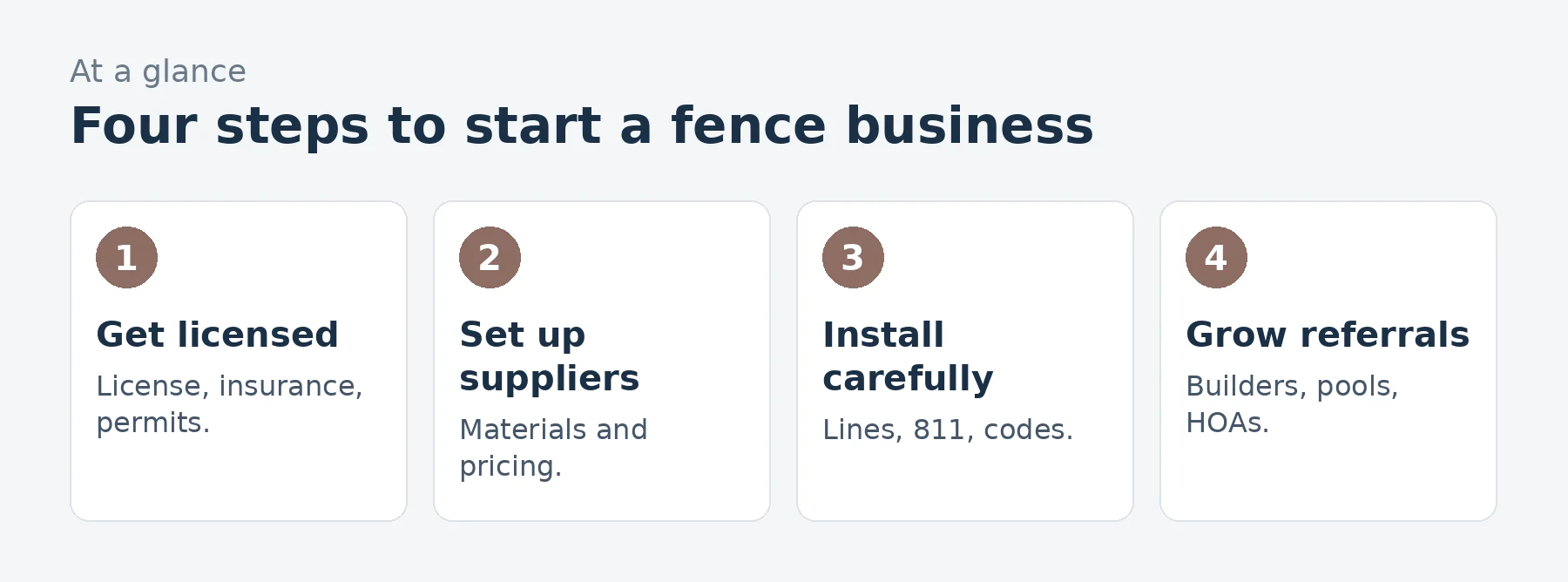
- Days 1-30: get licensed and insured, open supplier accounts and buy equipment.
- Days 31-60: learn local permit and pool rules, build a website and start quoting.
- Days 61-90: complete first jobs, collect reviews and contact pool and home builders.
Frequently asked questions about starting a fence installation business
Do I need a license to install fences?
Often; many states and cities require contractor licenses or registration, and fences frequently need permits.
Who is responsible for property lines?
The homeowner should confirm property lines, ideally with a survey; put it in your contract.
What are pool fence requirements?
Local codes typically require at least four-foot fences with self-closing, self-latching gates; check your local code.
How do fence companies price?
Usually per linear foot by type and height, plus gates and extras.
Do I need to call 811?
Yes, before digging post holes.
What fence materials are most popular?
Wood and vinyl for privacy, chain link for security, aluminum around pools.
Can I start with one truck?
Yes; many fence businesses start with one truck, an auger and a small crew.
What is the American Fence Association?
The industry association, offering training, certification and events.
Can fence companies install automatic gates?
Yes, but follow the manufacturer’s safety requirements, including entrapment protection, and use a licensed electrician where required.
Is fence repair worth offering?
Yes; repairs bring steady work between installations and often lead to full replacements.
How deep should fence posts be set?
Deep enough for your soil and frost line, often about a third of the post’s above-ground height; follow manufacturer guidance and local codes.
Keep learning
- Fencing and decks industry data
- How to start a deck building business
- How to start a hardscaping business
- Pricing calculator
Sources
- American Fence Association
- CPSC, Pool Safely (barrier guidelines)
- Common Ground Alliance, Call 811 before you dig
- US Small Business Administration, Apply for licenses and permits
- FTC, Cooling-Off Rule (door-to-door sales)
- OSHA, Respirable crystalline silica standard for construction (29 CFR 1926.1153)
Last reviewed November 7, 2026. Startup costs are estimates; check local prices, licensing and tax rules before you commit money.

